
Market Threads – Cross-Asset Tension Builds as Oil, Yields and the Dollar Shift the Market Tone

.png)
Tracking important market threads across currencies, commodities, and indices.
- UKOil and USOil are flashing bullish signals as geopolitical risk builds and key resistance levels come into play.
- USDOLLAR is back on breakout watch as rising rate expectations, resilient US data and geopolitical risk fuel a strengthening recovery.
- Gold is on the back foot as rising yields, a stronger USDOLLAR and fading momentum put XAUUSD's key support levels firmly in the spotlight.
- SPX500 is flashing fresh warning signs as rising yields, higher oil and geopolitical risk reinforce a bearish break below key support.
A New Era for Long-Term Bond Yields?
Long-term government bond yields are climbing, and the reasons go well beyond what central banks are doing with short-term interest rates. Governments are borrowing heavily, pushing more sovereign debt into the market at a time when foreign demand has softened and central banks have been trimming their bond holdings. At the same time, large technology companies are raising substantial sums to fund data centres and AI infrastructure, giving investors more places to put their money.
That matters because investors do not have unlimited appetite for long-dated debt. With inflation still uncertain and fiscal pressures building, they are asking for more compensation to lock up capital for decades. In practice, that means a higher term premium, lower bond prices and higher long-term yields. It can also steepen the yield curve when longer-dated yields rise faster than shorter ones.
The effects do not stop at the bond market. Higher sovereign yields can filter through to mortgages, corporate borrowing and government financing costs. The broader message is simple: when the supply of debt grows faster than investor demand, borrowers usually have to pay more to attract buyers.
Cross-Asset View
Markets are sending an increasingly coherent cross-asset message, with geopolitical risk, firmer oil prices and a renewed rise in US yields beginning to reshape the short-term landscape. The USDOLLAR is attempting to regain momentum, XAUUSD is struggling to absorb the accompanying rates pressure, and SPX500 is showing signs of fatigue just as crude pushes back towards important technical levels. None of these moves has fully broken into a new trend yet, but the alignment across asset classes suggests investors are becoming more sensitive to inflation, policy and geopolitical risk, making the next round of US data and key technical levels particularly important.
Oil
Technical Analysis
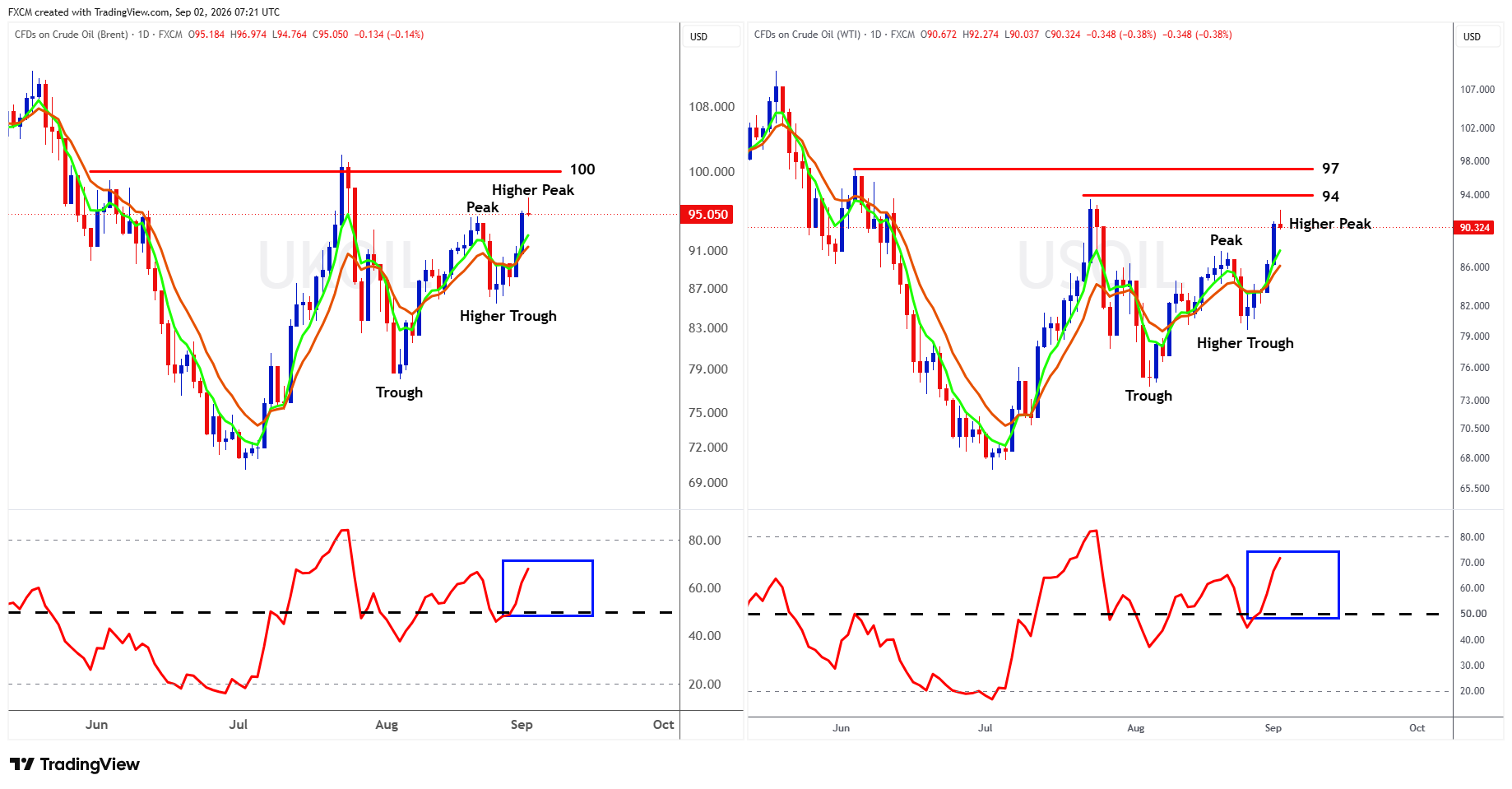
UKOil's technical picture has turned decisively more constructive. The recovery from the early-August trough has developed into a clear sequence of higher troughs and higher peaks, while the short-term moving averages have curled upwards and price is now holding above both. Momentum confirms the improvement, with RSI rebounding sharply from below 50 towards the 70 area, suggesting buyers have regained control without yet reaching the extreme overbought readings seen in July. The immediate test is the psychologically important $100 resistance zone, which capped the previous rally. A decisive daily break above $100 would complete the recovery pattern and strengthen the case for another leg higher; failure there would leave UKOil vulnerable to a near-term consolidation, although the higher-trough structure means dips currently look corrective rather than trend-breaking.
USOil is displaying an equally bullish recovery structure, but it has more overhead resistance to work through. The market has followed its August trough with a higher trough and now a higher peak, while rising short-term moving averages reinforce the improving trend. RSI has surged from around the mid-40s towards 70, a notable acceleration in momentum that suggests the latest move is being driven by increasingly committed buying. The next technical battleground sits around $94, followed by the more important $97 resistance level that marked the previous major peak. A clean move through $94 would put $97 firmly in play and materially strengthen the bullish reversal argument. For now, the combination of rising price structure and strengthening momentum keeps the bias positive, although the approach towards RSI 70 means USOil may need to digest some of its recent gains before attempting the next breakout.
Fundamental Perspective
The fundamental backdrop broadly supports the improving technical picture in UKOil and USOil, with the latest rally driven more by geopolitical and supply risk than stronger global demand. The latest US-Iran exchange has been the most significant in weeks, ending the relative lull since July, with US strikes targeting Iranian maritime assets and mine-laying capabilities and Iranian media reporting hits near the Strait of Hormuz. Iran also says it struck US assets in Bahrain, Jordan, Kuwait and Iraq, widening the geographical footprint of the escalation.
Hormuz flows remain fragile, with only four commodity vessels transiting the Strait on Tuesday after crude flows reached a wartime high on Monday. Meanwhile, the US Strategic Petroleum Reserve has fallen to 286.6 million barrels, its lowest since November 1982, leaving the market more exposed to further disruption. Venezuela could provide a medium-term offset, with Washington expecting production to more than double over the next few years, although that remains uncertain. For now, renewed hostilities, disrupted shipping and fragile Gulf export flows provide a credible fundamental foundation for the higher-high, higher-low structures developing in both UKOil and USOil.
USDOLLAR
Technical Analysis
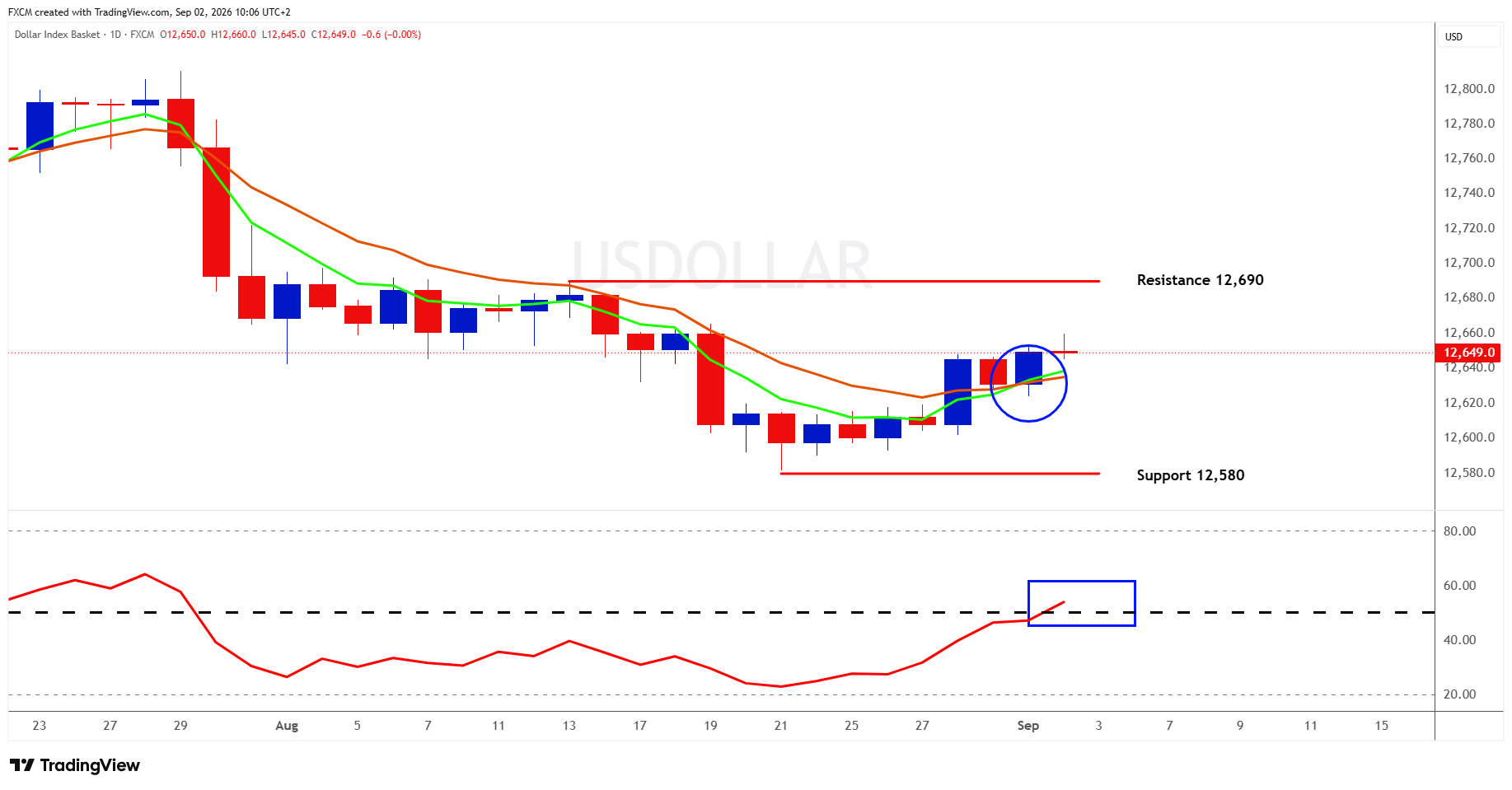
USDOLLAR is beginning to show signs of a potential trend reversal, but the bulls still have something to prove. After spending much of August under pressure, the index has built a base around 12,580 and pushed back above its short-term moving averages, with the faster average now turning higher and threatening a bullish crossover. Momentum is improving too: RSI has recovered from oversold territory and moved back above the neutral 50 level, suggesting selling pressure is giving way to renewed demand. The hesitation around 12,650 after the latest rebound argues against declaring victory just yet, with 12,690 the crucial resistance level that capped the mid-August recovery. A convincing daily break above 12,690 would mark a meaningful change in character and strengthen the case that a durable bottom has formed; until then, USDOLLAR remains in an improving but still unconfirmed recovery, with 12,580 the key line the bulls need to defend.
Fundamental Perspective
The USDOLLAR has climbed to its highest since mid-August as renewed US-Iran hostilities push oil prices higher, reviving inflation concerns and favouring the dollar relative to economies more exposed to an energy shock. US Treasury yields have risen alongside those concerns, with the 10-year reaching 4.812%, its highest since November 2023, while markets now price around a 70% probability of a September Fed rate hike, up from roughly 40% a week ago following Kevin Warsh's hawkish Jackson Hole message. The latest data have done little to undermine that case: US manufacturing remained firmly in expansion in August despite some moderation, input-price pressures stayed elevated and the labour market remains broadly stable despite weak hiring. Together, higher US rate expectations, resilient economic activity and the dollar's relative insulation from the energy shock provide a credible fundamental foundation for USDOLLAR's technical recovery, although Friday's payrolls report will be an important test of whether the move can extend towards 12,690 resistance.
Gold
Technical Analysis
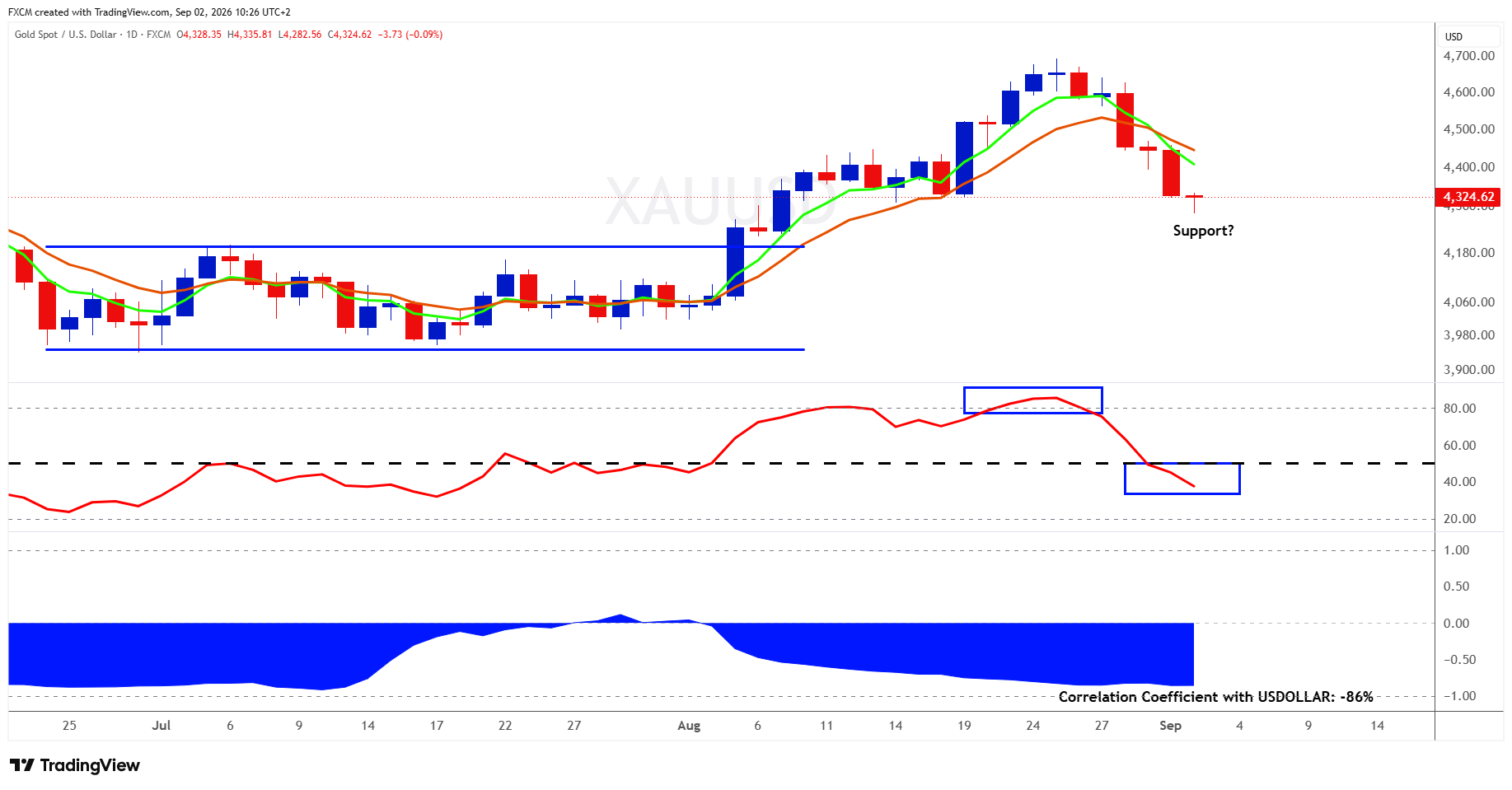
XAUUSD has shifted from a powerful uptrend into a meaningful corrective phase, with momentum now firmly favouring the bears. After breaking above the former $4,180 resistance zone in early August, gold accelerated to roughly $4,650-$4,670, but the rally became stretched as RSI moved above 80 and has since unwound sharply. Price has now fallen beneath both short-term moving averages, which are rolling over, while RSI has dropped below the neutral 50 level towards the mid-30s, confirming a clear loss of momentum without yet reaching oversold territory. The first test is whether buyers can stabilise the market around the current $4,300 area; below there, the former breakout zone around $4,180–$4,200 becomes the more important technical support and a natural area for bulls to attempt a defence. The strong -86% correlation with USDOLLAR also matters: if the dollar's nascent recovery continues, it would reinforce the pressure on gold. For now, XAUUSD remains a correction within the larger breakout structure, but the bulls need to reclaim the falling short-term averages before the recent weakness can be dismissed as merely a healthy pullback.
Fundamental Perspective
Although geopolitical tension can normally support gold through safe-haven demand, the latest US-Iran escalation is currently working through a more powerful oil-inflation-rates channel: higher crude prices are reviving inflation concerns, lifting Treasury yields and strengthening expectations for further Fed tightening. The US 10-year yield has reached 4.812%, its highest since November 2023, while markets are pricing around a 70% probability of a September Fed rate hike, increasing the opportunity cost of holding non-yielding gold. The dollar has also strengthened to its highest since mid-August, making bullion more expensive for buyers using other currencies. These pressures have pushed spot gold to its lowest in more than three weeks and fit the strong -86% inverse correlation with USDOLLAR shown on the chart. If USDOLLAR and yields continue higher, XAUUSD could remain under pressure; conversely, softer US employment data or a reversal in rates and the dollar would give gold a clearer opportunity to stabilise.
Index in Focus: SPX500
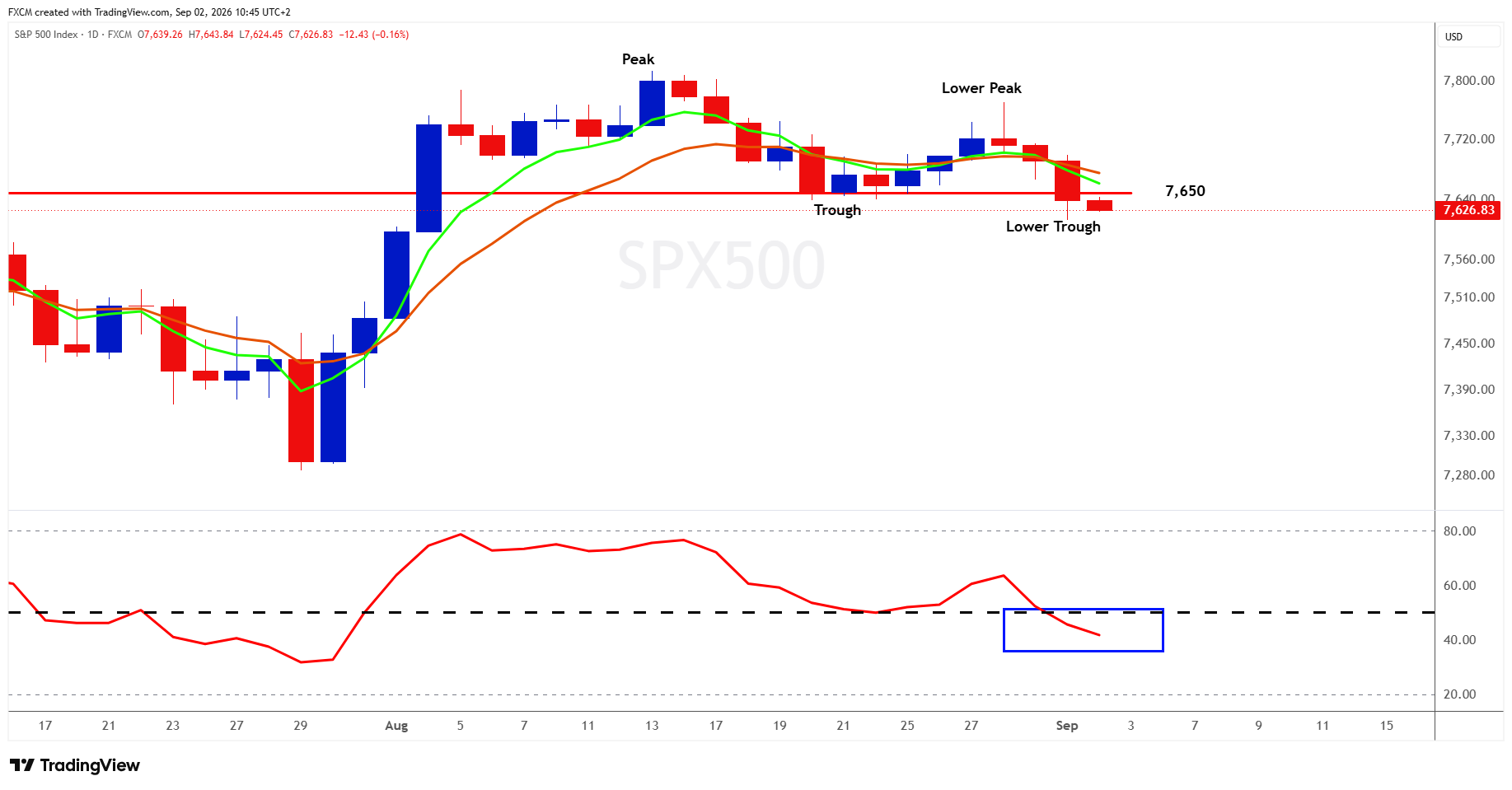
SPX500 is showing a clear deterioration in short-term structure, with the market slipping from consolidation into a more defensive phase. After peaking in mid-August, the index failed to make a new high and instead formed a lower peak, followed by a fresh lower trough, while price has now broken below the 7,650 support area and slipped beneath both short-term moving averages. Those averages are beginning to roll over, reinforcing the loss of upside momentum. RSI has also fallen back below the neutral 50 level towards the low-40s, suggesting sellers are gaining control without the market yet becoming oversold. The immediate question is whether 7,650 can be reclaimed quickly; failure to do so would leave SPX500 vulnerable to a deeper retracement towards the next support zone around 7,560-7,580. For now, the technical bias has shifted from bullish consolidation to cautious bearishness, and the bulls need a decisive move back above 7,650 and the short-term averages to stabilise the picture.
Fundamental Perspective
The fundamental backdrop supports the more cautious technical picture in SPX500, with resilient corporate earnings increasingly competing against a macro squeeze from higher oil prices, inflation concerns and rising bond yields. Renewed US-Iran hostilities have pushed Brent above $95, reviving inflation fears just as markets price around a two-thirds probability of a 25bp Fed rate hike in September, up sharply from a week ago.
Against that backdrop, the US 10-year Treasury yield has reached 4.812%, its highest since November 2023, tightening financial conditions and putting pressure on equity valuations, particularly growth stocks. The SPX500 has already weakened despite a strong earnings backdrop, making the emerging lower-peak/lower-trough structure more noteworthy while the index remains only around 2% below its August record.
Attention now turns to Broadcom's results after the close today and Friday's US payrolls report, where a stronger-than-expected jobs print could reinforce rate-hike expectations while softer data may offer some relief to yields. For now, higher oil, elevated rates and geopolitical uncertainty provide a credible fundamental backdrop to SPX500's break below 7,650 and its increasingly defensive short-term tone.

Russell Shor
Senior Market Strategist
Russell Shor is a Senior Market Strategist at FXCM, having been promoted to the role in 2025 in recognition of his depth of insight and consistent delivery of high-impact market analysis. He originally joined FXCM in October 2017 as a Senior Market Specialist.
Russell holds an Honours Degree in Economics from the University of South Africa, is a certified FMVA®, and a full member of the Society of Technical Analysts (UK). With over 20 years of experience in financial markets, his work is renowned for its clarity, precision, and strategic value across asset classes.

Any opinions, news, research, analyses, prices, other information, or links to third-party sites contained on this website are provided on an "as-is" basis, as general market commentary and do not constitute investment advice. The market commentary has not been prepared in accordance with legal requirements designed to promote the independence of investment research, and it is therefore not subject to any prohibition on dealing ahead of dissemination. Although this commentary is not produced by an independent source, FXCM takes all sufficient steps to eliminate or prevent any conflicts of interests arising out of the production and dissemination of this communication. The employees of FXCM commit to acting in the clients' best interests and represent their views without misleading, deceiving, or otherwise impairing the clients' ability to make informed investment decisions. For more information about the FXCM's internal organizational and administrative arrangements for the prevention of conflicts, please refer to the Firms' Managing Conflicts Policy. Please ensure that you read and understand our Full Disclaimer and Liability provision concerning the foregoing Information, which can be accessed here.