
Market Threads – The Debasement Trade Takes Centre Stage Across Markets

.png)
Tracking important market threads across currencies, commodities, and indices.
- Oil's momentum is cracking as weakening charts, easing geopolitical fears and rising US inventories put UKOil and USOil under renewed pressure.
- USDOLLAR is teetering as bearish momentum, the debasement trade and mounting concern over America's fiscal outlook put the greenback under pressure.
- Gold is breaking higher as the debasement trade, central-bank buying and dollar weakness add fresh fuel to XAUUSD's rally.
- JPN225 is shaping up for another leg higher as a potential higher trough meets strong earnings, surging buybacks and lower oil.
Cross Asset View
Markets are increasingly being shaped by the debasement trade, the idea that heavy government borrowing and efforts to contain long-term yields can push more of the adjustment into currencies themselves, weakening confidence in cash and favouring scarce or real assets. That theme is now intersecting with softer oil, a weaker USDOLLAR, renewed strength in XAUUSD and a still-constructive JPN225, creating a cross-asset backdrop in which currency confidence, inflation expectations and policy credibility are becoming just as important as traditional growth and rate signals.
Oil
Technical Analysis
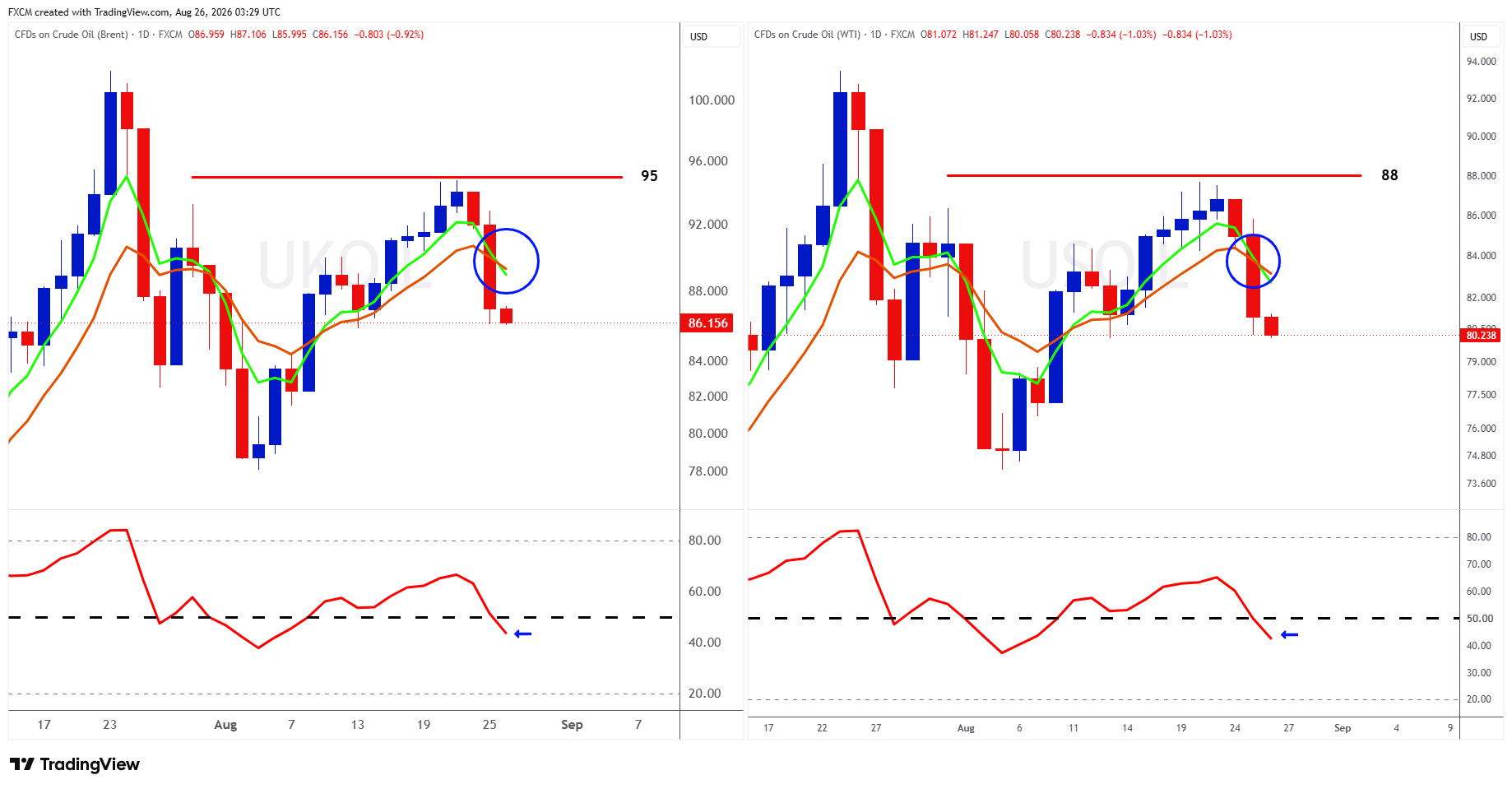
UKOil has undergone a sharp technical reversal after its August recovery stalled just beneath the $95 resistance zone. The rejection has been decisive, with consecutive bearish sessions driving price back to around $86 and through both short-term moving averages. More importantly, the faster green average is now rolling beneath the slower orange average, reinforcing the loss of upside momentum highlighted by the chart. RSI has simultaneously slipped below the neutral 50 level to the low-40s, confirming that sellers have regained control without the market yet becoming oversold. The immediate test is the $84-85 area; failure to hold there would expose roughly $82 and potentially the August lows near $78-79. For the technical picture to improve, UKOil would first need to reclaim the moving-average cluster around $89-91, while $95 remains the more important barrier to any renewed bullish breakout.
USOil is also displaying a deterioration in momentum. Its advance from the early-August lows ran out of steam beneath the clearly defined $88 resistance level, after which price reversed sharply and has fallen to around $80.20. The decline has broken beneath both moving averages, with the faster average crossing lower and turning the previously supportive trend structure into potential overhead resistance around $83-85. RSI has dropped through 50 towards 40, showing strengthening downside momentum, although it remains above oversold territory and therefore leaves room for further weakness. The $79-80 region is now an important near-term battleground; a sustained break beneath it would place $77-78 and ultimately the August trough around $75 back in focus. Bulls would need to reclaim $84-85 before the recent sell-off begins to look like a correction rather than a more meaningful bearish turn.
Fundamental Perspective
The deterioration in UKOil and USOil momentum looks primarily like an unwinding of the geopolitical risk premium rather than a sudden collapse in the underlying oil balance. Washington's latest sanctions on Iran initially sounded formidable, but Treasury Secretary Scott Bessent stopped short of identifying which trading partners would face penalties or when enforcement would begin, while the latest designations excluded Chinese financial institutions suspected of facilitating Iranian oil trade, encouraging traders to view economic pressure as less immediately threatening to supply than renewed military escalation. That shift has been reinforced by Iran and Oman discussing a temporary navigational corridor through the Strait of Hormuz and a mine-clearing project, alongside Washington beginning to return personnel to some Middle Eastern diplomatic missions, developments that have raised hopes that disrupted Gulf oil flows could eventually recover.
Adding to the bearish tone, preliminary API data showed US crude inventories rising by 4.2 million barrels, well above the roughly 600,000-barrel increase expected by analysts, although official EIA figures are still due later today. The market has therefore shifted from asking how much oil might disappear to how much disrupted supply might eventually return; importantly, however, this is a repricing of risk rather than its disappearance, with Hormuz traffic still dramatically below pre-war levels and attacks on shipping continuing.
USDOLLAR
Technical Analysis
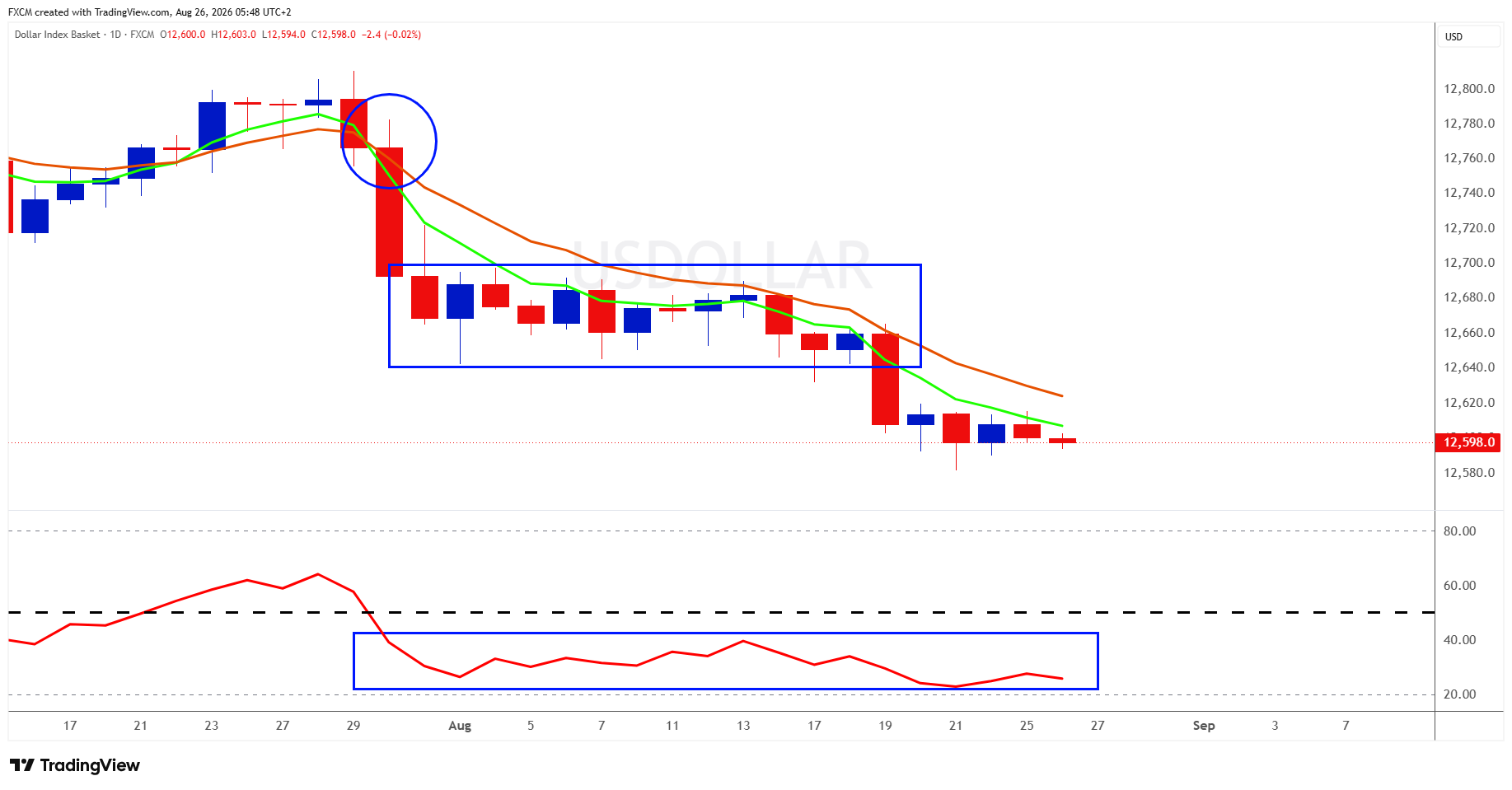
FXCM's USDOLLAR has deteriorated sharply from last week, with the technical picture turning decisively bearish after price broke beneath the lower boundary of its multi-week consolidation around 12,640. The breakdown has been followed by little evidence of a meaningful rebound, while USDOLLAR remains below both declining moving averages and the faster green average continues to sit beneath the slower orange average, reinforcing the loss of trend momentum. RSI has also remained firmly below the neutral 50 level and is now hovering close to oversold territory, an important warning that the longer it stays depressed without a recovery above 50, the greater the pressure on the greenback is likely to become. The former 12,640 to 12,660 support zone should now act as initial resistance, meaning USDOLLAR would need to reclaim this area before the damage begins to repair. Until then, the path of least resistance remains lower, with the recent lows around 12,580 to 12,600 the immediate test and a sustained break opening the door to another leg down.
Fundamental Perspective
The deterioration in USDOLLAR increasingly reflects concerns about US fiscal and Treasury policy alongside traditional interest-rate considerations, with the so-called debasement trade moving back into focus. The catalyst has been the Treasury's decision to at least double the maximum size of liquidity-support buybacks in the 10 to 20-year and 20 to 30-year sectors, from $2 billion to at least $4 billion per operation. Treasury says the move is designed to improve market liquidity, but investors have increasingly interpreted it as evidence that Washington has a low tolerance for further increases in long-term yields, particularly with US government debt now above $40 trillion and the fiscal deficit running close to 6% of GDP.
That has revived the debasement argument that if policymakers resist market-clearing yields, the adjustment may simply migrate from the bond market into the currency, potentially making US assets less attractive and weakening the dollar. The greenback is also confronting a less favourable relative growth backdrop as European economic surprises improve and US surprises fade. Easing Middle East tensions and falling oil prices are meanwhile supporting broader risk appetite, reducing some demand for defensive dollar positioning.
The counterweight remains monetary policy, with US inflation still above target and markets increasingly debating whether the Fed may ultimately need to raise rates further.
The important shift is therefore that investors are no longer looking only at where Fed rates are heading. They are also asking whether persistent deficits, mounting debt and increasingly active Treasury intervention will force the dollar itself to absorb more of the adjustment, making USDOLLAR's technical breakdown considerably more interesting from a fundamental perspective.
Gold
Technical Analysis
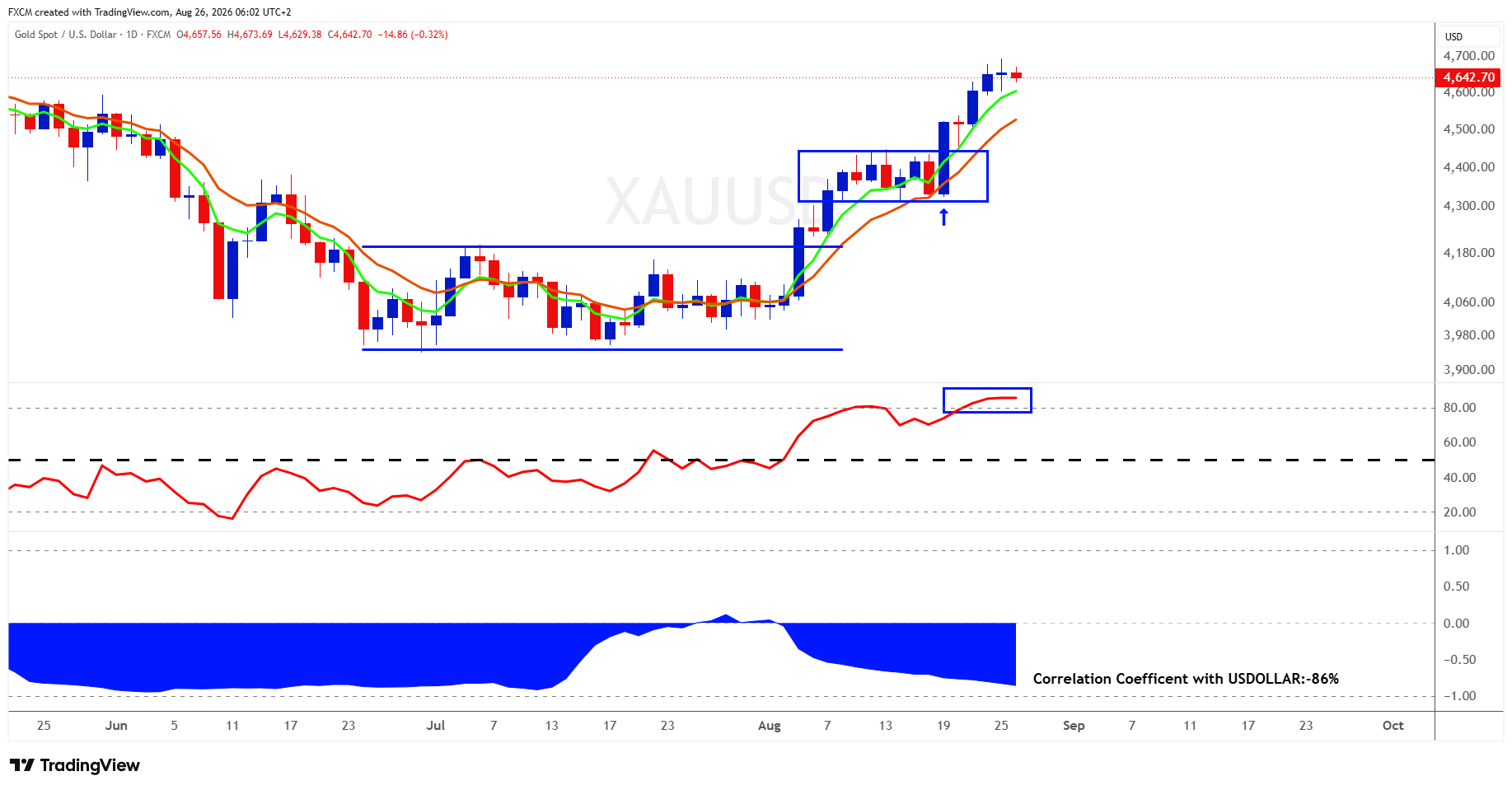
XAUUSD remains in a powerful uptrend after breaking decisively out of the 4,300 to 4,440 consolidation zone, with price accelerating towards 4,640 and both moving averages rising firmly beneath the market. The breakout has been technically convincing, but the strength of the move is now creating its own risk, with RSI pushing above 80 and remaining in overbought territory. That does not automatically signal an imminent reversal, but it does suggest the advance is becoming stretched and increasingly vulnerable to profit-taking or a short-term pullback. The former breakout area around 4,400 to 4,440 is now the key support zone, while the faster green moving average provides a nearer dynamic floor. Importantly, the chart also shows an extremely strong negative correlation of roughly 86% with USDOLLAR, reinforcing the idea that continued weakness in the greenback would remain a significant tailwind for gold. For now, the trend clearly favours the bulls, but with momentum this extended, chasing price at current levels carries more risk than waiting for either consolidation or a controlled retracement.
Fundamental Perspective
XAUUSD has emerged as one of the clearest beneficiaries of the renewed debasement trade, with gold increasingly reflecting concern over US fiscal sustainability alongside the traditional influence of interest rates and the dollar. A key recent catalyst was the Treasury's decision to at least double the maximum size of liquidity-support buybacks in the 10-to-20-year and 20-to-30-year sectors from $2 billion to at least $4 billion per operation.
Treasury says the programme is intended to improve market liquidity, but some investors have interpreted its timing and scale as evidence that Washington is increasingly reluctant to tolerate further increases in long-term yields. That has revived the debasement argument that if yields are prevented from fully reaching market-clearing levels, the adjustment may instead migrate into the dollar, increasing the appeal of alternatives such as gold.
Gold climbed to its highest level since mid-May this week after sharp gains that began following the Treasury announcement, while concerns over US fiscal sustainability remain an important part of the bullish narrative. The structural backdrop is equally supportive. OMFIF reports that 82% of surveyed central banks hold physical gold and a net 30% intend to increase allocations over the next one to two years, while for the first time more central banks expect to reduce rather than increase their dollar exposure over the coming decade.
Monetary policy remains the major counterweight, because softer inflation and lower real yields would favour non-yielding gold, whereas persistent inflation and further Fed tightening could work in the opposite direction. Gold has nevertheless remained close to its recent highs even as Iran and Oman resume discussions over the Strait of Hormuz, suggesting that the current rally is being driven by considerably more than geopolitical safe-haven demand alone. The bigger story increasingly combines fiscal anxiety, debasement concerns, central-bank diversification and uncertainty over the future path of real interest rates.
Index in Focus: JPN225
Technical Analysis
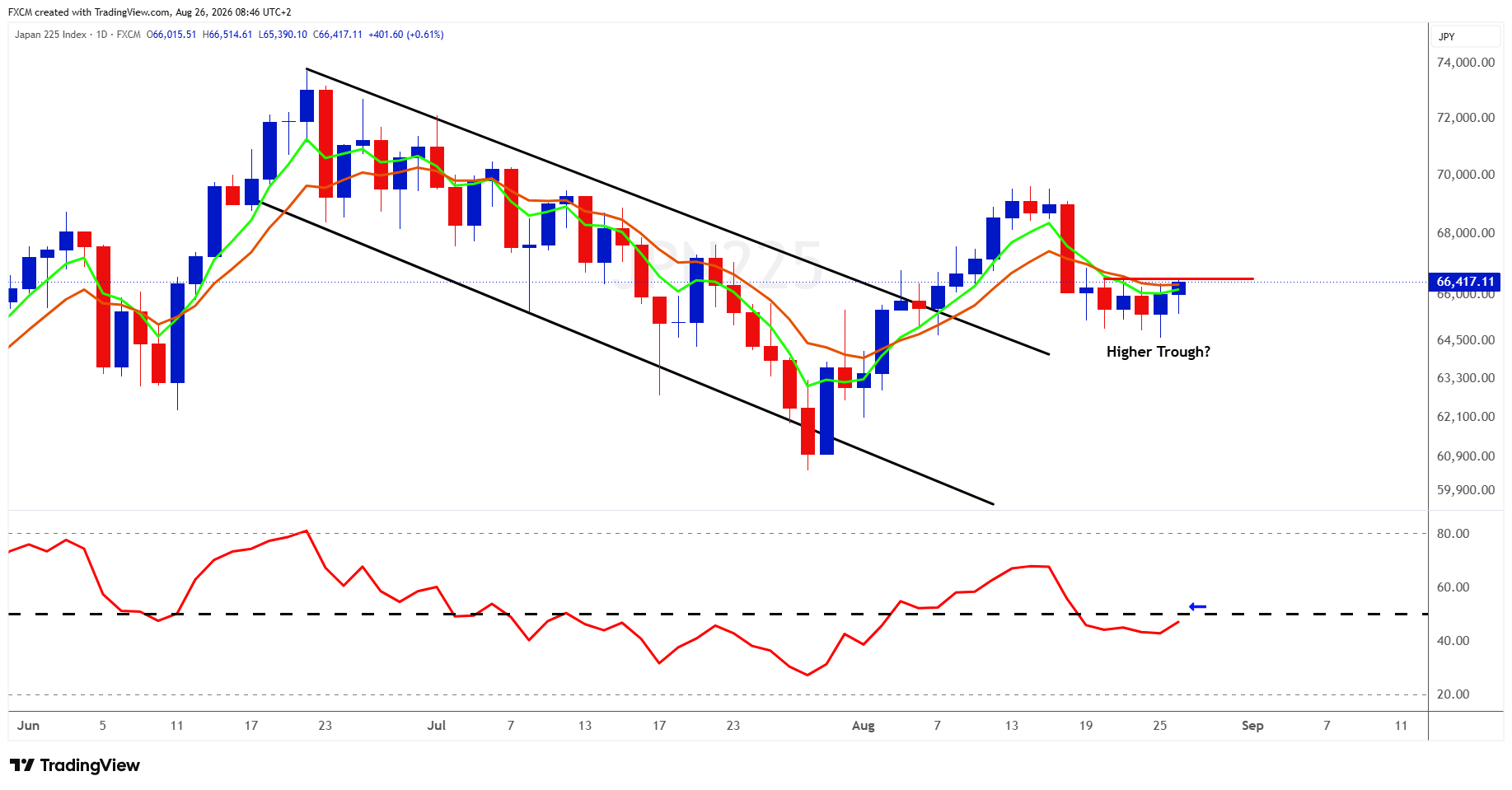
Further to last week's note, JPN225 is at an important technical inflection point after breaking out of its June to early-August descending channel and then pulling back from the 69,000 area. The key question now is whether the recent weakness is simply forming a higher trough, which would preserve the emerging bullish structure and provide a much stronger foundation for another leg higher. A daily close above roughly 66,545 would help confirm that the pullback is stabilising, while a move back through 67,000 would add further conviction. Momentum also needs to improve, with RSI currently hovering just below the neutral 50 level. A sustained cross back above 50 would be constructive and would suggest buyers are beginning to regain control. The moving averages are similarly important, with a bullish crossover of the faster green EMA above the slower orange EMA providing another layer of confirmation. If these signals align and the higher trough holds, JPN225 would be well placed to challenge the recent 68,500 to 69,500 resistance area and potentially begin its next leg higher.
Fundamental Perspective
JPN225 remains constructive although several important crosscurrents are developing. Falling oil prices are an immediate positive for energy-importing Japan, with UKOil retreating, potentially easing import-cost and inflation pressures if the decline proves durable.
Corporate Japan also remains in strong shape, with Nomura estimating that listed-company pretax profits jumped almost 50% in the three months to end-June, while share buybacks have reached about ¥20 trillion this year and the government is considering tax incentives that could encourage companies to divest non-core businesses and redeploy capital more productively.
For now the yen remains weak at around ¥159 per dollar, and Nomura estimates currency weakness accounted for at least a third of the recent surge in Japanese pretax profits. The main counterweight is increasingly the BOJ, with 57% of economists expecting a September rate rise to 1.25%, while fresh data showing corporate services inflation accelerating to 3.6% in July strengthens the case for further tightening.
Overall, lower oil, strong earnings, surging buybacks and continuing corporate reform provide a credible foundation for another advance, but JPN225 will need to absorb the potentially less friendly combination of tighter BOJ policy and the risk of a firmer yen.

Russell Shor
Senior Market Strategist
Russell Shor is a Senior Market Strategist at FXCM, having been promoted to the role in 2025 in recognition of his depth of insight and consistent delivery of high-impact market analysis. He originally joined FXCM in October 2017 as a Senior Market Specialist.
Russell holds an Honours Degree in Economics from the University of South Africa, is a certified FMVA®, and a full member of the Society of Technical Analysts (UK). With over 20 years of experience in financial markets, his work is renowned for its clarity, precision, and strategic value across asset classes.

Any opinions, news, research, analyses, prices, other information, or links to third-party sites contained on this website are provided on an "as-is" basis, as general market commentary and do not constitute investment advice. The market commentary has not been prepared in accordance with legal requirements designed to promote the independence of investment research, and it is therefore not subject to any prohibition on dealing ahead of dissemination. Although this commentary is not produced by an independent source, FXCM takes all sufficient steps to eliminate or prevent any conflicts of interests arising out of the production and dissemination of this communication. The employees of FXCM commit to acting in the clients' best interests and represent their views without misleading, deceiving, or otherwise impairing the clients' ability to make informed investment decisions. For more information about the FXCM's internal organizational and administrative arrangements for the prevention of conflicts, please refer to the Firms' Managing Conflicts Policy. Please ensure that you read and understand our Full Disclaimer and Liability provision concerning the foregoing Information, which can be accessed here.