
USD/JPY rises as Yen can’t benefit from risk aversion from the US-Iran conflict


USD/JPY Analysis
The military strike by the United States and Israel against Iran has sparked a global flight to safety, but the Yen once again fails to benefit from this shift, while the greenback attracts flows. The conflict sends oil prices soaring amid heightened supply risks, which could hurt the Japanese economy. Japan is a net importer of oil, with 94% of its crude imports coming from the Middle East. [1]
These headwinds may embolden PM Takaichi to pursue her expansive fiscal policies that have fuelled concerns over public finances and complicating the central bank's path. The BoJ is in a rate-hiking cycle but has adopted a cautious approach, and economic pressures from higher oil prices and tariffs could lead to an even more measured stance, potentially limiting further tightening. PM Takaichi expressed reluctance towards higher rates during her February meeting with BoJ governor Ueda, according to the Mainichi [2], while nominating two dovish board members, according to Reuters. [3]
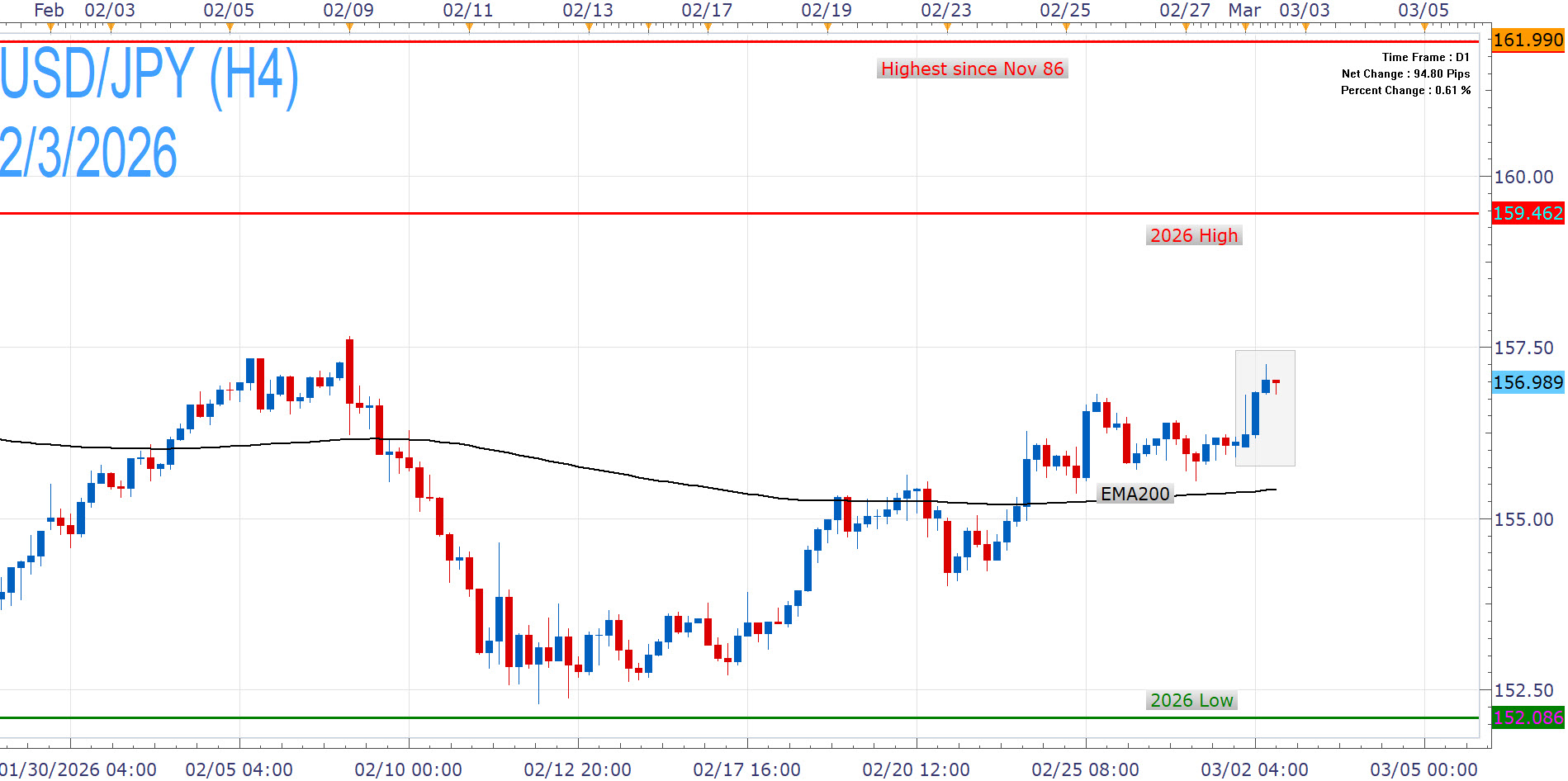
These factors prevent the currency from benefiting from risk aversion, while the USDOLLAR attracts safe-haven demand. Oil-driven inflation could raise the bar for further Fed rate cuts and support the greenback. As a result, USD/JPY advances and has the chance push towards new 2026 highs.
On the other hand, the dollar continues to face headwinds from disruptive trade policies, rising debt, and concerns over Fed independence, feeding de-dollarisation and de-risking trends. Moreover, the Bank of Japan maintains its tightening bias, while Japanese officials have repeatedly warned of intervention to curb excessive volatility and Yen weakness. As a result, USD/JPY remains vulnerable to sub-EMA200 moves that could negate the upside bias.

Nikos Tzabouras
Senior Financial Editorial Writer
Nikos Tzabouras is a graduate of the Department of International & European Economic Studies at the Athens University of Economics and Business. With extensive experience in market analysis and a strong foundation in international relations, he brings a unique perspective to financial markets. Nikos emphasizes not only technical analysis but also on fundamentals and the growing influence of geopolitics on financial trends.
As a Senior Financial Editorial Writer, he delivers comprehensive and forward-looking insights across a wide range of asset classes, including equities, commodities, and currencies. His work explores how macroeconomic events, political developments, and global policies impact market dynamics, providing readers with a deeper understanding of both short-term movements and long-term trends.
References
| Retrieved 02 Mar 2026 https://www.jetro.go.jp/biznews/2026/02/1963e21719ed7c58.html | |
| Retrieved 02 Mar 2026 https://mainichi.jp/articles/20260224/k00/00m/020/128000c | |
| Retrieved 30 Sep 2026 https://www.reuters.com/sustainability/boards-policy-regulation/japan-government-taps-academics-asada-sato-boj-board-2026-02-25/ |

Any opinions, news, research, analyses, prices, other information, or links to third-party sites contained on this website are provided on an "as-is" basis, as general market commentary and do not constitute investment advice. The market commentary has not been prepared in accordance with legal requirements designed to promote the independence of investment research, and it is therefore not subject to any prohibition on dealing ahead of dissemination. Although this commentary is not produced by an independent source, FXCM takes all sufficient steps to eliminate or prevent any conflicts of interests arising out of the production and dissemination of this communication. The employees of FXCM commit to acting in the clients' best interests and represent their views without misleading, deceiving, or otherwise impairing the clients' ability to make informed investment decisions. For more information about the FXCM's internal organizational and administrative arrangements for the prevention of conflicts, please refer to the Firms' Managing Conflicts Policy. Please ensure that you read and understand our Full Disclaimer and Liability provision concerning the foregoing Information, which can be accessed here.