
Intel’s AI-driven earnings impress, but risks linger


Intel turnaround
Under its new CEO, who took the helm a little over a year ago, Intel is executing an aggressive turnaround plan to re-establish itself at the centre of the AI revolution. This comeback is being fuelled by a wave of strategic partnerships and major capital investments.
The US government has signalled its commitment to domestic chip security with an $8.9 billion investment, taking a nearly 10% stake in the company [1]. Simultaneously, Nvidia is investing $5 billion to co-develop high-performance CPUs tailored for AI infrastructure [2]. Intel has also deepened its collaboration with Google, ensuring that Intel Xeon processors remain the backbone of Google's cloud services while the two companies work together on custom support chips. [3]
Perhaps most notably, Elon Musk has tapped Intel's cutting-edge "14A" manufacturing process to power the Terafab project, which will produce the custom chips needed for Tesla's future humanoid robotics and robotaxi initiatives [4]. Cementing this renewed momentum, Intel recently bought back its 49% stake in its advanced Fab 34 facility in Ireland, bringing its premier manufacturing engine fully back under its own control. [5]
Intel benefits from Agentic AI
Intel is regaining strategic relevance as AI workload patterns undergo a fundamental shift. The early era of AI was defined by large-scale training and an absolute dependence on GPUs, where Nvidia remains dominant. But the industry is now pivoting toward inference and the rise of Agentic AI, a transition that places the CPU back at the centre of the compute stack. Deloitte identifies inference as the "hot new thing" for 2026, expecting it to account for roughly two-thirds of all AI compute cycles [6], while Gartner expects 40% of enterprise applications to feature AI agents this year. [7]
This transition is a boon for Intel's CPU business, putting it back at the core of the AI story. During last week's earnings, CEO Lip-Bu Tan noted this shift is "significantly increasing" the need for Intel's CPUs, wafer capacity and advanced packaging offerings. CFO David Zinsner added that training clusters historically ran a ratio of 7-8 GPUs per CPU, but that this moves to 3-4:1 for inference. With Agentic AI, it is hitting 1:1 and "potentially even flipping in the other direction a little bit". [8]
AI demand powers strong results
Thursday's results for the first quarter and Q2 projections perfectly illustrated Intel's renewed AI strength. Revenues returned to growth, rising 7.2% y/y at the fastest pace in two years, while gross margins widened. The jump was fuelled by the outperformance of the Data Centre and AI (DCAI) segment, where revenues grew 22%. Management also provided upbeat guidance for the current quarter, pointing to continued momentum and AI demand, with a forecast of 7%-14.7% overall sales growth and solid gross margins.
The report also affirms that turnaround efforts are succeeding in transforming Intel into a leaner, more disciplined and efficient organisation. Lower SG&A and R&D expenses in Q1, alongside higher cash and cash equivalents, show that management is effectively reducing organisational bloat and optimising its cost structure without undermining product development.
Challenges linger
Despite rising revenues, net losses widened significantly, highlighting the massive capital intensity of this recovery effort. The $4.1 billion in restructuring and impairment charges serves as a stark reminder of the heavy price Intel is paying to purge the baggage of previous strategic missteps. Beyond the balance sheet, the company faces an increasingly precarious macroeconomic environment, with lingering tariffs and the fallout from the Middle East conflict posing a threat to Intel's momentum and the broader AI boom.
Then there is the Foundry business. While a 16% y/y revenue increase may look impressive at first glance, the underlying reality is tougher.Tthe segment remains unprofitable and that revenue is almost entirely internal, driven by Intel's own chip divisions rather than external clients, as evidenced by offsetting eliminations. Building a competitive foundry from scratch is a monumental task and Intel faces a gruelling uphill battle to capture meaningful market share from a titan like TSMC.
Finally, the Client Computing Group (CCG) showed only marginal growth, underscoring the ongoing fatigue in the PC and laptop market. With stagflation risks looming and memory prices surging, Intel's core segment faces significant headwinds that could stifle any potential recovery.
Intel stock soars
Markets cheered the strong results and guidance, sending the stock to new all-time highs and extending this year's rally to over 120%. With the AI boom appearing unstoppable and a shift in workload patterns supporting its momentum, Intel can continue its progress.
However, pitfalls loom. It still has considerable work to do to attract foundry customers, while a challenging external environment poses risks to the broader AI story, leaving Intel vulnerable to pullbacks. Markets now turn to Big Tech earnings this week to see whether they can sustain the momentum or whether sentiment will sour.
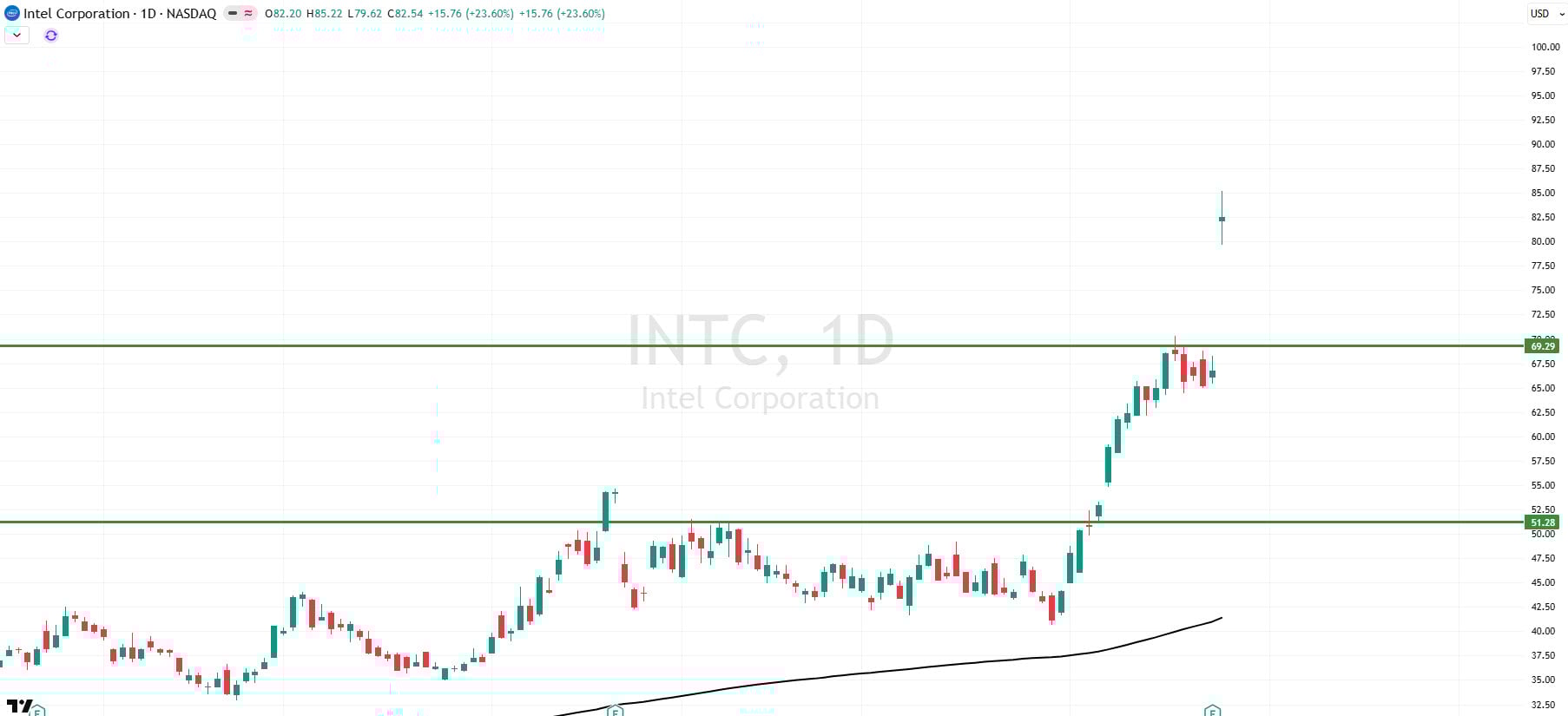
Chart source: www.tradingview.com

Nikos Tzabouras
Senior Financial Editorial Writer
Nikos Tzabouras is a graduate of the Department of International & European Economic Studies at the Athens University of Economics and Business. With extensive experience in market analysis and a strong foundation in international relations, he brings a unique perspective to financial markets. Nikos emphasizes not only technical analysis but also on fundamentals and the growing influence of geopolitics on financial trends.
As a Senior Financial Editorial Writer, he delivers comprehensive and forward-looking insights across a wide range of asset classes, including equities, commodities, and currencies. His work explores how macroeconomic events, political developments, and global policies impact market dynamics, providing readers with a deeper understanding of both short-term movements and long-term trends.

Any opinions, news, research, analyses, prices, other information, or links to third-party sites contained on this website are provided on an "as-is" basis, as general market commentary and do not constitute investment advice. The market commentary has not been prepared in accordance with legal requirements designed to promote the independence of investment research, and it is therefore not subject to any prohibition on dealing ahead of dissemination. Although this commentary is not produced by an independent source, FXCM takes all sufficient steps to eliminate or prevent any conflicts of interests arising out of the production and dissemination of this communication. The employees of FXCM commit to acting in the clients' best interests and represent their views without misleading, deceiving, or otherwise impairing the clients' ability to make informed investment decisions. For more information about the FXCM's internal organizational and administrative arrangements for the prevention of conflicts, please refer to the Firms' Managing Conflicts Policy. Please ensure that you read and understand our Full Disclaimer and Liability provision concerning the foregoing Information, which can be accessed here.