
Bank of Korea pivots to hikes on AI boom


BoK hikes rates and signals further action
On Thursday, the Bank of Korea pivoted with its first rate hike in more than three years [1]. Policymakers raised rates by 25 basis points to 2.75% in a unanimous decision, marking the end of an easing cycle that produced 100 basis points of cuts from October 2024 to May 2025.
Crucially, the Board signalled more tightening ahead, saying that developments in inflation, growth and financial stability will determine "the timing and pace of further increases". In their updated June projections, officials saw rates as high as 3.25% in the six months ahead, while the median projection of 3% suggests one more hike. [2]
The central bank has strong incentives to continue tightening monetary policy amid persistent won weakness, financial stability risks, higher oil prices from the Middle East conflict and an AI boom that exacerbates price pressures while also fuelling economic growth.
The Middle East conflict pushes inflation higher
The key driver behind the BoK's decision to pivot and adopt a hawkish bias is the surge in inflation, driven primarily by the US-Iran conflict. The war sparked an energy shock to which South Korea is particularly exposed, sourcing around 70% of its oil imports from the Middle East [3].
CPI surged 3.2% y/y in June, the fastest pace in more than two years, underscoring these dynamics. Transportation posted the biggest increase at 11.1%, with housing, water, electricity, gas and other fuels rising 1.7% [4]. The Bank of Korea expects inflation to remain above its 2% target for a "considerable time", projecting headline CPI at 2.7% this year.
Even though crude prices have declined substantially from their peak, they are climbing again this month due to a flare-up in hostilities. President Trump declared the ceasefire over and the two sides have been trading strikes in recent days, with flows through the Strait dropping again. This heightened uncertainty and transit disruption could sustain inflationary risks and keep the BoK under pressure to continue raising interest rates.
AI boom a key catalyst for rate hikes
South Korea is a crucial part of the global chip supply chain and home to two of the world's three high bandwidth memory makers, SK Hynix and Samsung, as the physical AI buildout leads to severe memory shortages. Unprecedented AI demand for high-performance chips is lifting investment and the broader South Korean economy.
Both companies have pledged massive spending to increase manufacturing capacity and meet demand, while South Korea's exports jumped nearly 80% y/y in June, driven by a near-tripling in semiconductor shipments [5]. GDP expanded by 3.8% y/y in the first quarter, the most since 2022, and the government upgraded its full-year outlook to 3% on the back of the chip sector boom. [6]
The semiconductor boom does more than provide the growth buffer needed for monetary tightening - it actively necessitates it by stoking domestic inflationary pressures. BoK Governor Hyun-Song Shin underscored this connection today, noting a surge in semiconductor prices that supports corporate profits, increased investment and gains in wages and tax revenues. He also noted that the sector's spillover into domestic demand is likely to cause greater and more persistent inflationary pressures.
Financial stability risks in play
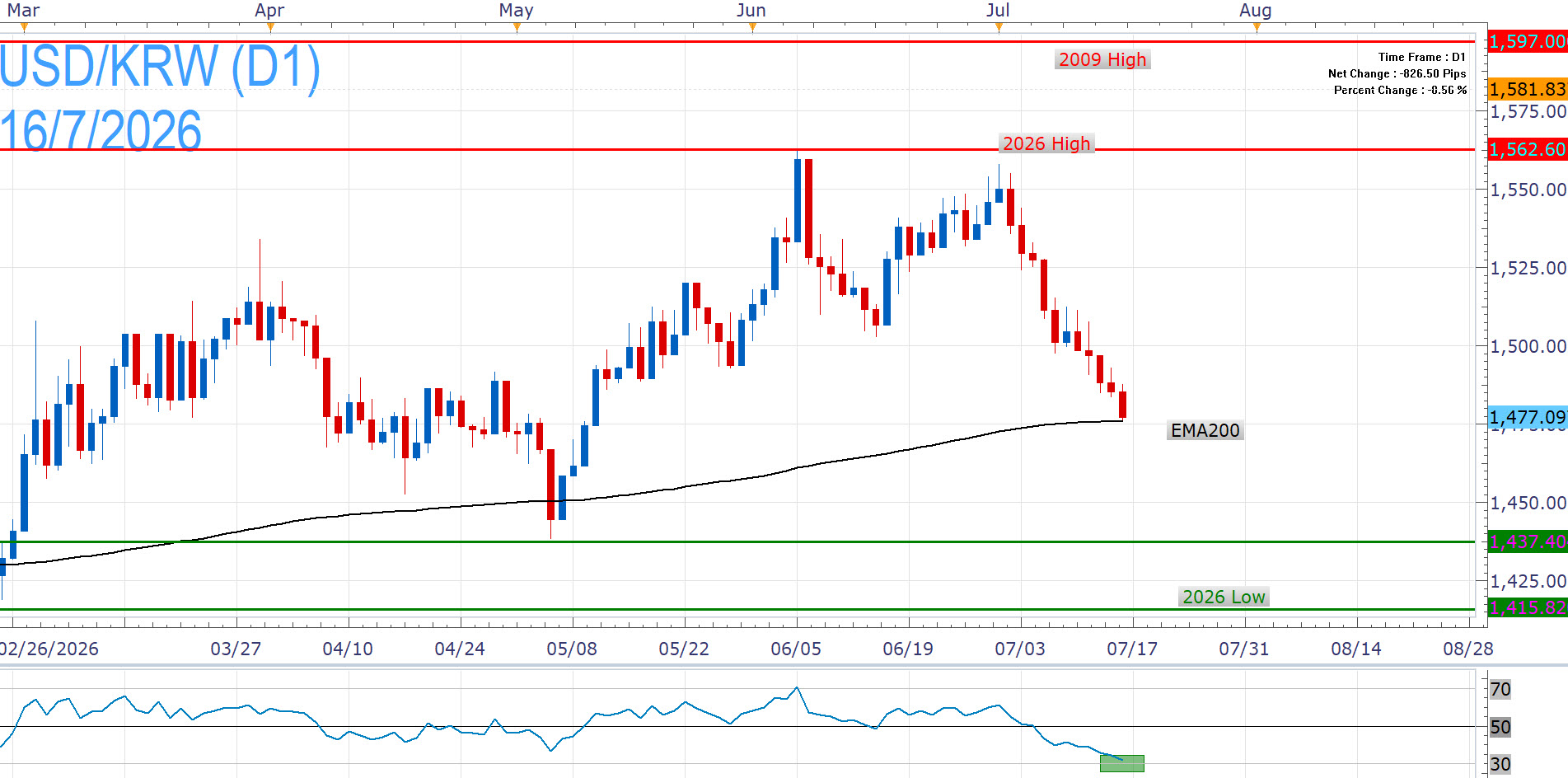
The won's persistent weakness and volatility is another factor supporting higher interest rates, posing a threat to financial stability and adding to inflationary pressures by making imports more expensive. USD/KRW reached a seventeen-year high in June and has gained roughly 2.5% year-to-date. Rising capital outflows could continue to pressure the currency, with outbound foreign direct investment surging 36.2% y/y in the first quarter [7], while foreign investors have been net sellers of South Korean equities this year, offloading roughly KRW 47 trillion of listed stocks in May alone. [8]
In its latest Financial Stability Report [9], the Bank of Korea highlighted additional risks that enhance the case for higher interest rates, including a renewed increase in Seoul's housing prices and rising household and corporate borrowing. Crucially, it flagged leveraged asset investments fuelling heightened equity volatility, prompting the South Korean President to announce measures to mitigate instability. [10]
BoK has reasons for a cautious policy stance
However, the BoK also flagged rising delinquencies and elevated insolvency risks in vulnerable sectors, which could deteriorate should officials raise interest rates aggressively. Meanwhile, the spike in consumer prices could weigh on an already sluggish consumption. Moreover, the country's economic recovery remains uneven and heavily concentrated in the tech sector, complicating the central bank's policy path.
At the same time, persistent concerns over the long-term viability of the AI and semiconductor boom remain, as aggressive capital spending partly fuelled by borrowing creates worries against a tough macroeconomic backdrop. Lingering uncertainty over global trade demand, combined with the ongoing Middle East conflict and South Korea's heavy energy dependency on the region, continues to pose downside risks to the broader economy, leaving policymakers walking a precarious tightrope.
BoK pivots, USD/KRW drops
The pair extended its recent pullback today, testing the EMA200, as the BoK's pivot could assist the ailing won. With strong incentives to tighten policy further, the pair is vulnerable to deeper declines that could push it into negative territory for the year. However, the decline is starting to look technically stretched, with moves to oversold levels, and above the EMA200 the upside bias remains intact.
The Bank of Korea has to navigate a challenging macroeconomic environment and set of risks that could keep it on a tightening path. Furthermore, the pair's trajectory relies heavily on the USDOLLAR. Rate hike bets have eased after Tuesday's softer-than-expected inflation print, which removes some urgency for hikes, and the dollar has been on the back foot in recent weeks. However, markets still expect higher rates this year, while Fed Chair Warsh downplayed the CPI downside surprise during his congressional testimony.

Nikos Tzabouras
Senior Financial Editorial Writer
Nikos Tzabouras is a graduate of the Department of International & European Economic Studies at the Athens University of Economics and Business. With extensive experience in market analysis and a strong foundation in international relations, he brings a unique perspective to financial markets. Nikos emphasizes not only technical analysis but also on fundamentals and the growing influence of geopolitics on financial trends.
As a Senior Financial Editorial Writer, he delivers comprehensive and forward-looking insights across a wide range of asset classes, including equities, commodities, and currencies. His work explores how macroeconomic events, political developments, and global policies impact market dynamics, providing readers with a deeper understanding of both short-term movements and long-term trends.
References
| Retrieved 16 Jul 2026 https://www.bok.or.kr/eng/bbs/E0000634/view.do | |
| Retrieved 16 Jul 2026 https://www.bok.or.kr/eng/bbs/E0000634/view.do | |
| Retrieved 16 Jul 2026 https://www.kiep.go.kr/gallery.es | |
| Retrieved 16 Jul 2026 https://mods.go.kr/board.es | |
| Retrieved 16 Jul 2026 https://www.motir.go.kr/kor/article/ATCL3f49a5a8c/171986/view | |
| Retrieved 16 Jul 2026 https://www.mofe.go.kr/nw/nes/detailNesDtaView.do;jsessionid=PT-hso6Svwj5eRIjSY8N04_DNfrxvqMtBzhSMb7v.node10 | |
| Retrieved 16 Jul 2026 https://english.mofe.go.kr/pc/selectTbPressCenterDtl.do | |
| Retrieved 16 Jul 2026 https://www.fss.or.kr/eng/bbs/B0000211/view.do | |
| Retrieved 16 Jul 2026 https://www.bok.or.kr/eng/bbs/B0000358/view.do | |
| Retrieved 05 Sep 2026 https://www.korea.kr/news/policyNewsView.do |

Any opinions, news, research, analyses, prices, other information, or links to third-party sites contained on this website are provided on an "as-is" basis, as general market commentary and do not constitute investment advice. The market commentary has not been prepared in accordance with legal requirements designed to promote the independence of investment research, and it is therefore not subject to any prohibition on dealing ahead of dissemination. Although this commentary is not produced by an independent source, FXCM takes all sufficient steps to eliminate or prevent any conflicts of interests arising out of the production and dissemination of this communication. The employees of FXCM commit to acting in the clients' best interests and represent their views without misleading, deceiving, or otherwise impairing the clients' ability to make informed investment decisions. For more information about the FXCM's internal organizational and administrative arrangements for the prevention of conflicts, please refer to the Firms' Managing Conflicts Policy. Please ensure that you read and understand our Full Disclaimer and Liability provision concerning the foregoing Information, which can be accessed here.