
Market Threads – The Consolidation Continues. Will Key Levels Hold or Fold?

.png)
Tracking important market threads across currencies, commodities, and indices
- Breakout or breakdown? Oil markets are at a critical crossroads as technical pressure builds and geopolitical uncertainty keeps traders on edge.
- The USDOLLAR faces a decisive test, with a key technical level in play and global events shaping what could become its next major move.
- Gold's next big move may be taking shape as a key technical level meets a powerful tug-of-war between the US dollar, inflation, and the Federal Reserve.
- Can the rally keep running? The SPX500 faces a crucial test as AI-driven optimism and strong earnings collide with overbought conditions, inflation risks, and geopolitical uncertainty.
Cross- Asset View
Financial markets remain caught between competing forces, with oil, the USDOLLAR, XAUUSD, and equities all reflecting a broader period of consolidation and uncertainty. Oil remains a key macro driver, as renewed strength could revive inflation concerns, support higher-for-longer interest rate expectations, and create a more challenging backdrop for risk assets. However, any easing in energy prices would need to be viewed carefully, as markets will have to determine whether it reflects improving supply conditions or weaker demand.
XAUUSD and the USDOLLAR remain influenced by the same push and pull between geopolitical uncertainty and the interest rate outlook. Safe-haven demand continues to provide support during periods of market stress, while changing expectations around central bank policy remain important for direction.
Meanwhile, the SPX500 continues to show resilience, supported by strong corporate earnings and optimism surrounding artificial intelligence. However, with valuations elevated and investor expectations high, the balance between growth optimism, inflation risks, and central bank policy will likely determine whether the current consolidation phase develops into another leg higher or a broader reset.
Oil
Technical Analysis
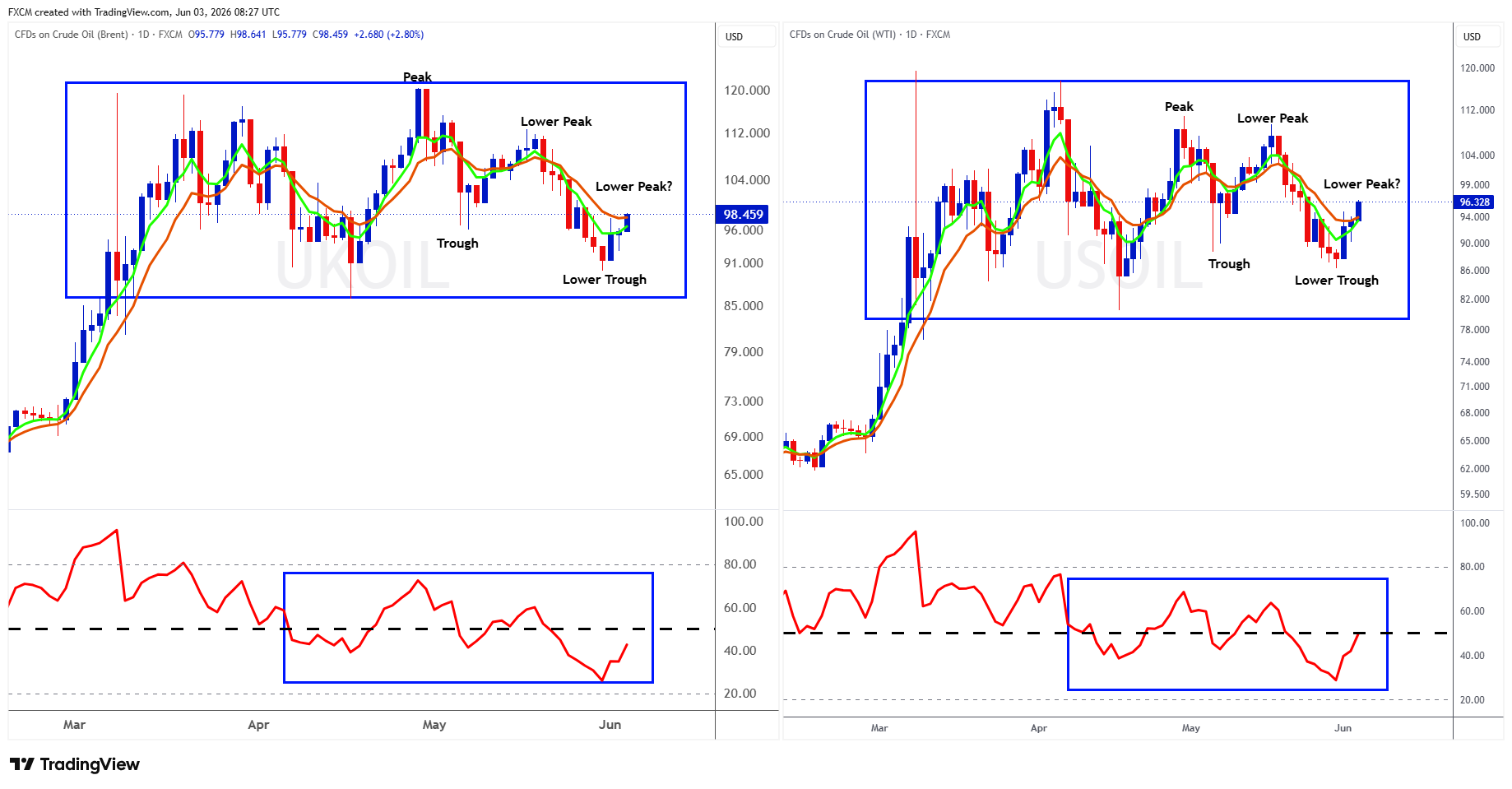
The left chart shows UKOil, while the right chart shows USOil. Both instruments remain within their respective consolidation patterns, although there have been some notable developments over the past week.
UKOil and USOil have both formed a lower peak followed by a lower trough within their consolidation ranges. This suggests a potential downside bias and raises the possibility of a breakdown from these areas. However, further confirmation is needed, with traders watching for another lower peak and lower trough to establish a clearer downward trend.
The individual RSI readings will be important to monitor, as they may provide clues about the next directional move. If the RSIs remain below the 50 level, it would suggest that underlying momentum remains tilted to the downside, increasing the possibility of further weakness.
That said, price action is likely to remain highly sensitive to developments around the Strait of Hormuz, with geopolitical news continuing to play a key role in determining the next major move.
Fundamental Perspective
The oil market remains caught between competing forces, with geopolitical tensions providing support while questions around future supply and demand keep prices contained. Developments around the Strait of Hormuz remain a key focus, as any disruption to this crucial energy route could quickly increase supply concerns and add a geopolitical premium to prices.
However, uncertainty surrounding peace negotiations has kept traders cautious, as any diplomatic breakthrough could reduce geopolitical risks, while a breakdown in talks could trigger renewed upside pressure. At the same time, expectations of higher OPEC+ output and concerns over the strength of global demand continue to weigh on sentiment.
For now, oil remains finely balanced, with the next major move likely to depend on whether geopolitical risks escalate or whether improving diplomacy shifts attention back toward supply growth and demand concerns.
The USDOLLAR
Technical Analysis
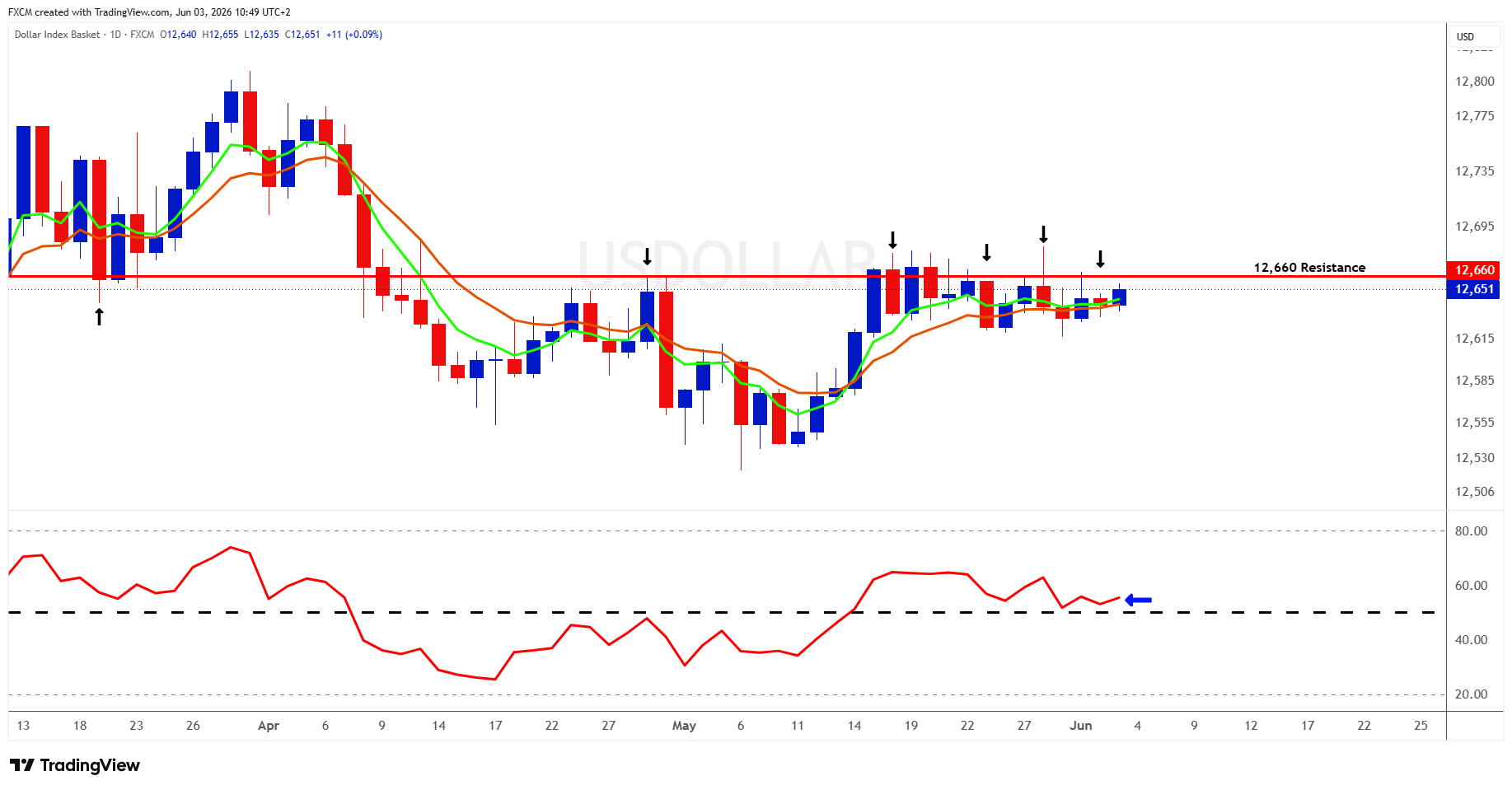
The market appears to view the 12,660 level on FXCM's USDOLLAR basket as a key technical area. Since March, this level has acted as both support and resistance on several occasions. Currently, 12,660 is serving as overhead resistance, with the greenback unable to achieve a decisive breakout above this level since mid-April.
The RSI is currently trading above 50 (blue arrow), suggesting that underlying momentum may still favour the upside. However, this will need to be monitored closely, as a shift in momentum could alter the outlook.
If oil continues its downward trend, it may help ease inflationary pressures, reducing some of the pressure on the Federal Reserve to maintain higher interest rates for longer. This could potentially weigh on the USDOLLAR. A move in the RSI back below 50 may provide an early indication of weakening momentum, and if it remains below this level, the 12,660 resistance zone could continue to hold.
However, if tensions around the Strait of Hormuz escalate and supply disruptions lead to renewed inflationary pressures, expectations for tighter monetary policy could strengthen. In this scenario, the RSI may remain above 50, increasing the possibility that the USDOLLAR basket eventually breaks above the 12,660 resistance level.
Fundamental Perspective
The USDOLLAR remains caught between competing forces, with interest rate expectations, inflation risks, and geopolitical uncertainty driving sentiment.
Elevated energy prices linked to tensions around the Strait of Hormuz have kept inflation concerns in focus, potentially supporting the greenback if markets believe the Federal Reserve will need to maintain a restrictive policy stance for longer.
However, any easing in geopolitical tensions or a sustained decline in oil prices could reduce inflation fears and revive expectations for a more accommodative Fed, limiting dollar strength. At the same time, the dollar continues to benefit from its traditional safe-haven appeal during periods of uncertainty.
For now, the greenback's next major move is likely to depend on whether sticky inflation and geopolitical risks remain dominant, or whether improving conditions shift attention back toward eventual policy easing.
Gold
Technical Analysis
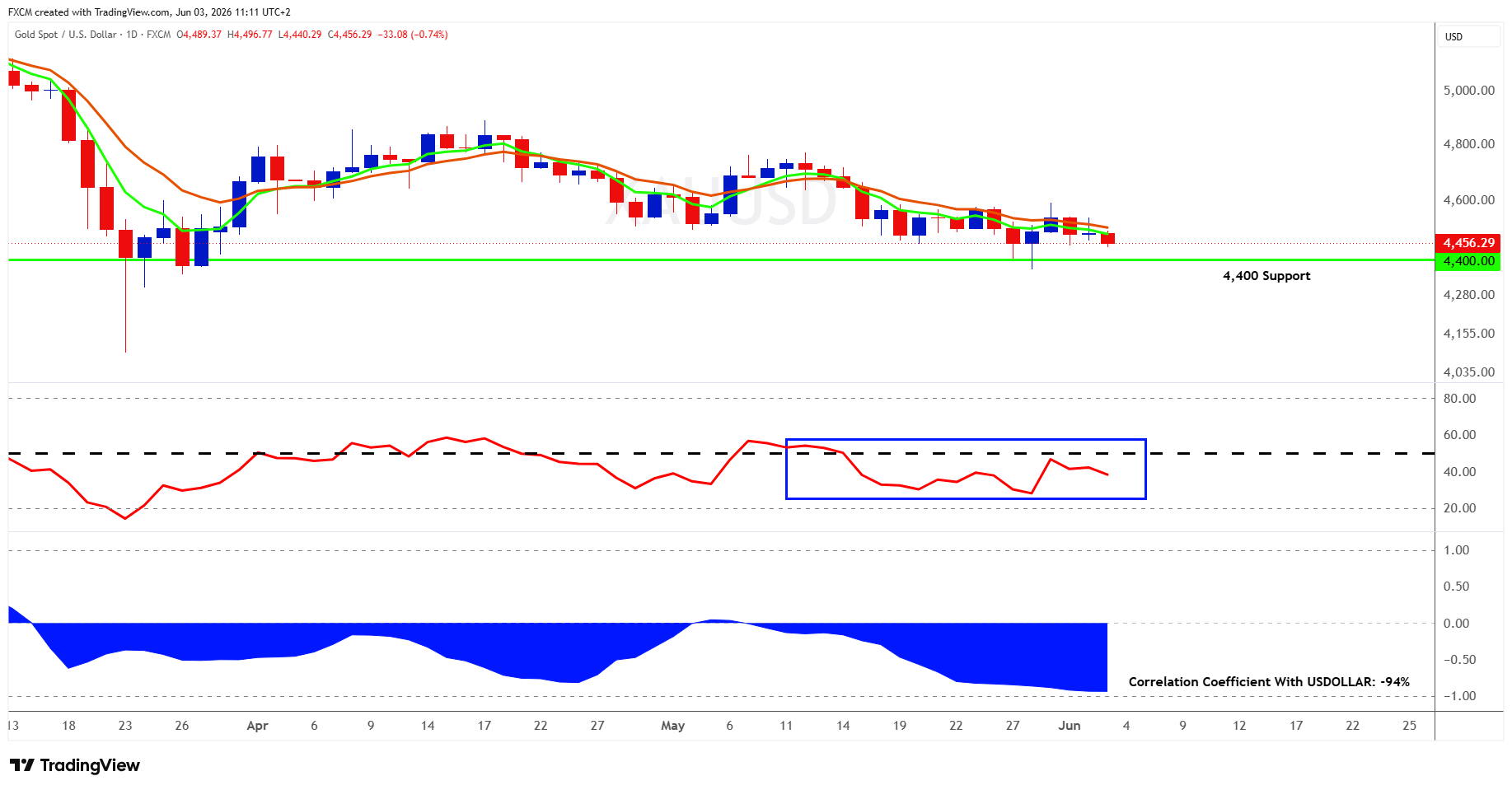
Gold's chart has become particularly interesting, especially given its strong relationship with the USDOLLAR. The correlation coefficient between the two instruments currently sits at a significant -94%, suggesting they have been moving closely together but generally in opposite directions.
With the USDOLLAR testing a key resistance level around 12,660, XAUUSD is approaching an important support area near 4,400. If the greenback manages to break above resistance, it could increase pressure on gold and raise the possibility of a move below this key support zone.
Gold's RSI is currently trading below 50, suggesting that underlying momentum remains tilted to the downside. The longer the RSI remains below this level, the greater the risk that XAUUSD could eventually break below the psychologically important 4,400 level.
However, the technical outlook remains heavily influenced by developments around the Strait of Hormuz. The key question is whether oil prices remain elevated, as this could have significant implications for inflation expectations.
In turn, inflation trends will influence Federal Reserve policy expectations and bond yields, which are likely to play a major role in determining the direction of the US dollar and, ultimately, the next major move for gold.
Fundamental Perspective
Gold remains caught between competing forces, with its traditional safe-haven characteristics being challenged by renewed strength in the USDOLLAR. Uncertainty around the Strait of Hormuz has increased concerns that higher energy prices could keep inflation pressures elevated, potentially supporting a more cautious Federal Reserve stance, firmer bond yields, and a stronger greenback.
Given gold's strong inverse relationship with the USDOLLAR, continued dollar strength could place pressure on XAUUSD despite broader geopolitical uncertainty.
However, longer-term support remains underpinned by central bank demand and gold's role as a portfolio diversifier. For now, gold's next major move is likely to depend on whether inflation concerns continue to support the dollar, or whether easing monetary expectations allow the yellow metal to regain momentum.
Another Metal to Keep an Eye on: Copper
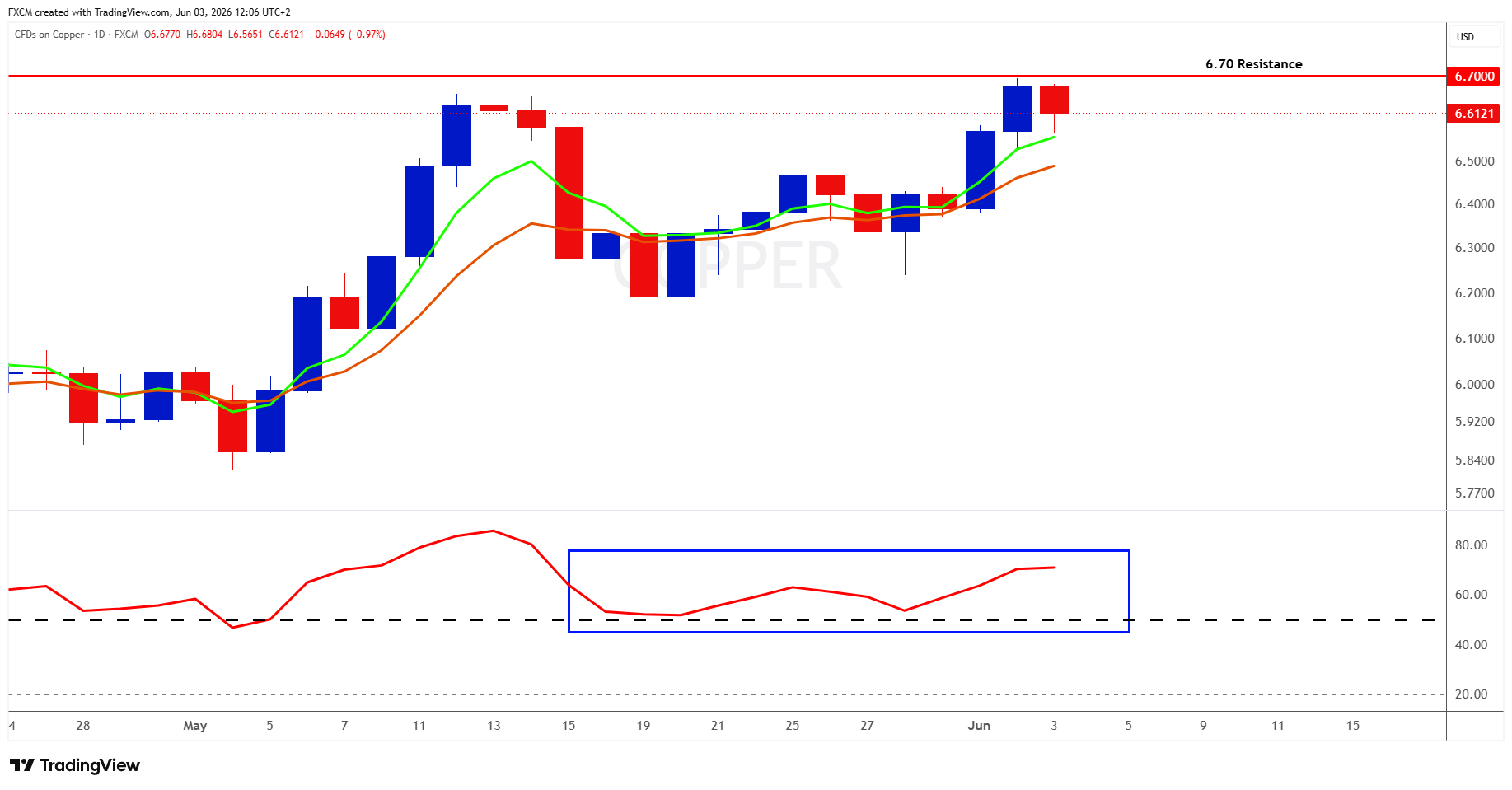
Copper continues to show a constructive technical setup, with prices testing the important 6.70 resistance level. The moving averages remain positively aligned, while the RSI continues to hold above the key 50 level, suggesting that underlying momentum remains supportive. If the RSI maintains this position, it could increase the probability of buyers challenging and potentially breaking through resistance.
Fundamentally, copper remains supported by powerful structural demand trends, including artificial intelligence infrastructure, data centre expansion, electrification, and investment in global power grids, all of which require significant copper usage.
However, while the long-term demand outlook remains positive, expectations around AI growth are already elevated, meaning any slowdown in infrastructure spending could create volatility. For now, copper's next major move may depend on whether strong demand expectations and supply constraints provide enough momentum to push prices beyond the 6.70 level.
Index in Focus: SPX500
Technical Analysis
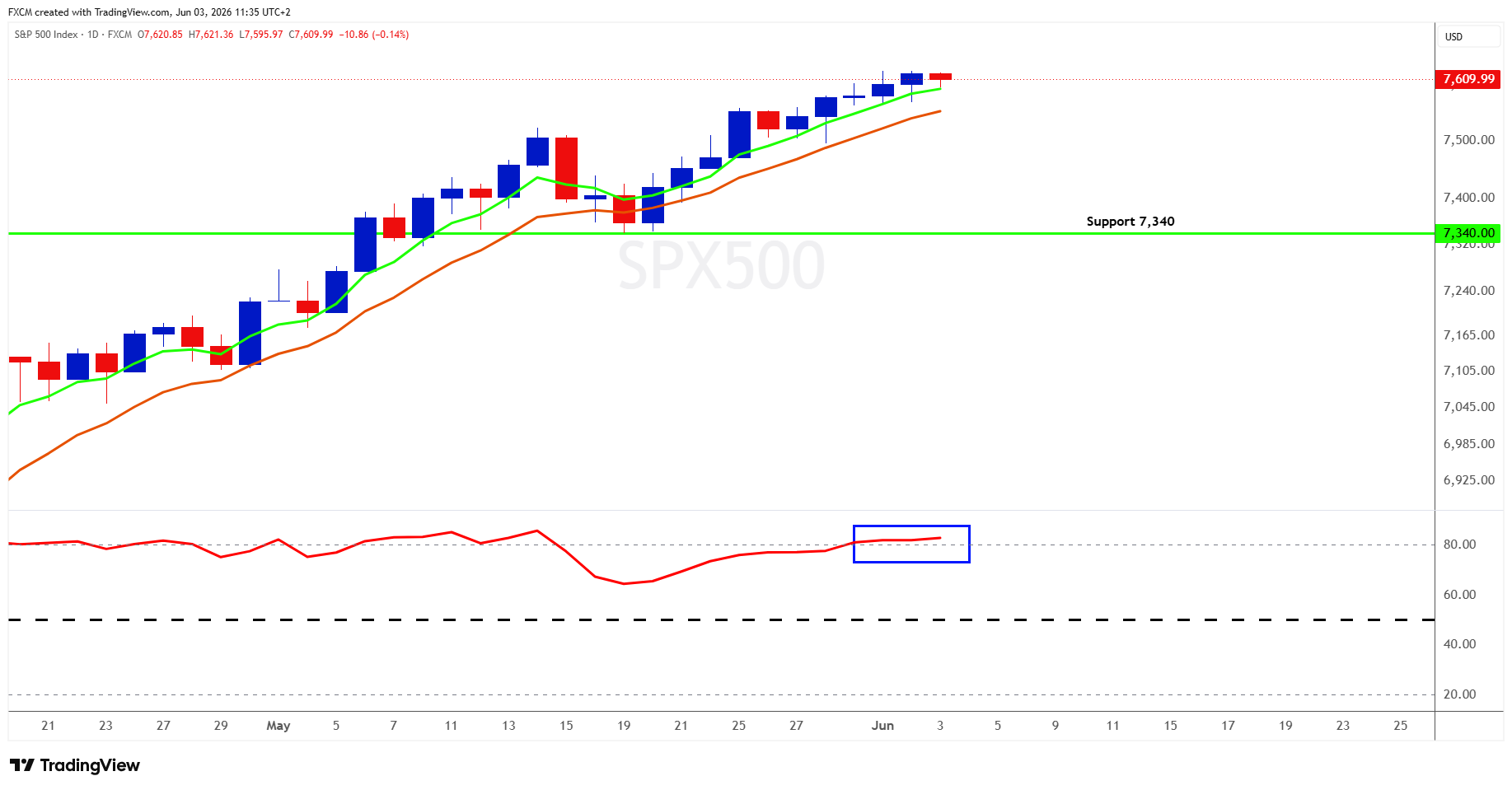
The SPX500 has maintained strong underlying momentum since its March low, delivering impressive gains throughout April and May. Its EMAs remain in a bullish formation, with healthy separation and a positive angle, suggesting that the broader uptrend remains intact.
Importantly, the RSI has consistently held above the 50 level, confirming that momentum has remained supportive of higher prices. However, the current RSI reading is above 80 (blue rectangle), indicating that the SPX500 has entered overbought territory. This suggests that near-term upside may become more limited, and a period of consolidation or profit-taking could develop.
That said, the strength of the current trend remains important. Any pullbacks should be viewed in the context of the broader bullish structure, with key support areas worth monitoring for potential opportunities. One important level to watch is the 7,340 support zone, which could act as an area of renewed buying interest if the index retraces.
Fundamental Perspective
The SPX500 continues to be supported by a combination of resilient corporate earnings, optimism around artificial intelligence, and confidence that the US economy can continue to absorb higher interest rates. AI remains the dominant market theme, with investment in chips, data centres, and infrastructure helping drive earnings expectations for several major technology companies. However, the strength of the rally has raised expectations, leaving markets increasingly dependent on continued earnings growth, particularly from AI-related companies, to justify current valuation levels.
At the same time, geopolitical uncertainty around the Strait of Hormuz and elevated oil prices remain key risks, as renewed inflation pressures could keep the Federal Reserve cautious for longer and weigh on risk appetite. For now, the SPX500 remains a battle between powerful earnings momentum and AI enthusiasm on one side, versus inflation risks, policy uncertainty, and geopolitical concerns on the other.

Russell Shor
Senior Market Strategist
Russell Shor is a Senior Market Strategist at FXCM, having been promoted to the role in 2025 in recognition of his depth of insight and consistent delivery of high-impact market analysis. He originally joined FXCM in October 2017 as a Senior Market Specialist.
Russell holds an Honours Degree in Economics from the University of South Africa, is a certified FMVA®, and a full member of the Society of Technical Analysts (UK). With over 20 years of experience in financial markets, his work is renowned for its clarity, precision, and strategic value across asset classes.

Any opinions, news, research, analyses, prices, other information, or links to third-party sites contained on this website are provided on an "as-is" basis, as general market commentary and do not constitute investment advice. The market commentary has not been prepared in accordance with legal requirements designed to promote the independence of investment research, and it is therefore not subject to any prohibition on dealing ahead of dissemination. Although this commentary is not produced by an independent source, FXCM takes all sufficient steps to eliminate or prevent any conflicts of interests arising out of the production and dissemination of this communication. The employees of FXCM commit to acting in the clients' best interests and represent their views without misleading, deceiving, or otherwise impairing the clients' ability to make informed investment decisions. For more information about the FXCM's internal organizational and administrative arrangements for the prevention of conflicts, please refer to the Firms' Managing Conflicts Policy. Please ensure that you read and understand our Full Disclaimer and Liability provision concerning the foregoing Information, which can be accessed here.