
Market Threads – Can Markets Build on a World With Less Geopolitical Risk?

.png)
Tracking important market threads across currencies, commodities, and indices
- The US-Iran peace deal has reshaped the outlook for oil, but could the market's reaction have moved too far, too fast?
- The forces behind the USDOLLAR rally are shifting, could this mark a turning point for the greenback?
- Gold's market backdrop is changing fast, we examine whether the recent rebound has more room to run.
- SpaceX excitement, AI momentum, and shifting market conditions are putting the NAS100 in focus, but can the rally continue?
Cross-Asset View
The US-Iran peace deal has provided financial markets with a significant shift in sentiment, reducing one of the major geopolitical risks that had been weighing on investors. The most immediate impact has been felt in oil markets, where easing supply concerns and expectations of more stable energy flows have pushed prices lower.
This decline has helped reduce fears of a renewed inflation shock, allowing markets to reassess the likely path of Federal Reserve monetary policy as pressure on the 2-year Treasury yield begins to ease. These changing expectations are now filtering through multiple asset classes: a softer interest-rate outlook has reduced support for the USDOLLAR, improved the relative appeal of gold as yields decline, and created a more supportive environment for growth-sensitive equities.
While risks remain, the combination of lower energy prices, easing inflation concerns, and improving risk appetite has created a more constructive backdrop across financial markets.
Oil
Technical Analysis
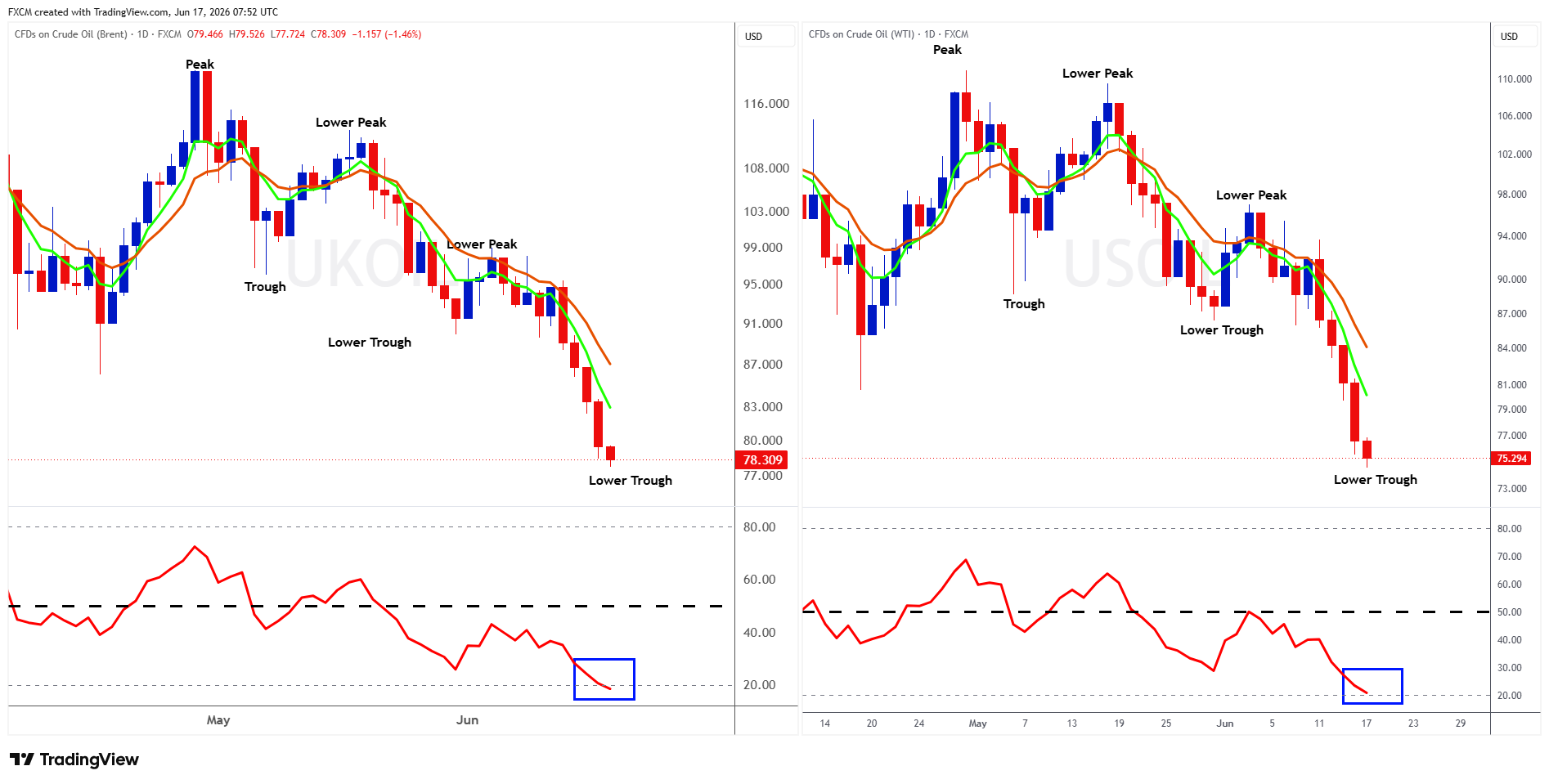
UKOil is shown on the left and USOil on the right. Last week, we highlighted that both instruments remained in established downtrends and that the key support levels would be important areas to monitor. Since then, UKOil has broken below the 90 level, while USOil has moved through the key 85 support level. In both cases, the downtrend has continued, with another clear lower trough forming in the sequence.
UKOil's RSI has moved below 20, placing it firmly in oversold territory, while USOil is approaching a similar level. This suggests that further downside may become more limited in the short term, and oil could attempt to stabilise or rebound from current levels, potentially forming another lower peak within the broader downtrend. However, as long as RSI readings remain below 50, momentum continues to favour the downside.
Fundamental Perspective
Fundamentally, oil prices have come under renewed pressure following the US-Iran peace deal, which has reduced the geopolitical risk premium that previously supported crude prices.
A major driver of the decline has been expectations that energy flows through the Strait of Hormuz will normalise, easing concerns around potential supply disruptions. However, after the sharp move lower, markets may have already priced in much of this positive development. Any delays in restoring confidence around shipping flows, renewed geopolitical uncertainty, or changes in the demand outlook could allow oil prices to stabilise or recover in the short term.
Nevertheless, as long as supply fears continue to fade, the broader fundamental pressure on oil remains tilted to the downside.
The USDOLLAR
Technical Analysis
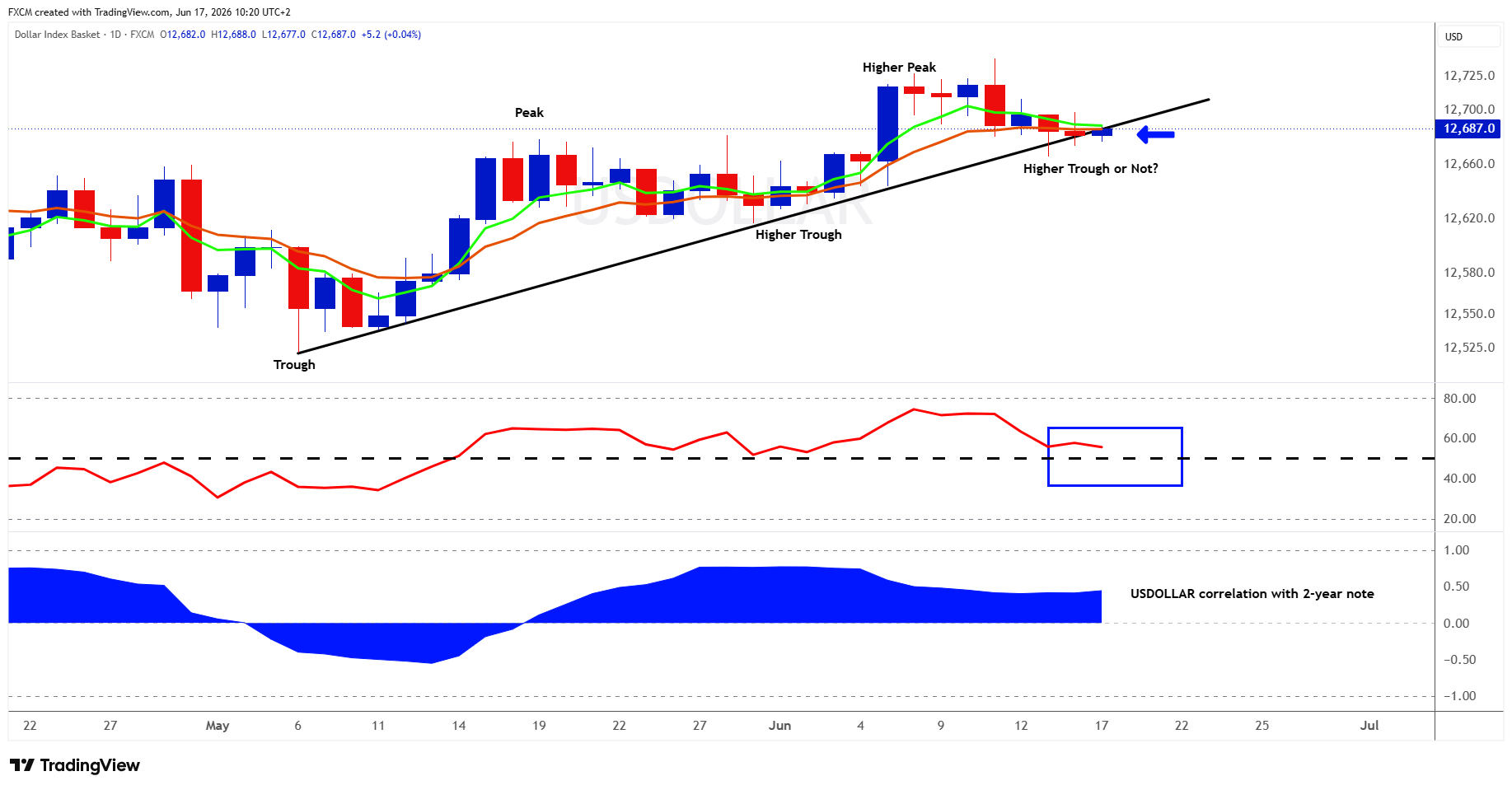
The USDOLLAR continues to maintain its uptrend, with the formation of a higher trough followed by a higher peak. The key question now is whether the index can establish another higher trough and higher peak to confirm that the broader uptrend remains intact.
One potential warning signal is the break below the upward-sloping black trendline. While this does not confirm a change in trend, it does suggest that upside momentum has started to weaken.
In this regard, the RSI will be an important indicator to monitor. A sustained move below the 50 level would suggest that bullish momentum has faded and that the USDOLLAR's uptrend may be at risk. However, if the RSI manages to hold above 50, it would indicate that underlying momentum remains supportive of further strength in the greenback.
The bottom indicator shows the USDOLLAR's correlation coefficient with the 2-year note. The relationship is currently positive, and while correlation does not imply causation, it suggests that the two have recently tended to move in the same direction.
Fundamental Perspective
The USDOLLAR's recent strength has been supported by elevated inflation expectations and the resulting move higher in US interest-rate expectations. This has been reflected in the 2-year Treasury yield, which is closely watched as a proxy for the market's view on future Federal Reserve policy. A key driver behind this move was the rise in oil prices, as supply concerns increased fears that inflation could remain persistent, supporting yields and providing a tailwind for the greenback.
However, last week's CPI release provided some reassurance, with core inflation coming in softer than expected, suggesting that the recent inflation acceleration remained largely concentrated in energy prices rather than showing clear signs of broadening across the economy.
Following the recent decline in oil prices after the US-Iran peace deal reduced supply concerns, inflation pressures have started to ease. Importantly, momentum in the 2-year yield has begun to weaken, suggesting that one of the key fundamental supports behind the USDOLLAR's advance may be losing strength.
If yields continue to move lower, the greenback could struggle to maintain its uptrend. However, should inflation prove more persistent and the Fed maintain a more restrictive stance, yield support could return and help reinforce the broader USDOLLAR uptrend.
Gold
Techncical Anlysis
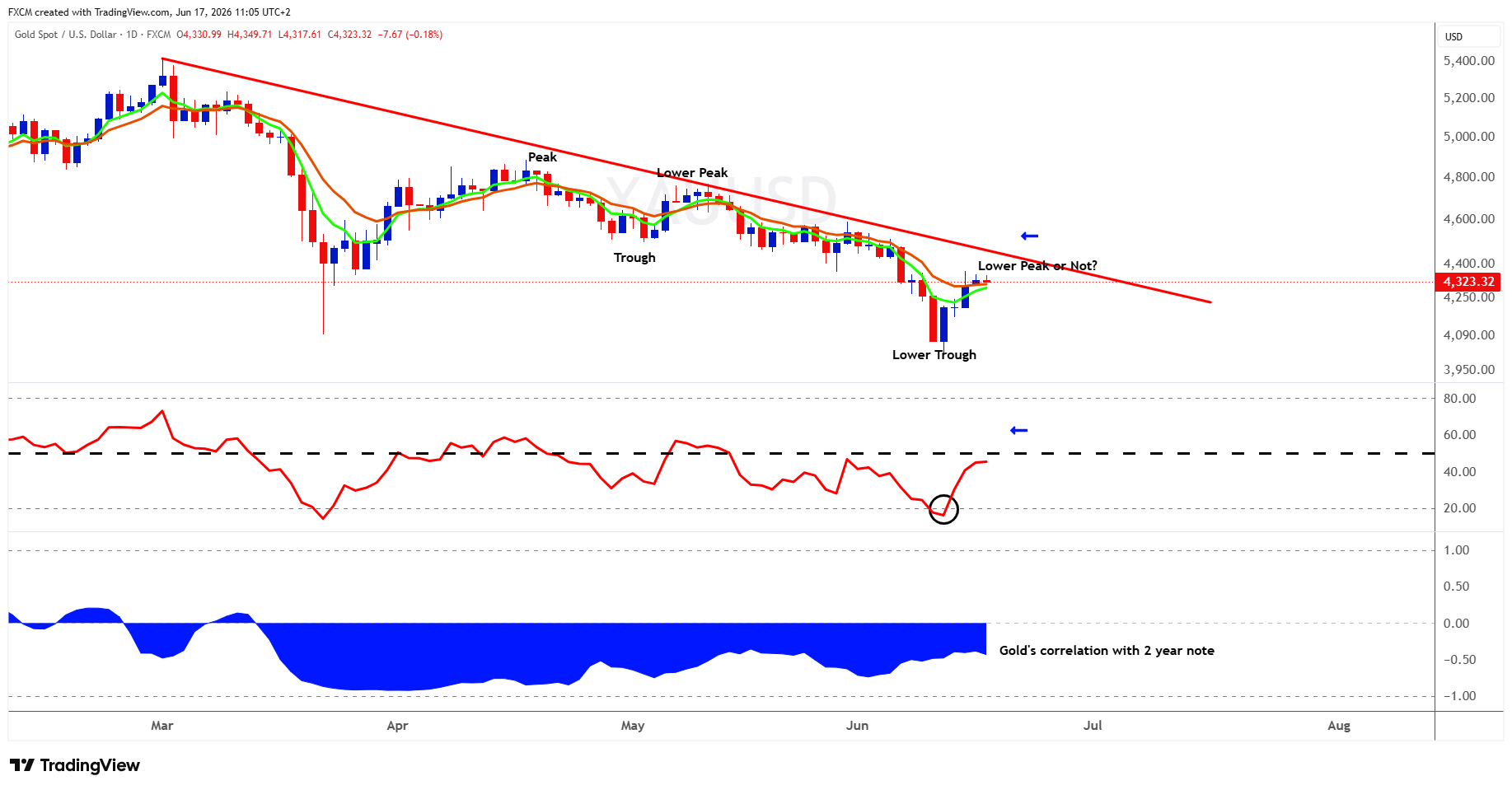
Last week, we noted that gold remained in a downtrend while also trading in oversold territory. Since then, XAUUSD has rebounded as its RSI has normalised. The key question now is whether the yellow metal forms another lower peak followed by a lower trough, which would confirm the continuation of the broader downtrend.
In this regard, monitoring the RSI remains important. If it stays below the 50 level, the path of least resistance is likely to remain to the downside. However, if the RSI moves above 50 and XAUUSD breaks through the red downward-sloping trendline, the technical picture may begin to shift.
Importantly, a sustained move above 50 on the RSI would suggest that momentum has shifted in favour of further upside support. The bottom indicator shows gold's correlation coefficient with the 2-year note. The relationship remains inverse, suggesting that a decline in the 2-year yield could provide support for gold prices.
Fundamental Perspective
Gold's recent rebound has been supported by the shift lower in US interest-rate expectations. Last week's CPI release provided some reassurance, with core inflation coming in softer than expected, suggesting that the recent inflation acceleration was largely driven by energy pressures rather than showing significant evidence of broadening across the economy.
The subsequent decline in oil prices following the US-Iran peace deal has further eased inflation concerns, reducing upward pressure on the 2-year Treasury yield, which is closely watched as a proxy for future Federal Reserve policy expectations. As yields move lower, the opportunity cost of holding non-yielding assets such as gold declines, improving the relative attractiveness of the yellow metal.
In addition, reduced geopolitical uncertainty may ease safe-haven demand for the USDOLLAR, removing another recent headwind for gold. Going forward, the direction of yields, the greenback, and Fed expectations are likely to remain key drivers for XAUUSD.
Another Metal to Keep an Eye on: Copper
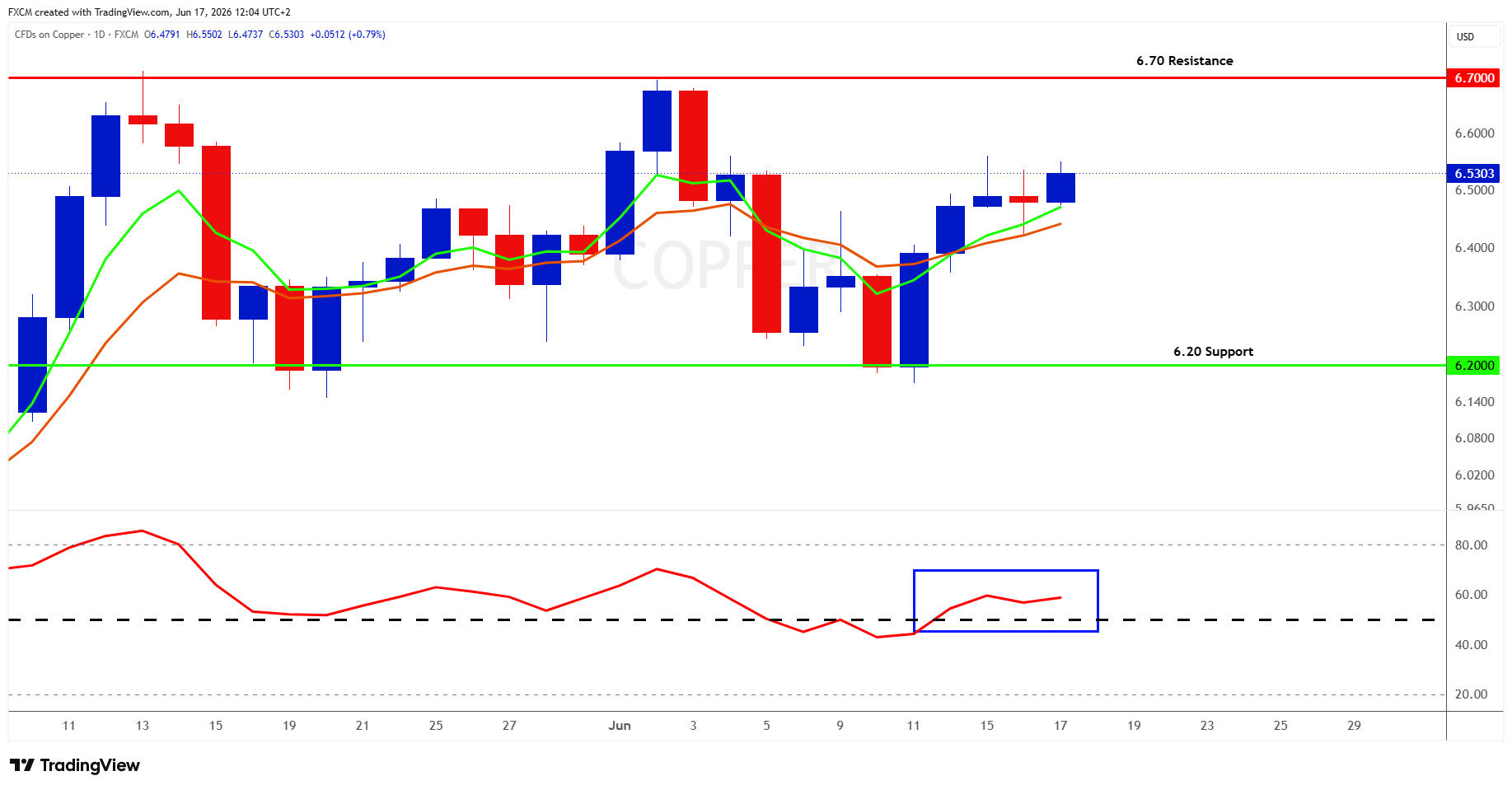
Copper bounced from the 6.20 support level identified last week. Since then, its EMAs have moved into a positive formation, while the RSI has pushed above the key 50 level. The longer the RSI remains above 50, the stronger the indication that underlying momentum is supportive of further upside.
The 6.70 level remains the key area of overhead resistance. However, if the RSI continues to hold above 50 and momentum remains positive, this level could come under pressure and potentially be challenged.
Copper has been supported by improving risk sentiment following the US-Iran peace deal, with prices briefly pushing back toward record highs and trading above $6.55 before easing as markets reassessed the speed and certainty of a lasting resolution.
The agreement has helped pressure oil prices lower, reducing fears of a renewed inflation shock and easing pressure on the 2-year Treasury yield, a key proxy for future Federal Reserve policy expectations.
Lower yields and improving investor sentiment have provided a more supportive backdrop for growth-sensitive assets such as copper. Beyond the short-term reaction, the red metal continues to benefit from longer-term structural demand linked to artificial intelligence infrastructure, data centres, electrification, and energy transition investment, while ongoing supply constraints remain supportive
Index in Focus: NAS100
Technical Analysis
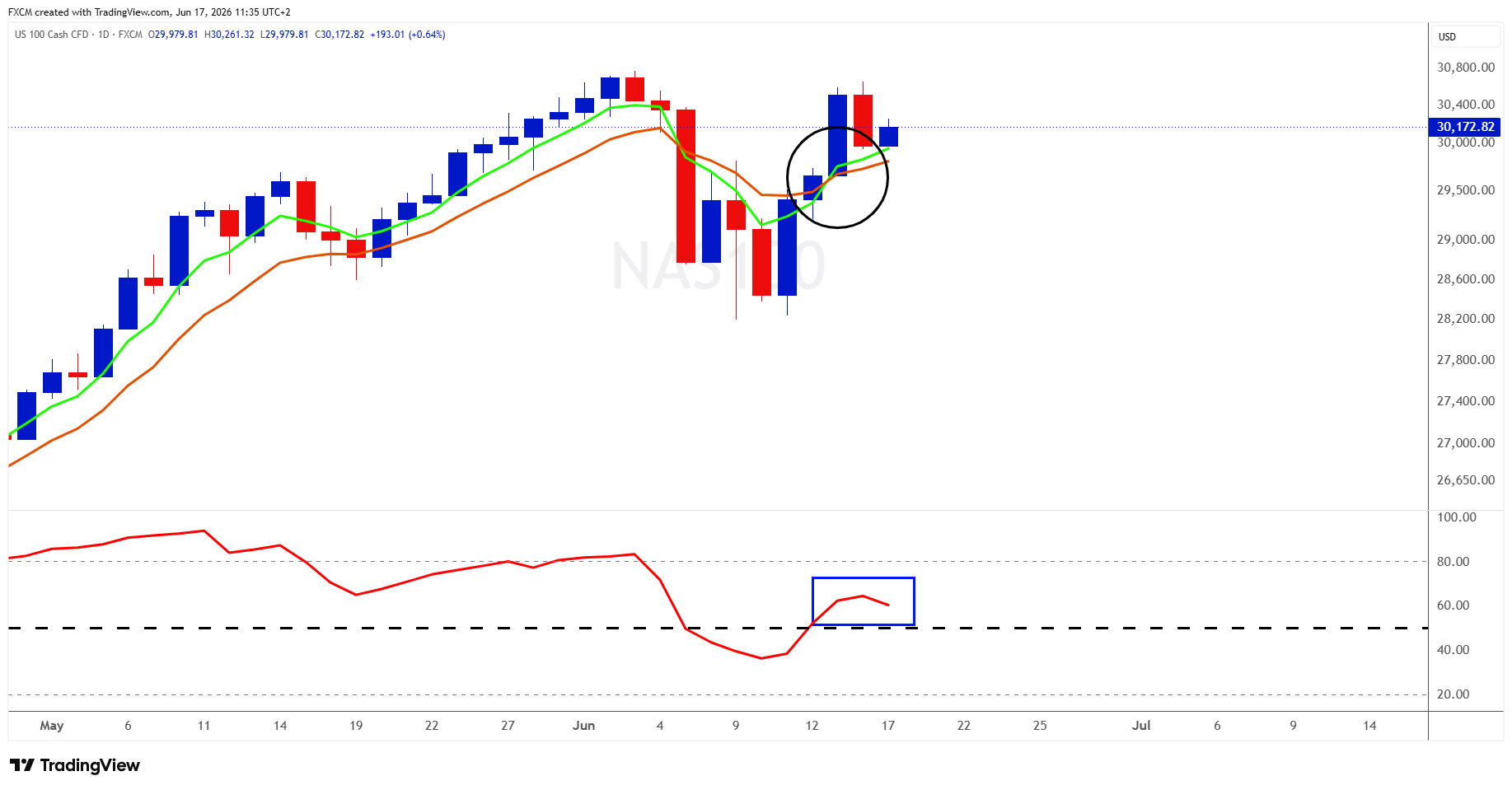
The NAS100's EMAs have crossed bullishly, while the RSI has moved above the key 50 level. If the RSI can maintain above 50, it would suggest that underlying momentum remains positive and supportive of the index. Further angle and separation between the EMAs would strengthen the bullish technical picture, while a move above 30,773.04 would see the NAS100 reach a new all-time high.
However, if the RSI falls back below 50, it would represent a negative momentum signal, suggesting that underlying strength has started to fade.
Fundamental Perspective
The NAS100 has been supported by improving interest-rate expectations, easing geopolitical risks, and continued enthusiasm around artificial intelligence and innovation-led growth. The US-Iran peace deal has pressured oil prices lower as supply concerns have eased, reducing fears of a renewed inflation shock and helping ease pressure on the 2-year Treasury yield, a key proxy for market expectations around Federal Reserve policy.
Lower yields are particularly supportive for growth-orientated technology companies, as future earnings become more attractive when discount rates decline. In addition, sentiment continues to be supported by AI investment and anticipation around SpaceX's expected inclusion in the Nasdaq 100 around 6 July, which could create additional demand from index-tracking funds.
However, with the NAS100 trading near record highs, earnings growth remains critical as investors look for fundamentals to justify elevated valuations.

Russell Shor
Senior Market Strategist
Russell Shor is a Senior Market Strategist at FXCM, having been promoted to the role in 2025 in recognition of his depth of insight and consistent delivery of high-impact market analysis. He originally joined FXCM in October 2017 as a Senior Market Specialist.
Russell holds an Honours Degree in Economics from the University of South Africa, is a certified FMVA®, and a full member of the Society of Technical Analysts (UK). With over 20 years of experience in financial markets, his work is renowned for its clarity, precision, and strategic value across asset classes.

Any opinions, news, research, analyses, prices, other information, or links to third-party sites contained on this website are provided on an "as-is" basis, as general market commentary and do not constitute investment advice. The market commentary has not been prepared in accordance with legal requirements designed to promote the independence of investment research, and it is therefore not subject to any prohibition on dealing ahead of dissemination. Although this commentary is not produced by an independent source, FXCM takes all sufficient steps to eliminate or prevent any conflicts of interests arising out of the production and dissemination of this communication. The employees of FXCM commit to acting in the clients' best interests and represent their views without misleading, deceiving, or otherwise impairing the clients' ability to make informed investment decisions. For more information about the FXCM's internal organizational and administrative arrangements for the prevention of conflicts, please refer to the Firms' Managing Conflicts Policy. Please ensure that you read and understand our Full Disclaimer and Liability provision concerning the foregoing Information, which can be accessed here.