
AlphaTrack – SPX500 Bearish Momentum Tests the Bulls’ Resolve


Thoughtful insights and approachable analysis.
- Meta faces a make-or-break earnings test as bearish signals emerge and soaring AI costs put investors on edge.
- Tesla's earnings could spark its next big move as shares trade sideways and investors demand answers on profitability and AI ambitions.
- Procter & Gamble's bullish breakout faces a crucial earnings test as investors look for signs of stronger demand and improving profitability.
Quick Market Overview
US equities steadied as technology stocks rebounded, but the recovery remained narrow and investors are now looking to earnings for confirmation that the AI-led bull case still holds. The main issue is whether strong profits can justify heavy AI spending, rising debt and premium valuations after last week's selloff. With tech carrying such a large weight in the major indices, solid results from leading chip and AI companies could restore confidence across the broader market, while disappointment would leave equities vulnerable to another leg lower.
General Equity Market Health (SPX500)
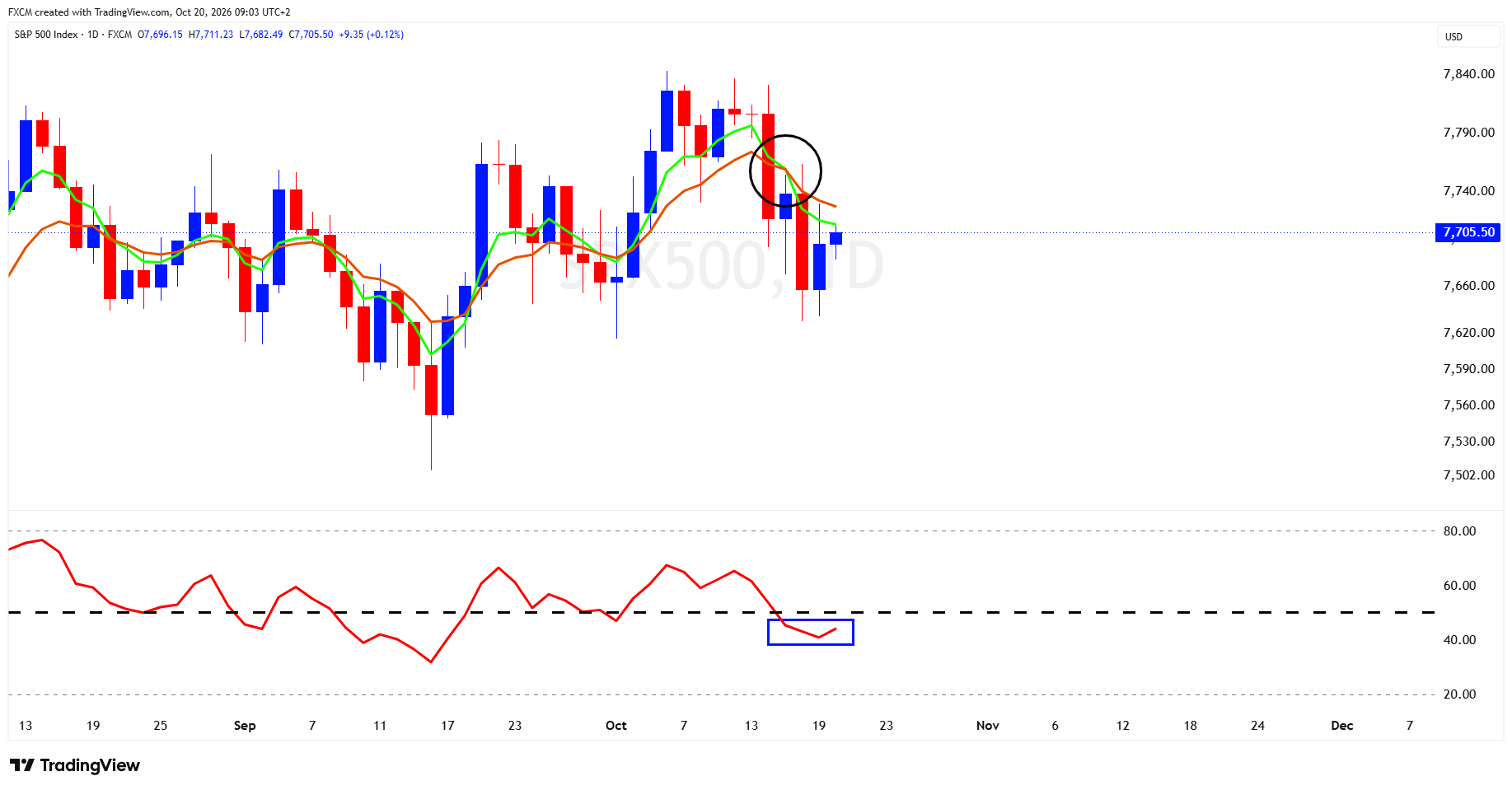
The SPX500 is showing signs of increasing technical vulnerability following its recent retreat from October highs. The exponential moving averages (EMAs) have shifted into a bearish formation, with the shorter-term average crossing below the longer-term average, suggesting that selling pressure is gaining traction. Although the index has attempted to recover towards 7,705, the Relative Strength Index (RSI) remains below the critical 50 threshold, indicating that bearish momentum continues to dominate. The longer the RSI remains below this level, the greater the risk of sustained downside pressure, potentially exposing support around 7,660 and 7,620. However, the picture is not entirely negative. A convincing recovery above the moving averages, accompanied by the RSI reclaiming and holding above 50, could signal renewed buying interest and potentially turn the recent weakness into an attractive buy-the-dip opportunity.
The SPX500 is facing a difficult balancing act as encouraging corporate earnings prospects compete with persistent inflation and rising borrowing costs. Wall Street recovered some ground on Monday, helped by renewed buying interest in technology and artificial intelligence stocks. However, the recovery was far from broad-based, with most stocks declining despite the index's gains. Investors are also becoming more selective about the AI trade, questioning whether the enormous investment in infrastructure will ultimately deliver the returns needed to justify elevated valuations. Adding to the uncertainty, higher Treasury yields and stubborn inflation are keeping the prospect of further Federal Reserve tightening firmly in focus, even as policymakers are expected to leave rates unchanged at their October meeting. Attention now turns to the latest corporate earnings and, importantly, what management teams say about demand, profitability and future investment. Strong results could help rebuild confidence, but with valuations sensitive to borrowing costs and expectations already high, there is little room for disappointment.
Potential Trade Setups
A busy earnings week could provide some interesting trading opportunities as three Wall Street heavyweights prepare to report. Meta faces mounting technical pressure as investors question its soaring AI spending, while Tesla remains stuck in a trading range, with earnings potentially providing the spark for its next move. Procter & Gamble, meanwhile, has broken above key resistance, but can improving consumer demand keep the rally alive? With expectations running high and plenty at stake, the coming days could prove decisive for all three stocks.
Meta Platforms (META.us)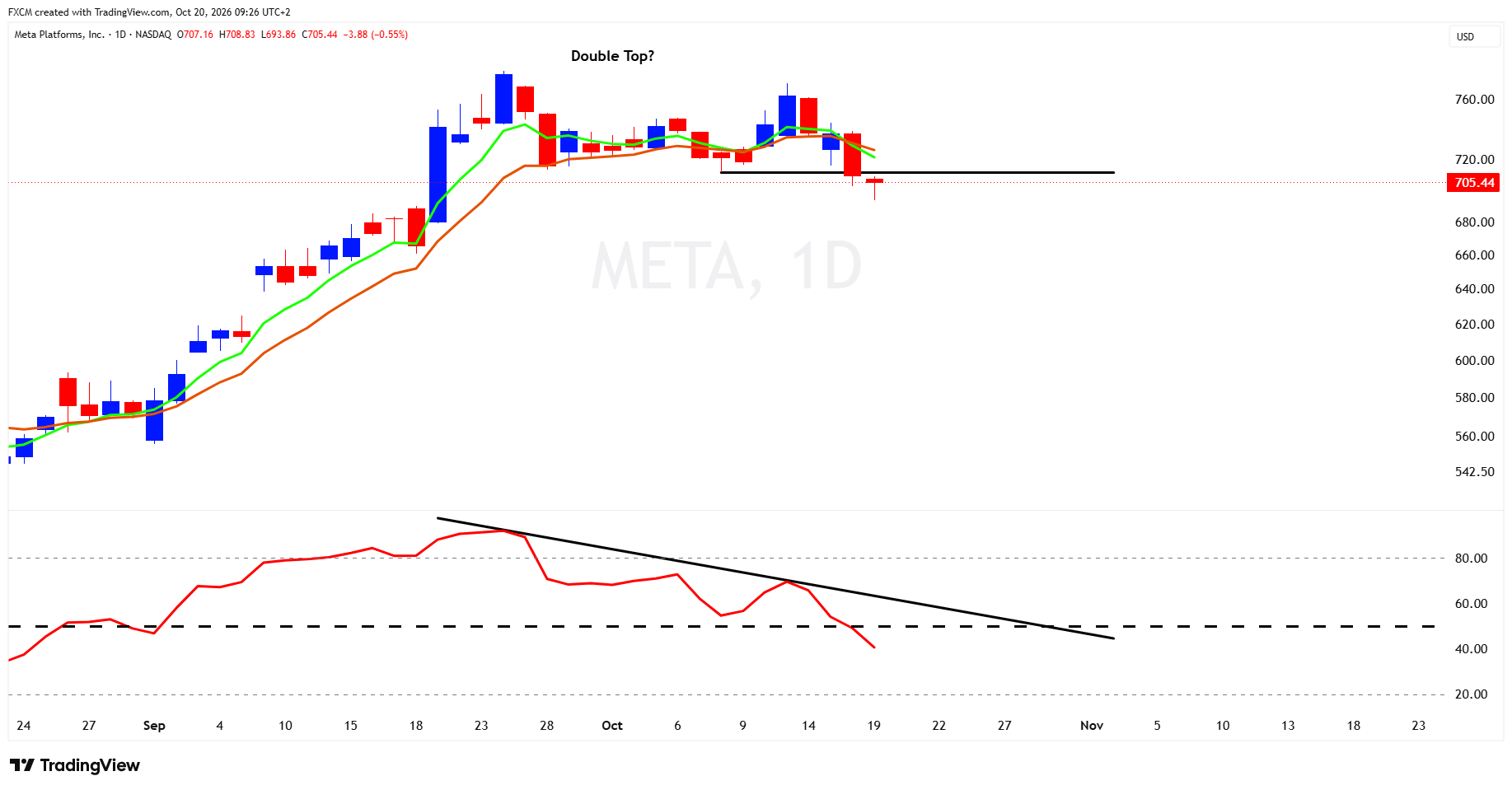
Technical Analysis
Meta Platforms is showing signs of a potential double-top reversal following its impressive rally, with two prominent peaks around $760 suggesting that buyers are struggling to push the stock higher. More concerning is the recent move below neckline support around $712, although a sustained break is still needed to confirm the pattern. The exponential moving averages (EMAs) have also turned bearish, reinforcing the deterioration in the short-term technical picture. Meanwhile, the Relative Strength Index (RSI) has fallen below the important 50 threshold, indicating that sellers are gaining control. A prolonged period below 50 would strengthen the bearish outlook, potentially exposing the stock to further declines towards $690 and $680. However, with earnings approaching, sentiment could change quickly. A recovery above the neckline and moving averages, supported by the RSI reclaiming and holding above 50, would suggest improving momentum and could undermine the bearish reversal scenario.
Fundamental Perspective
Meta Platforms faces an important test when it reports third-quarter earnings after tomorrow's closing bell, with Wall Street expecting revenue of approximately $63.3 billion, an increase of nearly 24% from a year earlier. While the strength of its advertising business remains central to the outlook, investors are increasingly concerned about the cost of Meta's ambitious artificial intelligence strategy. The company expects capital expenditure of between $130 billion and $145 billion this year, raising questions about profitability and the returns on that investment. Attention will therefore turn to advertising growth, operating margins and, perhaps most importantly, management's spending plans for 2027. Investors will also be looking for signs that newer AI products, including Muse, can develop into meaningful commercial opportunities. Strong earnings and reassuring guidance could help restore confidence, but another increase in spending expectations or signs of weakening profitability may prove difficult for the market to overlook. With so much riding on its AI ambitions, Meta needs to convince investors that its substantial investment is creating lasting value rather than simply adding to costs.
Tesla Motors (TSLA.us)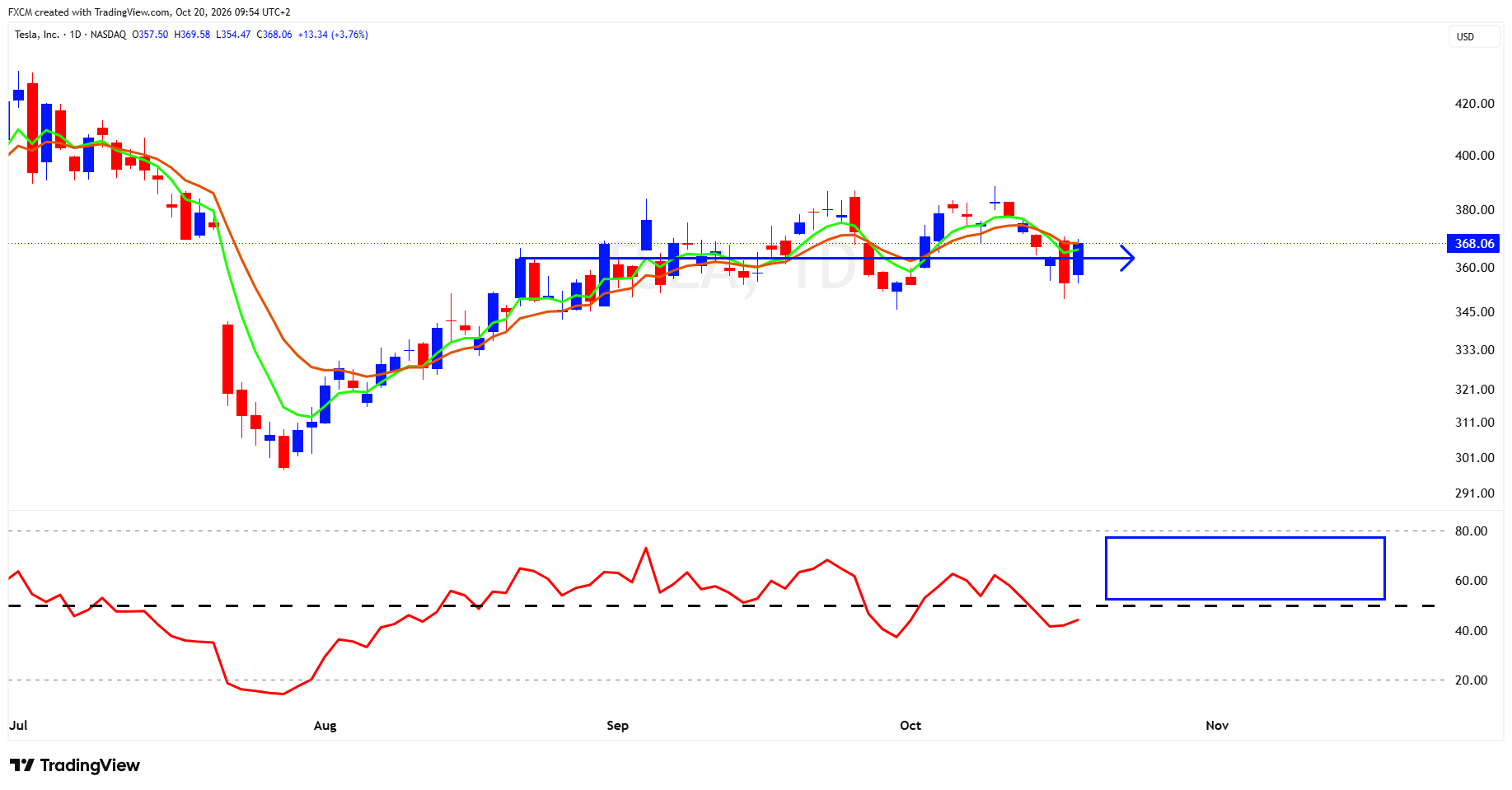
Technical Analysis
Tesla remains well below its December 2025 highs around $490, with the shares currently trading near $368. Following the sharp selloff in July and subsequent recovery, price action has settled into a sideways consolidation since August, reflecting a lack of clear directional conviction. The stock is finding support around $360–$365, while repeated attempts to break above the $380–$385 region have struggled to gain traction. The exponential moving averages (EMAs) are relatively flat and intertwined, reinforcing the range-bound picture. Meanwhile, the Relative Strength Index (RSI) continues to fluctuate around the critical 50 threshold, suggesting that neither buyers nor sellers have established a lasting advantage. As long as the RSI remains around this level, consolidation could persist. However, a sustained move above 50, accompanied by a recovery in price and a break above resistance, would signal improving bullish momentum. Conversely, a decisive break below support, particularly if the RSI remains below 50, could open the door to renewed selling pressure towards $350 and potentially $340.
Fundamental Perspective
Tesla faces an important earnings test tomorrow, with investors looking for signs that stronger-than-expected vehicle deliveries are translating into improved profitability. The company delivered 486,532 vehicles during the third quarter, beating market expectations despite a 2.1% decline from a year earlier. Tesla's company-compiled analyst consensus points to revenue of approximately $28.3 billion and adjusted earnings of $0.45 per share, putting automotive margins and pricing trends firmly in the spotlight. Its energy storage business remains another important area to watch, having deployed 13.7 GWh during the quarter. However, the cost of Tesla's ambitious expansion plans is becoming harder to ignore, with analysts forecasting capital expenditure of approximately $7.8 billion and negative free cash flow of $4.5 billion. Beyond the financial results, investors will be listening for meaningful updates on robotaxis, Cybercab and the Optimus humanoid robot, particularly evidence that these projects are moving closer to commercial viability. Stronger margins, better cash generation and credible progress on these initiatives could support the shares. Conversely, disappointing profitability or further pressure on cash flow could weigh on sentiment. Ultimately, Tesla needs to demonstrate that its ambitions beyond electric vehicles can translate into sustainable financial returns.
Procter & Gamble Company (PG.us)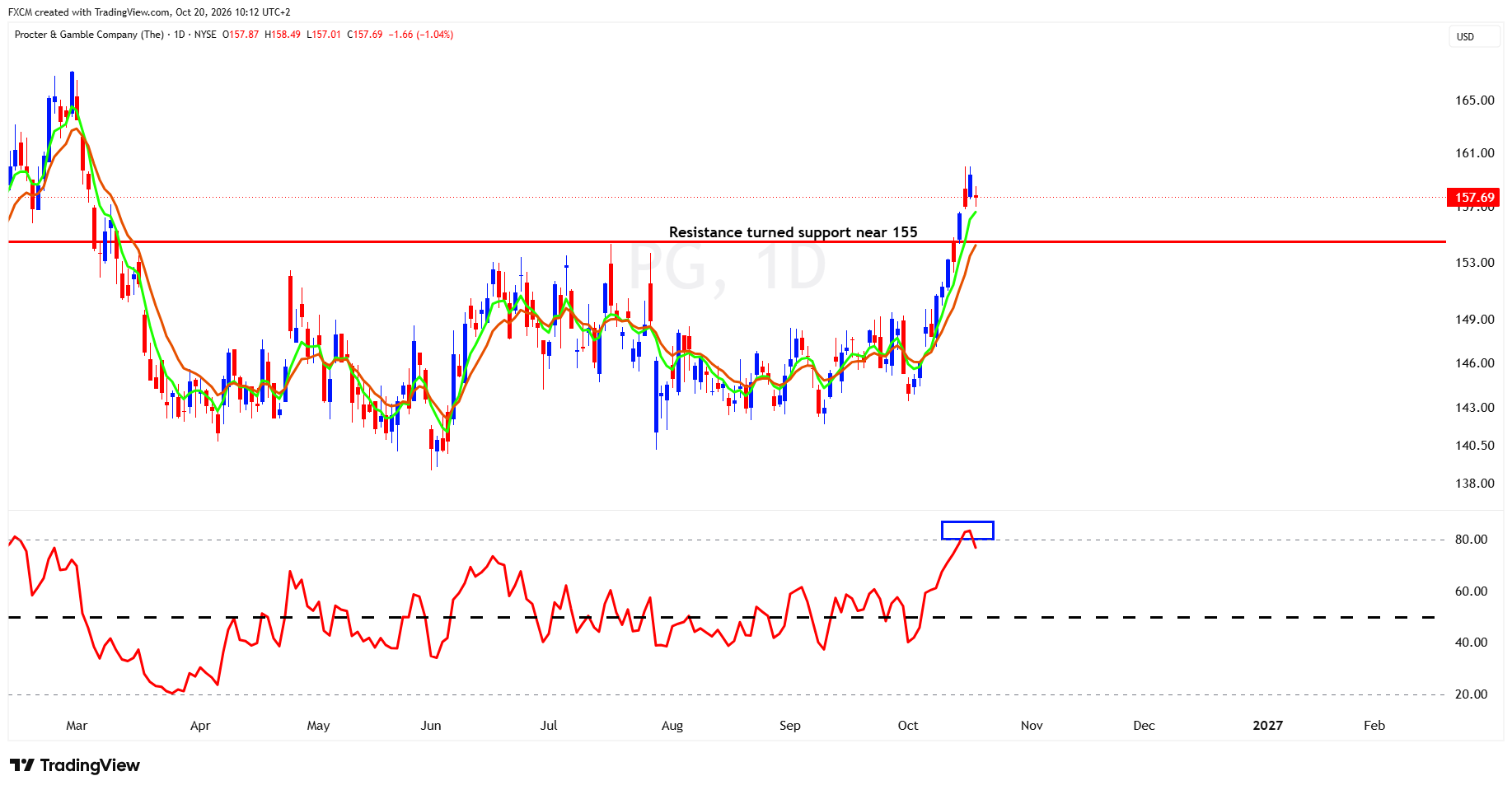
Technical Analysis
Procter & Gamble has enjoyed a strong recovery in October, breaking above the important $155 resistance level following several months of largely sideways trading. This former resistance now represents a key support area, with the shares trading near $157.70. The exponential moving averages (EMAs) have turned higher and remain in a bullish formation, suggesting that buyers have regained control of the short-term trend. Meanwhile, the Relative Strength Index (RSI) recently moved briefly into overbought territory above 80 before retreating, suggesting that some of the rally's initial momentum has cooled. However, the RSI remains comfortably above the important 50 threshold, indicating that underlying momentum continues to support prices. As long as the RSI holds above 50 and the shares defend support around $155, the technical outlook remains constructive, potentially encouraging another attempt to challenge resistance around $160 and $165. A sustained move below $155, particularly if accompanied by the RSI falling beneath 50, would weaken the bullish picture and raise the risk of a deeper correction.
Fundamental Perspective
Procter & Gamble faces an important earnings test on Thursday with investors looking for signs that consumer demand is improving despite persistent pressure on household budgets. Wall Street expects fiscal first-quarter revenue of approximately $22.8 billion, representing growth of around 2%, while core earnings are forecast to decline by roughly 6% to $1.88 per share. However, the real question is whether consumers are buying more of P&G's products or whether growth continues to rely heavily on pricing. That distinction matters, particularly after organic sales growth of just 1% in fiscal 2026. Profitability is another concern, with the company anticipating approximately $1 billion in after-tax cost pressures from higher raw material, energy and transportation expenses during fiscal 2027. Investors will therefore be watching sales volumes, market share, operating margins and management's ability to offset rising costs through productivity improvements. Any changes to its full-year outlook could be particularly influential. Stronger underlying demand and reassuring guidance could help sustain the recent recovery in P&G's shares, while disappointing volumes or further pressure on margins may test investor confidence. Ultimately, P&G needs to demonstrate that its brands can deliver meaningful growth even as consumers remain careful with their spending.
Hot News, Cold Logic
US tech stocks rebounded from oversold levels, but investors now need earnings to confirm that the recovery is more than a short-term bounce. With SPX500 profits tracking near 29% growth, the key question is whether major AI-linked companies can justify the earnings expectations already embedded in their valuations. Strong results could extend the rebound, but weaker guidance may expose heavily indebted or richly priced AI names, increasing the gap between winners and losers across the sector.
Final Thought
The bull market is entering a more discriminating phase. AI investment remains a powerful source of growth, but investors are increasingly demanding evidence that extraordinary spending can generate returns that justify its rising financing costs, while oil above $100 keeps inflation and interest-rate risk firmly in the background. The broader advance can continue if earnings deliver, but from here resilience will depend less on enthusiasm for the AI story and more on companies proving that the economics behind it ultimately add up.

Russell Shor
Senior Market Strategist
Russell Shor is a Senior Market Strategist at FXCM, having been promoted to the role in 2025 in recognition of his depth of insight and consistent delivery of high-impact market analysis. He originally joined FXCM in October 2017 as a Senior Market Specialist.
Russell holds an Honours Degree in Economics from the University of South Africa, is a certified FMVA®, and a full member of the Society of Technical Analysts (UK). With over 20 years of experience in financial markets, his work is renowned for its clarity, precision, and strategic value across asset classes.

Any opinions, news, research, analyses, prices, other information, or links to third-party sites contained on this website are provided on an "as-is" basis, as general market commentary and do not constitute investment advice. The market commentary has not been prepared in accordance with legal requirements designed to promote the independence of investment research, and it is therefore not subject to any prohibition on dealing ahead of dissemination. Although this commentary is not produced by an independent source, FXCM takes all sufficient steps to eliminate or prevent any conflicts of interests arising out of the production and dissemination of this communication. The employees of FXCM commit to acting in the clients' best interests and represent their views without misleading, deceiving, or otherwise impairing the clients' ability to make informed investment decisions. For more information about the FXCM's internal organizational and administrative arrangements for the prevention of conflicts, please refer to the Firms' Managing Conflicts Policy. Please ensure that you read and understand our Full Disclaimer and Liability provision concerning the foregoing Information, which can be accessed here.