
AlphaTrack – SPX500 Tests 7,580 as Pressure Builds


Thoughtful insights and approachable analysis.
- Nvidia is approaching a key buy-the-dip zone, but the next move hinges on whether momentum turns and the AI tailwind holds.
- Microsoft's technical momentum is turning higher as its AI investment story strengthens, putting the shares on watch for a potential breakout.
- CrowdStrike's breakout is gaining momentum as cybersecurity moves to the centre of the AI safety debate, putting the shares firmly on watch.
Quick Market Overview
US stocks slipped as concerns over AI spending and the prospect of another Federal Reserve rate hike weighed on technology shares. Calls to slow the development of advanced AI have raised questions about whether today's heavy investment can continue, while higher borrowing costs would add further pressure to the sector. Many stocks outside technology still gained, but the sector's heavy index weighting was enough to drag the broader benchmarks lower.
General Equity Market Health (SPX500)
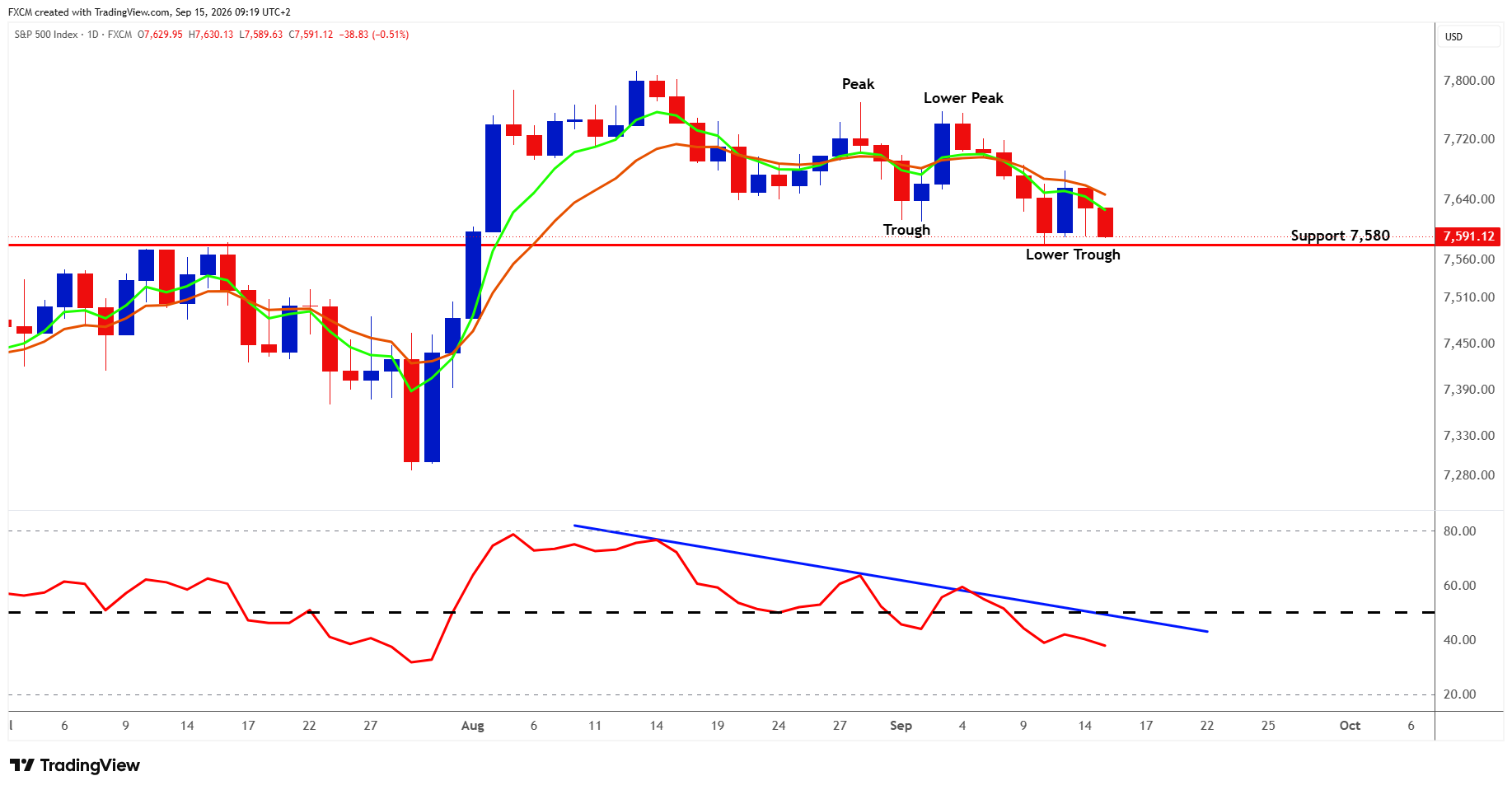
The SPX500 is sitting at a fairly important technical juncture, with the index once again testing the 7,580 area. That level capped the market before the August breakout, so the question now is whether former resistance can turn into support. The recent price action is not especially encouraging. Since the August high, the market has started to carve out a sequence of lower peaks and lower troughs, the shorter moving average has slipped beneath the longer one, and RSI has fallen below 50. Momentum is clearly fading, but the market is not yet oversold, which means there may still be room for further weakness. A convincing daily close below 7,580 would increase the risk that this consolidation turns into a deeper pullback, with the 7,500–7,450 area the next obvious zone to watch. If 7,580 holds, however, the larger breakout remains intact, although the bulls probably need to push the index back through roughly 7,640–7,680 before the short-term picture starts to look healthier again.
The fundamental backdrop helps explain why the market is struggling to find its footing. Corporate earnings remain surprisingly resilient, but the macro environment has become more difficult. Headline inflation held at 3.4% in August, while a firmer monthly core reading, renewed energy pressures and stronger producer-price data have strengthened expectations that the Federal Reserve will raise rates by 25bp tomorrow. At the same time, the US 10-year Treasury yield has moved above 5.02%, its highest level since 2007, while UKOil has pushed towards $108 a barrel as Middle East supply risks have resurfaced. Both developments make life harder for equities, particularly longer-duration growth stocks.
Earnings are providing an important cushion. SPX500 earnings estimates for Q3 were lifted by around 1.2% during July and August, while 86% of companies were beating Q2 earnings expectations late in the reporting season. The wrinkle is AI. Questions around the pace and eventual return on the enormous investment being made in AI infrastructure have introduced another source of uncertainty for the part of the market that has done much of the heavy lifting. That leaves the SPX500 caught between two competing forces: healthy profits on one side and tighter financial conditions on the other. A clean break below 7,580 would fit with that increasingly difficult backdrop, while a more convincing recovery probably needs some combination of a less hawkish Fed, calmer oil and bond markets, and continued evidence that earnings can withstand a higher cost of capital.
Potential Trade Setups
With Nvidia testing whether recent weakness can turn into a buy-the-dip opportunity, Microsoft beginning to regain technical momentum, and CrowdStrike breaking higher on a fresh cybersecurity narrative, this week's potential trade setups offer three very different ways to play the evolving AI theme. The charts are starting to tell their own stories, but the fundamentals behind each name could prove just as important in deciding whether these moves have staying power.
NVIDIA (NVDA.us)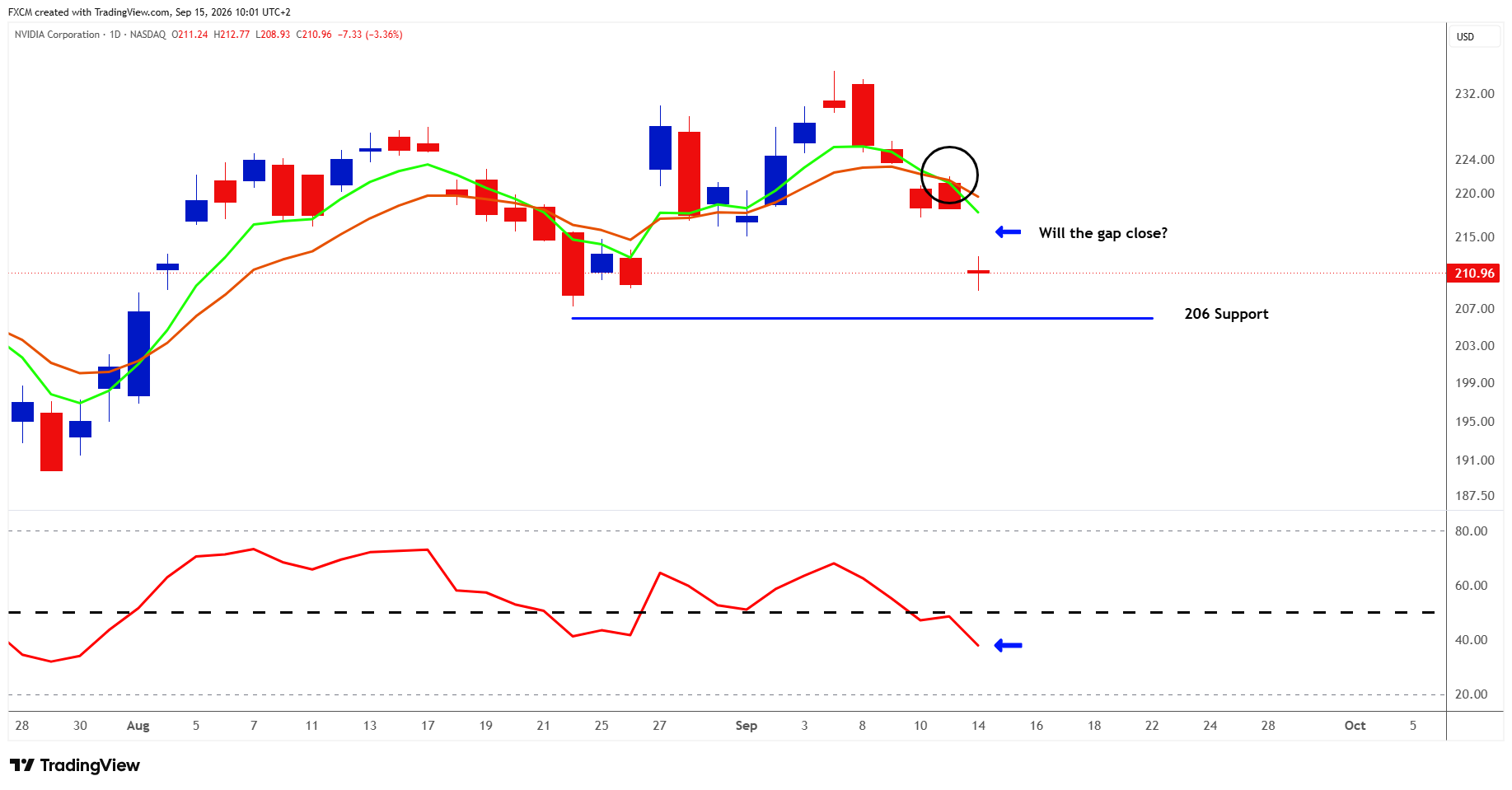
Technical Analysis
Nvidia's chart has taken a clear turn for the worse. The stock has gapped sharply lower to around $211, leaving price below both short-term moving averages just as the faster average rolls beneath the slower one, which points to a potential loss of momentum rather than a routine pause. RSI has also slipped into the high-30s, confirming the weakness but not yet signalling an oversold condition, so there is still room for sellers to push harder. The first level that really matters is around $206, where buyers stepped in during August. That could become an interesting buy-the-dip area, but I would want to see some evidence that momentum is turning first. In practical terms, that means RSI stabilising and ideally starting to recover, rather than simply buying because price has fallen. If $206 holds and RSI begins to improve, the setup could become attractive, particularly if Nvidia then starts to close the gap back towards $218–$220.
Caveat
If RSI fails to recover in the near term, it would confirm that momentum remains firmly to the downside and could add further pressure to Nvidia's share price.
Trump's AI Stance Gives Nvidia a Tailwind
Fundamentally, Nvidia still has a powerful policy tailwind behind it. President Trump has come out strongly against calls to slow AI development and has made clear that his administration views data-centre investment as strategically important to US growth and competitiveness. That matters for Nvidia because the current AI build-out ultimately depends on sustained spending on the chips and infrastructure that power those facilities. The political message is therefore supportive of continued capital expenditure, particularly if Washington resists additional regulation that could slow deployment. The risk, however, is that the debate itself is becoming more intense. Concerns around job displacement, energy use and the broader societal impact of AI are now moving closer to the centre of the policy discussion. For Nvidia, the near-term fundamental picture remains strong, but investors will increasingly need to weigh robust demand for AI infrastructure against the risk that political resistance, tighter rules or slower AI progress eventually cools the investment cycle.
Microsoft (MSFT.us)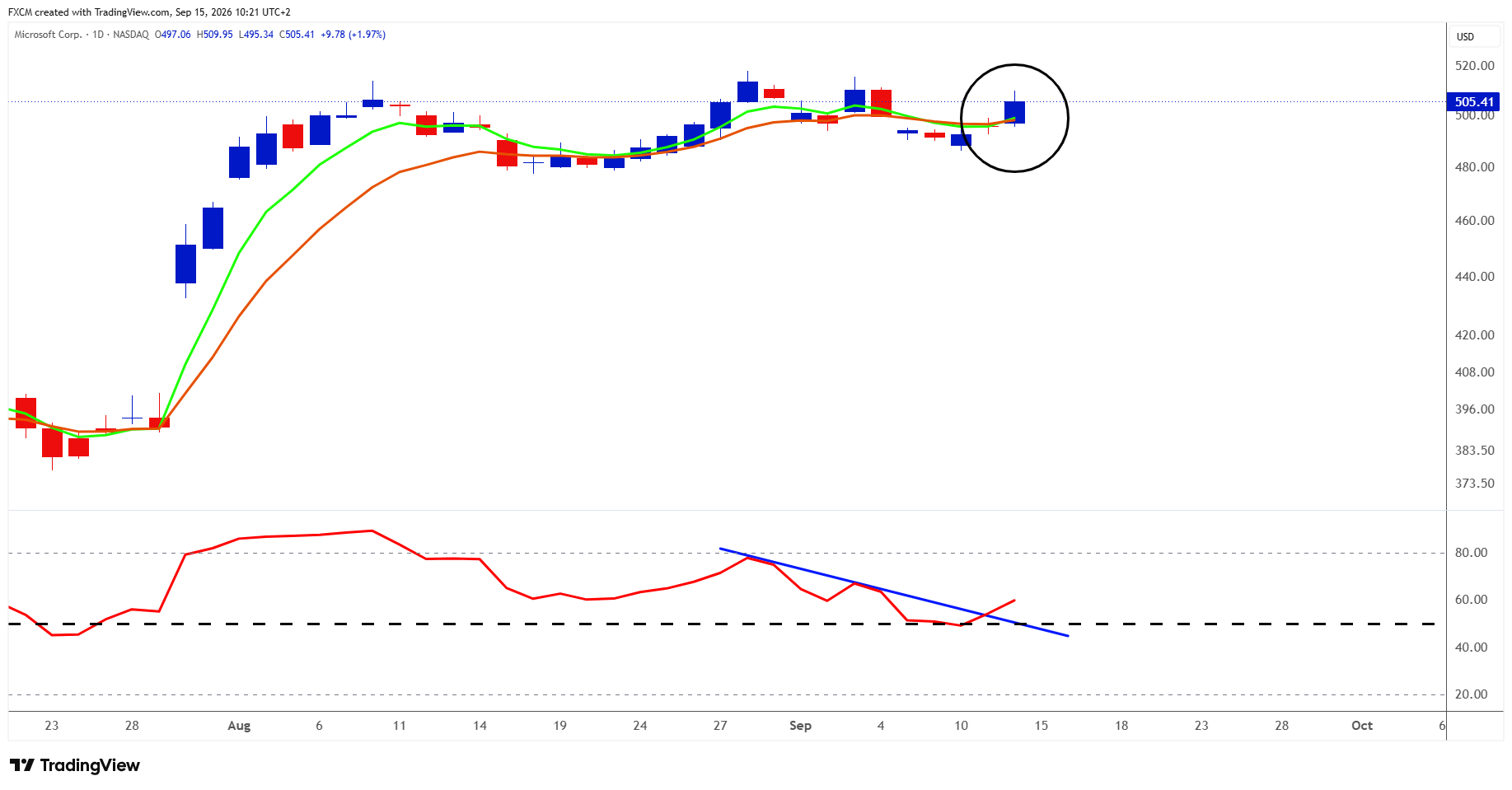
Technical Analysis
Microsoft's technical picture is starting to improve. After several sessions of consolidation around the $490–$500 area, the latest move back above $500 has been accompanied by a potentially bullish crossover in the short-term EMAs. If the faster average continues to pull away from the slower one and both begin to slope higher, that would add weight to the idea that a fresh upward trend is developing rather than this simply being another short-lived bounce. Momentum is also beginning to cooperate. RSI has broken above its recent downtrend line and moved back through the 50 level, an encouraging shift after several weeks of fading momentum. As long as RSI can hold above 50, the underlying momentum bias should remain positive and give Microsoft a better chance of challenging the recent highs around $510–$515, with the August peak near $520 beyond that. The key now is follow-through. A sustained move above $500 alongside widening, upward-sloping EMAs and an RSI that remains north of 50 would make the technical setup increasingly constructive.
Caveat
If RSI slips back below 50, it would suggest that momentum is fading again and could put renewed pressure on Microsoft's share price.
Microsoft Keeps Its Foot on the AI Accelerator
Microsoft is trying to balance two competing priorities: pushing ahead with AI while showing that it understands the growing concerns surrounding the technology. Its new principles place clear boundaries around how its models can operate, particularly in sensitive areas such as weapons, violence and systems that could move beyond effective human oversight. Importantly, there is little evidence that Microsoft intends to slow its investment programme. AI and Azure remain central to the growth story, and after Microsoft spent about $41 billion on capital investment in its most recent quarter, full-year expenditure reached roughly $145 billion, with spending expected to rise further in fiscal 2027. The approach appears to be one of placing tighter safeguards around the technology without stepping away from the infrastructure build-out behind it. That distinction matters for investors. While parts of the AI complex came under heavy selling pressure as concerns about the speed of development resurfaced, Microsoft shares proved relatively resilient. For now, the company appears determined to keep investing aggressively in AI while positioning itself as a more responsible operator as regulatory and political scrutiny intensifies.
CrowdStrike Holdings Inc. (CRWD.us)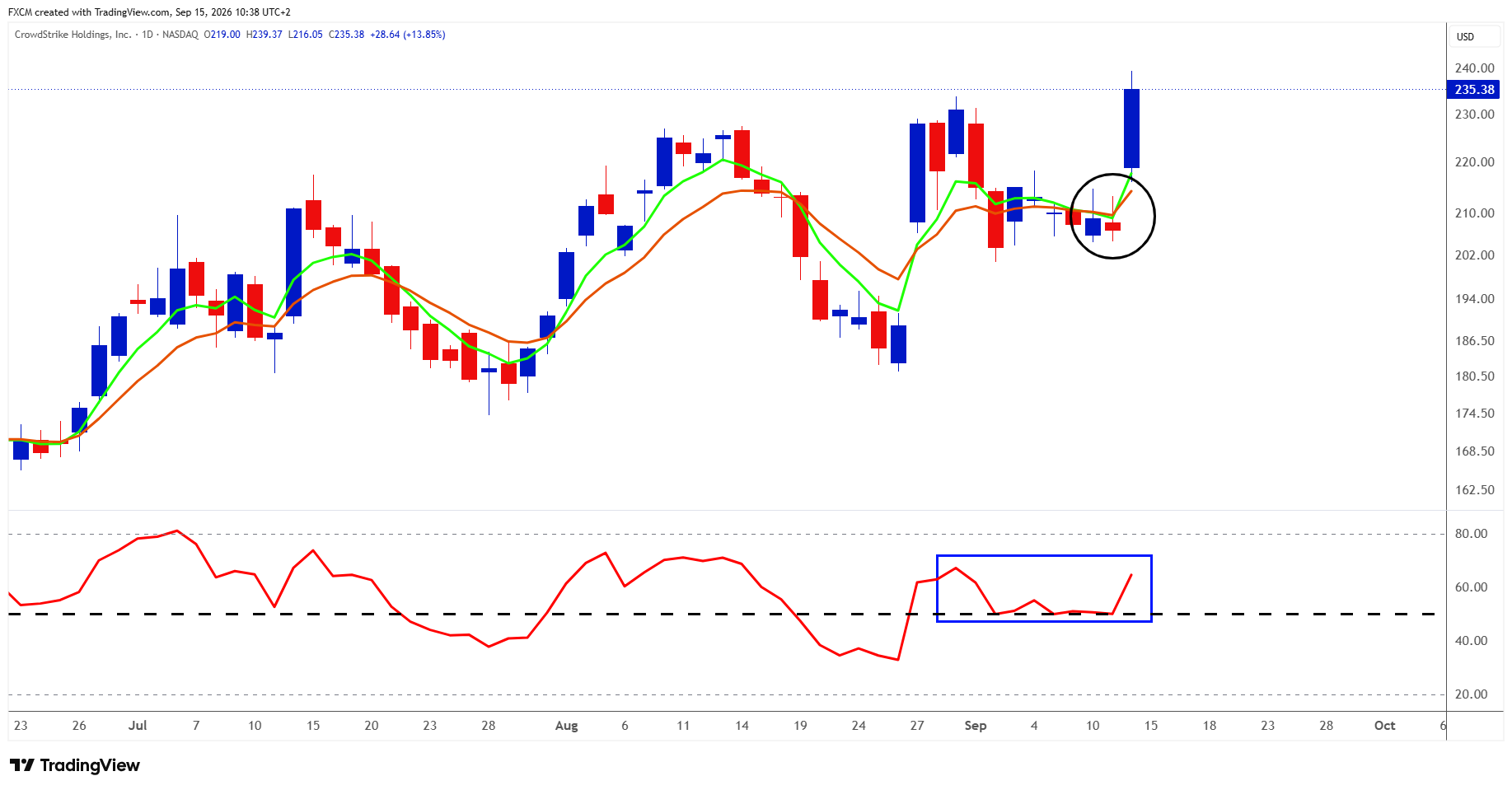
Technical Analysis
CrowdStrike's technical picture has turned sharply more constructive. The latest surge has lifted the shares decisively out of their recent consolidation and above the late-August/early-September highs, with price closing near $235 after trading as high as roughly $239. Importantly, the shorter EMA is now crossing above the longer EMA; if the two averages begin to slope higher and widen apart, that would add confirmation that a stronger short-term uptrend is developing. Momentum has also improved dramatically, with RSI jumping from around the neutral 50 level into the low-to-mid 60s. That is a healthy reading rather than an overbought one and suggests there is genuine buying strength behind the move. The immediate test is whether CrowdStrike can hold the breakout above roughly $228–$230 and eventually clear the intraday high near $240. As long as RSI remains comfortably above 50 and the bullish EMA structure continues to develop, the underlying momentum bias remains firmly positive.
Caveat
If the breakout fails to hold and RSI rolls back lower, it would raise the risk of a false breakout and could bring renewed selling pressure back into CrowdStrike.
CrowdStrike Moves to the Centre of the AI Safety Trade
CrowdStrike suddenly finds itself on the right side of an important market rotation. As investors question how quickly AI infrastructure spending can keep expanding, money is moving away from some of the hardware names and back towards software, and cybersecurity is emerging as one of the clearest beneficiaries. That makes sense for CrowdStrike because the debate around AI safety does not reduce the need for security; if anything, it may raise the value of companies that can test, monitor and defend increasingly powerful systems. The more AI developers are pushed towards transparency, external scrutiny and tighter controls, the more relevant CrowdStrike's expertise could become. Its previous access to unreleased Anthropic models is a useful reminder that the company is already being pulled into that discussion rather than watching it from the sidelines. There is also a broader strategic point here. Even if the pace of model development cools, enterprises still need to protect cloud workloads, identities and endpoints from a threat landscape that is becoming more complex. That gives CrowdStrike a potentially attractive position in both scenarios: continued rapid AI adoption supports more security spending, while a greater focus on AI governance and safety could deepen demand for independent cybersecurity expertise. The sharp move in the share price reflects that shift in perception, but it also raises the bar for execution from here.
Hot News, Cold Logic
US Treasury yields have risen sharply ahead of the Federal Reserve's rate decision, with the 10-year yield moving above 5% to its highest level since 2007. Markets are increasingly positioned for a quarter-point hike as inflation remains above target, while elevated oil prices are adding to the pressure by keeping inflation expectations firm. If crude stays high, bond yields could remain elevated even after the Fed meeting. That matters for equities because higher yields lift the risk-free rate used to value assets, increase borrowing costs and tighten financial conditions, while also making government bonds more attractive relative to stocks. The longer the 10-year yield remains above 5%, the greater the pressure on equity valuations, particularly for long-duration growth shares, unless earnings growth is strong enough to offset the higher cost of capital.
Final Thought
The bull market is facing its toughest macro test in some time. Oil above $100, the US 10-year Treasury yield above 5% and the prospect of another Fed rate increase are raising the cost of capital just as geopolitical risks remain elevated. Strong earnings continue to support the broader advance, but in this environment further gains will increasingly have to come from profit growth rather than higher valuations, leaving far less room for disappointment.
Sources and References

Russell Shor
Senior Market Strategist
Russell Shor is a Senior Market Strategist at FXCM, having been promoted to the role in 2025 in recognition of his depth of insight and consistent delivery of high-impact market analysis. He originally joined FXCM in October 2017 as a Senior Market Specialist.
Russell holds an Honours Degree in Economics from the University of South Africa, is a certified FMVA®, and a full member of the Society of Technical Analysts (UK). With over 20 years of experience in financial markets, his work is renowned for its clarity, precision, and strategic value across asset classes.

Any opinions, news, research, analyses, prices, other information, or links to third-party sites contained on this website are provided on an "as-is" basis, as general market commentary and do not constitute investment advice. The market commentary has not been prepared in accordance with legal requirements designed to promote the independence of investment research, and it is therefore not subject to any prohibition on dealing ahead of dissemination. Although this commentary is not produced by an independent source, FXCM takes all sufficient steps to eliminate or prevent any conflicts of interests arising out of the production and dissemination of this communication. The employees of FXCM commit to acting in the clients' best interests and represent their views without misleading, deceiving, or otherwise impairing the clients' ability to make informed investment decisions. For more information about the FXCM's internal organizational and administrative arrangements for the prevention of conflicts, please refer to the Firms' Managing Conflicts Policy. Please ensure that you read and understand our Full Disclaimer and Liability provision concerning the foregoing Information, which can be accessed here.