
AlphaTrack – Record Highs, Rising Risks


Thoughtful insights and approachable analysis.
- Tesla's (TSLA.us) technical breakout, strong earnings, and its aggressive AI and robotics push are giving investors plenty to think about.
- Intel's (INTC.us) explosive momentum, accelerating AI growth, and buy-the-dip technical levels suggest this rally may not be over yet.
- AI momentum, explosive earnings, and powerful technicals are putting Advanced Micro Devices (AMD.us) in the spotlight, with any pullback potentially creating a standout opportunity in one of the market's hottest growth stories.
Quick Market Overview
US stocks drifted only slightly higher, but it was enough for the SPX500 and NAS100 to reach fresh record highs again in 2026. With most earnings already out, trading was relatively quiet as investors looked ahead to key inflation data and upcoming US-China talks. Despite ongoing tensions with Iran keeping energy stocks supported, the broader market remained calm, helped by strong corporate results and continued optimism around artificial intelligence. With major names like Nvidia and retailers still to report, AI remains the dominant force underpinning market confidence.
General Equity Market Health (SPX500)
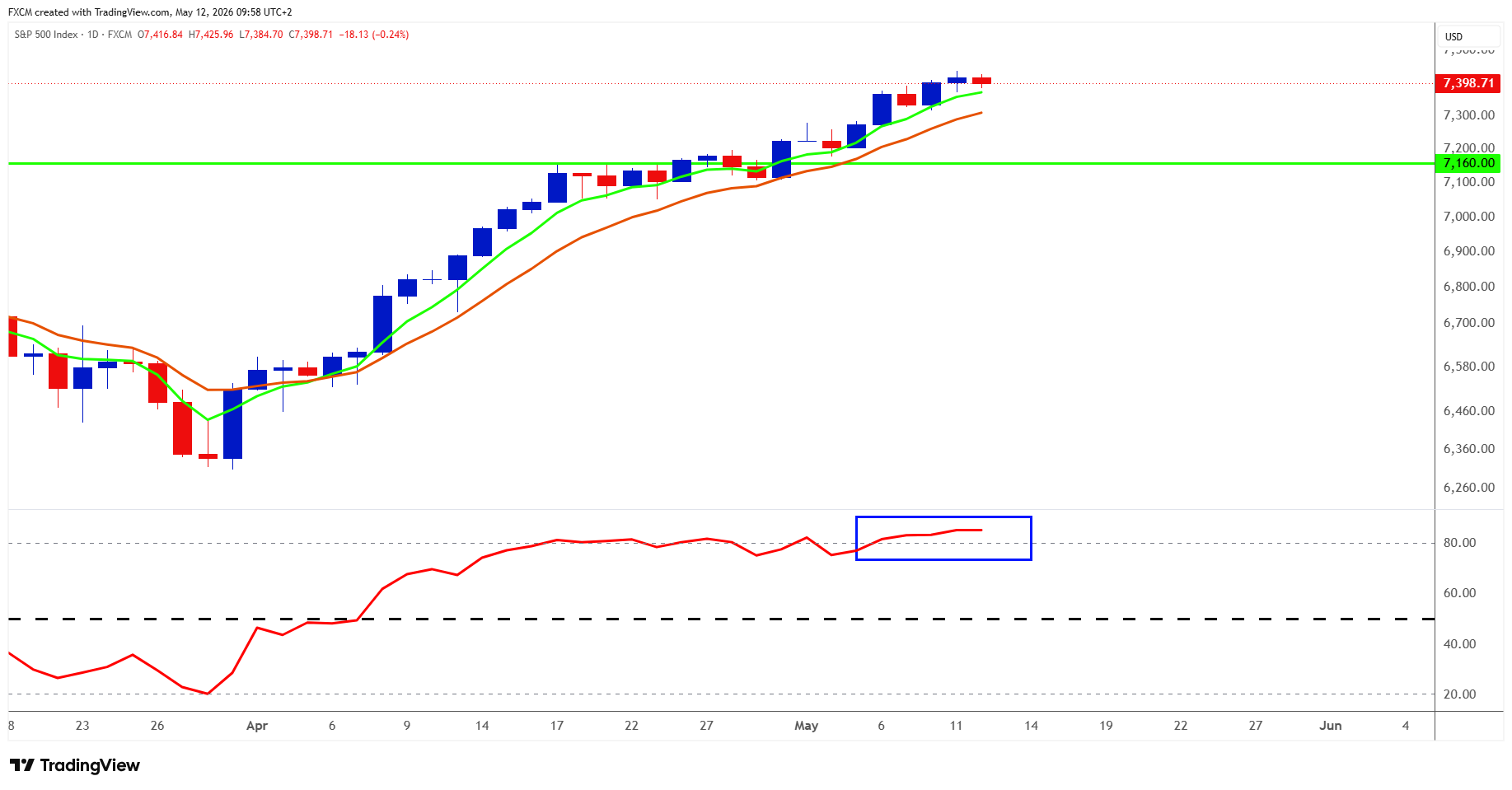
The SPX500 remains fundamentally supported by resilient corporate earnings, AI-driven capital spending, and a US economy that continues to avoid recession. First-quarter earnings have broadly exceeded expectations, particularly across technology and semiconductor-linked companies, helping lift the index to fresh record highs above 7,400.
However, valuations remain elevated, with the Federal Reserve noting that equity multiples are still near the upper end of historical ranges. At the same time, rising oil prices, firmer Treasury yields, and fading expectations for near-term rate cuts are beginning to test investor complacency.
In short, the broader trend remains bullish, but future upside increasingly depends on earnings continuing to justify premium valuations.
The index is up more than 2% so far in May, building on a powerful April rally that saw the index gain nearly 11%. After such a strong run, it is fair to ask when profit-taking might emerge. The RSI has moved back above 80 (blue rectangle), suggesting the market may be stretched in the short term, with the right headline potentially triggering a pullback. Even so, underlying support remains around the 7,160 level, and any dips towards support are likely to attract buyers given the strength of the broader uptrend, until proven otherwise.
Potential Trade Setups
We first highlighted INTC.us on 14 April, and it has delivered extraordinary gains since then. In today's issue, we revisit the stock to assess potential buy-the-dip opportunities within its broader uptrend. We also turn to TSLA.us, which appears to be emerging from a downtrend and is beginning to show more constructive technical characteristics. Finally, we look at AMD.us (initially considered on 21 April), another semiconductor name that is tracing a pattern similar to Intel and may present a comparable opportunity.
Tesla Motors Inc. (TSLA.us)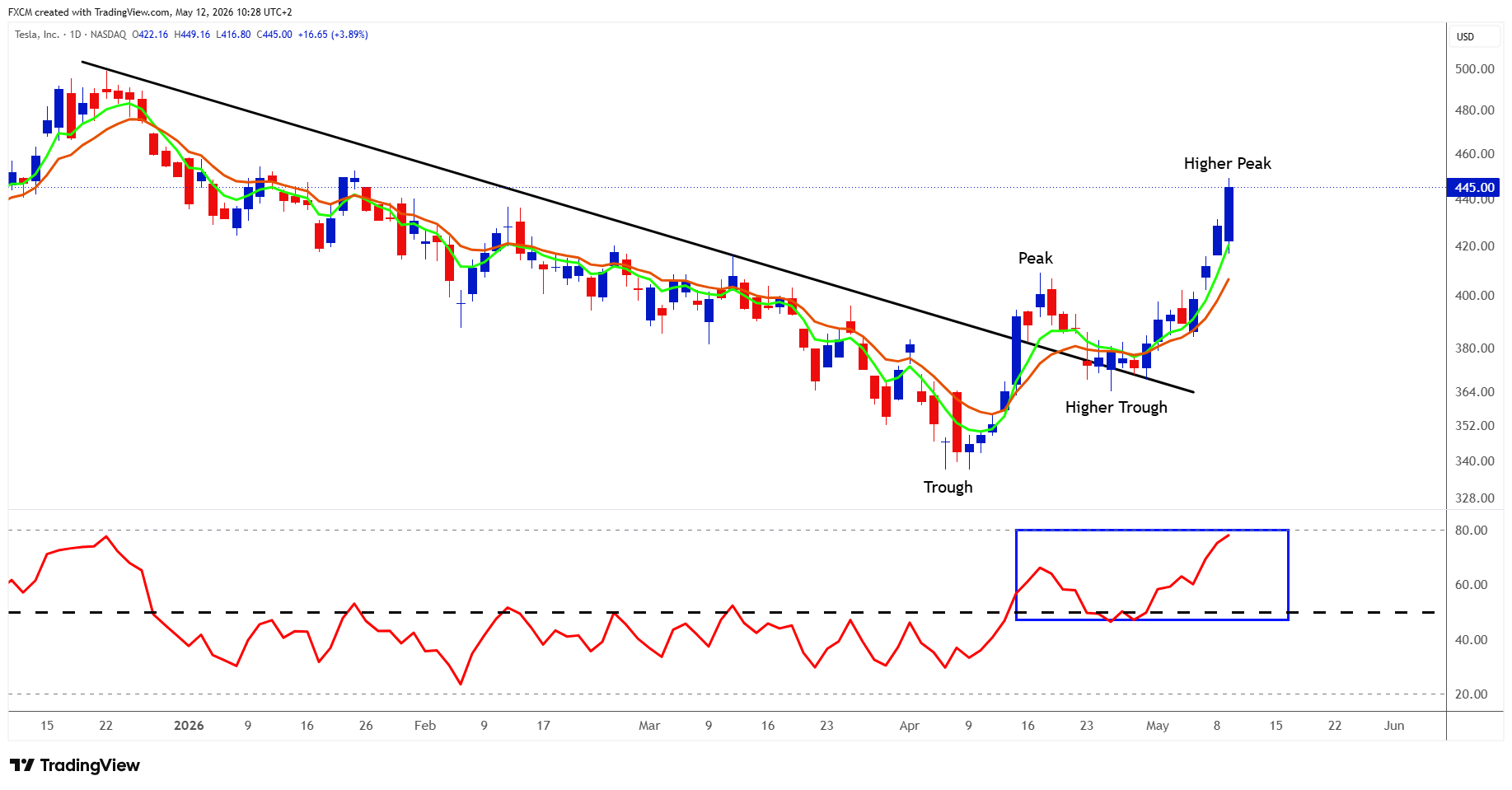
Technical Analysis
- TSLA broke above its downward-sloping black trendline in mid-April.
- Importantly, the RSI remains above 50, pointing to underlying bullish momentum.
- As long as the RSI holds above 50, price action should retain momentum support.
- TSLA has formed a higher trough followed by a higher peak.
- This confirms an uptrend on the daily chart.
- If the trend remains intact, the next phase should be another higher trough.
- If and when that forms, it could present a compelling "buy the dip" opportunity.
Caveat
- If the pattern of higher troughs and higher peaks breaks down, it would be a negative technical development.
- If the RSI falls below 50 and stays there, the bullish momentum signal would likely fade.
Fundamental Perspective
After Tesla's 22 April earnings, the investment case for holding TSLA has arguably become more strategic than ever. The headline numbers were solid: revenue rose 16% year-on-year to $22.39 billion, gross margin improved to 21.1%, and free cash flow came in at $1.44 billion, far better than the market expected. But the real story sits beyond the quarter. Elon Musk has effectively repositioned Tesla from being just an EV manufacturer into an AI, autonomy, robotics, and energy platform, lifting 2026 capital expenditure plans to more than $25 billion to fund robotaxis, custom AI chips, and Optimus. That heavy spending will pressure near-term cash flow, and the core car business still faces stiff competition, but Tesla now has nearly $45 billion in cash to fund that transition. For long-term investors, the question is no longer whether Tesla can sell cars, it is whether it can successfully turn today's EV business into the launchpad for entirely new, higher-margin industries. If Musk executes, current volatility may one day look less like risk and more like early positioning.
Intel (INTC.us)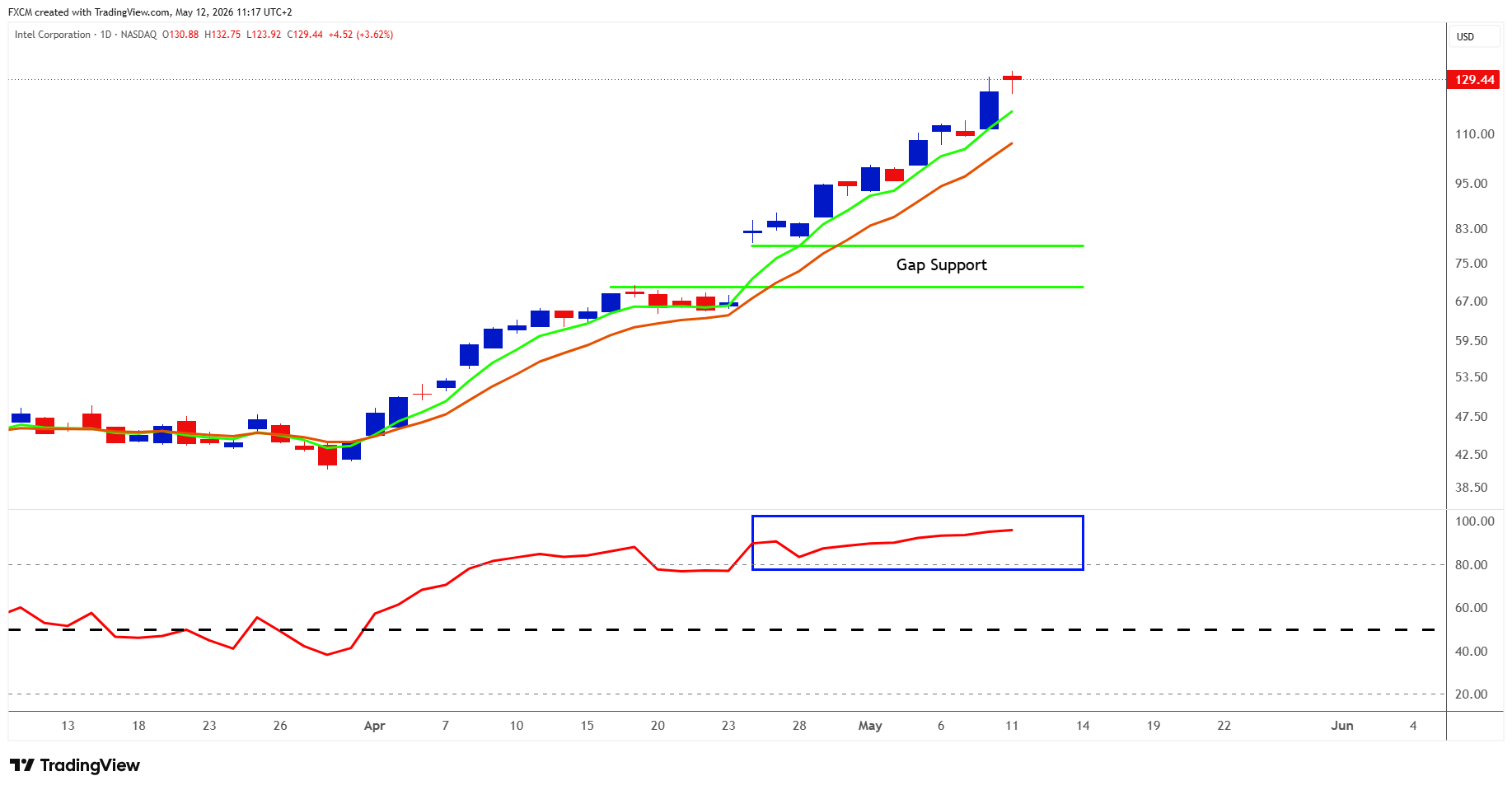
Technical Analysis
- INTC has been on an absolute tear, rising 37% so far in May after a 114% surge in April.
- It is therefore no surprise that the RSI is now deeply overbought (blue rectangle).
- Given the scale of the recent rally, some profit-taking would not be surprising.
- That said, the broader uptrend remains strong, so any pullbacks could present attractive opportunities.
- In this regard, it is worth monitoring key underlying support levels.
- For example, there is notable gap support between 70 and 79.
- If the stock retraces into a support area, it could offer a compelling buy-the-dip setup.
Caveat
- A break below gap support would be a negative technical signal.
- If the RSI falls below 50 and remains there, the strength of the uptrend would come into question.
Fundamental Perspective
The investment case for INTC looks far more credible after its 23 April results. Intel delivered Q1 revenue of $13.6 billion, up 7% year-on-year, while non-GAAP EPS of $0.29 comfortably beat expectations. More importantly, its Data Center and AI business grew 22% to $5.1 billion, foundry revenue rose 16%, and Q2 guidance came in ahead of Wall Street forecasts, suggesting momentum is continuing. Yes, Intel still posted a sizeable GAAP loss because of restructuring and impairment charges, but the market appears to be looking through that and focusing instead on improving execution, rising AI-related demand, and the possibility that Intel's foundry business becomes strategically valuable over time. INTC looks less like a legacy PC story and more like a higher-risk, higher-upside semiconductor turnaround with genuine AI optionality.
Advanced Micro Devices Inc. (AMD.us)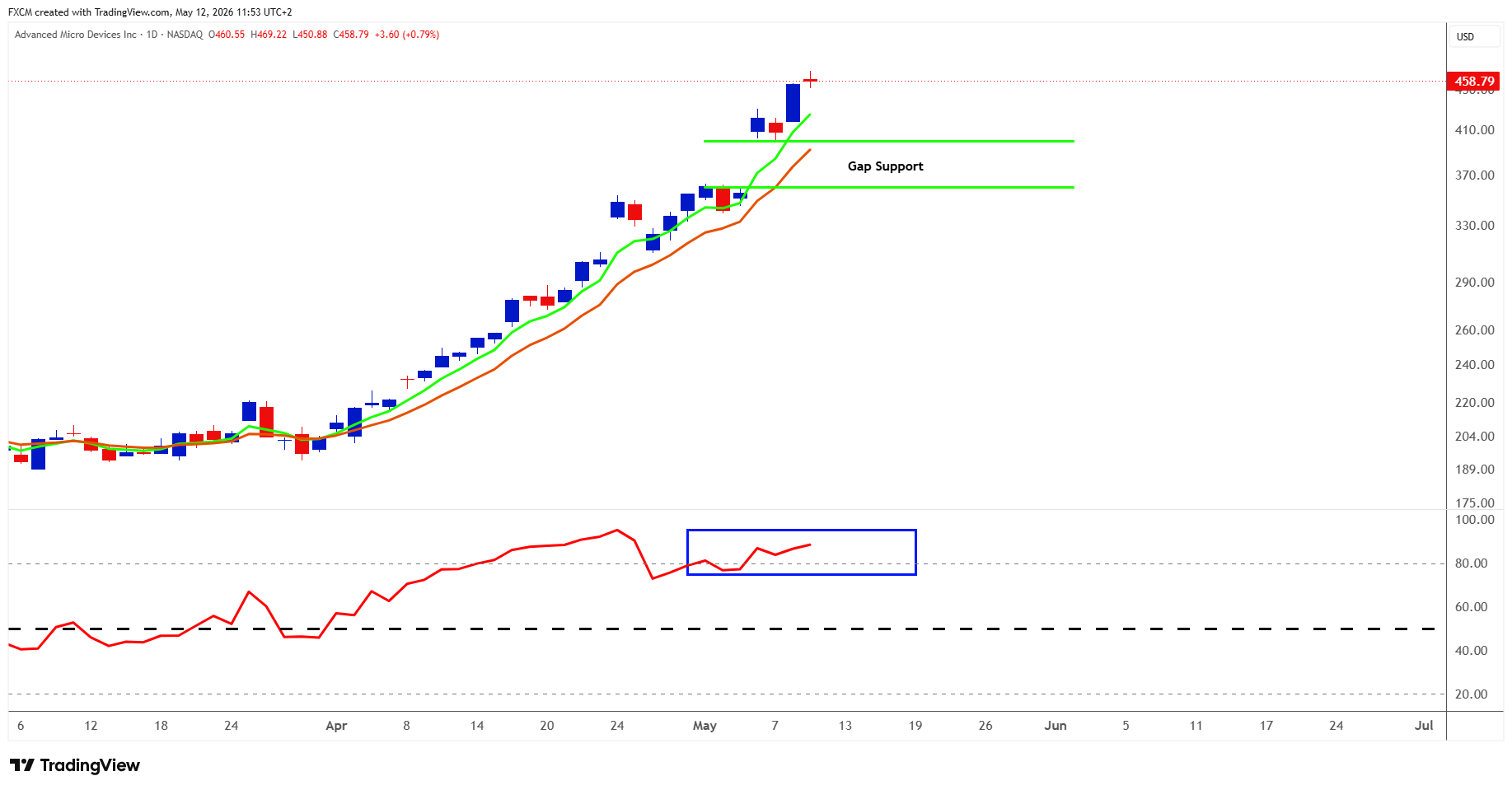
Technical Analysis
- AMD is up nearly 30% so far in May, following a roughly 74% rally in April.
- As a result, the stock is now firmly in overbought territory (blue rectangle).
- After such strong gains, some profit-taking would not be surprising.
- If that happens, key support levels could become attractive.
- In particular, there is notable gap support between 360 and 400.
- A pullback, combined with a normalisation in the RSI, could create a compelling buy-the-dip opportunity.
Caveat
- A break below the 360 level would be a negative technical development.
- If the RSI falls below 50 and remains there, bullish momentum would weaken significantly.
Fundamental Perspective
The investment case for AMD looks increasingly compelling after its 5 May results. AMD delivered Q1 revenue of $10.25 billion, up 38% year-on-year, with its data centre business surging 57% to a record $5.8 billion, driven by strong demand for EPYC server chips and Instinct AI accelerators. Just as importantly, Q2 guidance of $11.2 billion came in ahead of expectations, reinforcing the view that enterprise AI spending remains robust. There are risks, with management warning that gaming and PC demand could soften later this year, but right now the market is focused on where the real growth is coming from. AMD looks less like a traditional chipmaker and more like one of the market's purest ways to gain exposure to the AI infrastructure buildout, with earnings momentum still backing the story.
Hot News, Cold Logic
The ceasefire between the US and Iran looks increasingly fragile after Donald Trump publicly dismissed Tehran's latest peace proposal, raising fresh doubts about whether diplomacy can hold. Iran is reportedly demanding sanctions relief and greater control around the Strait of Hormuz, while Washington is weighing stronger naval involvement if talks collapse. The uncertainty pushed oil prices higher again, adding to global inflation and growth concerns as the conflict drags into its tenth week. With regional tensions rising and key energy routes still under threat, markets remain highly sensitive to any shift in negotiations or military action.
Final Thought
Markets are once again being pulled between resilience and rising macro stress: oil has climbed back above $106 as the US-Iran ceasefire frays and supply fears return, while the once-unstoppable AI rally cools and equities turn more cautious. Yet if recent months have shown anything, it's that bull markets can absorb a great deal of uncertainty, until the macro narrative decisively changes.

Russell Shor
Senior Market Strategist
Russell Shor is a Senior Market Strategist at FXCM, having been promoted to the role in 2025 in recognition of his depth of insight and consistent delivery of high-impact market analysis. He originally joined FXCM in October 2017 as a Senior Market Specialist.
Russell holds an Honours Degree in Economics from the University of South Africa, is a certified FMVA®, and a full member of the Society of Technical Analysts (UK). With over 20 years of experience in financial markets, his work is renowned for its clarity, precision, and strategic value across asset classes.

Any opinions, news, research, analyses, prices, other information, or links to third-party sites contained on this website are provided on an "as-is" basis, as general market commentary and do not constitute investment advice. The market commentary has not been prepared in accordance with legal requirements designed to promote the independence of investment research, and it is therefore not subject to any prohibition on dealing ahead of dissemination. Although this commentary is not produced by an independent source, FXCM takes all sufficient steps to eliminate or prevent any conflicts of interests arising out of the production and dissemination of this communication. The employees of FXCM commit to acting in the clients' best interests and represent their views without misleading, deceiving, or otherwise impairing the clients' ability to make informed investment decisions. For more information about the FXCM's internal organizational and administrative arrangements for the prevention of conflicts, please refer to the Firms' Managing Conflicts Policy. Please ensure that you read and understand our Full Disclaimer and Liability provision concerning the foregoing Information, which can be accessed here.