
AlphaTrack – Strong Earnings Reflected in Strong Market


Thoughtful insights and approachable analysis.
- Micron (MU.us) is combining explosive AI-driven earnings growth with market-leading price momentum, making it one of the most compelling semiconductor stories heading into June earnings.
- Taiwan Semiconductor Manufacturing Company (TSM.us) continues to fire on both fundamentals and momentum, with booming AI-driven earnings, industry-leading margins, and clear technical strength above key 390 support, keeping the broader bull story firmly intact.
- Texas Instruments' (TXN.us) April breakout is backed by both technical momentum and a sharp fundamental re-rating, with industrial recovery, AI-driven data centre demand, and stronger cash flow all reinforcing the bull case.
Quick Market Overview
Markets pulled back to start the week as renewed tensions in the Middle East reminded investors that the Iran conflict remains unresolved, briefly interrupting the earnings-driven rally. The S&P 500 lost 0.4% and the Nasdaq Composite slipped 0.2%, despite both indexes recently hitting record highs. Strong earnings continue to anchor sentiment, with around 80% of companies beating earnings estimates so far. For now, geopolitics can still trigger volatility, but as long as profit growth remains strong, investors appear willing to treat these pullbacks as temporary rather than trend-changing.
General Equity Market Health (SPX500)
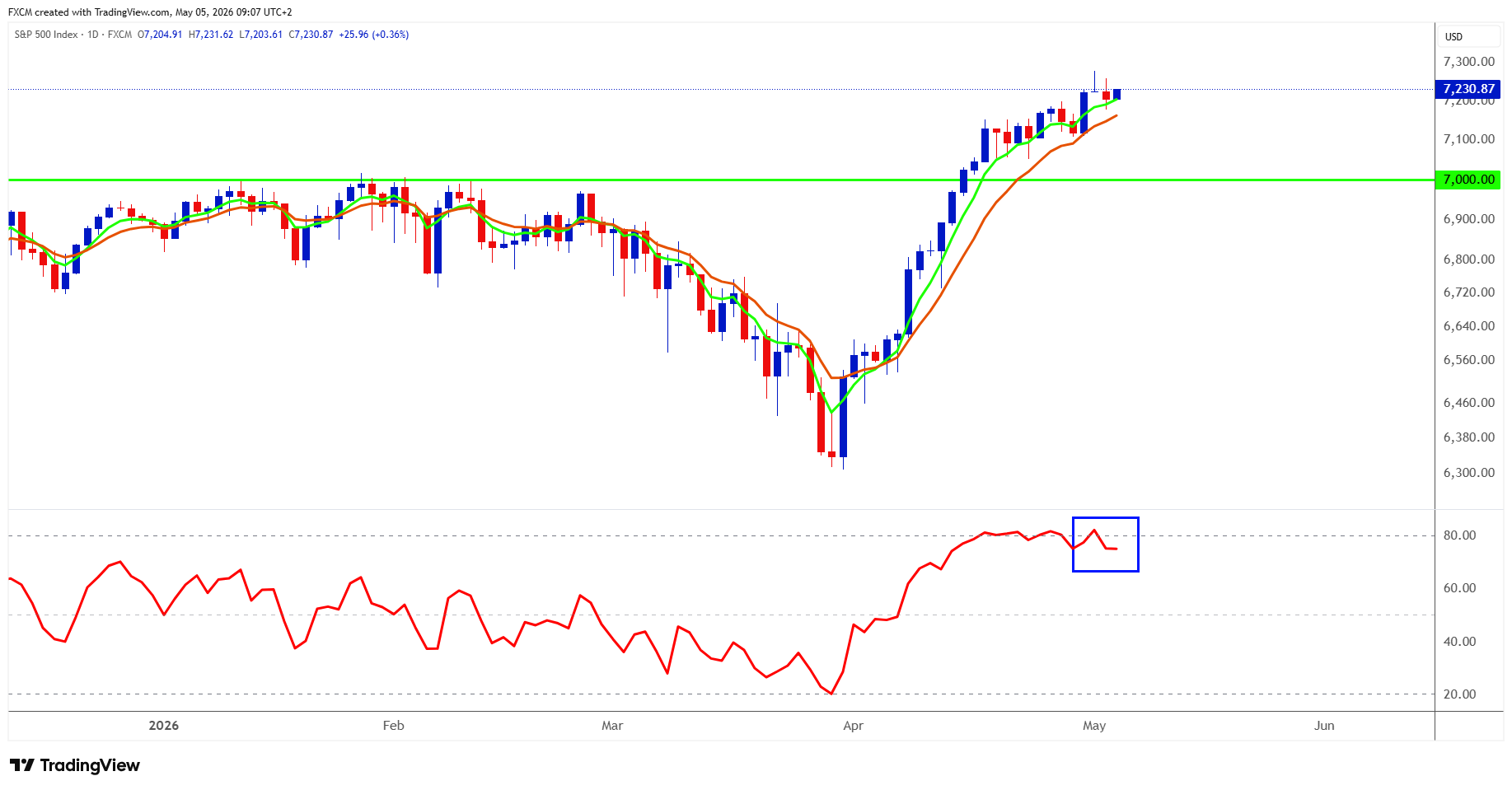
The SPX500 is now trading comfortably above 7,000, hovering around the 7,225 level. Encouragingly, the RSI has moved back below 80, suggesting that overbought conditions have eased somewhat. That implies the near-term technical ceiling may have faded, leaving room for the index to push higher from here.
Earnings have also been supportive, with roughly 80% of reporting companies beating estimates, comfortably above historical norms. In other words, corporate America is generally delivering results ahead of Wall Street's expectations. A major driver behind this strength remains heavy capital expenditure on AI infrastructure, which is helping support broader economic activity and aggregate demand.
That said, there are reasons for caution. While the market-cap weighted SPX500 continues to trade near record highs, the equal-weighted RSP (not shown here) has failed to keep pace. This suggests that a relatively small group of mega-cap stocks is doing much of the heavy lifting, leaving market breadth narrow. If leadership in those names begins to falter, the broader index could quickly lose momentum.
For now, the AI spending story remains the dominant force underpinning the rally. But given how central that narrative has become, any signs of slowing investment, weaker returns, or cracks in confidence could have meaningful consequences for the market.
Potential Trade Setups
Given the narrow market breadth, we're focusing on companies showing strong relative strength as potential trade setups. By that measure, Micron Technology, Taiwan Semiconductor Manufacturing Company, and Texas Instruments stand out, combining technical strength with solid underlying fundamentals.
Micron Technology (MU.us)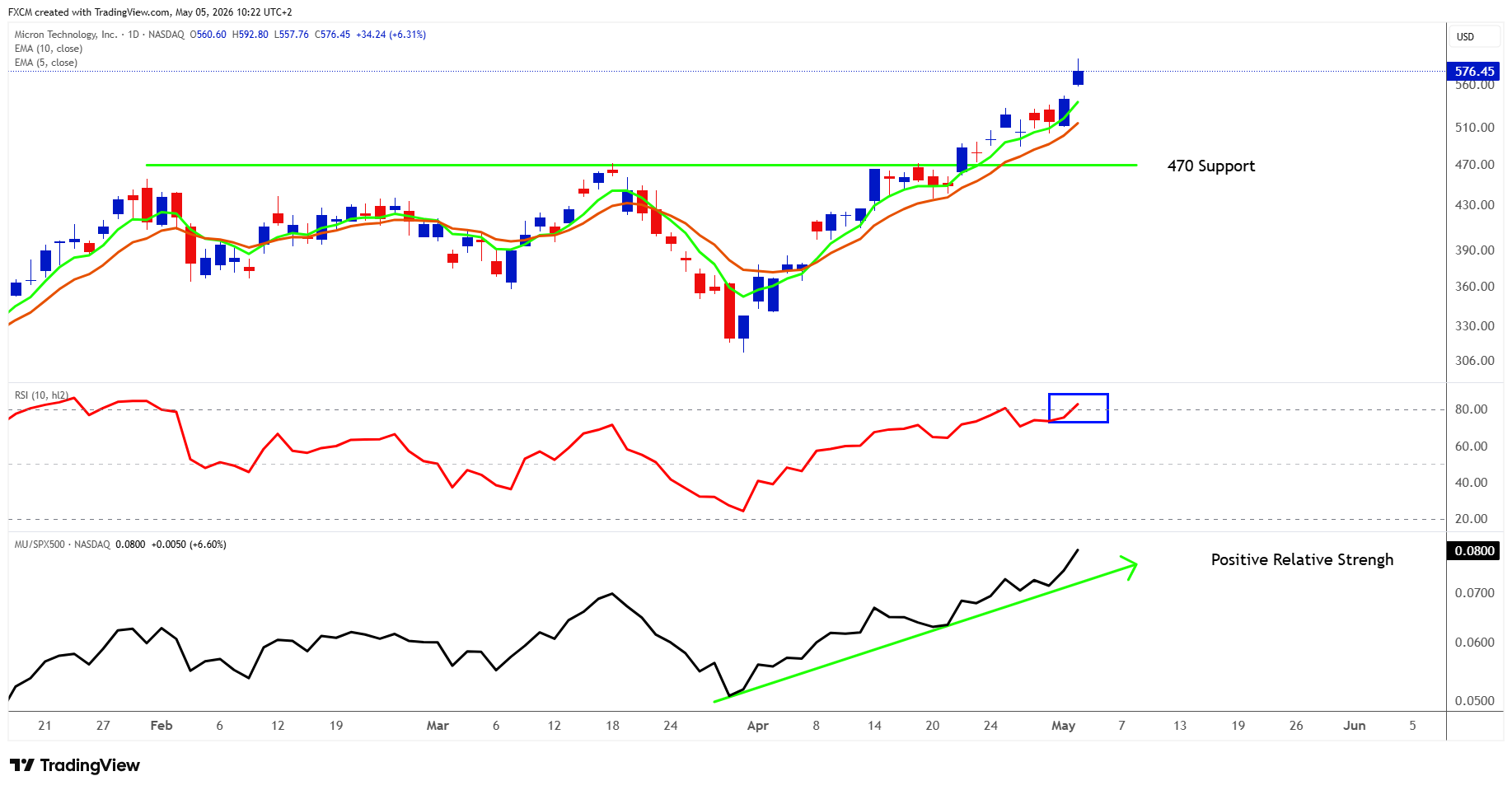
Technical Analysis
- MU is showing strong relative strength and continues to outperform the SPX500.
- Its RSI is above 80, indicating overbought conditions.
- As a result, a period of consolidation or a short-term pullback would not be surprising as momentum cools.
- In that scenario, support levels become increasingly important to watch.
- In particular, the 470 support zone could attract buyers if the stock pulls back.
Caveat
- If the 470 level fails to hold, it would be a negative technical development.
- Moreover, if the RSI drops below 50 and remains there, it would suggest weakening momentum and would challenge the bullish outlook until price action proves otherwise.
Fundamental Perspective
Micron is delivering numbers that look far more like a structural AI infrastructure winner than a traditional memory-cycle stock. In fiscal Q2 2026, Micron reported record revenue of $23.86 billion, up 196% year-on-year, alongside record non-GAAP gross margins of 74.9% and non-GAAP EPS of $12.20, showing just how much operating leverage is flowing through as AI-related demand accelerates.
Management then guided for an even stronger fiscal Q3, targeting roughly $33.5 billion in revenue with gross margins near 81%, implying demand still exceeds supply. The biggest driver is high-bandwidth memory (HBM), DRAM, and NAND demand from hyperscale AI infrastructure, with Micron confirming that its calendar 2026 HBM supply is essentially sold out, giving it unusually strong earnings visibility.
Add $11.9 billion in operating cash flow, a 30% dividend increase, and management commentary that tight supply conditions could persist beyond 2026, and the bull case becomes clear: if AI capital spending from companies like Microsoft, Amazon, and Alphabet remains intact, Micron still looks positioned for further earnings upgrades rather than a typical semiconductor slowdown.
Taiwan Semiconductor Manufacturing Company (TSM.us)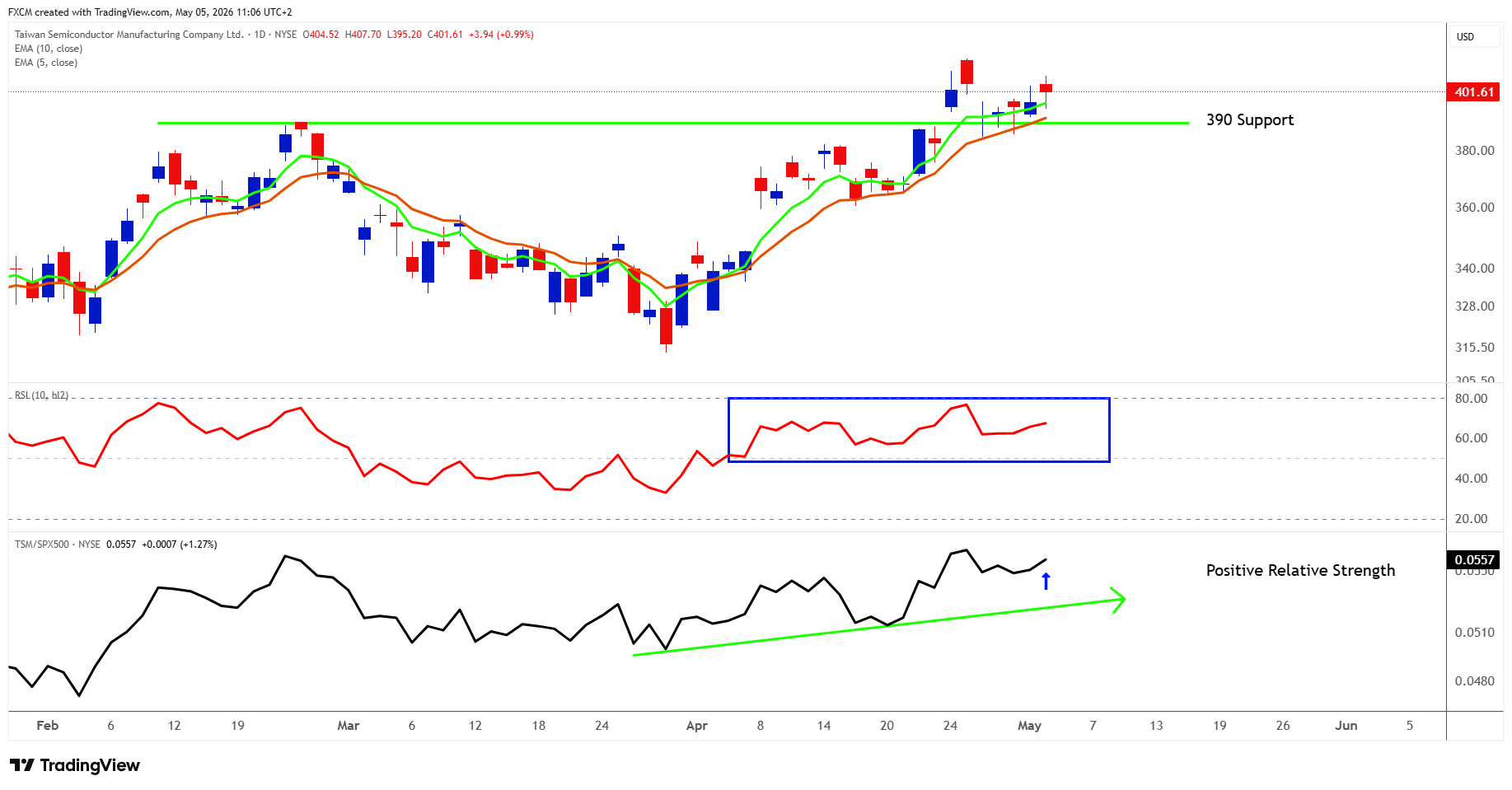
Technical Analysis
- TSM gained more than 17% in April and continues to show positive relative strength.
- Its relative strength has also recently turned higher (blue arrow), which is an encouraging sign.
- The RSI remains above 50, and as long as it holds this level, momentum should continue to support the price.
- TSM's EMAs remain in a bullish formation, with healthy angle and separation.
- The 390 level is acting as an important area of underlying support.
Caveat
- If the 390 support level fails and the price continues lower, it would be a negative technical development.
- Additionally, if the RSI falls below 50 and remains there, it would suggest momentum has turned negative and could call into question how much upside remains.
Fundamental Perspective
The investment case for TSM remains strong following its 16 April results. TSMC delivered Q1 2026 revenue of US$35.9 billion, gross margins of 66.2%, and net profit growth of 58.3% year-on-year, all ahead of expectations and a sign that demand for its most advanced chips remains exceptionally strong.
Management also guided Q2 revenue to US$39.0–40.2 billion and lifted its full-year 2026 growth outlook to above 30% in U.S. dollar terms, supported by what it called "extremely robust" AI demand.
The quality of that growth matters: 7nm and below now make up 74% of wafer revenue, with 3nm alone contributing 25%, showing customers are increasingly relying on TSMC's highest-margin, hardest-to-replicate technologies.
With major clients such as NVIDIA, Apple, and hyperscale AI infrastructure players depending on its manufacturing, TSMC is not just participating in the AI cycle, it is sitting at the centre of it. Risks around geopolitics and heavy capital spending remain, but fundamentally, few companies combine TSMC's pricing power, technology leadership, and earnings visibility.
Texas Instruments Incorporated (TXN.us)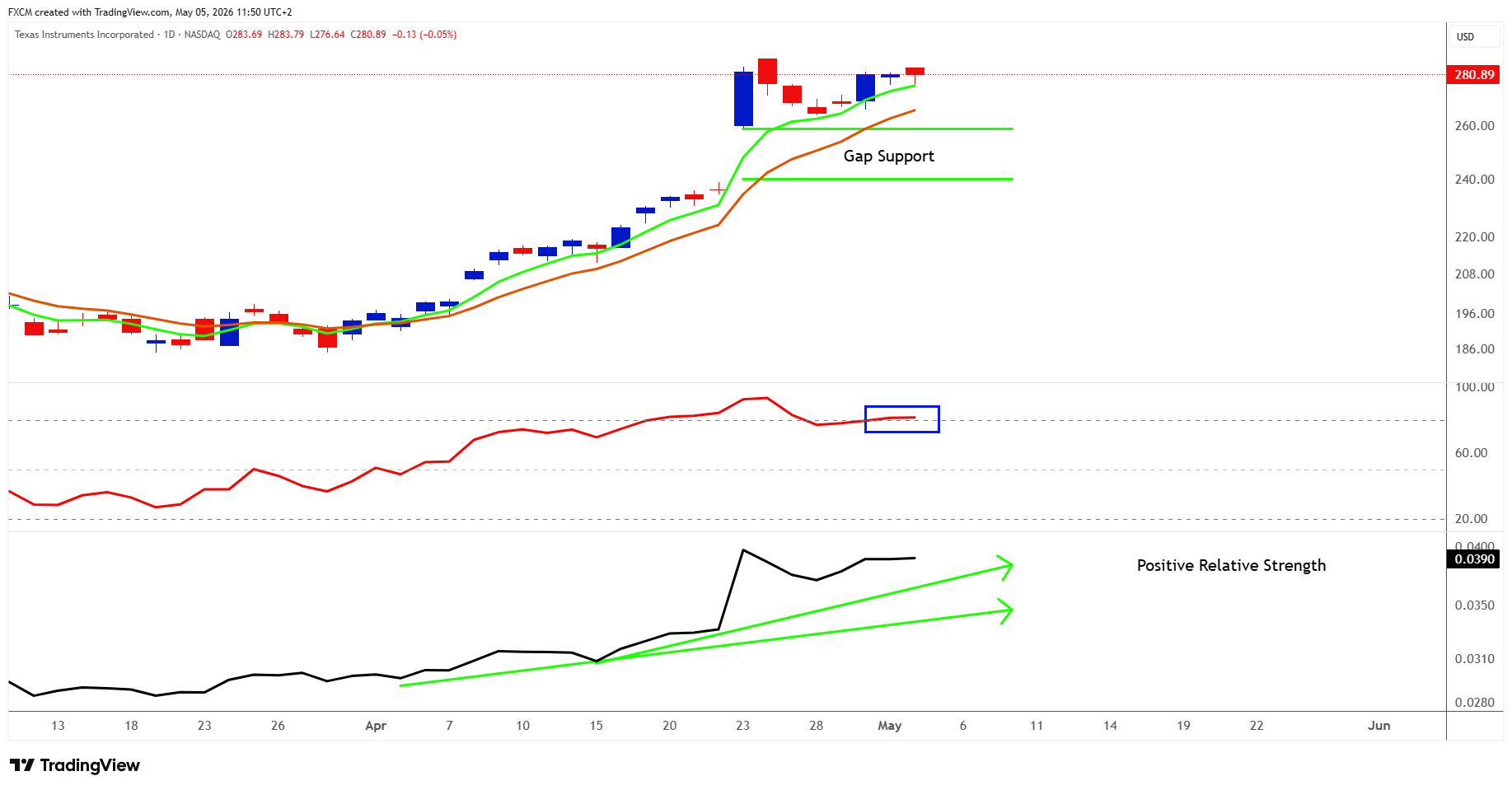
Technical Analysis
- TXN delivered a powerful move in April, gaining more than 44%.
- It is therefore no surprise that the stock is showing strong relative strength.
- However, its RSI is above 80, placing it firmly in overbought territory (blue rectangle).
- As a result, a period of consolidation or a pullback would be normal as the RSI begins to cool.
- Given the stock's strong relative strength, support levels will be particularly important on any retracement.
- In this regard, there is gap support between 240 and 259, following the earnings-driven gap higher after the company reported on 22 April.
- Its EMAs remain in a bullish formation, with healthy angle and separation.
Caveat
- If that earnings gap fully closes, it would be a negative technical development.
- A more significant warning signal would come if the RSI drops below 50 and remains there.
- That would suggest momentum has turned negative and could cap further upside until proven otherwise.
Fundamental Perspective
The investment case for holding TXN after its 22 April results looks fundamentally stronger than it has in several years. The company delivered a genuine earnings inflection, with Q1 revenue rising 19% year-on-year to $4.83 billion, EPS climbing 31% to $1.68, and operating profit jumping 37%, all ahead of expectations.
More importantly, the growth was driven by the right areas: management highlighted industrial revenue up more than 30% and data centre demand up around 90%, showing that TXN is benefiting both from a cyclical recovery in core industrial markets and the broader AI infrastructure buildout.
Cash generation also improved sharply, with trailing 12-month free cash flow reaching $4.35 billion, up 154%, as years of heavy factory investment begin to moderate and the benefits of its 300mm manufacturing footprint start flowing through.
With Q2 guidance also coming in above Wall Street estimates, a diversified customer base across industrial, automotive, communications and enterprise systems, plus a long track record of dividends and buybacks, TXN increasingly looks less like a cyclical chip trade and more like a high-quality compounder entering the next leg of its earnings cycle.
Hot News, Cold Logic
Oil prices remain elevated as markets assess renewed tensions in the Strait of Hormuz, even as Donald Trump tries to calm fears over shipping disruption. UKOil is still trading above $113 a barrel and USOil above $104, keeping both benchmarks sharply higher after a multi-week rally. With roughly 20% of global oil flows passing through Hormuz, even limited military escalation is enough to keep a geopolitical risk premium in the market. In short, traders are still pricing in the risk of a prolonged supply disruption.
Final Thought
Markets are showing resilience in the face of a deepening energy shock: equities remain supported by strong earnings and AI-driven optimism, even as oil holds above $110 and renewed disruption in the Strait of Hormuz keeps inflation and policy risks firmly alive. For now, the broader bull case remains intact, but with geopolitics unresolved and positioning increasingly stretched, this is a market still climbing while quietly carrying the seeds of its next test.

Russell Shor
Senior Market Strategist
Russell Shor is a Senior Market Strategist at FXCM, having been promoted to the role in 2025 in recognition of his depth of insight and consistent delivery of high-impact market analysis. He originally joined FXCM in October 2017 as a Senior Market Specialist.
Russell holds an Honours Degree in Economics from the University of South Africa, is a certified FMVA®, and a full member of the Society of Technical Analysts (UK). With over 20 years of experience in financial markets, his work is renowned for its clarity, precision, and strategic value across asset classes.

Any opinions, news, research, analyses, prices, other information, or links to third-party sites contained on this website are provided on an "as-is" basis, as general market commentary and do not constitute investment advice. The market commentary has not been prepared in accordance with legal requirements designed to promote the independence of investment research, and it is therefore not subject to any prohibition on dealing ahead of dissemination. Although this commentary is not produced by an independent source, FXCM takes all sufficient steps to eliminate or prevent any conflicts of interests arising out of the production and dissemination of this communication. The employees of FXCM commit to acting in the clients' best interests and represent their views without misleading, deceiving, or otherwise impairing the clients' ability to make informed investment decisions. For more information about the FXCM's internal organizational and administrative arrangements for the prevention of conflicts, please refer to the Firms' Managing Conflicts Policy. Please ensure that you read and understand our Full Disclaimer and Liability provision concerning the foregoing Information, which can be accessed here.