Why Gold Is Falling During a War - Is it still a safe haven?
Gold is supposed to go up when the world gets dangerous. That's the shorthand most traders have carried for years, and for much of 2025 it held true. XAU/USD surged 65% over the course of the year, driven by geopolitical uncertainty, central bank buying, and a weakening dollar. It hit an all-time high of $5,589 per ounce in late January 2026.
Then a war started, and gold fell sharply.
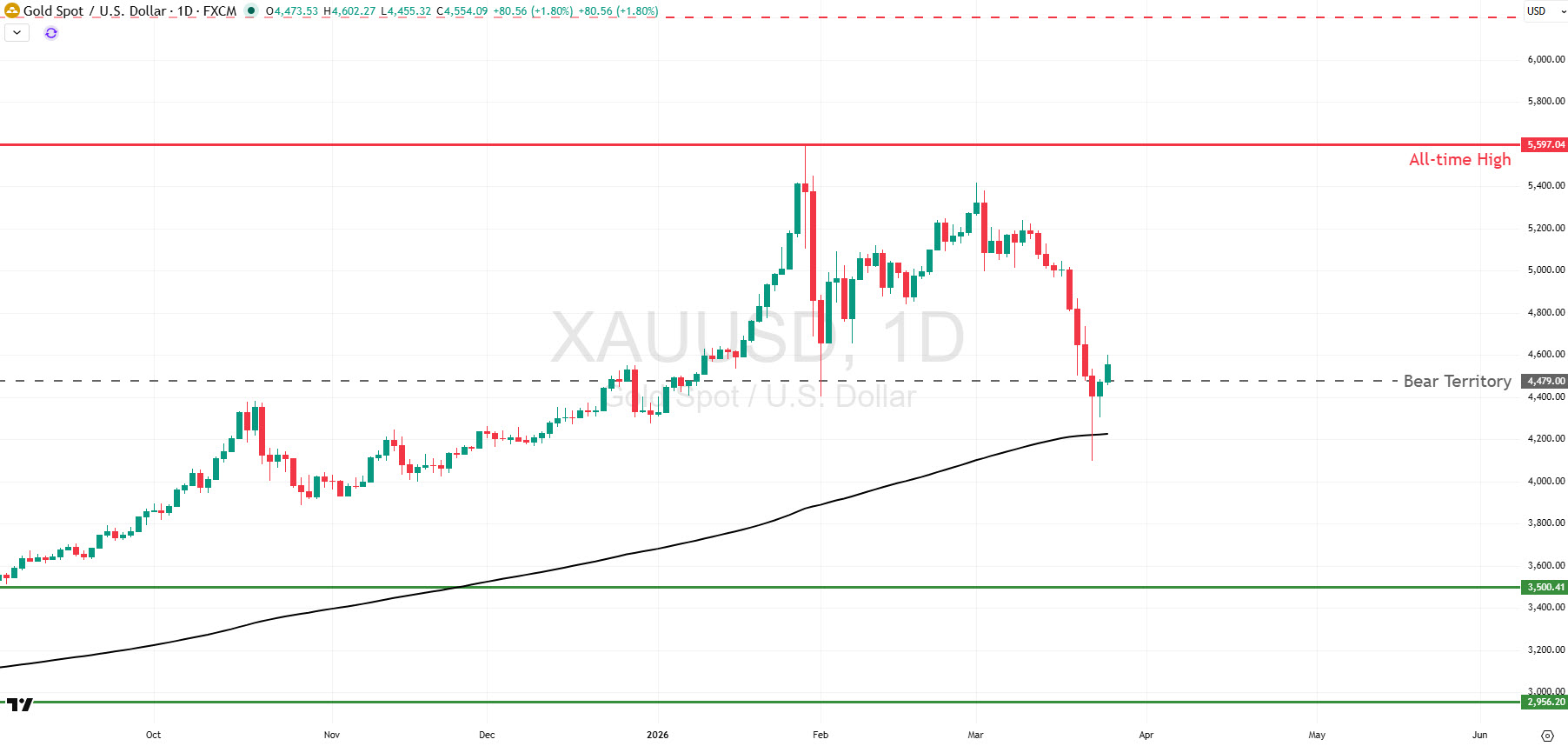
Between 28 February, when the US-Israel strikes on Iran began on, and March 23 gold fell 18%, hitting a low of $4,226.50. It also posted its worst weekly loss in 15 years. For traders watching the price move against what felt like obvious safe-haven logic, it raises a legitimate question: what's actually going on?
The three main reasons gold is falling
1. The war is stoking inflation
This is the key mechanism most people miss. Gold often tracks real yields, interest rates after adjusting for inflation, more closely than it tracks inflation headlines on their own. Surging energy prices (USOil) from the Middle East conflict are prompting central banks across the globe to rethink the outlook for interest rates. The Fed shifted to a more hawkish direction in March due to inflationary risk, and Chair Powell dismissed rate cuts if progress on inflation is not made. The 10-year Treasury yield jumped, and the Dollar Index climbed, and gold, a non-yielding asset whose bull thesis rested on falling real yields and a weakening dollar, repriced accordingly.
2. The dollar is winning
Gold's decline reflects investors prioritising cash-like safety and easy access to dollars. That pattern has appeared in past crises, when gold initially fell as markets rushed to hold dollars instead. The US dollar has rebounded this month, making gold, which is priced in dollars, relatively more expensive for international investors.
3. Crowded trade + liquidity flush
There's another unglamorous reason gold is falling: it has become crowded. Gold had already staged a historic run into early 2026. When a trade gets that popular, reversals can be sharp. In this kind of environment, a shock doesn't always trigger new buying, sometimes it pushes investors to lock in gains. What we're seeing isn't a rejection of gold's fundamentals, it's financial investors reducing risk across the board. Fast-moving, leveraged funds are facing higher borrowing costs, and gold is liquid enough to sell quickly. That's driving the price, not a change in the underlying case for the metal.
This phase is known as a classic "liquidity flush". Gold's recent slide has been driven partly by forced selling, as investors scrambled for quick cash to offset war-related losses elsewhere in their portfolios.
What this means for the longer-term picture
None of the structural reasons gold ran from $2,600 to over $5,500 in twelve months have fundamentally changed, and institutional forecasts, JPMorgan at $6,300* 1, Goldman Sachs at $6,000 for year-end 2, remain in place, with both banks characterising the current selloff as a tactical correction within a longer bull trend.
Central bank demand is expected to remain elevated, around 585 tonnes per quarter on average in 2026 3. The structural case, de-dollarisation, US fiscal deficits, geopolitical uncertainty, hasn't changed. Markets are adjusting to a new rate reality, not abandoning gold. There's a meaningful difference between the two.
But the current episode is a useful reminder that safe-haven assets don't operate on a simple rule. Gold's relationship with fear, inflation, and rates is conditional, it depends on the type of crisis, the central bank response it triggers, and the positioning of the market at the time.
Understanding those conditions doesn't change what gold is. But it does change how you read it.