
Value Investing and Growth Investing


People buy shares for much the same reason. They hope that the businesses behind them will create wealth over time. Where they expect to find that wealth, however, can differ considerably. Value investors look for shares trading below a sensible estimate of what the underlying business is worth. Growth investors concentrate on companies that may increase sales, profits and cash flows faster than average. Both approaches can work, but they ask different questions, carry different risks and test an investor's patience in different ways.
Understanding Value Investing
Value investing begins with a simple distinction. A share's market price is not necessarily the same as the value of the business behind it. A profitable, financially sound company can fall out of favour after disappointing results, during an industry downturn or simply because pessimism has gone too far. If its share price drops below a careful estimate of underlying value, an opportunity may emerge. Benjamin Graham described the protective gap between those two figures as a margin of safety. Buying with a meaningful discount does not prevent losses, but it gives the investor more room when an estimate is wrong or the company encounters an unexpected setback.
Value investors commonly examine measures such as the price-to-earnings ratio, dividend yield, balance-sheet strength and the stability of past profits. These figures are useful, but they are not proof that a share is genuinely cheap. A low price-to-earnings ratio may reflect profits that are about to fall, while a high dividend yield may precede a dividend cut. This is the value trap: a share appears inexpensive because the business is deteriorating. Successful value investing therefore requires more than buying the lowest-priced shares. The investor must judge whether earnings are sustainable, whether debt is manageable and whether the market's pessimism is temporary rather than justified.
Understanding Growth Investing
Growth investing looks for opportunity in a different place. Rather than waiting for an overlooked company to regain favour, the investor searches for a business with room to expand for many years. It might serve a large and growing market, possess a durable competitive advantage, introduce an important product or reinvest its profits at attractive rates. Investors will often accept a higher valuation for these qualities because sustained earnings growth can eventually justify a price that initially looks expensive. Even the strongest growth shares do not rise in a straight line, however. Their prices can stall or fall when excitement moves faster than the company's financial progress.
The danger is that expectations become too demanding. A fine business can still be a poor investment when its price assumes almost flawless execution. If a highly valued company slows even modestly, investors may cut both their earnings forecasts and the multiple they are prepared to pay, causing a sharp decline in the share price. Growth investing therefore requires discipline about price as well as confidence in the company. The investor must decide whether expansion is durable or merely part of a temporary boom, and how much future success is already built into the valuation.
The two styles can also respond differently as economic conditions change. Value shares are commonly associated with mature or cyclical industries and may perform strongly when depressed expectations improve. Growth shares can be especially sensitive to interest rates when much of their estimated worth depends on profits expected far into the future. Rising discount rates reduce the present value of those projected earnings, although actual market performance also depends on inflation, profits and investor expectations. These patterns are tendencies, not laws. A portfolio confined to one style can lag for years when market leadership shifts, which is one reason diversification and a long time horizon remain important.
Intel Case Study
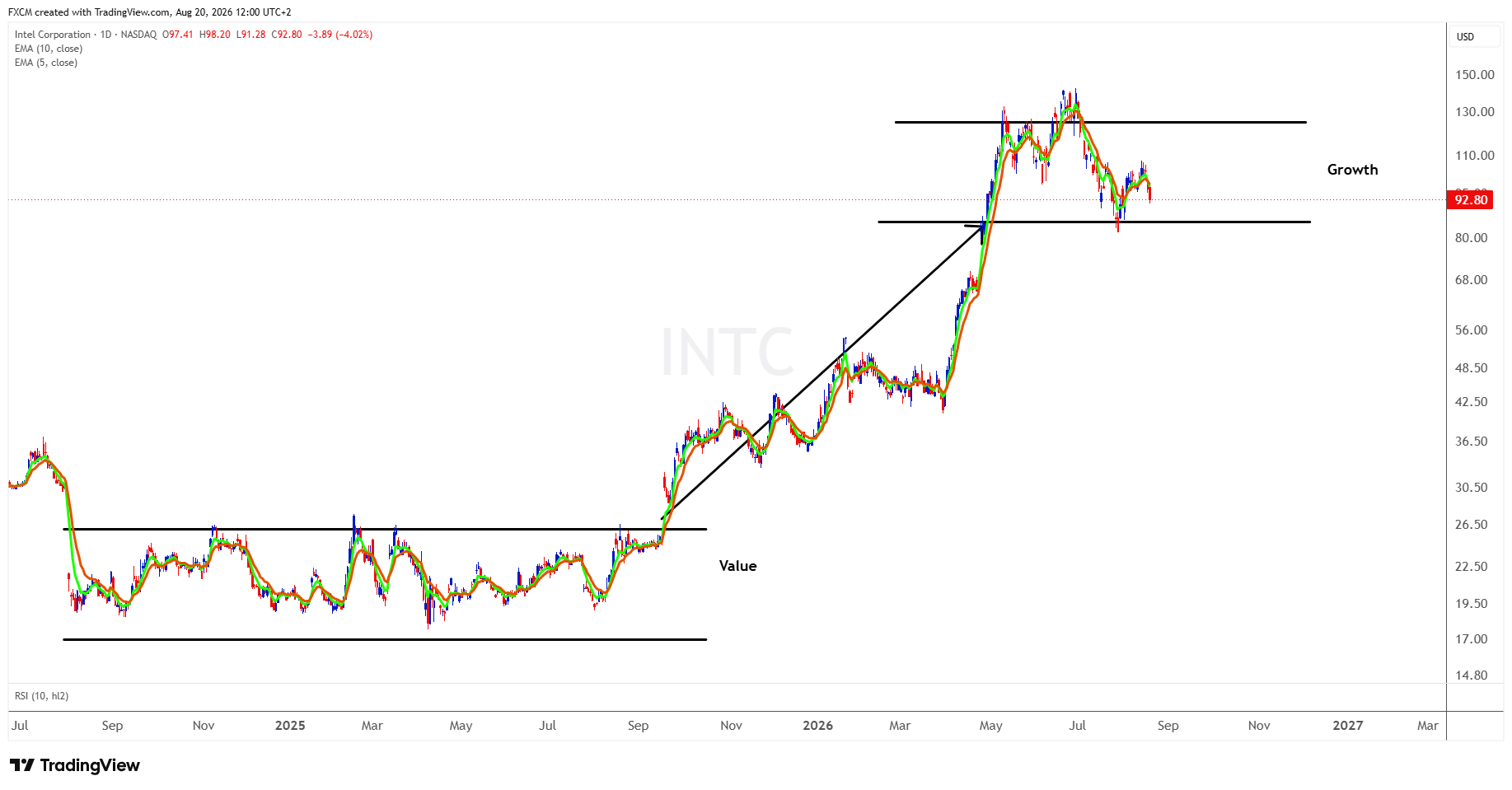
Intel offers a useful real-world illustration of how the market's view of a share can change. As the chart shows, the price spent much of August 2024 to September 2025 between roughly $17 and $26. This long base was consistent with widespread concern about weak profitability, costly manufacturing investment, competitive pressure and the uncertain turnaround. However, value investors were accumulating at this stage.
By 2026, the market was telling a very different story, transforming Intel from a deeply out-of-favour business in the value accumulation phase into a growth-rated turnaround. Intel's second-quarter revenue rose 25% year on year to $16.1 billion. By August 2026, the share price had climbed to $92.80, more than four times its August 2024 close.
Intel's journey shows how a share can move from a value-style chart pattern to a growth-oriented market rating.
Bringing Value and Growth Together
In practice, the boundary between value and growth is blurred. A value investor still needs to think about whether earnings can recover or endure, while a growth investor must decide whether the expected expansion is worth the price being asked. A fast-growing company may become a value opportunity after a market decline, just as an established value share may find a new source of growth. The labels are useful because they highlight different priorities, but they do not divide the market into two entirely separate camps.
Neither approach is automatically better. Value investing seeks protection through a margin of safety, but patience helps only when the underlying business remains sound. Growth investing offers access to companies capable of compounding strongly, but enthusiasm can lead to overconfidence and excessive valuations. The better fit is the approach an investor can apply consistently, with realistic assumptions and sensible risk controls. In the end, the label matters less than the work. It depends on understanding the company, assessing its prospects carefully and avoiding paying too much for its shares.

Russell Shor
Senior Market Strategist
Russell Shor is a Senior Market Strategist at FXCM, having been promoted to the role in 2025 in recognition of his depth of insight and consistent delivery of high-impact market analysis. He originally joined FXCM in October 2017 as a Senior Market Specialist.
Russell holds an Honours Degree in Economics from the University of South Africa, is a certified FMVA®, and a full member of the Society of Technical Analysts (UK). With over 20 years of experience in financial markets, his work is renowned for its clarity, precision, and strategic value across asset classes.

Any opinions, news, research, analyses, prices, other information, or links to third-party sites contained on this website are provided on an "as-is" basis, as general market commentary and do not constitute investment advice. The market commentary has not been prepared in accordance with legal requirements designed to promote the independence of investment research, and it is therefore not subject to any prohibition on dealing ahead of dissemination. Although this commentary is not produced by an independent source, FXCM takes all sufficient steps to eliminate or prevent any conflicts of interests arising out of the production and dissemination of this communication. The employees of FXCM commit to acting in the clients' best interests and represent their views without misleading, deceiving, or otherwise impairing the clients' ability to make informed investment decisions. For more information about the FXCM's internal organizational and administrative arrangements for the prevention of conflicts, please refer to the Firms' Managing Conflicts Policy. Please ensure that you read and understand our Full Disclaimer and Liability provision concerning the foregoing Information, which can be accessed here.