
Nvidia earnings preview: AI leadership faces structural challenges


The physical AI buildout marches on
The latest earnings from tech giants anchoring the AI buildout show that semiconductor demand remains locked in an aggressive upward trajectory. TSMC, the world's largest foundry, revised its full-year guidance upward, targeting capex of $60-$64 billion and revenue growth exceeding 40%, with CEO C.C. Wei speaking of an "AI megatrend" [1]. ASML, another crucial chokepoint of the global chip supply chain, raised its revenue outlook to €43-45 billion and CEO Christophe Fouquet noted "huge demand" coming from AI [2]. Echoing these corporate developments, the WSTS projects the global semiconductor market will grow by 89.9% this year and expand further in 2027. [3]
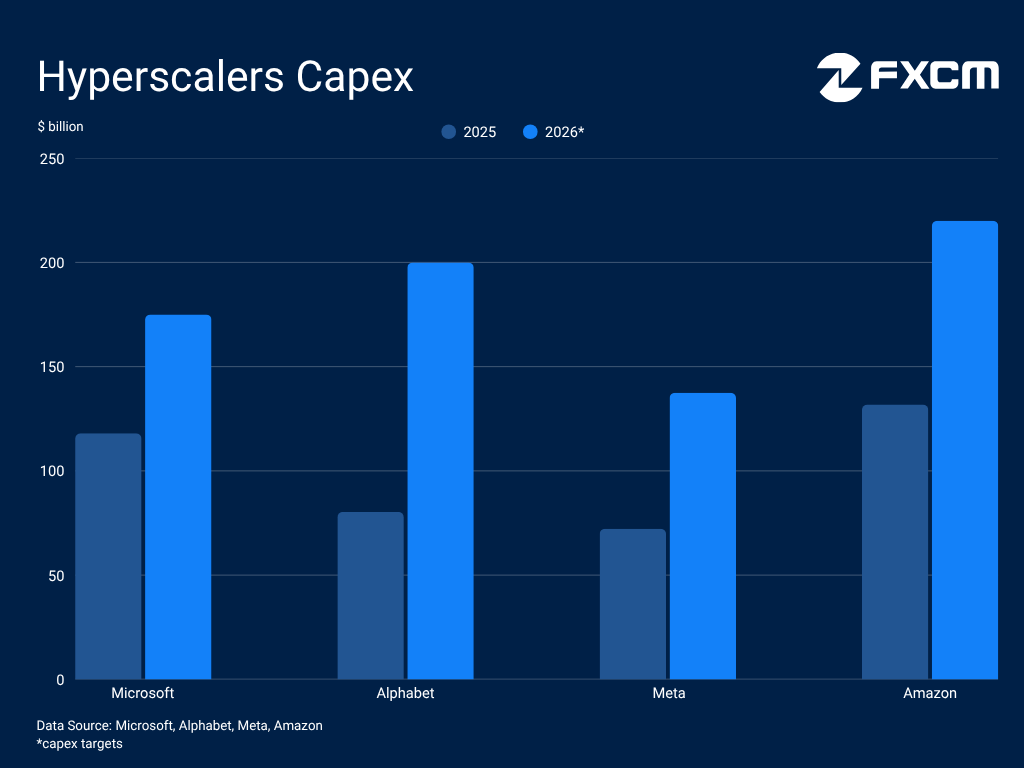
Crucially, the hyperscalers funding the physical AI buildout posted strong results and cloud growth while ramping up capital expenditure. Microsoft, Amazon.com, Alphabet and Meta Platforms expect to spend a combined $720-$745 billion this year, up 78.96%-85.2% y/y. Goldman Sachs estimates that cumulative global AI spending, encompassing power generation, state-of-the-art data centres and specialised compute, will more than double to exceed $1.6 trillion by 2031. [4]
Nvidia remains a key beneficiary and driver of the AI boom
The AI boom would not be possible without Nvidia's chips, which remain the go-to solution for AI compute, attracting a large share of hyperscaler investment. JP Morgan recently estimated that 26% of their capex goes straight to Nvidia's bottom line [5]. Nvidia is deepening these ties and its AI leadership, as underscored by its long-term partnership with Meta including the latest Vera Rubin architecture, [6] and Amazon's commitment to deploy more than one million NVIDIA GPUs this year. [7]
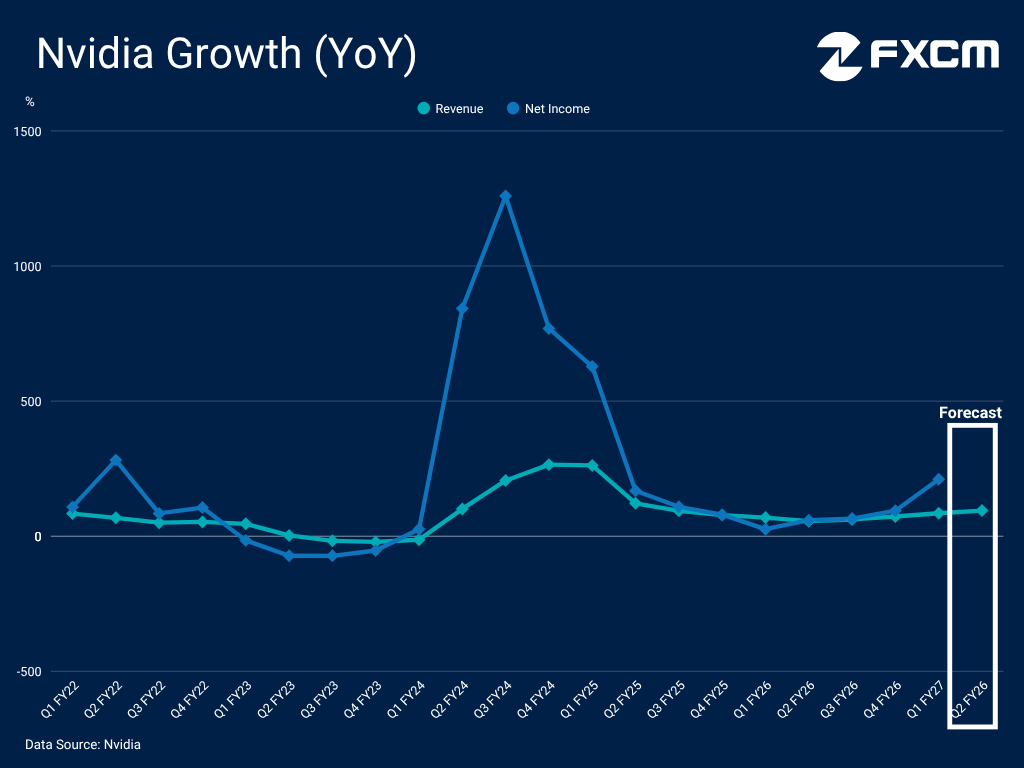
Nvidia's AI leadership translates directly into record top and bottom lines. Net income rose to $38.52 billion in the April quarter (Q1 FY27), up 210.63% y/y, marking the fastest pace in almost five years. Revenues also continued to accelerate, rising 85.2% y/y to $81.615 billion. Sales from hyperscalers were the main driver, jumping 115% y/y to $37.869 billion and accounting for nearly half of total revenue. [8]
Management's forward guidance underscores strong confidence ahead of the July quarter results due Wednesday August 26. The company expects revenue growth of around 94.9% y/y and steady gross margins of 74.9%.
The rise of CPUs and custom silicon threatens Nvidia's dominance
The tech industry is undergoing a structural shift, moving away from GPU-heavy model training toward CPU-centric inference and Agentic AI workloads. Gartner estimates a 139% surge in enterprise AI agent software investments this year [9], with inference spending projected to outpace training for the first time [10]. This transition naturally benefits traditional CPU heavyweights like Intel and Advanced Micro Devices Inc (AMD).
Beyond the CPU rebound, a pivot toward custom silicon by major hyperscalers is also chipping away at Nvidia's moat. Meta is partnering with Broadcom to co-develop custom accelerators to handle its soaring compute demands[11], while Microsoft continues to scale its Maia 200 silicon to power OpenAI models [12]. Google is aggressively scaling its TPUs, having begun selling such hardware directly to external clients ahead of a 2027 ramp [13]. Meanwhile, Amazon CEO Andy Jassy highlighted during the Q2 earnings call that adoption of its Trainium chips is accelerating rapidly, backed by multi-year commitments from top AI labs like Anthropic and OpenAI. [14]
Although these developments establish credible alternatives, they are unlikely to unseat Nvidia in the near term given the immense stickiness of its vertically integrated ecosystem. Recognising Agentic workflows and real-time execution as the next major inflection points, Nvidia is launching its own in-house CPU architecture, highlighted by the incoming Vera Rubin platform's deep CPU-GPU integration. Furthermore, hyperscalers remain deeply tethered to its architecture. Amazon leadership notes customers will run on NVIDIA hardware for the foreseeable future and Microsoft is among the first cloud providers slated to deploy next-generation Vera Rubin.
Headwinds from a challenging macro-geopolitical environment
Unresolved conflicts in the Middle East continue to sustain elevated energy prices and strain supply chains for key semiconductor materials like helium, compounding pressures from an ongoing memory crunch. While these cost increases are unlikely to derail Nvidia's primary sales volumes, rising input expenses could pressure hardware margins.
Broader macroeconomic headwinds, including inflation, tariffs and volatile energy costs, raise the expense of building and operating data centres, potentially testing the resolve of tech giants to sustain their massive infrastructure buildout. This broader economic strain also threatens to dampen corporate advertising budgets while compressing demand for consumer electronics.
Meanwhile, Sino-US trade friction remains a persistent source of volatility. US export controls on advanced technology have accelerated Beijing's drive toward technological self-reliance, with domestic players like Baidu and Alibaba aggressively expanding their own AI silicon initiatives. Although US licensing permissions have allowed limited shipments of chips like the H200, navigating compliance and local demand remains complex.
However, this China risk is already fully absorbed into Nvidia's baseline operations. Because management does not include any China revenue in its forward projections, any sales realised in the region would serve as pure upside. Coupled with an unstoppable wave of AI proliferation, overall chip demand remains exceptionally robust.
Debt, circular financing and concentration risks
Hyperscalers and chip makers are locked in a spending spree to keep pace with rivals in the AI arms race and rapidly scale capacity to meet soaring demand. However, funding these massive capital expenditures increasingly requires burning cash, issuing new stock or tapping debt markets, all of which raise concerns about ultimate returns on investment. Alphabet recently spooked investors after posting negative free cash flow, while Intel's $20 billion stock offering intensified equity dilution concerns. [15]
Perhaps more concerning is the degree to which these investments are fuelled by debt issuance, particularly against a backdrop of elevated bond yields that drive up the cost of capital. The US Treasury's bond buyback announcement this week has helped bring them down [16], but ballooning government deficits and the Fed's reluctance to tighten could keep long-term yields elevated. According to the Securities Industry and Financial Markets Association, US corporate bond issuance has risen 26.9% y/y in the first seven months of the year [17]. NVIDIA is among the companies tapping the debt market for the first time in five years, with a $25 billion bond sale. [18]
Meanwhile, the flurry of cross-investments and commercial partnerships among AI firms has sparked growing concerns over circular financing, evoking dot-com era parallels and casting doubt on the organic nature of market demand. Circular financing typically occurs when a corporation funds its customer, which in turn buys products from that same corporation. NVIDIA is at the epicentre of this debate, with $105 billion in financing for an OpenAI data centre in Ohio renewing such concerns. [19]
At the same time, Nvidia faces concentration risks, as the physical AI buildout is primarily driven by a small group of companies, with nearly half of its Q1 FY27 sales coming from hyperscalers. Its most recent annual report revealed that just two direct customers accounted for 36% of total revenue, a heavier dependence than the previous year when three customers represented 34%. Its manufacturing supply chain also remains tightly bottlenecked in Asia, relying heavily on partners like TSMC and SK Hynix. [20]
Despite these legitimate vulnerabilities, fears may be overstated. Nvidia has an extremely healthy balance sheet with substantial cash generation. It is not issuing debt out of financial distress but to strategically lock in long-dated capital and preserve cash reserves while maintaining flexibility for massive future supply commitments. Demand for its products is real, with massive backlogs, while the $500 billion financing platform with global financial institutions alleviates circular financing concerns. Furthermore, rising sovereign AI adoption provides valuable geographic diversification, while a tightly integrated software ecosystem builds a strong buffer against customer concentration risks.
Nvidia leadership and mounting risks intersect ahead of earnings
As NVIDIA approaches its August 26 earnings report, its AI leadership persists, continuing to attract massive demand as the infrastructure buildout keeps expanding. Based on these favourable dynamics, the company expects faster revenue growth and strong margins. A strong report and upbeat guidance, coupled with a currently reasonable valuation, would reaffirm the stock's bullish bias and open the door to new all-time highs.
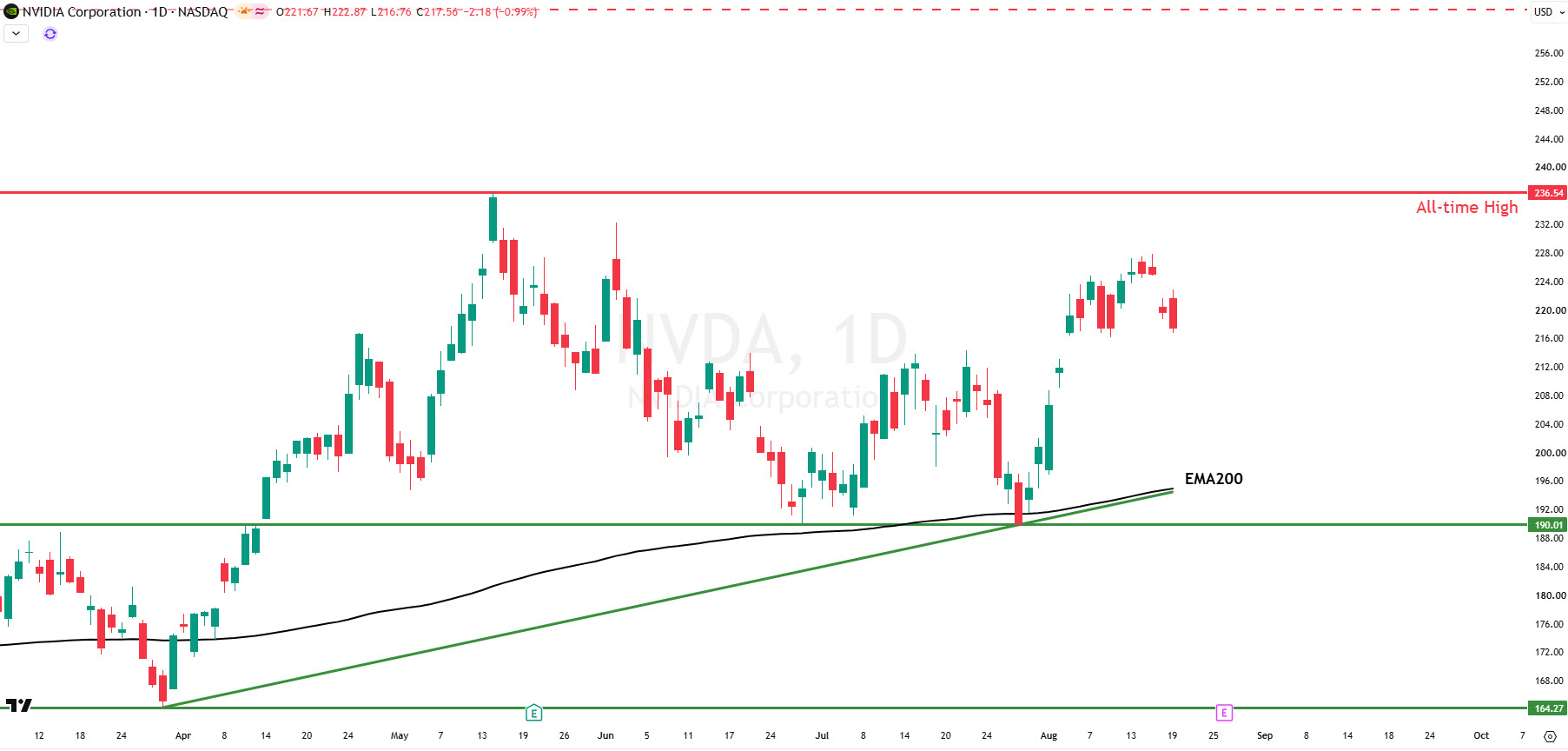
Chart source: www.tradingview.com
Nonetheless, expectations remain high and broader sentiment stays volatile. Any underwhelming outcome could erode conviction and push the stock lower, challenging the bullish outlook. Trade restrictions, circular financing risks and return on investment prospects are among the hurdles markets are grappling with.
Furthermore, capital rotation has shifted across the broader semiconductor landscape this year, with memory and CPU makers like Micron and Intel emerging as top SPX500 performers. Whether Nvidia can brush off these structural anxieties will depend entirely on whether its upcoming guidance proves that real-world monetisation is keeping pace with its historic multi-billion-dollar buildout.

Nikos Tzabouras
Senior Financial Editorial Writer
Nikos Tzabouras is a graduate of the Department of International & European Economic Studies at the Athens University of Economics and Business. With extensive experience in market analysis and a strong foundation in international relations, he brings a unique perspective to financial markets. Nikos emphasizes not only technical analysis but also on fundamentals and the growing influence of geopolitics on financial trends.
As a Senior Financial Editorial Writer, he delivers comprehensive and forward-looking insights across a wide range of asset classes, including equities, commodities, and currencies. His work explores how macroeconomic events, political developments, and global policies impact market dynamics, providing readers with a deeper understanding of both short-term movements and long-term trends.

Any opinions, news, research, analyses, prices, other information, or links to third-party sites contained on this website are provided on an "as-is" basis, as general market commentary and do not constitute investment advice. The market commentary has not been prepared in accordance with legal requirements designed to promote the independence of investment research, and it is therefore not subject to any prohibition on dealing ahead of dissemination. Although this commentary is not produced by an independent source, FXCM takes all sufficient steps to eliminate or prevent any conflicts of interests arising out of the production and dissemination of this communication. The employees of FXCM commit to acting in the clients' best interests and represent their views without misleading, deceiving, or otherwise impairing the clients' ability to make informed investment decisions. For more information about the FXCM's internal organizational and administrative arrangements for the prevention of conflicts, please refer to the Firms' Managing Conflicts Policy. Please ensure that you read and understand our Full Disclaimer and Liability provision concerning the foregoing Information, which can be accessed here.