
Xiaomi struggles deepen in Q2 2026, but EVs remain a bright spot


Xiaomi Q2 2026 results - key takeaways
Revenues dropped 6.1% y/y to RMB 108.9 billion (around $16.16 billion), marking a second straight contraction, while adjusted profits were down 27.6% y/y in the third consecutive decline.
The declines were fuelled by rising costs from the global memory chip crunch, declining smartphone sales and lower EV selling prices.
EV deliveries picked up pace with a 28.2% y/y increase to 104,199 units amid continued appeal.
Xiaomi exposed to rising memory costs
The massive physical AI buildout has sparked unprecedented demand for memory solutions, driving severe shortages and a spike in prices that is pushing up costs for smartphone makers like Xiaomi. Conventional DRAM and NAND Flash prices shot up at least 55% in the second quarter according to TrendForce [1], while Micron's CEO said the company does "not have line of sight" as to when supply will catch up with demand. [2]
The memory crunch is causing significant headwinds for the smartphone market, pushing prices higher and weighing on sales, with global shipments dropping 6% y/y in the second quarter according to Omdia [3]. Apple raised device prices due to what CEO Cook described as "exponential" increases in memory costs, expecting acquisition costs to keep rising. [4]
Apple occupies a higher price tier and commands greater margins, which cushion it from higher input costs, but Xiaomi is far more vulnerable to the memory chip crunch. Omdia noted that half of Xiaomi's Q2 sales were priced below $200, making it the "most exposed" of the top five makers, while Xiaomi's management acknowledged higher costs as a key business headwind. [5]
Smartphone weakness persists, EVs continue to grow
The memory chip disruptions add to broader headwinds from global macro-geopolitical uncertainty and persistent inflation weighing on demand for discretionary items like consumer electronics, while consumption in China remains weak. As a result, Xiaomi's global smartphone shipments dropped 26.4% y/y in Q2, the second consecutive contraction.
Although its core smartphone business struggled, the successful EV entry continues to support top-line growth. Smart Electric Vehicle deliveries expanded 28.2% y/y to 104,199 units as demand for its YU7 sedan and newer SUV configurations remains robust. Crucially, Xiaomi is actively expanding its lineup, showcasing the SkyNomad EREV series with deliveries slated for September.
Despite its aggressive manufacturing ramp-up, Xiaomi faces an uphill battle to hit its 550,000 annual delivery target, which requires roughly doubling sales volume in the second half of the year. The domestic market remains highly competitive and promotional, with rivals boosting exports to find growth. Although Xiaomi is gearing up for an overseas automotive expansion, it does not expect to enter the European market before H2 2027.
Revenues and profits extend their decline
Xiaomi posted a challenging financial scorecard for the second quarter as it grappled with a difficult external environment. Total revenues dropped 6.1% y/y and adjusted net profit slumped 42.6% y/y to RMB 6.219 billion, marking the third consecutive quarterly decline in profitability.
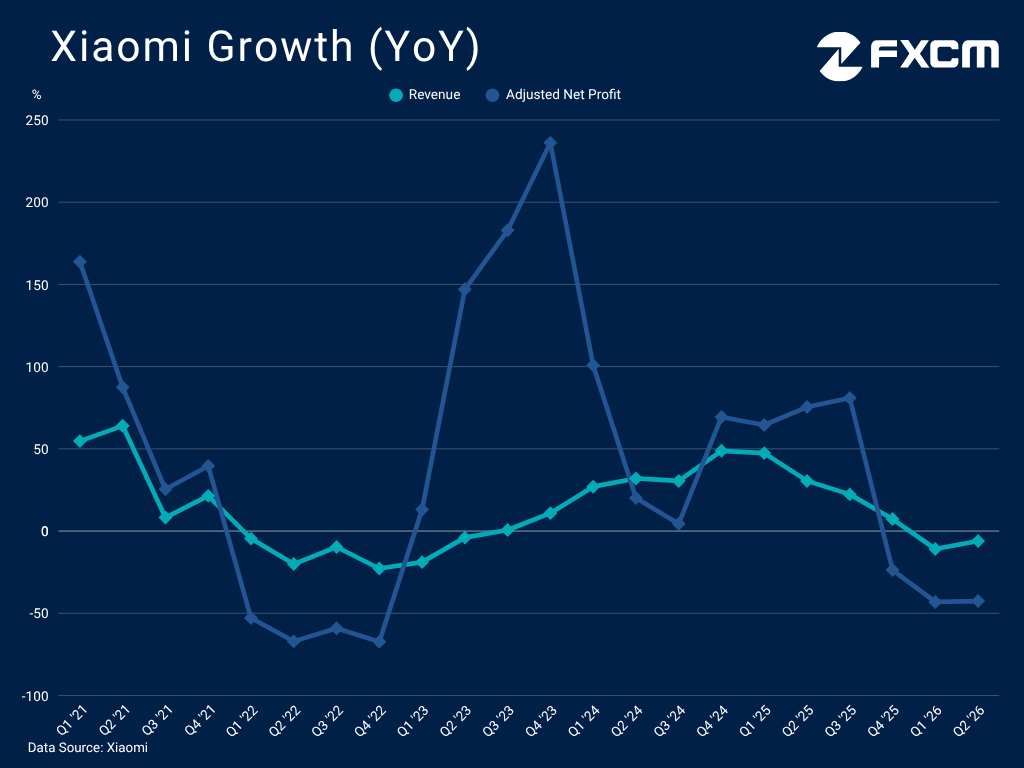
The top and bottom-line weakness was driven by dwindling smartphone volume, soaring memory expenses and lower vehicle average selling prices, while the pricing strategy for its newest SkyNomad series has temporarily weighed on profitability.
Still, the EV segment remains a key growth engine, generating RMB 24.9 billion, up 17.1% y/y across EVs, AI and new initiatives, according to corporate financial disclosures. While core smartphone revenues contracted, Xiaomi's long-term premiumisation strategy, which saw premium smartphone shipments in mainland China reach 32.1% of sales, partially insulated the hardware division from a sharper decline. Moreover, management siad that the situation around memory chips is now controllbale, hinting that the worse may be over.
Xiaomi near-term risks clash with structural tailwinds
Looking ahead, Xiaomi's near-term trajectory will be heavily shaped by severe macro and structural hurdles that threaten to prolong margin compression. The lingering wave of component inflation, driven by the broader memory chip crunch, could continue to squeeze profitability. Xiaomi is disproportionately affected due to its high exposure in lower-priced device tiers where costs cannot easily be passed on to consumers.
Moreover, execution risk looms large over its automotive division. Hitting the ambitious 550,000 annual vehicle delivery target requires a near-doubling of sales in the second half of the year. Compounding these pressures are a hyper-competitive domestic EV landscape in China, persistent softness in consumer discretionary spending and a European expansion timeline that keeps overseas automotive growth restricted for the near term.
However, Xiaomi's strategic initiatives and R&D investments put it in a strong position to navigate these adversities. The EV entry has been an unequivocal success, quickly becoming a crucial growth engine that also helps diversify an already wide product portfolio and enhances ecosystem integration, while smartphone premiumization supports profits.
The underlying consumer base continues to expand, with global monthly active users hitting a record 766.5 million and connected devices surpassing 1.16 billion for the first time. Moreover, proprietary software and hardware architectures, including its custom silicon roadmap, the Kunlun technical platform and deep HyperOS AI integration, underscore its technological ambition and growing independence.

Nikos Tzabouras
Senior Financial Editorial Writer
Nikos Tzabouras is a graduate of the Department of International & European Economic Studies at the Athens University of Economics and Business. With extensive experience in market analysis and a strong foundation in international relations, he brings a unique perspective to financial markets. Nikos emphasizes not only technical analysis but also on fundamentals and the growing influence of geopolitics on financial trends.
As a Senior Financial Editorial Writer, he delivers comprehensive and forward-looking insights across a wide range of asset classes, including equities, commodities, and currencies. His work explores how macroeconomic events, political developments, and global policies impact market dynamics, providing readers with a deeper understanding of both short-term movements and long-term trends.
References
| Retrieved 18 Aug 2026 https://www.trendforce.com/presscenter/news/20260703-13134.html | |
| Retrieved 18 Aug 2026 https://investors.micron.com/static-files/631b1a32-5537-46ae-8f40-82e42fc79dfe | |
| Retrieved 18 Aug 2026 https://omdia.tech.informa.com/pr/2026/july/global-smartphone-shipments-fell-6percent-in-2q26-as-supply-side-pressures-reshape-the-market | |
| Retrieved 18 Aug 2026 https://www.apple.com/newsroom/pdfs/fy2026q3/FY26_Q3_Consolidated_Financial_Statements.pdf | |
| Retrieved 02 Oct 2026 https://ir.mi.com/static-files/4a85fc36-8a6d-4c24-b45b-b18d5d162e6c |

Any opinions, news, research, analyses, prices, other information, or links to third-party sites contained on this website are provided on an "as-is" basis, as general market commentary and do not constitute investment advice. The market commentary has not been prepared in accordance with legal requirements designed to promote the independence of investment research, and it is therefore not subject to any prohibition on dealing ahead of dissemination. Although this commentary is not produced by an independent source, FXCM takes all sufficient steps to eliminate or prevent any conflicts of interests arising out of the production and dissemination of this communication. The employees of FXCM commit to acting in the clients' best interests and represent their views without misleading, deceiving, or otherwise impairing the clients' ability to make informed investment decisions. For more information about the FXCM's internal organizational and administrative arrangements for the prevention of conflicts, please refer to the Firms' Managing Conflicts Policy. Please ensure that you read and understand our Full Disclaimer and Liability provision concerning the foregoing Information, which can be accessed here.