
USD/JPY tepid amid FX intervention risks after Fed and BoJ hikes


USD/JPY analysis
The Federal Reserve unanimously raised interest rates for the first time in nearly three years to support a "timelier" return of inflation to the 2% target [1]. Chair Warsh said that with the decision the central bank removed a "dose of accommodation", while reiterating his pledge to restore price stability. The updated dot plot showed broad support for one more hike within the year, with markets pricing in such an outcome. Policymakers have strong justification to pursue more tightening due to stubborn inflation, driven by elevated oil prices from the ongoing Middle East conflict, AI investments and chip shortages, ballooning defence spending and other factors.
The Bank of Japan also raised rates last week to 1.25% [2], in what is now its fastest tightening cycle since 1990. Officials pointed to more moves ahead to ensure inflation does not exceed their 2% target, with persistent pressures deriving largely from the AI boom and a weak currency pushing up import prices. However, two members dissented in favour of a hold in a 7-2 vote split, and Governor Ueda maintained a cautious tone during his press conference, giving the decision a dovish spin. There are strong reasons for maintaining this reserved approach. Rates are now on the cusp of neutral and lingering risks remain to an otherwise solid economy. Moreover, aggressive hikes could clash with government priorities and push yields even higher, raising borrowing and debt-servicing costs.
The BoJ decision sparked a jump in the Nikkei on Friday and in USD/JPY, which recorded its best week in almost a year. The Fed clearly outhawked its Japanese counterpart and without any overt signals from the BoJ around an accelerated hiking path ahead, the yen remains vulnerable to continued weakness. The rate differential is still sizeable, which could continue to support the carry trade and a further USD/JPY advance, keeping the path open to new multi-decade highs. On the other hand, the pair faces pushback at the EMA200. A rejection would keep the immediate bias to the downside and the 2026 lows in play, while volatility is set to persist.
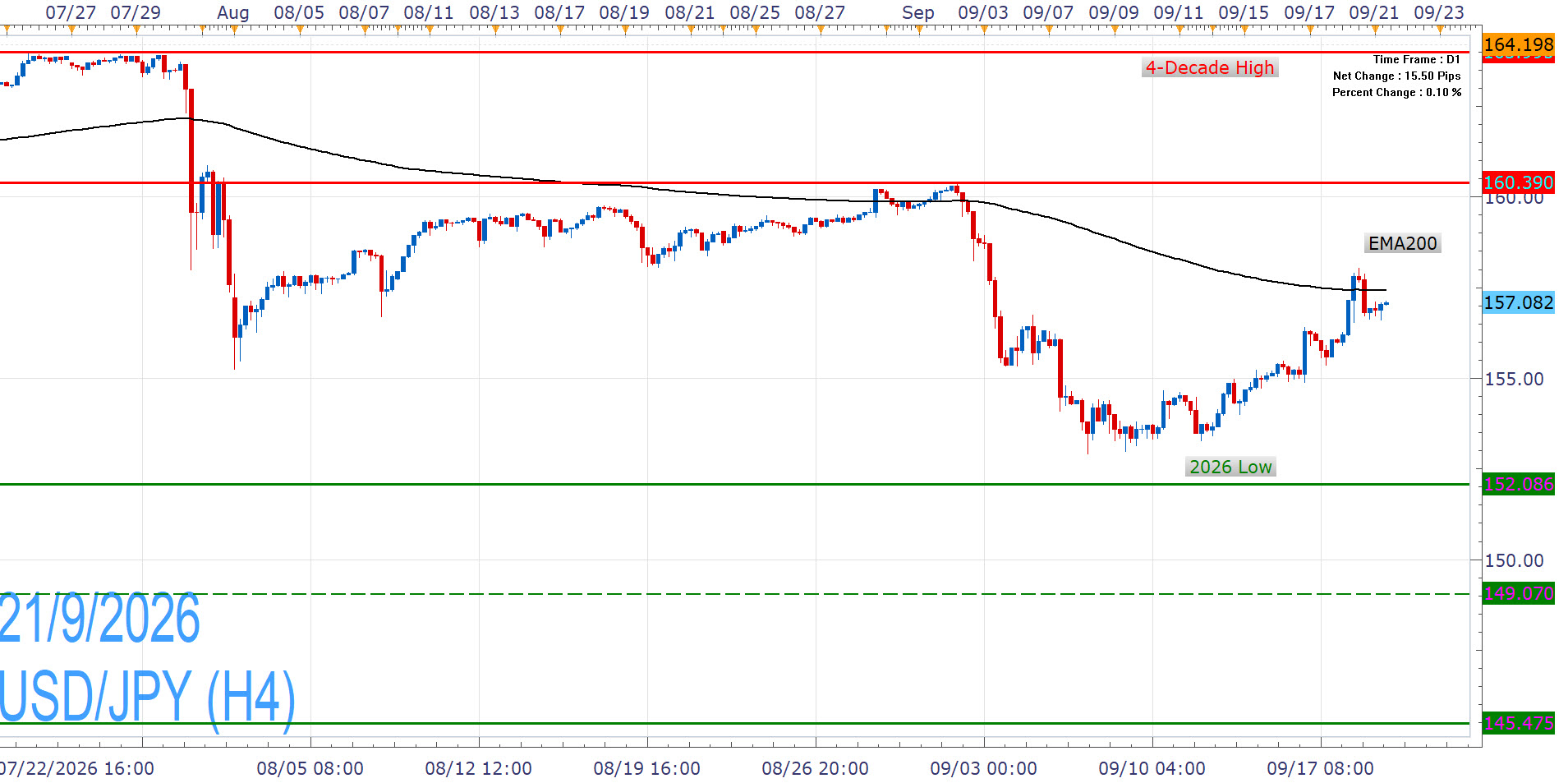
Despite a hawkish outcome, Chair Warsh maintained his no forward guidance, no reaction function stance, while not embracing the hawkish economic projections in which he does not participate. On the BoJ side, policymakers reiterated their tightening bias, keeping more hikes in play.
Crucially, the trajectory of USD/JPY is also tied to FX intervention risks. The current Silver Week holiday period provides opportune timing for further FX operations, as typically thin liquidity can amplify their impact. The Nikkei reported that the BoJ carried out rate checks right after the decision [3], a prelude to potential currency buying, which led the pair to erase some of its gains. Japanese authorities have managed to build some deterrence against yen shorts, pushing USD/JPY down from its four-decade highs. They have confirmed over ¥27 trillion worth of operations [4], [5] this year, including a rare joint intervention with the US, while keeping their options open.

Nikos Tzabouras
Senior Financial Editorial Writer
Nikos Tzabouras is a graduate of the Department of International & European Economic Studies at the Athens University of Economics and Business. With extensive experience in market analysis and a strong foundation in international relations, he brings a unique perspective to financial markets. Nikos emphasizes not only technical analysis but also on fundamentals and the growing influence of geopolitics on financial trends.
As a Senior Financial Editorial Writer, he delivers comprehensive and forward-looking insights across a wide range of asset classes, including equities, commodities, and currencies. His work explores how macroeconomic events, political developments, and global policies impact market dynamics, providing readers with a deeper understanding of both short-term movements and long-term trends.
References
| Retrieved 21 Sep 2026 https://www.federalreserve.gov/monetarypolicy/fomcpresconf20260916.htm | |
| Retrieved 21 Sep 2026 https://www.boj.or.jp/en/mopo/mpmdeci/mpr_2026/k260918a.pdf | |
| Retrieved 21 Sep 2026 https://asia.nikkei.com/business/markets/currencies/yen-surges-to-upper-156-range-against-dollar-after-boj-rate-check | |
| Retrieved 21 Sep 2026 https://www.mof.go.jp/english/policy/international_policy/reference/feio/monthly/20260529e.html | |
| Retrieved 21 Sep 2026 https://www.mof.go.jp/english/policy/international_policy/reference/feio/monthly/20260828e.html |


Any opinions, news, research, analyses, prices, other information, or links to third-party sites contained on this website are provided on an "as-is" basis, as general market commentary and do not constitute investment advice. The market commentary has not been prepared in accordance with legal requirements designed to promote the independence of investment research, and it is therefore not subject to any prohibition on dealing ahead of dissemination. Although this commentary is not produced by an independent source, FXCM takes all sufficient steps to eliminate or prevent any conflicts of interests arising out of the production and dissemination of this communication. The employees of FXCM commit to acting in the clients' best interests and represent their views without misleading, deceiving, or otherwise impairing the clients' ability to make informed investment decisions. For more information about the FXCM's internal organizational and administrative arrangements for the prevention of conflicts, please refer to the Firms' Managing Conflicts Policy. Please ensure that you read and understand our Full Disclaimer and Liability provision concerning the foregoing Information, which can be accessed here.