
NZD/USD falls on dovish RBNZ rate hike


NZD/USD Analysis
The Reserve Bank of New Zealand raised interest rates by 25 basis points, to 3.75% and the highest in a year, in a consensus decision. This was the second straight hike after July's pivot, which ended an easing cycle that started in August 2024 and produced 300 bps of cuts. The committee judged it was "appropriate" to "gradually" remove monetary stimulus, while supporting growth and employment. [1]
Price pressures have intensified, making it hard for the central bank to stay on the sidelines. Inflation accelerated by 4.1% y/y in the second quarter, exceeding forecasts and marking the fastest pace in more than two years. The RBNZ expects CPI to have peaked, but does not see a return below 3% this year – the upper bound of its 1%-3% target. [2]
Despite being a crude producer, New Zealand is a net importer of oil [3], making it vulnerable to the energy shock from the Middle East conflict. US-Iran hostilities continue, and flows remain well below pre-war levels. This means crude prices can keep rising and sustain inflation, keeping pressure on the RBNZ for additional hikes, with updated projections seeing the OCR topping out at 3.2% next year, creating scope for such an outcome.
However, further increases in the near-term may be hard, with OCR seen at 2.8% this year - only marginally above its current level. What's more, policymakers offered dovish guidance, noting that today's move "reduces the risk that the OCR needs to increase by more later", although they kept the door open to more moves.
The central bank is wary of aggressive tightening that would derail a fragile economy and a weak labour market. Officials may be optimistic about a recovery from an expected lack of growth in Q2, but do not expect GDP to exceed 0.5% q/q this and the next quarter. Unemployment rose to 5.6% in Q2, the highest rate in over a decade. While officials view this as the peak level, they see it staying above 5% through to 2027.
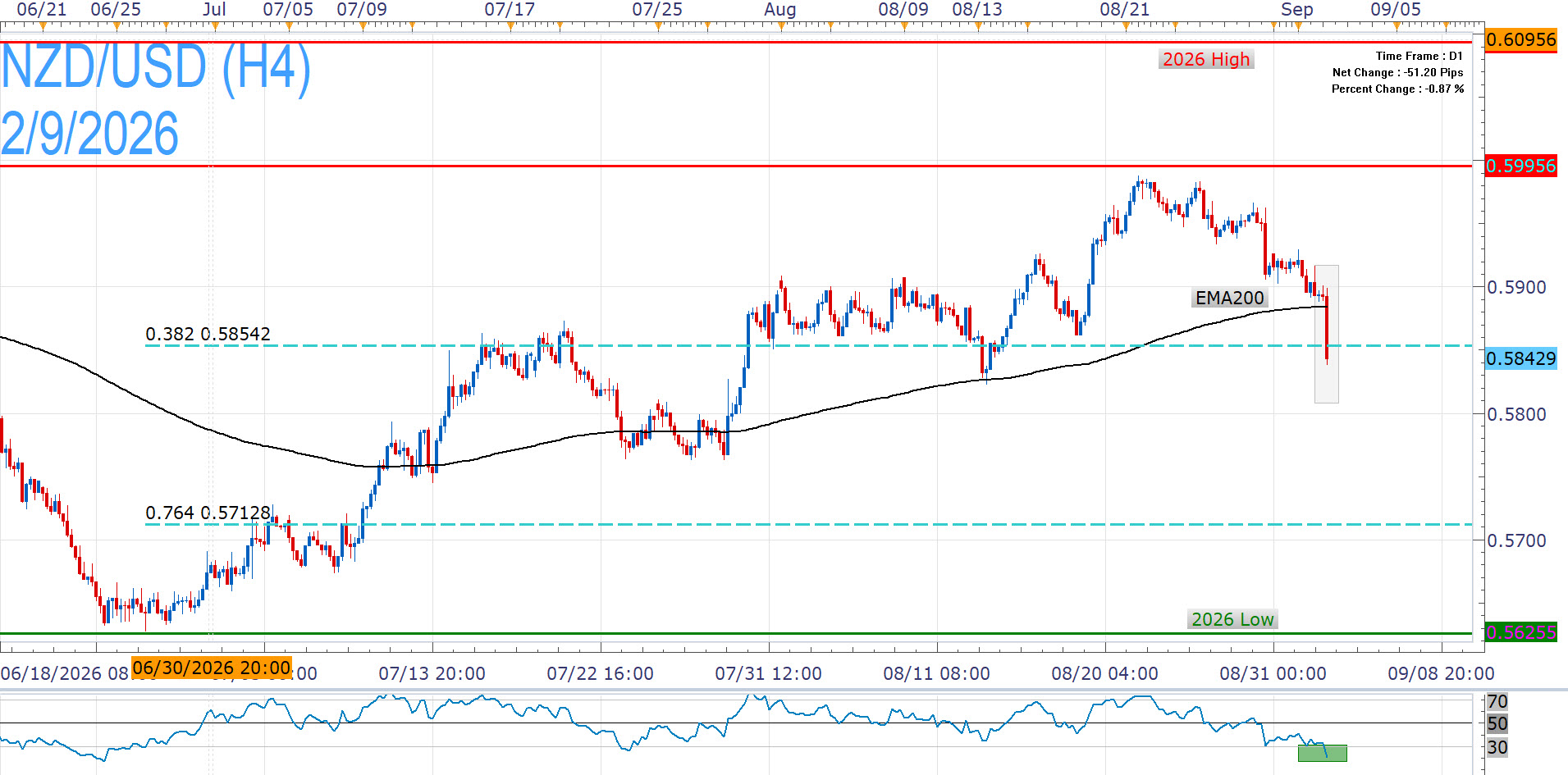
NZD/USD dropped after the decision, reacting to dovish guidance that shows limited appetite for more immediate action, as the RBNZ is wary of the impact on growth. It now moves below the EMA200, shifting immediate bias to the downside and leaving it vulnerable to deeper declines. Renewed USDOLLAR strength from rising Fed hike bets, following the hawkish Jackson Hole debut by Fed Chair Warsh [4], adds to the headwinds.
On the other hand, the move is now technically stretched, creating scope for an NZD recovery that would keep the 2026 high in the spotlight. The RBNZ kept the door open to further rate increases, and projections point to a higher OCR ahead. Moreover, Fed Chair Warsh did not commit to a September hike, while the USDOLLAR faces challenges from debasement trends amid heightened concerns around ballooning government deficits.

Nikos Tzabouras
Senior Financial Editorial Writer
Nikos Tzabouras is a graduate of the Department of International & European Economic Studies at the Athens University of Economics and Business. With extensive experience in market analysis and a strong foundation in international relations, he brings a unique perspective to financial markets. Nikos emphasizes not only technical analysis but also on fundamentals and the growing influence of geopolitics on financial trends.
As a Senior Financial Editorial Writer, he delivers comprehensive and forward-looking insights across a wide range of asset classes, including equities, commodities, and currencies. His work explores how macroeconomic events, political developments, and global policies impact market dynamics, providing readers with a deeper understanding of both short-term movements and long-term trends.


Any opinions, news, research, analyses, prices, other information, or links to third-party sites contained on this website are provided on an "as-is" basis, as general market commentary and do not constitute investment advice. The market commentary has not been prepared in accordance with legal requirements designed to promote the independence of investment research, and it is therefore not subject to any prohibition on dealing ahead of dissemination. Although this commentary is not produced by an independent source, FXCM takes all sufficient steps to eliminate or prevent any conflicts of interests arising out of the production and dissemination of this communication. The employees of FXCM commit to acting in the clients' best interests and represent their views without misleading, deceiving, or otherwise impairing the clients' ability to make informed investment decisions. For more information about the FXCM's internal organizational and administrative arrangements for the prevention of conflicts, please refer to the Firms' Managing Conflicts Policy. Please ensure that you read and understand our Full Disclaimer and Liability provision concerning the foregoing Information, which can be accessed here.