
Oil prices rise on renewed Middle East hostilities


USOIL Analysis
The United States launched further strikes against Iranian targets [1] while Tehran targeted US assets in the Middle East including Kuwait, causing damage to an onshore drilling platform [2]. The two sides are vying for control over the Strait of Hormuz, with Tehran declaring this crucial waterway closed [3] while the US insists it remains open [4]. The UK Maritime Trade Operations (UKMTO) reported another ship coming under attack in the Strait while maintaining the threat level at "severe". [5]
The latest flare-up follows another wave of hostilities and attacks on ships transiting the Strait last week, with President Trump saying the ceasefire is "over" and that he no longer wants a deal [6]. These developments cast doubt over transit through the Strait of Hormuz and the prospects of a lasting US-Iran agreement, which the IEA sees as a "must" for the normalisation of oil markets. [7]
Developments in the Middle East remain a key driver for crude and other major commodities in H2 2026, and USOil posted a rebound last week amid heightened geopolitical uncertainty and disrupted flows through the Strait. The latest escalation is driving gains today and could push crude above the pivotal resistance cluster provided by the EMA200 and the 38.2% Fibonacci level. However, a rejection would reaffirm the bearish bias, leaving USOil vulnerable to deeper declines.
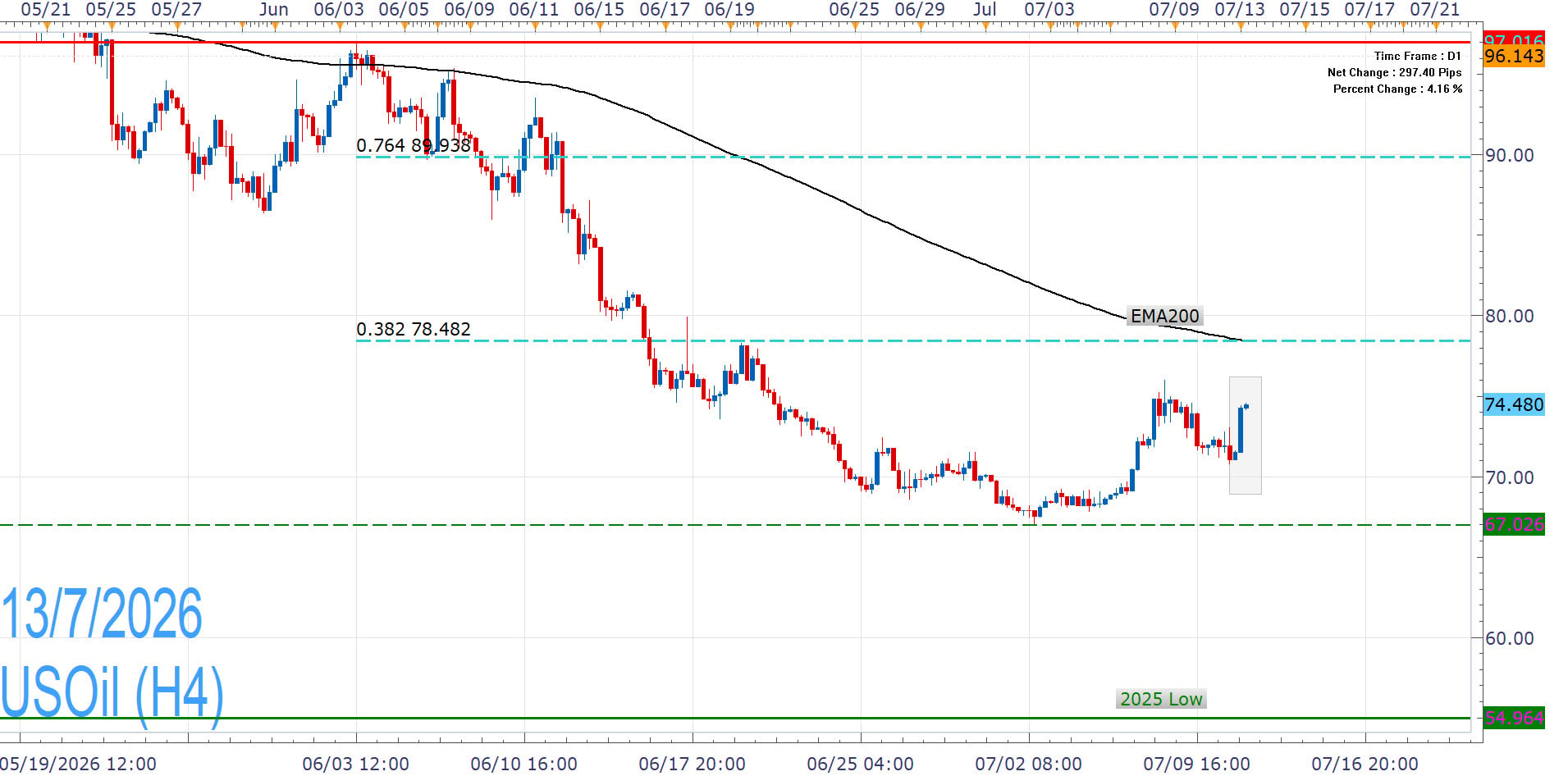
The US strikes against Iran are framed as an effort to "degrade" Iran's ability to attack ships transiting the Strait of Hormuz [1], and there has been no indication of a restart of full-scale war. President Trump may have declared the ceasefire over but has not closed the door to further negotiations, saying on Friday that US has agreed to continue talks upon Tehran's request.
Throughout this conflict, aggressive rhetoric and military flare-ups have eventually led to de-escalation, with the two sides having signed a Memorandum of Understanding that led to a pick-up in flows through the Strait of Hormuz. Should the restoration of flows continue, the market could return to oversupply, as the conflict has caused demand destruction, OPEC+ is committed to continuing its output increases [9] and a price war is brewing. The IEA expects a decline in consumption in 2026 and a surplus toward the end of the year.

Nikos Tzabouras
Senior Financial Editorial Writer
Nikos Tzabouras is a graduate of the Department of International & European Economic Studies at the Athens University of Economics and Business. With extensive experience in market analysis and a strong foundation in international relations, he brings a unique perspective to financial markets. Nikos emphasizes not only technical analysis but also on fundamentals and the growing influence of geopolitics on financial trends.
As a Senior Financial Editorial Writer, he delivers comprehensive and forward-looking insights across a wide range of asset classes, including equities, commodities, and currencies. His work explores how macroeconomic events, political developments, and global policies impact market dynamics, providing readers with a deeper understanding of both short-term movements and long-term trends.
References
| Retrieved 13 Jul 2026 https://x.com/CENTCOM/status/2076495252454584794 | |
| Retrieved 13 Jul 2026 https://x.com/KuwaitArmyGHQ/status/2076345395802710160 | |
| Retrieved 13 Jul 2026 https://x.com/PGSA_IRAN/status/2076285693500813681 | |
| Retrieved 13 Jul 2026 https://x.com/CENTCOM/status/2076278945993888116 | |
| Retrieved 13 Jul 2026 https://x.com/UK_MTO/status/2076260613035004029 | |
| Retrieved 13 Jul 2026 https://www.youtube.com/watch | |
| Retrieved 13 Jul 2026 https://www.iea.org/reports/oil-market-report-july-2026 | |
| Retrieved 27 Oct 2026 https://www.opec.org/pr-detail/1835609-5-july-2026.html |


Any opinions, news, research, analyses, prices, other information, or links to third-party sites contained on this website are provided on an "as-is" basis, as general market commentary and do not constitute investment advice. The market commentary has not been prepared in accordance with legal requirements designed to promote the independence of investment research, and it is therefore not subject to any prohibition on dealing ahead of dissemination. Although this commentary is not produced by an independent source, FXCM takes all sufficient steps to eliminate or prevent any conflicts of interests arising out of the production and dissemination of this communication. The employees of FXCM commit to acting in the clients' best interests and represent their views without misleading, deceiving, or otherwise impairing the clients' ability to make informed investment decisions. For more information about the FXCM's internal organizational and administrative arrangements for the prevention of conflicts, please refer to the Firms' Managing Conflicts Policy. Please ensure that you read and understand our Full Disclaimer and Liability provision concerning the foregoing Information, which can be accessed here.