
Oil Remains Under Pressure as a Fragile Floor Meets a Softer Supply Outlook


The Downtrend Is Still Intact
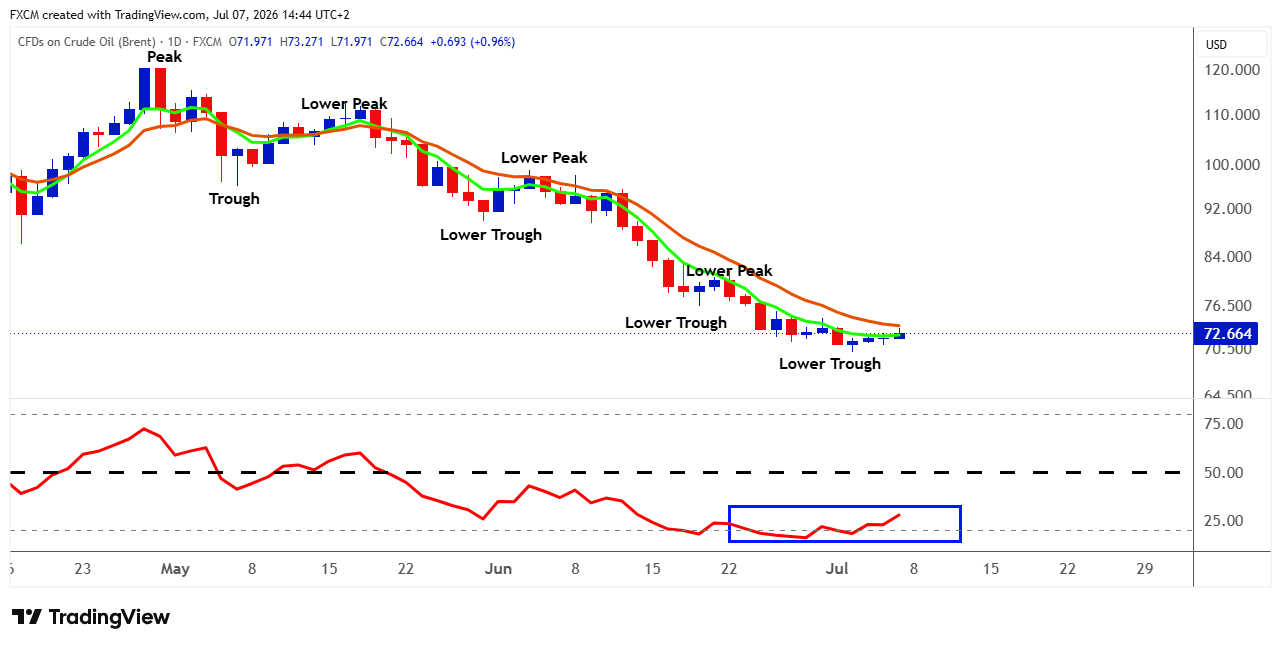
UKOil remains technically weak. Since reaching a May peak near $118, price has established a consistent sequence of lower peaks and lower troughs, the clearest indication that sellers remain in control. The decline gathered pace through mid-June and, at around $72.66, UKOil is now trading close to its most recent lows.
The moving averages support that bearish reading. Both remain pointed lower, while price continues to trade beneath the slower moving average. Although the faster average is beginning to flatten around current levels, there is still no convincing bullish crossover or break above meaningful resistance. For now, the chart looks less like the start of a recovery and more like a period of consolidation after a sharp fall.
Oversold Conditions May Support a Bounce
Momentum has improved modestly. The RSI fell below 20, signalling deeply oversold conditions, before turning higher as selling pressure began to ease. That creates scope for a short-term relief rally, particularly after such a rapid decline.
However, the broader momentum picture remains bearish. The RSI is still well below the neutral 50 level, meaning that buyers have not yet regained meaningful control. Oversold readings can mark the start of a bounce, but they do not automatically signal that a downtrend has ended.
The immediate support zone lies between $70.50 and $71.00, where UKOil stabilised in late June and early July. A decisive daily close below that area would confirm another lower trough and place the psychological $70 level in focus. Conversely, the first meaningful resistance sits between $73.50 and $75.00, where the recent consolidation ceiling meets the falling moving averages. A sustained move above that region would be the first sign that near-term selling pressure is fading.
The more important test is higher, around $76.50 to $78.00. UKOil would need to reclaim that zone and then begin forming higher troughs before the technical outlook could be described as genuinely constructive.
Supply Recovery Is Bearish, but Hormuz Remains the Wild Card
Fundamentally, UKOil's retreat towards $72 reflects a substantial unwinding of the Iran-war risk premium as expectations of recovering Gulf supply have improved. The UAE raised June crude output above 3.8 million barrels per day, OPEC+ approved a further 188,000 barrels per day production adjustment for August, and Saudi Aramco sharply reduced the August Arab Light price for Asia. Taken together, those developments suggest that Gulf producers are competing aggressively for Asian demand.
The demand picture is less straightforward. Chinese seaborne crude imports fell sharply during the Hormuz disruption, although that decline reflected restricted access to Middle Eastern supply as well as softer buying appetite. The immediate risk for oil prices is that returning Gulf barrels may need to clear at lower prices if Asian demand does not strengthen sufficiently.
Yet the supply outlook is not entirely secure. Saudi and Iraqi flows remain below pre-conflict levels, strategic stock buffers have been drawn down, and the reported missile attack on commercial vessels near the Strait of Hormuz shows that shipping risk can re-emerge quickly.
The near-term balance therefore remains cautiously bearish. UKOil is oversold and capable of a short-term rebound, but unless it can break and hold above roughly $75, the dominant technical message remains lower prices and a renewed test of $70.50. The main threat to that view is not a sudden improvement in demand, but another disruption to Hormuz traffic that rapidly restores a geopolitical premium.

Russell Shor
Senior Market Strategist
Russell Shor is a Senior Market Strategist at FXCM, having been promoted to the role in 2025 in recognition of his depth of insight and consistent delivery of high-impact market analysis. He originally joined FXCM in October 2017 as a Senior Market Specialist.
Russell holds an Honours Degree in Economics from the University of South Africa, is a certified FMVA®, and a full member of the Society of Technical Analysts (UK). With over 20 years of experience in financial markets, his work is renowned for its clarity, precision, and strategic value across asset classes.


Any opinions, news, research, analyses, prices, other information, or links to third-party sites contained on this website are provided on an "as-is" basis, as general market commentary and do not constitute investment advice. The market commentary has not been prepared in accordance with legal requirements designed to promote the independence of investment research, and it is therefore not subject to any prohibition on dealing ahead of dissemination. Although this commentary is not produced by an independent source, FXCM takes all sufficient steps to eliminate or prevent any conflicts of interests arising out of the production and dissemination of this communication. The employees of FXCM commit to acting in the clients' best interests and represent their views without misleading, deceiving, or otherwise impairing the clients' ability to make informed investment decisions. For more information about the FXCM's internal organizational and administrative arrangements for the prevention of conflicts, please refer to the Firms' Managing Conflicts Policy. Please ensure that you read and understand our Full Disclaimer and Liability provision concerning the foregoing Information, which can be accessed here.