
US Bank Earnings Must Turn an Orderly Chart Into a Confirmed Breakout


A Constructive Chart, but a Clear Line in the Sand
FXCM's US.BANKS basket has worked its way into a technically encouraging position, but the latest candle makes the setup more delicate. The basket is equally weighted across JPMorgan Chase, Bank of America, Wells Fargo, Citigroup and Capital One. Its direction over the next few weeks will still be driven largely by what these five banks say about margins, loan growth, credit quality and capital returns.
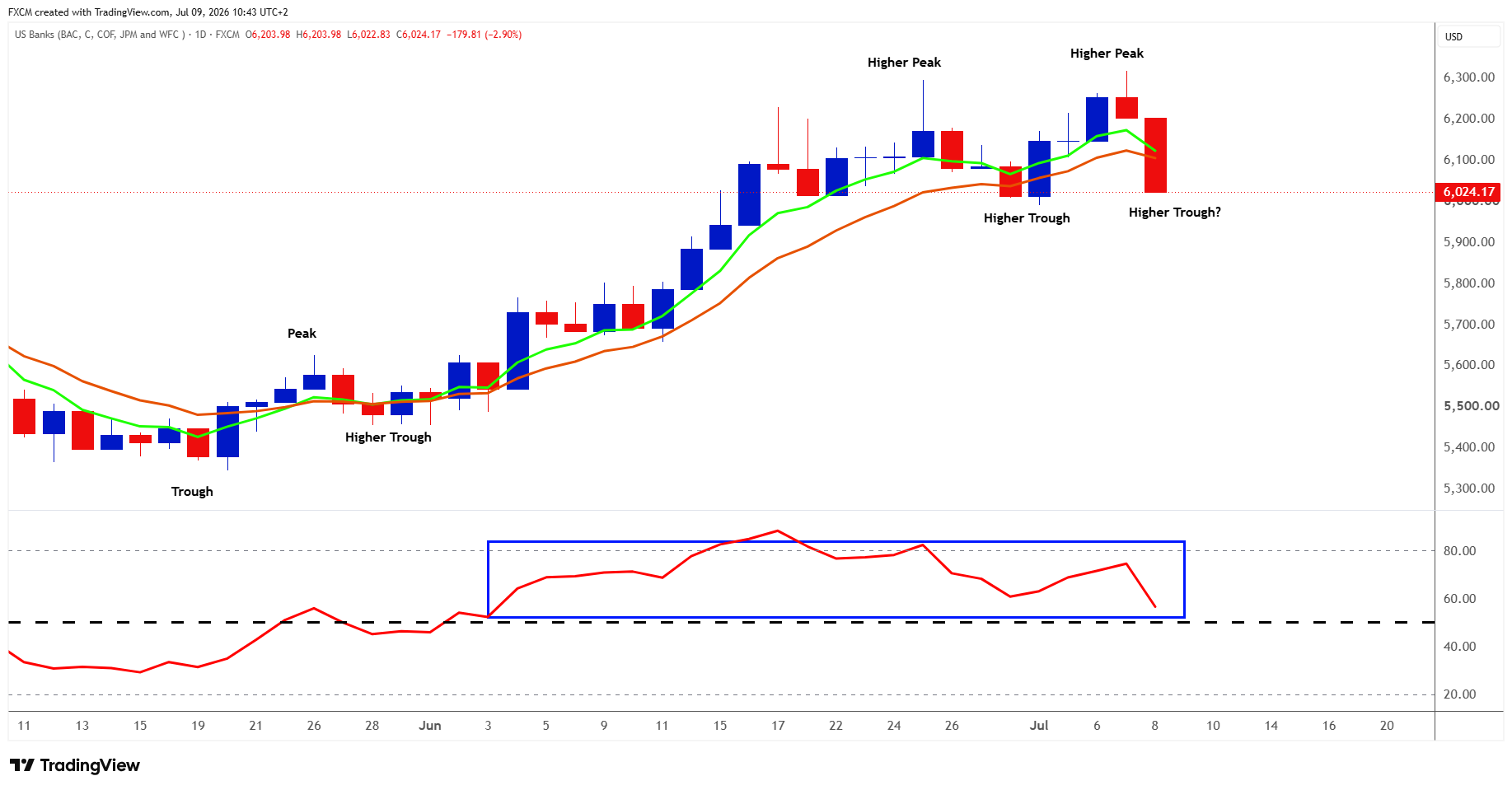
The price action has improved meaningfully since May. The basket formed a trough near 5,350, pushed up towards 5,600, then held a higher trough around the mid-5,400s before moving into a stronger advance through June. That was followed by another higher peak above 6,100 and then a fresh push towards the 6,200-6,235 area in early July. That sequence still looks constructive, but the most recent pullback now puts the chart at an important test.
The hurdle remains obvious. The 6,300 area is the level to watch on the upside. The basket came close to that zone but has not yet produced the convincing signal bulls would want. A brief move into resistance is not enough. The stronger signal would be a daily close above that level, followed by the ability to hold above it rather than slipping straight back into the prior range.
The more immediate issue is support. The latest red candle has pulled the basket back towards 6,024, testing whether the recent decline is simply another higher trough or the start of a broader loss of momentum. A hold above the early-July trough area would keep the uptrend structure alive. A decisive break below it would weaken the higher peak, higher trough pattern and shift the chart from constructive consolidation to a more defensive setup.
The moving averages are no longer quite as clean as before. Price has now pulled back into and below the short-term moving-average area. That does not break the trend on its own, but it does show that momentum has faded. The RSI tells the same story: it has cooled sharply from overbought territory and is now approaching its midpoint, rather than merely easing from stretched levels.
For now, the chart still favours consolidation within an uptrend, but with less margin for error. Bulls need to see the current pullback stabilise quickly and form a confirmed higher trough. Without that, the basket risks moving from a healthy pause after a sharp rally into a more meaningful correction.
The Earnings Base Is Stronger, but the Risks Are Uneven
The technical setup has a credible fundamental base, but it is not an all-clear signal. In June, the Federal Reserve held rates at 3.50%-3.75% and said the economy was still expanding at a solid pace, even as inflation remained above target and uncertainty stayed elevated. The labour market also looks more mixed than weak: payrolls rose by only 57,000 in June, while unemployment was little changed at 4.2%. That keeps the macro backdrop supportive enough for the trade, but not risk-free. Investors will need to watch incoming data closely, particularly loan demand, consumer stress, reserve builds and deposit pricing.
JPMorgan remains the strongest anchor in the group. Its first-quarter numbers illustrated why it continues to set the standard among large US banks. Net income came in at $16.5 billion, while return on tangible common equity reached 23%. Average loans were up 11% year on year, deposits rose 7%, investment-banking fees increased 28% and Markets revenue climbed 20%. Assets under management reached $4.8 trillion. The important point is not simply that JPMorgan had a strong quarter; it is that strength came from across the business. Lending, deposits, trading, investment banking and wealth management all contributed.
Bank of America also entered the year from a solid position. First-quarter revenue, net of interest expense, was $30.3 billion, net income was $8.6 billion and return on tangible common equity reached 16.0%. The question for BAC is whether it can keep net interest income resilient as the rate outlook evolves, while still generating enough fee income, trading revenue and investment-banking activity to support overall earnings growth. Its results are likely to provide one of the clearest reads on deposit costs and the health of the US consumer.
Wells Fargo has become a more interesting story than it was a year ago. Revenue rose 6% year on year in the first quarter, supported by a 5% increase in net interest income and an 8% increase in non-interest income. Loans rose 11%, deposits increased 7% and net loan charge-offs held steady at 45 basis points. Its Corporate and Investment Bank also delivered 11% growth in Banking revenue and 19% growth in Markets revenue, while Wealth and Investment Management revenue rose 14%.
That matters because Wells is no longer just a play on higher rates and a large deposit base. The removal of its regulatory constraints has given management more room to improve the franchise, and investors will now want proof that this is feeding through into better business momentum rather than merely preserving the existing earnings base.
Citigroup remains the most obvious rerating candidate, but also the bank where execution matters most. First-quarter revenue rose 14% to $24.6 billion, supported by a 12% increase in net interest income and a 17% rise in non-interest revenue, while return on tangible common equity reached 13.1%. Those are encouraging numbers, but the credit line still needs watching. Citi's provision for credit losses was $2.8 billion, including $2.2 billion of net credit losses and a $597 million net ACL build, reflecting portfolio quality, seasonal mix effects and a more uncertain macro outlook. The improvement story is real, but not risk-free. Investors still need evidence that revenue growth can continue while expenses, credit costs and the broader transformation programme remain under control.
Capital One brings a different set of variables to the basket. It is more exposed to consumer credit than the other names and is also working through the integration of Discover. First-quarter net income was $2.2 billion, its CET1 ratio stood at 14.4%, and adjusted earnings were $4.42 per share after Discover-related amortisation and integration adjustments. Yet the credit picture deserves scrutiny: net charge-offs totalled $3.8 billion, reserves increased by $230 million and net interest margin fell 39 basis points sequentially to 7.87%.
Capital One could add significant upside if the Discover integration goes well and consumer credit remains stable. It could also become the weak link in the basket if charge-offs accelerate or margins come under further pressure.
14 July Is the Real Test
The capital backdrop remains supportive, but it should not be exaggerated. The Federal Reserve's 2026 stress tests showed that all 32 tested banks remained above their minimum CET1 capital requirements under a severe recession scenario. That scenario included more than $708 billion of projected losses, unemployment reaching 10%, a 39% decline in commercial-property prices and a 30% fall in house prices. It reinforces the idea that the large banks are better capitalised than they were in past cycles. It does not, however, guarantee higher dividends, bigger buybacks or immunity from an earnings disappointment.
That leaves the reporting calendar as the immediate catalyst. JPMorgan, Bank of America, Citigroup and Wells Fargo report second-quarter results on 14 July, while Capital One follows on 21 July. Four of the five equally weighted names are therefore due to report just as the basket sits below a clear technical resistance level.
For the bullish case to strengthen, investors will want more than headline earnings beats. They will want signs that net interest income can hold up, deposit pricing remains manageable, loan demand is not fading too quickly and fee income from capital markets, trading, investment banking and wealth management continues to broaden the earnings mix. Just as importantly, they will want no material deterioration in credit costs.
JPMorgan's Markets and investment-banking revenues, Bank of America's margins and deposits, Wells Fargo's post-regulatory momentum, Citi's costs and credit provisions, and Capital One's charge-offs and Discover integration will be the key points to watch.
The bottom line is that the basket remains in a constructive position, but this is now an earnings-led chart rather than a purely technical one. A sustained break above 6,300 would support the case for further upside and confirm that the higher-high/higher-low structure remains in place. A pullback that holds the 6,000-6,100 area would still look like healthy consolidation. A move below 5,800 would weaken the near-term setup, while a break beneath the May higher-trough zone around 5,400-5,450 would pose a much more serious challenge to the trend.
The chart has done its part. Earnings now need to do theirs.

Russell Shor
Senior Market Strategist
Russell Shor is a Senior Market Strategist at FXCM, having been promoted to the role in 2025 in recognition of his depth of insight and consistent delivery of high-impact market analysis. He originally joined FXCM in October 2017 as a Senior Market Specialist.
Russell holds an Honours Degree in Economics from the University of South Africa, is a certified FMVA®, and a full member of the Society of Technical Analysts (UK). With over 20 years of experience in financial markets, his work is renowned for its clarity, precision, and strategic value across asset classes.

Any opinions, news, research, analyses, prices, other information, or links to third-party sites contained on this website are provided on an "as-is" basis, as general market commentary and do not constitute investment advice. The market commentary has not been prepared in accordance with legal requirements designed to promote the independence of investment research, and it is therefore not subject to any prohibition on dealing ahead of dissemination. Although this commentary is not produced by an independent source, FXCM takes all sufficient steps to eliminate or prevent any conflicts of interests arising out of the production and dissemination of this communication. The employees of FXCM commit to acting in the clients' best interests and represent their views without misleading, deceiving, or otherwise impairing the clients' ability to make informed investment decisions. For more information about the FXCM's internal organizational and administrative arrangements for the prevention of conflicts, please refer to the Firms' Managing Conflicts Policy. Please ensure that you read and understand our Full Disclaimer and Liability provision concerning the foregoing Information, which can be accessed here.