
S&P 500 path driven by AI earnings, oil, inflation and deficit updates


Oracle to test the AI trade
The S&P 500 comes off a strong August, largely underpinned by an solid earnings season that renewed AI optimism. According to FactSet, the index reported 52% earnings growth, its highest in five years, with 86% of companies exceeding EPS estimates [1]. Crucially, Amazon, Alphabet, Meta and Microsoft delivered robust results and reiterated their commitment to the physical AI buildout, pushing their combined 2026 capex targets to between $720 billion and $745 billion.
Key players across the global chip supply chain also posted strength, pointing to sustained structural demand. Last week, Dell Technologies posted record figures and raised its full-year guidance on the back of demand for AI-optimised servers. Nvidia saw sales surge 106% y/y while guiding for continued growth into the next fiscal year. Earlier in the season, memory manufacturers like Micron and SK Hynix, indispensable to data centre expansion, delivered stellar results highlighting a persistent supply-demand gap. Meanwhile, Intel remains a notable beneficiary as the rise of Agentic AI and inference workloads drives renewed CPU demand.
Conversely, software companies, long viewed as the casualties of the AI transition, performed resiliently last month as solid earnings metrics helped soothe market anxieties. Salesforce Inc pushed back against the SaaSpocalypse narrative with strong top and bottom-line figures alongside an upgraded full-year outlook. Adobe will offer fresh sector insights with its upcoming earnings report, expecting solid growth.
Yet all eyes turn to Oracle. While rooted in software, it functions above all as a bellwether for the broader AI trade. Heavily embedded in the physical AI buildout via massive data centre investments, it is reaping the rewards through explosive cloud infrastructure growth. Management expects upcoming results to show accelerating revenues and sustained earnings expansion. [2]
However, Oracle's aggressive capital expenditure is heavily funded by debt issuance and negative free cash flow, mirroring a wider industry trend that is breeding market unease. Set against a backdrop of mounting infrastructure costs, elevated yields driving up the cost of capital and lingering macro-geopolitical friction, these capital pressures introduce genuine execution risks to the broader AI trajectory.
Oil, inflation and the Fed's decision
Oil prices are extending their advance this week, bringing USOIL closer to the $100 threshold. Fresh US-Iran hostilities are compounding escalation fears and dampening prospects for a diplomatic resolution and a normalisation of crude flows. The longer transit routes remain disrupted, the tighter markets become, keeping upward pressure on prices.
This sustains inflationary risks, with markets now turning to the latest factory-gate and consumer inflation data due Thursday and Friday respectively. Although inflation has eased in recent months, it remains well above the 2% target. Energy disruptions alongside AI and defence spending are key upside drivers, capable of keeping price pressures elevated.
Fed policymakers will be scrutinising the data ahead of next week's pivotal policy meeting. Three members already voted for hikes at the July hold [3], while officials such as Governor Barr have noted they would back an increase if inflation fails to subside [4]. Chair Warsh offered a more hawkish view at Jackson Hole [5], which alongside strong non-farm payrolls has led markets to price in a September move [6]. However, pricing remains fluid and Fed conviction elusive, meaning any softness in upcoming inflation prints could allow policymakers to stand pat. Governor Waller has voiced support for a hold under such a scenario [7], while Chair Warsh stopped short of committing to a definitive action.
Treasury update to sustain the deficits theme
Another headwind for stock and bond markets stems from intensifying concerns over the US fiscal position, which continues to drive yields higher and force the Treasury to manage duration risk via bond buybacks. These worries were accentuated after gross national debt crossed the $40 trillion threshold, while the monthly budget deficit soared to $432.3 billion in July, its highest level in over five years. [8]
Crucially, net interest payments accounted for 15% of federal outlays in the first ten months of fiscal 2026. Investors now look ahead to Friday's monthly Treasury statement for a fresh gauge on public finances. With the Middle East conflict continuing and yields on the rise, fiscal slippage risks widening the gap further. Should the deficit continue to expand, it could renew market jitters and exert additional downward pressure on both fixed-income and equity assets.
SPX500: navigating a macro matrix
The S&P 500's trajectory is shaped by a complex web of forces, highlighted by this week's pivotal events that could spark volatility. Geopolitical uncertainty lingers and the ongoing Middle East conflict sustains inflationary risks. Any upside surprise in the CPI and PPI prints could force the Fed's hand. Higher interest rates typically do not bode well for equities, while any expansion in the budget deficit could further dent market sentiment.
However, a rate hike by the Fed is unlikely to derail the structural bullish outlook for the S&P 500, even if it causes near-term pullbacks. Paradoxically, it could help Wall Street by reinforcing conviction that the central bank will not let inflation get out of hand.
One way or the other, the most potent driver for the stock market remains AI proliferation, with Oracle offering fresh insights. Sentiment around AI ebbs and flows due to financing and monetisation concerns alongside stretched valuations that fuel bubble fears. Yet AI adoption appears unstoppable, as generational investments drive unprecedented demand that spills over beyond core AI firms and into the broader economy.
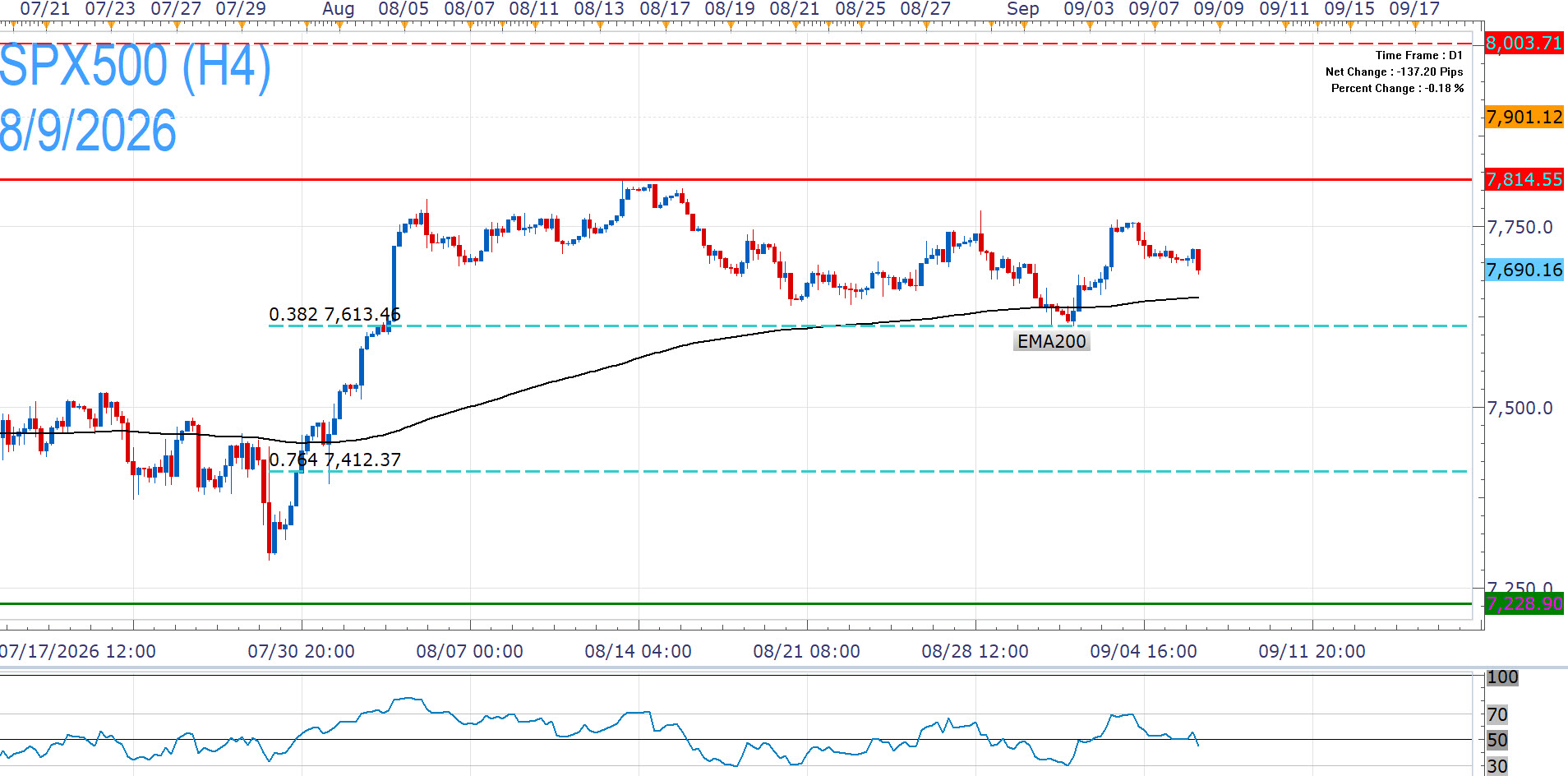
The S&P 500 heads for a cautious return from the long weekend as geopolitical uncertainty and high-impact incoming data keep investors on edge. A drop below the EMA200, coupled with the RSI moving below 50, would shift the immediate bias to the downside and open the door to deeper pullbacks should the data disappoint.
However, the S&P 500 has so far defended the EMA200 and the 38.2% Fibonacci retracement level, maintaining its underlying bullish structure with the path of least resistance pointing toward new record highs. Favourable incoming prints would facilitate that trajectory, although firm directional conviction may prove elusive ahead of the September 16 Federal Reserve policy decision.

Nikos Tzabouras
Senior Financial Editorial Writer
Nikos Tzabouras is a graduate of the Department of International & European Economic Studies at the Athens University of Economics and Business. With extensive experience in market analysis and a strong foundation in international relations, he brings a unique perspective to financial markets. Nikos emphasizes not only technical analysis but also on fundamentals and the growing influence of geopolitics on financial trends.
As a Senior Financial Editorial Writer, he delivers comprehensive and forward-looking insights across a wide range of asset classes, including equities, commodities, and currencies. His work explores how macroeconomic events, political developments, and global policies impact market dynamics, providing readers with a deeper understanding of both short-term movements and long-term trends.
References
| Retrieved 08 Sep 2026 https://insight.factset.com/earnings-insight-infographic-q2-2026-by-the-numbers | |
| Retrieved 08 Sep 2026 https://s23.q4cdn.com/440135859/files/doc_earnings/2026/q4/earnings-result/4q26-pressrelease-final.pdf | |
| Retrieved 08 Sep 2026 https://www.federalreserve.gov/monetarypolicy/fomcpresconf20260729.htm | |
| Retrieved 08 Sep 2026 https://www.federalreserve.gov/newsevents/speech/barr20260901a.htm | |
| Retrieved 08 Sep 2026 https://www.federalreserve.gov/newsevents/speech/warsh20260828a.htm | |
| Retrieved 08 Sep 2026 https://www.cmegroup.com/markets/interest-rates/cme-fedwatch-tool.html | |
| Retrieved 08 Sep 2026 https://www.federalreserve.gov/newsevents/speech/waller20260903a.htm | |
| Retrieved 20 Oct 2026 https://fiscaldata.treasury.gov/static-data/published-reports/mts/MonthlyTreasuryStatement_202607.pdf |

Any opinions, news, research, analyses, prices, other information, or links to third-party sites contained on this website are provided on an "as-is" basis, as general market commentary and do not constitute investment advice. The market commentary has not been prepared in accordance with legal requirements designed to promote the independence of investment research, and it is therefore not subject to any prohibition on dealing ahead of dissemination. Although this commentary is not produced by an independent source, FXCM takes all sufficient steps to eliminate or prevent any conflicts of interests arising out of the production and dissemination of this communication. The employees of FXCM commit to acting in the clients' best interests and represent their views without misleading, deceiving, or otherwise impairing the clients' ability to make informed investment decisions. For more information about the FXCM's internal organizational and administrative arrangements for the prevention of conflicts, please refer to the Firms' Managing Conflicts Policy. Please ensure that you read and understand our Full Disclaimer and Liability provision concerning the foregoing Information, which can be accessed here.