
Intel’s upside bias questioned amid AI-fuelled growth and business risks

Intel turnaround fuelled by AI demand
Intel is a key beneficiary of the AI boom and the transition from training frontier models to inference and the rise of Agentic AI, which reduces the CPU-to-GPU ratio. Gartner projects a 139% jump this year in enterprise spending on AI agent software [1] and Counterpoint expects this hardware transition to expand the total addressable market for server CPUs to $110-$120 billion annually by 2030. [2]
While these developments play into Intel's natural strengths, management is actively leveraging high-profile alliances to secure a central role in the physical AI buildout, including Nvidia's $5 billion investment to co-develop custom x86 CPUs [3]. The company is also trying to carve out a credible alternative for advanced chip fabrication through its Foundry business, underpinned by its participation in Elon Musk's Terafab project [4]. Furthermore, Intel's operational revitalisation is supported by structural sovereign backing, as the US government has assumed a nearly 10% stake with an $8.9 billion investment. [5]
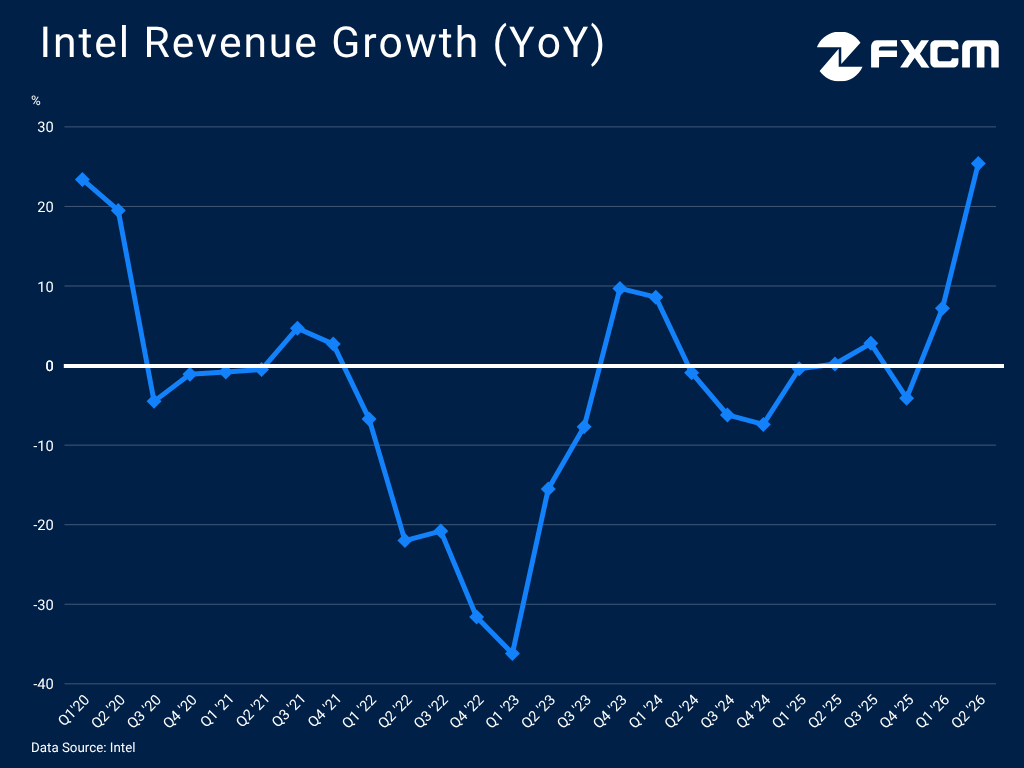
The proliferation of AI workloads boosts demand for CPUs, a domain where Intel occupies a dominant position, directly improving its financial performance. Intel generated $7.0 billion in cash from operations in the second quarter, highlighting a healthy core business. Operating income soared 156.5% y/y and revenues rose 25.4%, marking the biggest increase since 2011. Management expects to maintain solid momentum in the current quarter, projecting sales growth of 15.33%-22.6% y/y and a return to GAAP earnings with EPS of $0.31. [6]
Execution risks and macro headwinds persist
To meet unprecedented demand, sizeable investments are needed to scale capacity, prompting Intel to raise its 2026 capex target by 21% y/y to over $20 billion, while guiding for "significantly" higher expenditure next year. Even though its balance sheet is improving, Intel remains constrained by past strategic mistakes and a heavy debt burden, limiting its flexibility compared to more deep-pocketed rivals. To fund its expansion the company issued a $20 billion common stock offering [7], which caused dilution concerns, but this is preferable to over-leveraging its debt profile or pushing cash flows into prolonged deficits.
Even though Intel posted another strong quarter, hurdles still loom. It maintains a dominant position in the CPU market but its share is declining as rival AMD gains ground according to Mercury Research [8]. Furthermore, the Foundry division keeps losing money and despite solid sales, these remain mostly internal as indicated by offsetting eliminations, showing that attracting clients away from titans like TSMC remains a tall order.
Meanwhile, AI proliferation could reinvigorate the now renamed Client Computing and Physical AI segment thanks to edge AI opportunities, but headwinds are likely to persist as the PC market contracted 3.6% y/y in Q2 according to Omdia [9]. This decline is largely attributed to shortages and price spikes in memory chips - a market Intel abandoned a few years ago. This underscores past mistakes, as the memory and storage industry explodes and players like Micron and SK Hynix have become indispensable to the physical AI buildout.
Intel also has to grapple with broader industry risks stemming from macro-geopolitical uncertainty. Continued disruptions in the Strait of Hormuz weigh on energy-intensive chip manufacturing and push the costs of building and running AI infrastructure higher. Furthermore, technology trade restrictions and complex supply chain vulnerabilities add persistent pressure to an already strained operating environment.
Intel stock analysis: turnaround momentum and headwinds intersect
Intel has flipped the narrative from concerns over survival to whether it can scale quickly enough to meet rising AI demand, with its financial position substantially improved. Underscoring these dynamics, the stock has emerged as a top SPX500 performer, gaining over 150% this year.
The technical outlook remains favourable as long as the stock stays above its EMA200, keeping the bullish bias intact and the road to new all-time highs wide open. The fundamental picture also supports the case, as its turnaround plans are bearing fruit thanks to shifts in AI workloads favouring CPU usage.
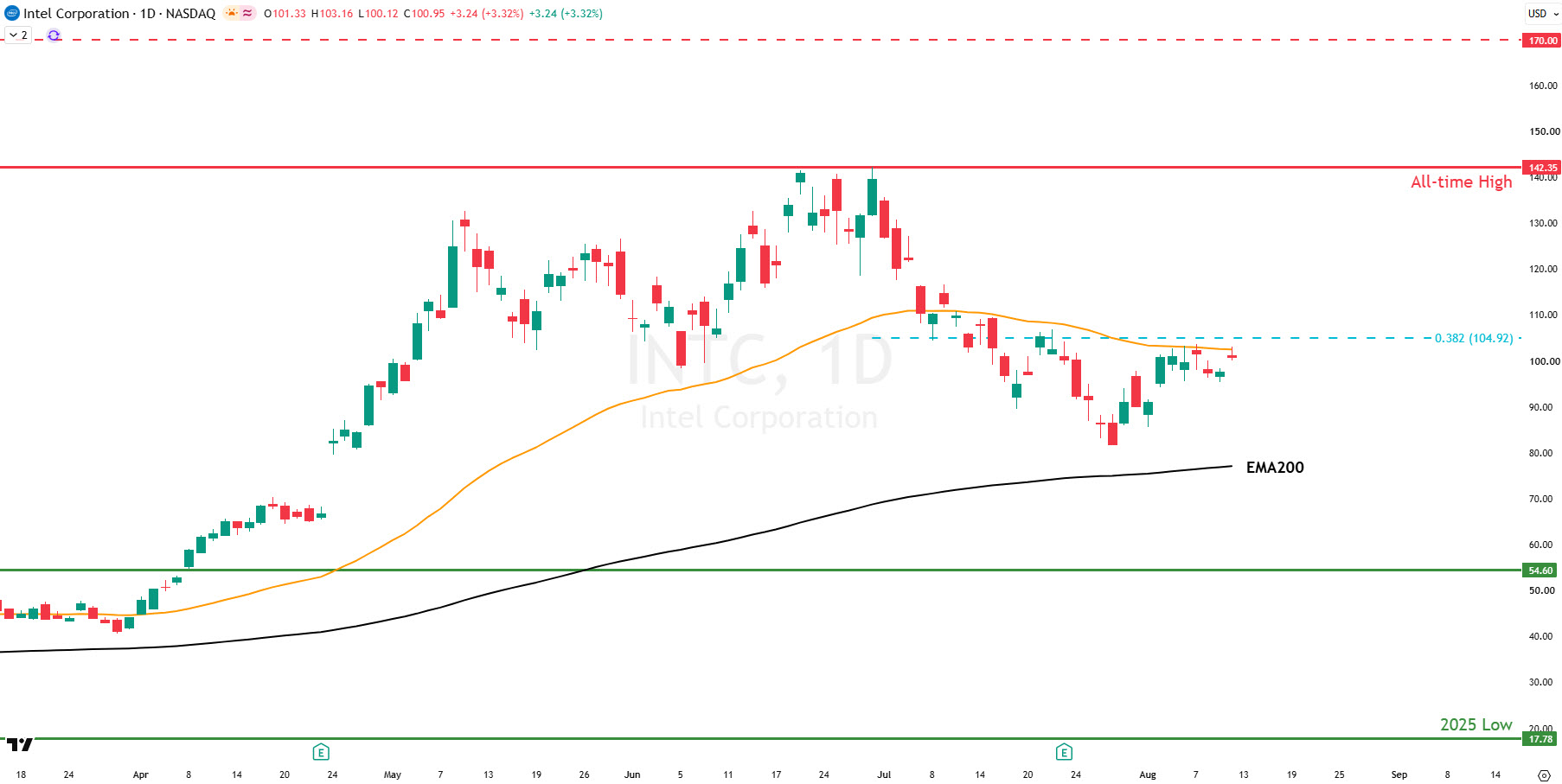
Chart source: www.tradingview.com
However, the stock sits at a technical and fundamental crossroads. INTC has dropped substantially from its June record peak and its recovery effort is finding resistance at the 38.2% Fibonacci level. A rejection of this pivotal level could push shares below the EMA200 and shift the immediate bias to the downside, creating scope for deeper declines.
The company has little room for operational missteps. It has to balance spending to build out its manufacturing capacity, defending market share and navigating a difficult macro-geopolitical environment.
Ultimately, Intel's fate rests on flawless execution. Whether the stock can sustain its massive gains or succumb to technical rejection depends entirely on management's ability to navigate capital constraints, fend off aggressive competition and steer through an increasingly volatile macro landscape.

Nikos Tzabouras
Senior Financial Editorial Writer
Nikos Tzabouras is a graduate of the Department of International & European Economic Studies at the Athens University of Economics and Business. With extensive experience in market analysis and a strong foundation in international relations, he brings a unique perspective to financial markets. Nikos emphasizes not only technical analysis but also on fundamentals and the growing influence of geopolitics on financial trends.
As a Senior Financial Editorial Writer, he delivers comprehensive and forward-looking insights across a wide range of asset classes, including equities, commodities, and currencies. His work explores how macroeconomic events, political developments, and global policies impact market dynamics, providing readers with a deeper understanding of both short-term movements and long-term trends.

Any opinions, news, research, analyses, prices, other information, or links to third-party sites contained on this website are provided on an "as-is" basis, as general market commentary and do not constitute investment advice. The market commentary has not been prepared in accordance with legal requirements designed to promote the independence of investment research, and it is therefore not subject to any prohibition on dealing ahead of dissemination. Although this commentary is not produced by an independent source, FXCM takes all sufficient steps to eliminate or prevent any conflicts of interests arising out of the production and dissemination of this communication. The employees of FXCM commit to acting in the clients' best interests and represent their views without misleading, deceiving, or otherwise impairing the clients' ability to make informed investment decisions. For more information about the FXCM's internal organizational and administrative arrangements for the prevention of conflicts, please refer to the Firms' Managing Conflicts Policy. Please ensure that you read and understand our Full Disclaimer and Liability provision concerning the foregoing Information, which can be accessed here.