
Can Warsh and Hormuz Push USDOLLAR Higher


USDOLLAR is being pulled by two forces that can support it but now send conflicting signals. One is US monetary policy, where the Federal Reserve sounds hawkish but is harder to read. The other is the conflict around Iran and the Strait of Hormuz, which can strengthen the dollar through safe-haven demand while threatening a fresh inflation shock. Investors are weighing America's interest-rate advantage against doubts about policy credibility and the dollar's role as shelter when markets turn nervous.
Warsh has made the rate story less comfortable
The Fed left the federal funds target at 3.50 percent to 3.75 percent on 29 July. The decision passed by nine votes to three, with Beth Hammack, Neel Kashkari and Lorie Logan preferring an immediate quarter-point increase. The Fed said economic activity was expanding at a solid pace and inflation remained above its 2 percent objective, partly because of energy-related supply shocks. Yet Chair Kevin Warsh gave investors no clear indication that the July pause would soon be followed by tighter policy.
The response showed unease. The two-year Treasury yield fell 3.52 basis points to 4.24 percent, while the ten-year yield rose 7.53 basis points to 4.68 percent. The 30-year yield later reached 5.24 percent, its highest level since 2007. Shorter-dated yields, which are more sensitive to Fed expectations, moved lower while long-dated yields rose as investors demanded more compensation for future inflation and uncertainty.
That distinction matters for USDOLLAR. A rise in the two-year yield caused by expectations of tighter Fed policy would normally be more supportive than a rise in the 30-year yield driven by inflation compensation or a larger term premium.
Markets still regard a September increase as more likely than another pause with a 65% probability of a 25-bps hike. However, according to CME group data, the implied probability of no change rose to 35% percent from 24% before the July decision. The figure can move quickly, but it captures the problem. Warsh sounds determined to control inflation, but traders remain unsure what will make the Fed act.
Hormuz gives the dollar two different faces
The Strait of Hormuz adds further uncertainty. Renewed US attacks on Iranian targets helped lift Brent crude above 91 dollars a barrel on 30 July. Oil flows through Hormuz have historically equalled about one-fifth of global petroleum-liquids consumption, while more than one-fifth of global LNG trade also passed through the strait. Security problems around Bab el-Mandeb have created a second pressure point for energy shipping.
The first effect is defensive. The broad dollar index recovered part of its post-Fed decline after news of fresh US strikes, as geopolitical tension encouraged demand for liquid safe assets. This shows how fear can temporarily outweigh disappointment about monetary policy.
The second effect works through inflation. Headline US consumer prices rose 3.5 percent over the year to June but fell 0.4 percent during the month on a seasonally adjusted basis as the energy index dropped 5.7 percent. Core inflation was 2.6 percent year on year and unchanged during June. A renewed oil surge could interrupt that improvement. If higher fuel costs lift inflation expectations and expectations of further Fed tightening, the two-year yield could rise and support USDOLLAR.
There is a darker possibility. An oil shock can raise inflation while weakening growth. If markets decide the Fed is behind the curve, long-term yields could stay elevated without a comparable rise in the two-year yield. That would tighten financial conditions without giving the dollar the clean support associated with a more hawkish expected policy path.
Shipping data offer a useful reality check. Twelve commodity vessels passed through the strait on 29 July, although some ships may have travelled with transponders switched off. This is evidence of movement, not proof that normal traffic has resumed.
The chart is constructive but not yet convincing
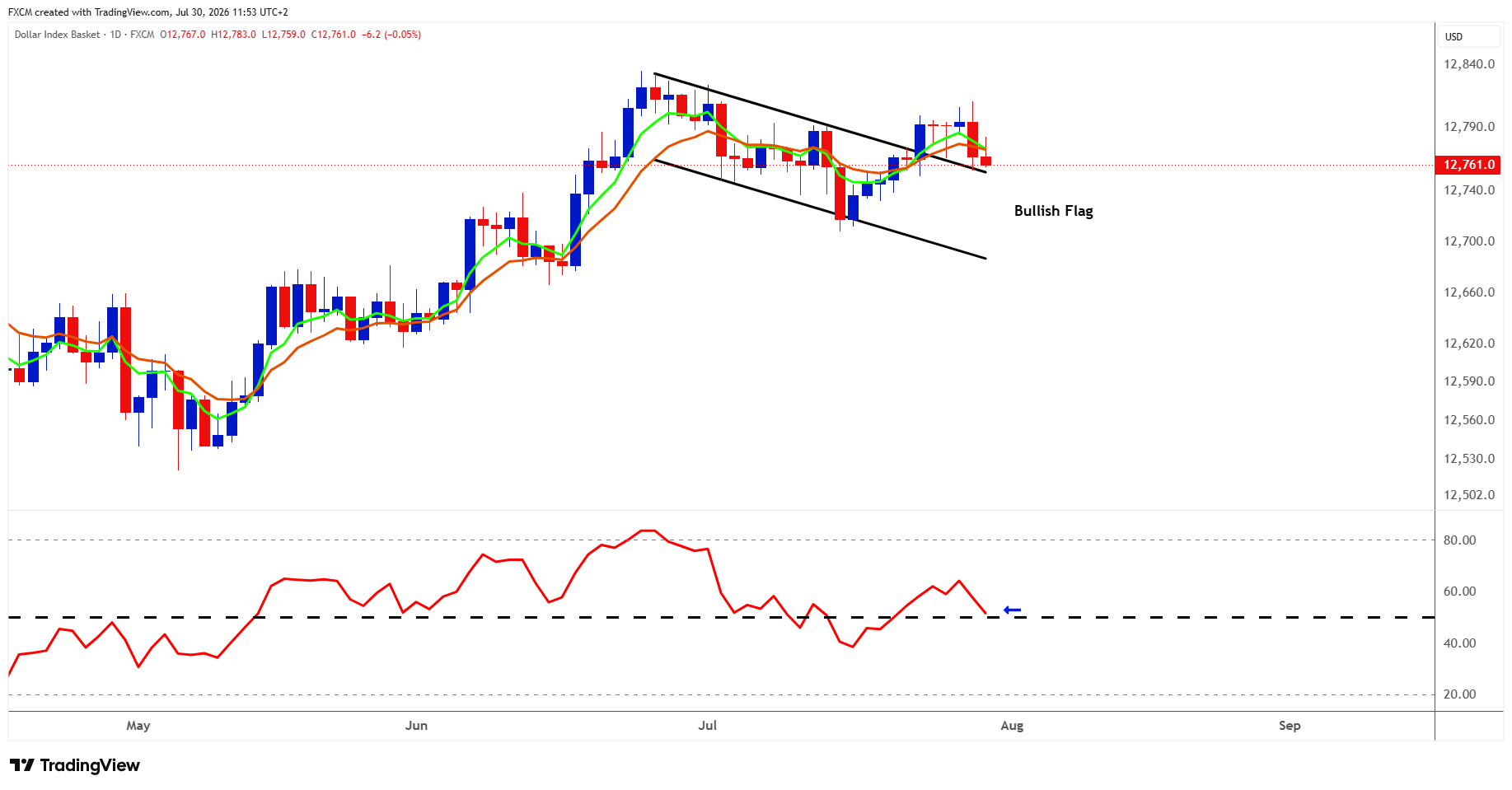
USDOLLAR has rallied sharply from its late-April low and moved into a downward-sloping consolidation resembling a bullish flag. It has tentatively broken above the channel, but the latest pullback is testing whether that break can hold. RSI is close to 50 and price is just below its short-term moving averages, leaving momentum neutral rather than clearly bullish.
A sustained move above roughly 12,800 to 12,820 would strengthen the recovery, while a break above about 12,830 would clear the late-June peak. A sustained return below the approximate 12,750 to 12,770 breakout area would weaken the pattern. A fall below roughly 12,700 would do much greater damage to the bullish case.
What Could Decide the Next Move
The two-year Treasury yield is one of the most useful near-term variables to watch, but it is not the only one. Relative foreign yields, oil prices, inflation and labour-market data, and shipping volumes through Hormuz all matter. Strong data or clearer hawkish guidance from Warsh could help USDOLLAR break higher, particularly if US short-term yields rise relative to those abroad. Softer data or continued ambiguity would leave it vulnerable even if long-term yields remain high.
USDOLLAR still has a modest upward bias, but it is fragile. US economic resilience, the prospect of eventual tightening and safe-haven demand provide support. Against that stand lower post-meeting two-year yields, uncertainty over the Fed's reaction function and the risk that high long-term yields reflect inflation anxiety rather than confidence. The next move will depend less on how tough Warsh sounds and more on whether the data, the Fed and the ships moving through Hormuz make that toughness believable.

Russell Shor
Senior Market Strategist
Russell Shor is a Senior Market Strategist at FXCM, having been promoted to the role in 2025 in recognition of his depth of insight and consistent delivery of high-impact market analysis. He originally joined FXCM in October 2017 as a Senior Market Specialist.
Russell holds an Honours Degree in Economics from the University of South Africa, is a certified FMVA®, and a full member of the Society of Technical Analysts (UK). With over 20 years of experience in financial markets, his work is renowned for its clarity, precision, and strategic value across asset classes.

Any opinions, news, research, analyses, prices, other information, or links to third-party sites contained on this website are provided on an "as-is" basis, as general market commentary and do not constitute investment advice. The market commentary has not been prepared in accordance with legal requirements designed to promote the independence of investment research, and it is therefore not subject to any prohibition on dealing ahead of dissemination. Although this commentary is not produced by an independent source, FXCM takes all sufficient steps to eliminate or prevent any conflicts of interests arising out of the production and dissemination of this communication. The employees of FXCM commit to acting in the clients' best interests and represent their views without misleading, deceiving, or otherwise impairing the clients' ability to make informed investment decisions. For more information about the FXCM's internal organizational and administrative arrangements for the prevention of conflicts, please refer to the Firms' Managing Conflicts Policy. Please ensure that you read and understand our Full Disclaimer and Liability provision concerning the foregoing Information, which can be accessed here.