
Japan and US confirm joint FX intervention: what’s next for USD/JPY?


Rare Japan-US joint FX intervention
The authorities of Japan and the United States conducted a joint intervention to support the ailing yen on Friday July 31, in a rare bilateral action. Japan Finance Minister Katayama said the JPY buying "countered excessive volatility" and "disorderly movements" in the currency, while warning of readiness for further coordinated action [1]. US Treasury Secretary Bessent reiterated his determination to act, spoke of an undervalued yen and noted that the Treasury remains "attentive and in close communication" with its Japanese counterparts. [2]
This joint action was part of a suspected series of interventions from Thursday, and potentially up to today, that have helped USD/JPY pull back from its four-decade peak. Japanese authorities had stepped into the market earlier this year, spending ¥11,734.9 billion from late April to early May to prop the yen [3]. However, this was the first joint intervention since 2011, when the G7 coordinated to weaken the yen after Japan's earthquake [4]. In terms of Japan-US coordinated yen buying specifically, that had not occurred since June 1998 and the height of the Asian financial crisis. [5]
Grounds for a lasting yen recovery?
The coordinated Japan-US intervention is a major structural escalation in the effort to support the ailing currency, making it more difficult to bet against the yen and potentially triggering an unwinding of short positions. Alongside shifts in Fed and Bank of Japan rhetoric, USD/JPY could face lasting pressure.
The Federal Reserve kept rates steady at 3.5%-3.75% last week and Chair Warsh did not provide any forward guidance or insights into his reaction function and what it would take to tighten policy [6]. This non-committal stance eroded the Fed's credibility and left investors less convinced about his resolve to contain inflation, paring back rate hike bets and weighing on the USDOLLAR.
The Bank of Japan also held last week but maintained its tightening bias, having raised rates in June to around 1%. Policymakers repeated a warning that underlying inflation could "deviate" above the 2% target and reiterated their intention to keep raising interest rates [7]. Moreover, Governor Ueda firmed up his rhetoric, boosting the chances of an acceleration in the pace of hikes and pushing short-term yields higher. The BoJ has strong incentive to keep tightening given strong wage increases, the energy shock pushing prices higher and the AI boom lifting semiconductor exports, which exacerbate inflationary pressures and support economic growth.
Structural tailwinds for USD/JPY remain
Despite the steep pullback, USD/JPY retains underlying support from persistent structural tailwinds. Chief among these is the still-vast Fed-BoJ rate differential, which keeps the structural carry trade alive, alongside stubborn yen weakness driven by fiscal concerns.
Despite Warsh's non-committal stance, he has pledged to restore price stability and downplayed a recent cooling in price pressures. Moreover, three policymakers dissented in favour of a hike last week, showing a tightening bias that could increase pressure for a September move should the data fail to show a lasting decline in inflation.
Meanwhile, BoJ Governor Ueda may have hardened his rhetoric but did not offer any overtly hawkish signals or explicit details around the timing of the next hike. The Bank of Japan remains trapped in a delicate balancing act: moving too quickly risks hurting an uneven economic recovery and sparking a sharp spike in domestic bond yields, dangerously inflating debt-servicing costs for a nation carrying a gross debt-to-GDP ratio of 204% according to the IMF. [8]
Compounding these monetary constraints is Tokyo's fiscal stance. The government continues to run expansive fiscal policies, committing over ¥3 trillion in additional spending [9] on top of a record baseline budget alongside plans to cut food taxes [10]. These measures undercut the BoJ's tightening efforts and sustain fears over Japan's public finances, weighing on the yen.
USD/JPY post-intervention outlook
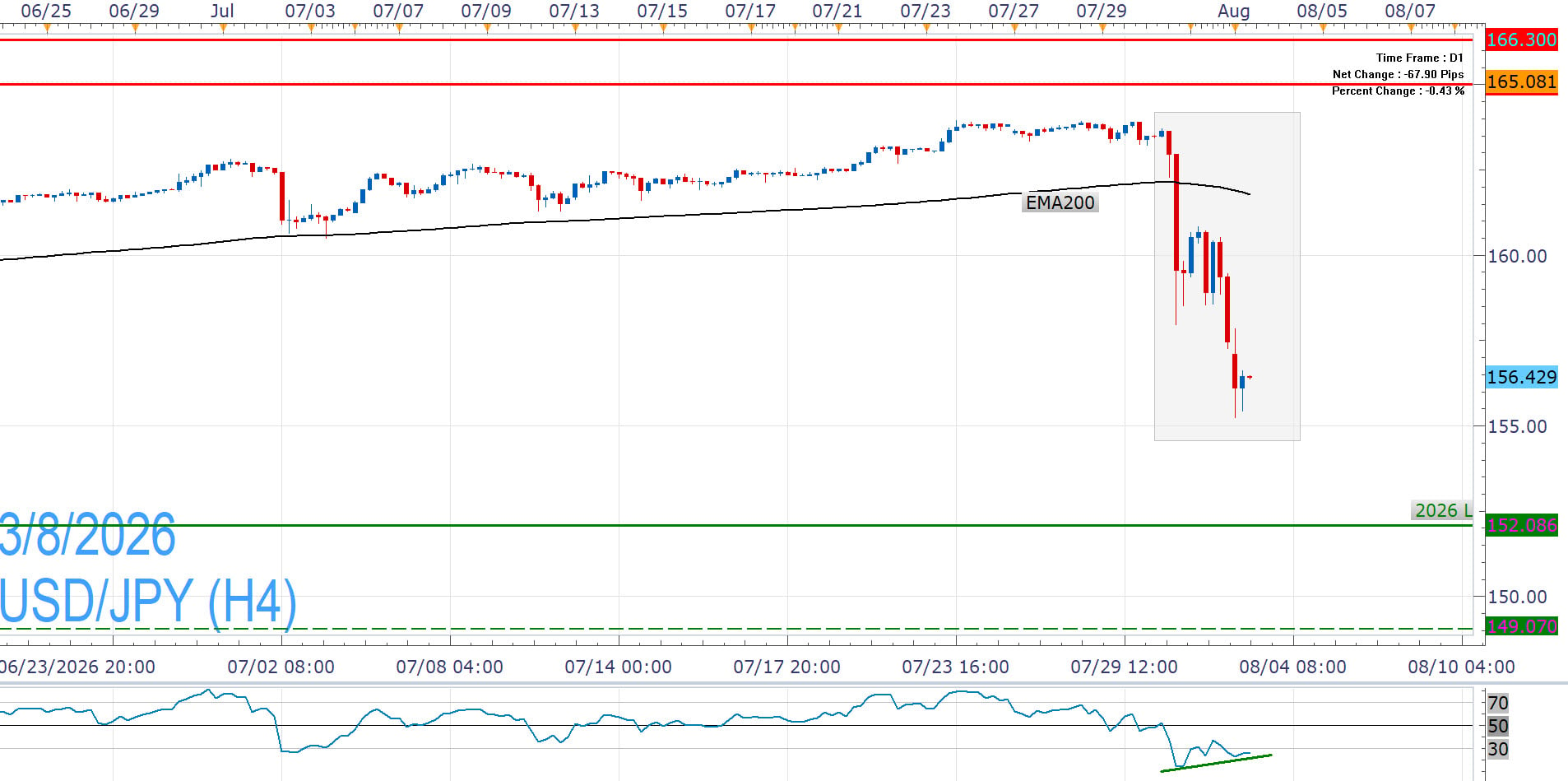
USD/JPY extends its decline following the confirmed US-Japan joint operation. This significant escalation in intervention firepower and warnings for more action will force speculative yen sellers to think twice, creating a hostile environment for fresh short positions and aiding a broader corrective phase.
Simultaneously, the dollar has softened on fading conviction over the Fed's inflation-fighting resolve, alongside a sharp drop in oil prices triggered by fresh Middle East hopes after President Trump said negotiations wth Iran will restat today [11]. These combined dynamics suggest USD/JPY may face more near-term pressure, exposing it to new 2026 lows.
However, past interventions have proved short-lived, ultimately failing to prevent new USD/JPY highs. The pair continues to face strong macro tailwinds from factors like the rate differential and fiscal concerns. The fundamental landscape remains favourable, keeping the road open to new four-decade highs. On the technical front, the RSI has not followed prices lower, a divergence that suggests the decline may be running out of steam and a rebound could ensue.

Nikos Tzabouras
Senior Financial Editorial Writer
Nikos Tzabouras is a graduate of the Department of International & European Economic Studies at the Athens University of Economics and Business. With extensive experience in market analysis and a strong foundation in international relations, he brings a unique perspective to financial markets. Nikos emphasizes not only technical analysis but also on fundamentals and the growing influence of geopolitics on financial trends.
As a Senior Financial Editorial Writer, he delivers comprehensive and forward-looking insights across a wide range of asset classes, including equities, commodities, and currencies. His work explores how macroeconomic events, political developments, and global policies impact market dynamics, providing readers with a deeper understanding of both short-term movements and long-term trends.
References
| Retrieved 03 Aug 2026 https://www.mof.go.jp/english/public_relations/statement/others/20260803073000.html | |
| Retrieved 03 Aug 2026 https://x.com/SecScottBessent/status/2084051676801933622 | |
| Retrieved 03 Aug 2026 https://www.mof.go.jp/english/policy/international_policy/reference/feio/monthly/20260529e.html | |
| Retrieved 03 Aug 2026 https://www.ecb.europa.eu/press/pr/date/2011/html/pr110318.en.html | |
| Retrieved 03 Aug 2026 https://www.newyorkfed.org/newsevents/news/markets/1998/fx980730 | |
| Retrieved 03 Aug 2026 https://www.federalreserve.gov/monetarypolicy/fomcpresconf20260729.htm | |
| Retrieved 03 Aug 2026 https://www.boj.or.jp/en/mopo/outlook/gor2607a.pdf | |
| Retrieved 03 Aug 2026 https://www.imf.org/external/datamapper/GGXWDG_NGDP@WEO/JPN | |
| Retrieved 03 Aug 2026 https://www.mof.go.jp/about_mof/mof_budget/budget/fy2026/hosei1_20260603.html | |
| Retrieved 03 Aug 2026 https://www.jimin.jp/news/information/213915.html | |
| Retrieved 13 Sep 2026 https://www.youtube.com/watch |

Any opinions, news, research, analyses, prices, other information, or links to third-party sites contained on this website are provided on an "as-is" basis, as general market commentary and do not constitute investment advice. The market commentary has not been prepared in accordance with legal requirements designed to promote the independence of investment research, and it is therefore not subject to any prohibition on dealing ahead of dissemination. Although this commentary is not produced by an independent source, FXCM takes all sufficient steps to eliminate or prevent any conflicts of interests arising out of the production and dissemination of this communication. The employees of FXCM commit to acting in the clients' best interests and represent their views without misleading, deceiving, or otherwise impairing the clients' ability to make informed investment decisions. For more information about the FXCM's internal organizational and administrative arrangements for the prevention of conflicts, please refer to the Firms' Managing Conflicts Policy. Please ensure that you read and understand our Full Disclaimer and Liability provision concerning the foregoing Information, which can be accessed here.