
Oil at $100 per Barrel Remains in Sight as Hormuz Keeps the Market on Edge


UKOil started the week under pressure, with UKOil falling back towards $93 a barrel after two consecutive weekly gains. Some profit-taking was inevitable after the recent rally, but traders also have a more immediate reason to hesitate. Washington is preparing to unveil another round of sanctions against Iran, potentially tightening the screws on a market already wrestling with severely restricted shipping through the Strait of Hormuz. For now, oil is caught between two powerful forces, genuine supply anxiety on one side and the growing economic consequences of high prices on the other.
Sanctions, Hormuz and a Fragile Supply Picture
The next test is whether Washington's sanctions actually make Iranian barrels harder to sell. There are already signs that pressure is building. Iranian shipments to China, its largest crude customer, are estimated at around 534,000 barrels per day in August, down from 823,000 in July and an average of 1.4 million barrels per day during 2025. Offers for September and October cargoes have also become scarcer. If the new measures make financing, shipping or purchasing Iranian crude more difficult, regional supply could tighten further.
Hormuz remains the bigger issue. Fewer than 20 commodity vessels crossed the strait over the latest weekend, while AIS-detected traffic has been running roughly 90% below pre-conflict levels. That disruption is already visible in the broader oil balance. The IEA now expects global oil supply to decline by 4.3 million barrels per day in 2026, while observed inventories fell by another 69 million barrels in July. The agency estimates that the global market could run a deficit of around 1.8 million barrels per day in the third quarter.
There is a catch, however. The supply shock is increasingly being accompanied by weaker consumption. The IEA expects global oil demand to fall by 1.6 million barrels per day this year as elevated fuel prices, disrupted trade and product shortages weigh on activity. Tightness is especially visible in refined products, where Atlantic Basin refining margins reached record levels in July. Oil therefore has an unusual problem: the longer the disruption lasts, the greater the chance that high prices begin destroying some of the demand supporting them.
There are also offsets on the supply side. Seven OPEC+ producers have agreed to restore another 188,000 barrels per day in September and will meet again on 6 September to reassess conditions. US refineries, meanwhile, were operating at a very high 97.2% of capacity in the week ending 14 August. These are useful pressure valves, but neither changes the central issue while one of the world's most important energy chokepoints remains severely constrained.
The range of possible outcomes remains unusually wide. The EIA expects UKOil to average around $85 in the third quarter and decline towards $78 in the fourth as Hormuz traffic gradually improves, production returns and inventories eventually rebuild. Morgan Stanley is looking in the other direction, projecting a UKOil peak of $100 in the fourth quarter as Middle East disruption and inventory draws persist. Both forecasts are plausible because they ultimately rest on different assumptions about how quickly physical oil flows normalise.
Technical Picture Keeps the Bulls Interested
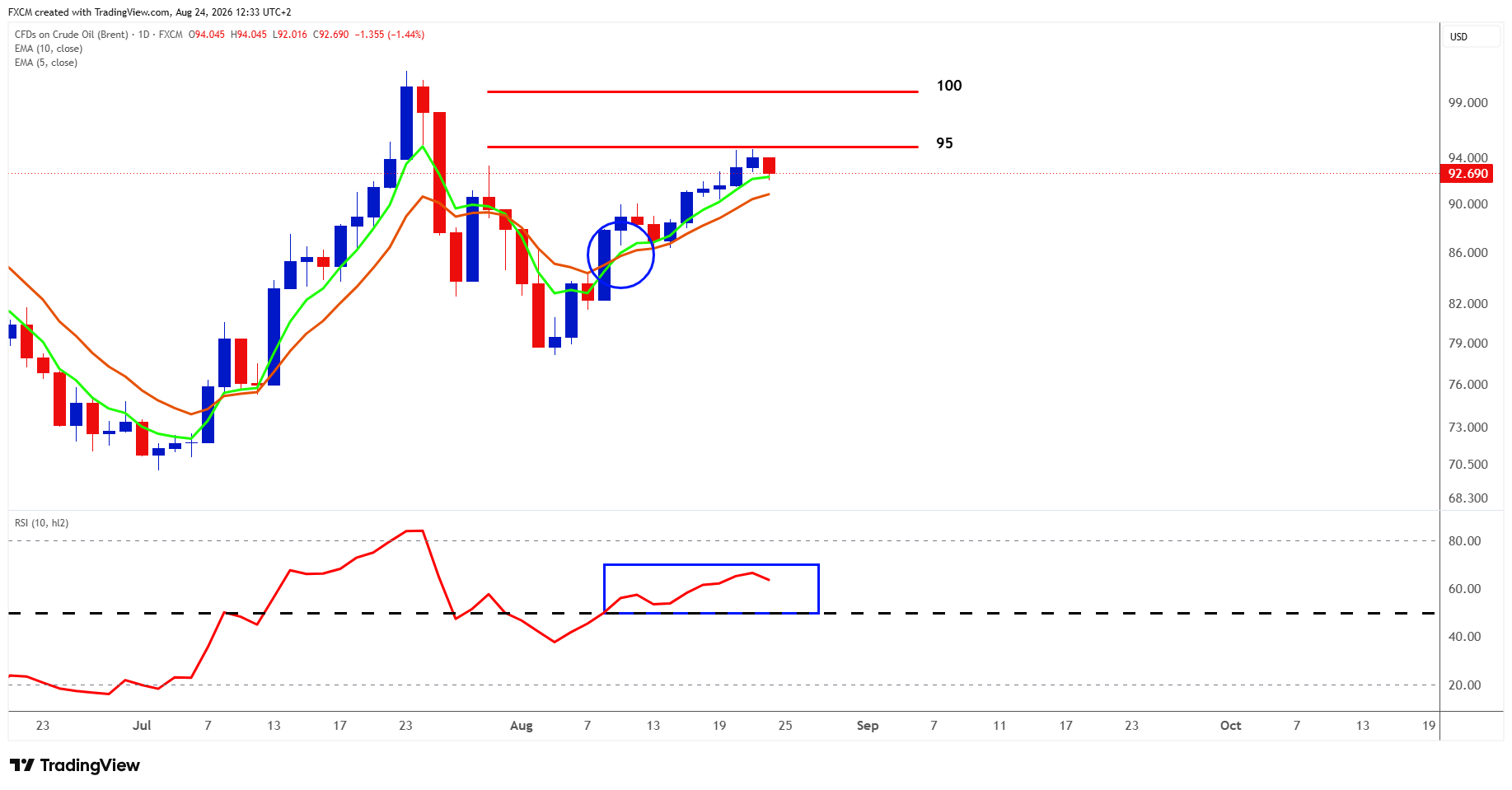
UKOil's short-term EMAs remain in bullish formation, with the 5-day EMA above the 10-day EMA, while the recent pattern of higher lows suggests buyers are still appearing on weakness. RSI remains above 50, signalling supportive rather than accelerating momentum.
The important test is now the $95-$96 technical resistance zone. A sustained break above it would reinforce the bullish structure and bring the genuinely psychological $100 level firmly into view. If UKOil fails to clear resistance, initial support sits around $90-$91, with the $87–$88 area providing a deeper technical reference point.
For now, the near-term technical bias remains positive, but this is not a market where the chart can be viewed in isolation. The next major move in UKOIL is likely to depend on whether oil can once again move more freely through Hormuz, and whether Washington's latest attempt to isolate Iran makes an already tight physical market tighter still.
References

Russell Shor
Senior Market Strategist
Russell Shor is a Senior Market Strategist at FXCM, having been promoted to the role in 2025 in recognition of his depth of insight and consistent delivery of high-impact market analysis. He originally joined FXCM in October 2017 as a Senior Market Specialist.
Russell holds an Honours Degree in Economics from the University of South Africa, is a certified FMVA®, and a full member of the Society of Technical Analysts (UK). With over 20 years of experience in financial markets, his work is renowned for its clarity, precision, and strategic value across asset classes.
These materials constitute marketing communication and do not take into consideration your personal circumstances, investment experience or current financial situation. The content is provided as general market commentary and should not be construed as containing any type of investment advice, investment recommendation and/or a solicitation for any investment transactions. This market communication does not imply or impose an obligation on you to perform an investment transaction and/or purchase investment products or services. These materials have not been prepared in accordance with legal requirements designed to promote the independence of investment research and are not subject to any prohibition on dealing ahead of the dissemination of investment research.
FXCM, and any of its Affiliates, shall not in any way be liable to you for any inaccuracies, errors or omissions, regardless of cause, in the content of these materials, or for any damages (whether direct or indirect) which may arise from the use of such materials, services and their content. Consequently, any person acting on them does so entirely at their own risk. Please ensure that you read and understand our Full Disclaimer and Liability provision concerning the foregoing Information, which can be accessed here.