
USD/JPY takes another dive, fueling fresh intervention speculation


USD/JPY analysis
Japanese authorities reportedly intervened in the FX market last Thursday [1] after a hawkish Bank of Japan rate hold failed to offer lasting support to the yen. The reported action came after stronger verbal warnings and after USD/JPY had crossed above 160.00, a level widely viewed as a line in the sand.
The move sparked a swift decline in the pair, which is experiencing another steep drop today, raising speculation that Japanese authorities stepped in again. Although its not known if such intervention has acually occurred, it would be consistent with past behaviour and the timing would be well chosen to maximise impact. The previous interventions in April/May and July 2024 each unfolded over more than one day. Furthermore, with Japanese markets closed leading to thin liquidity and the USDOLLAR already under pressure amid renewed hopes of a US-Iran deal, the effectiveness of any action could be enhanced.
USD/JPY now trades firmly below the EMA200, shifting the immediate bias to the downside and creating scope for deeper pullbacks toward this year's low (152.086). The reported intervention and speculation over further action are supporting the yen, while the monetary policy differential is also favourable. The Fed has adopted a holding stance and markets are pricing out any cuts, but the Bank of Japan is on a tightening path and has signalled additional hikes. The central bank has raised its inflation forecasts, real wages are rising and the country's largest trade union points to continued growth in negotiated wages this fiscal year.
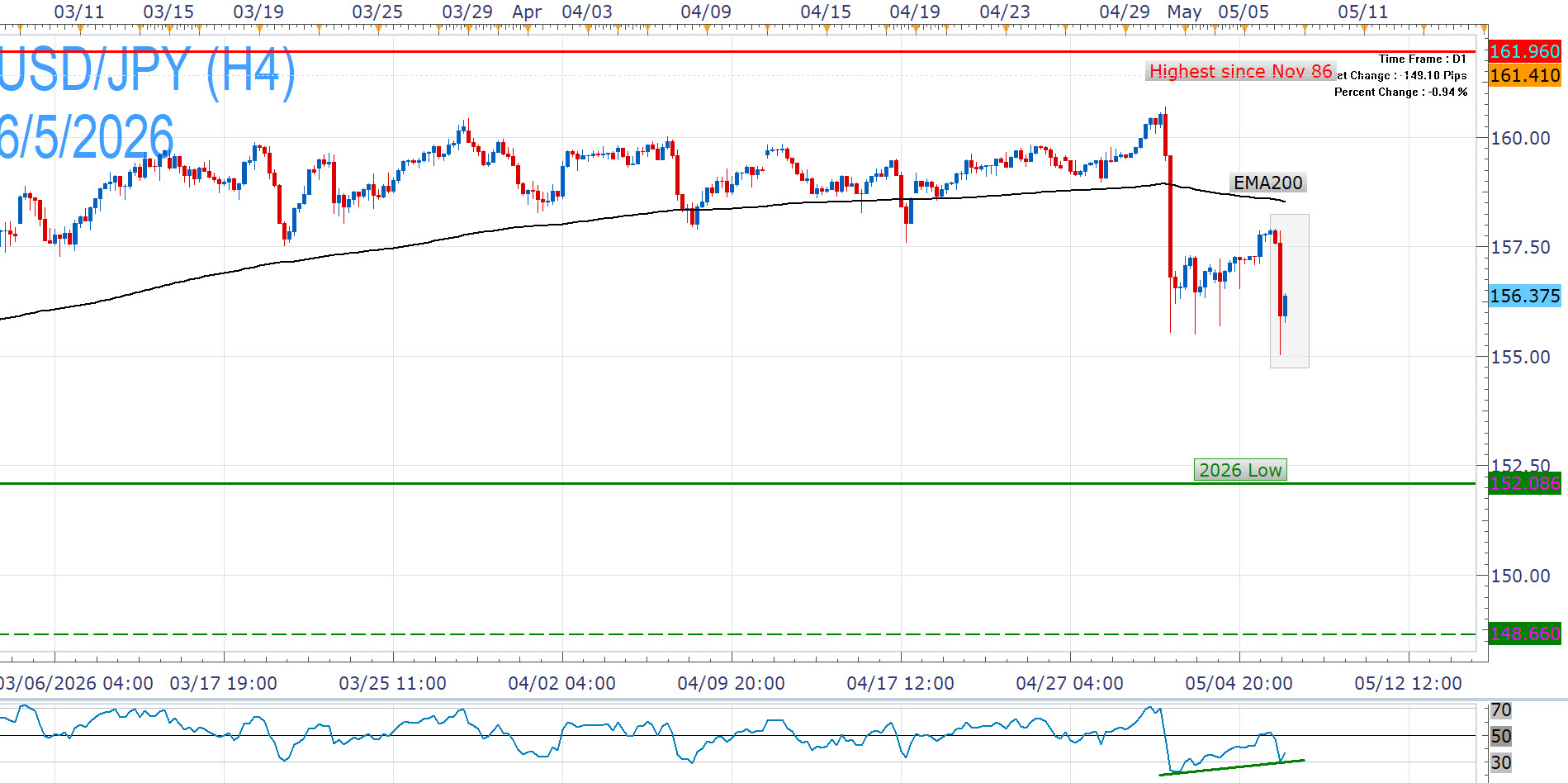
However, the move looks technically stretched and the RSI has not followed the pair lower, in a divergence that could fuel a recovery. A return above the EMA200 would restore the bullish bias and place USD/JPY back on a path toward new multi-decade highs.
The 2024 FX interventions had only a short-lived impact, ultimately failing to prevent new highs. Furthermore, the USDOLLAR has emerged as the key beneficiary of the Middle East conflict and as long as uncertainty persists, it could continue to attract safe-haven flows.
The energy shock weighs heavily on the Japanese economy, which sources most of its oil from the Middle East, complicating the BoJ's tightening path and forcing a cautious approach. Moreover, this enhances the need for fiscal stimulus, with the FY26 budget rising to a record ¥122.3 trillion. This sustains fears over Japan's public finances, one of the most indebted in the world, eroding confidence in the yen amid global currency debasement trends.

Nikos Tzabouras
Senior Financial Editorial Writer
Nikos Tzabouras is a graduate of the Department of International & European Economic Studies at the Athens University of Economics and Business. With extensive experience in market analysis and a strong foundation in international relations, he brings a unique perspective to financial markets. Nikos emphasizes not only technical analysis but also on fundamentals and the growing influence of geopolitics on financial trends.
As a Senior Financial Editorial Writer, he delivers comprehensive and forward-looking insights across a wide range of asset classes, including equities, commodities, and currencies. His work explores how macroeconomic events, political developments, and global policies impact market dynamics, providing readers with a deeper understanding of both short-term movements and long-term trends.
References
| Retrieved 01 Oct 2026 https://asia.nikkei.com/business/markets/currencies/japan-launches-fx-intervention-briefly-pushing-yen-to-155-range |

Any opinions, news, research, analyses, prices, other information, or links to third-party sites contained on this website are provided on an "as-is" basis, as general market commentary and do not constitute investment advice. The market commentary has not been prepared in accordance with legal requirements designed to promote the independence of investment research, and it is therefore not subject to any prohibition on dealing ahead of dissemination. Although this commentary is not produced by an independent source, FXCM takes all sufficient steps to eliminate or prevent any conflicts of interests arising out of the production and dissemination of this communication. The employees of FXCM commit to acting in the clients' best interests and represent their views without misleading, deceiving, or otherwise impairing the clients' ability to make informed investment decisions. For more information about the FXCM's internal organizational and administrative arrangements for the prevention of conflicts, please refer to the Firms' Managing Conflicts Policy. Please ensure that you read and understand our Full Disclaimer and Liability provision concerning the foregoing Information, which can be accessed here.