
GER30 Subdued after the ECB’s Hawkish Cut, but Bulls in Control


GER30 Analysis
The European Central Bank slashed rates on Thursday by 0.25%, for the first time in nearly five years [1]. This ended the tightening cycle that started in July 2022 and produced 10 hikes worth 450 basis points. However, the central bank raised its inflation forecast for the current year (2.5%) and the next (2.2%), following recent elevated CPI and wage prints. As a result, policymakers did not pre-commit to future moves and adopted a reserved stance, with President Lagarde cautioning that "I cannot confirm that it is the dialling-back process that is underway". [2]
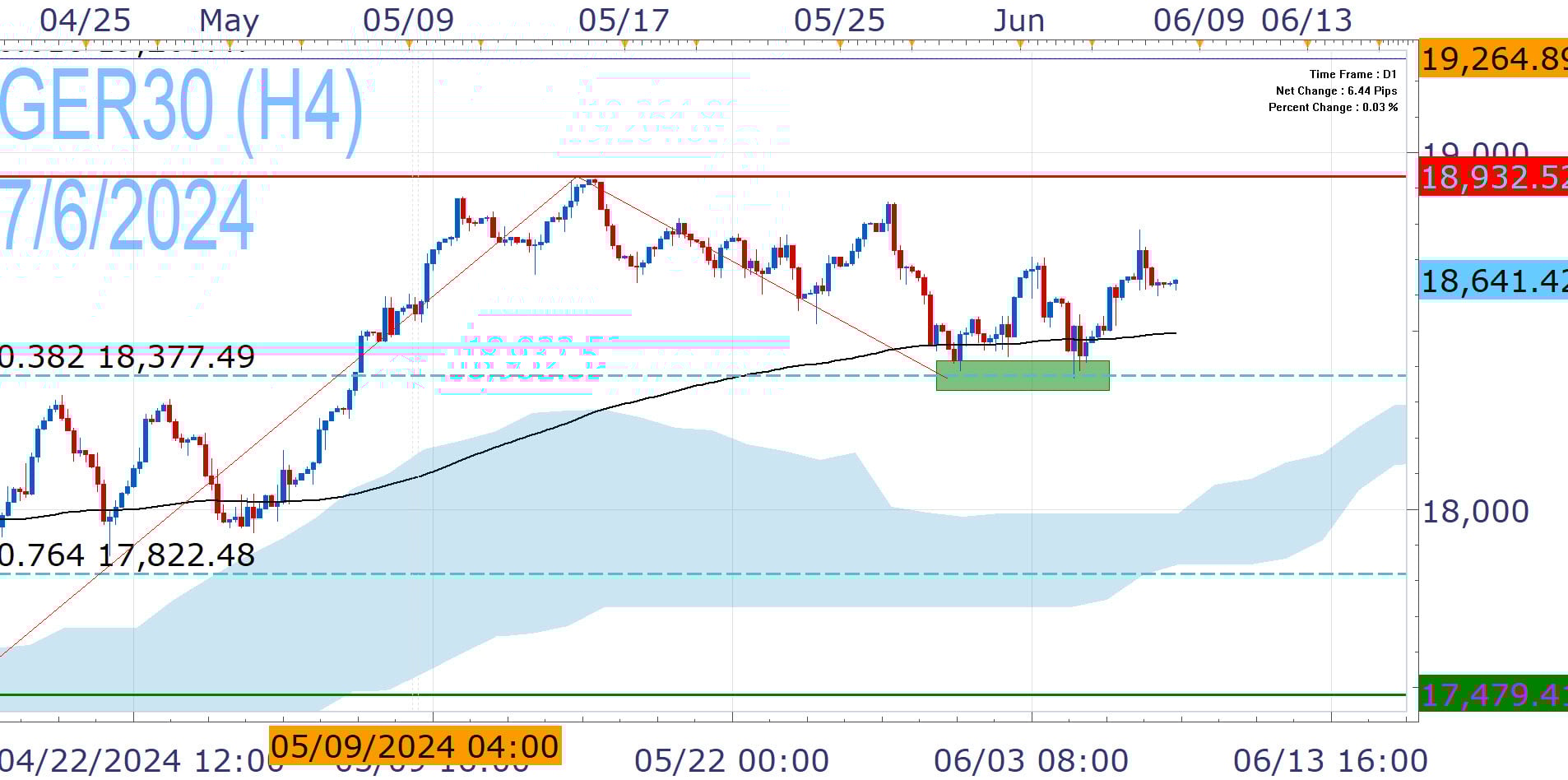
Yesterday's decision was largely a hawkish cut, while GER30 comes from three losing weeks and a series of lower highs. These factors could generate further pressure towards the pivotal 38.2% Fibonacci of the April-May surge, but prolonged weakness below this region has a higher degree of difficulty.
On the other hand, the ECB reaffirmed its view that inflation will fall below the 2% in 2026, is still likely to lower rates at least one more time during this year and the less restrictive monetary environment will be tailwind for the stock market. Furthermore, the policy differential with its major peers could weigh further on the Euro and make German stocks cheaper for foreign investors. Things are looking more upbeat for the economy as well, since Germany exited its brief recession.
On the technical front, GER30 defended the aforementioned crucial 38.2% Fibonacci, forming a double bottom and pullbacks contained by that region reaffirm the upside bias. The path of least resistance (technically and fundamentally) is higher, with bulls having the upper hand and the ability to set new records (18,932).

Nikos Tzabouras
Senior Financial Editorial Writer
Nikos Tzabouras is a graduate of the Department of International & European Economic Studies at the Athens University of Economics and Business. With extensive experience in market analysis and a strong foundation in international relations, he brings a unique perspective to financial markets. Nikos emphasizes not only technical analysis but also on fundamentals and the growing influence of geopolitics on financial trends.
As a Senior Financial Editorial Writer, he delivers comprehensive and forward-looking insights across a wide range of asset classes, including equities, commodities, and currencies. His work explores how macroeconomic events, political developments, and global policies impact market dynamics, providing readers with a deeper understanding of both short-term movements and long-term trends.

Any opinions, news, research, analyses, prices, other information, or links to third-party sites contained on this website are provided on an "as-is" basis, as general market commentary and do not constitute investment advice. The market commentary has not been prepared in accordance with legal requirements designed to promote the independence of investment research, and it is therefore not subject to any prohibition on dealing ahead of dissemination. Although this commentary is not produced by an independent source, FXCM takes all sufficient steps to eliminate or prevent any conflicts of interests arising out of the production and dissemination of this communication. The employees of FXCM commit to acting in the clients' best interests and represent their views without misleading, deceiving, or otherwise impairing the clients' ability to make informed investment decisions. For more information about the FXCM's internal organizational and administrative arrangements for the prevention of conflicts, please refer to the Firms' Managing Conflicts Policy. Please ensure that you read and understand our Full Disclaimer and Liability provision concerning the foregoing Information, which can be accessed here.