
Micron post-earnings outlook: Structural AI growth vs execution risks


The AI buildout boosts the semiconductor market
Tech giants continue to pour vast sums into data centre infrastructure to support the sprawling compute needs of expanding AI workloads. Alphabet, Amazon, Microsoft and Meta Platforms plan to spend a combined $720-$745 billion this year, up 78.96%-85.2% y/y. Gartner expects worldwide spending on AI to total $2.7 trillion in 2026, 49.5% more than last year. [1]
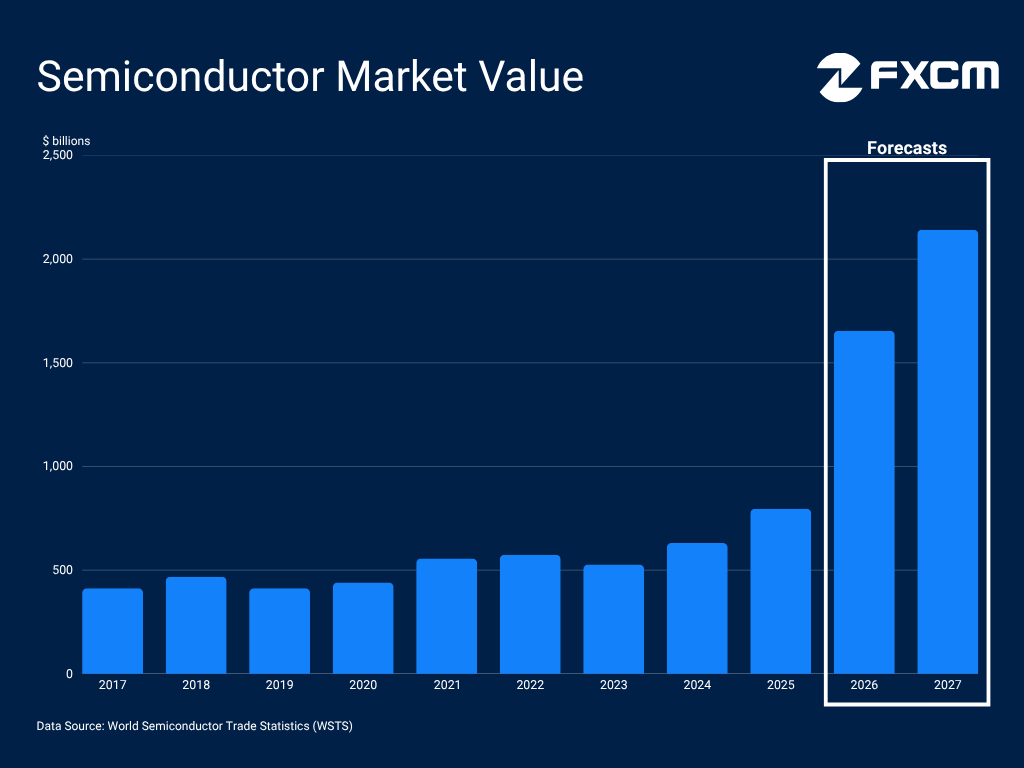
These massive capital expenditures are accelerating the entire semiconductor ecosystem. TSMC, the world's largest foundry, saw revenues jump 43.96% y/y in Q3, its fastest quarterly pace in four years [2]. Nvidia returned to triple-digit revenue growth in the July quarter (Q2 FY27), posting its biggest increase in over two years, with CEO Jensen Huang speaking of "accelerating" demand [3]. Underscoring this momentum, the WSTS projects the total semiconductor market to surpass $1.5 trillion, overwhelmingly led by memory expansion. [4]
Inference and Agentic AI boost the need for memory chips
This new phase of the data centre buildout is increasingly driven by a structural shift from model training toward continuous inference and Agentic AI. Gartner projects that 40% of enterprise applications will feature AI agents this year [5], but this functionality is expanding into consumer-facing applications too. Meta's launch of its Muse personal agent [6], which quickly topped app store download charts, and OpenAI's subsequent release of Dots [7] demonstrate how autonomous, multi-step assistants are moving into mainstream adoption.
The rise of inference and Agentic AI is turbocharging the chip industry as a whole while also increasing the need for memory and storage. Micron highlighted how this shift intensifies demand "across every layer of the compute stack and memory hierarchy"[8]. McKinsey notes that High Bandwidth Memory is crucial in keeping expensive compute resources operating efficiently while requiring much more silicon wafer capacity than standard DRAM [9]. This leads to shortages and price increases across the memory spectrum. Underscoring this structural shift, Gartner projects global memory revenue to jump roughly 280% this year, far outperforming the total semiconductor market. [10]
The memory supercycle fuels record earnings
Micron is a key player in the memory landscape and one of only three HBM makers globally, alongside South Korea's Samsung and SK Hynix. This positioning allows it to capitalise on generational demand for memory and storage solutions, with the severe crunch providing pricing power and forward visibility. During last week's earnings call, CEO Sanjay Mehrotra disclosed that the vast majority of its calendar 2027 HBM output has already been contracted to customers with "significant price increases" year-on-year. Crucially, he expects the supply-demand gap to be "much tighter" for both FY27 and FY28. [11]
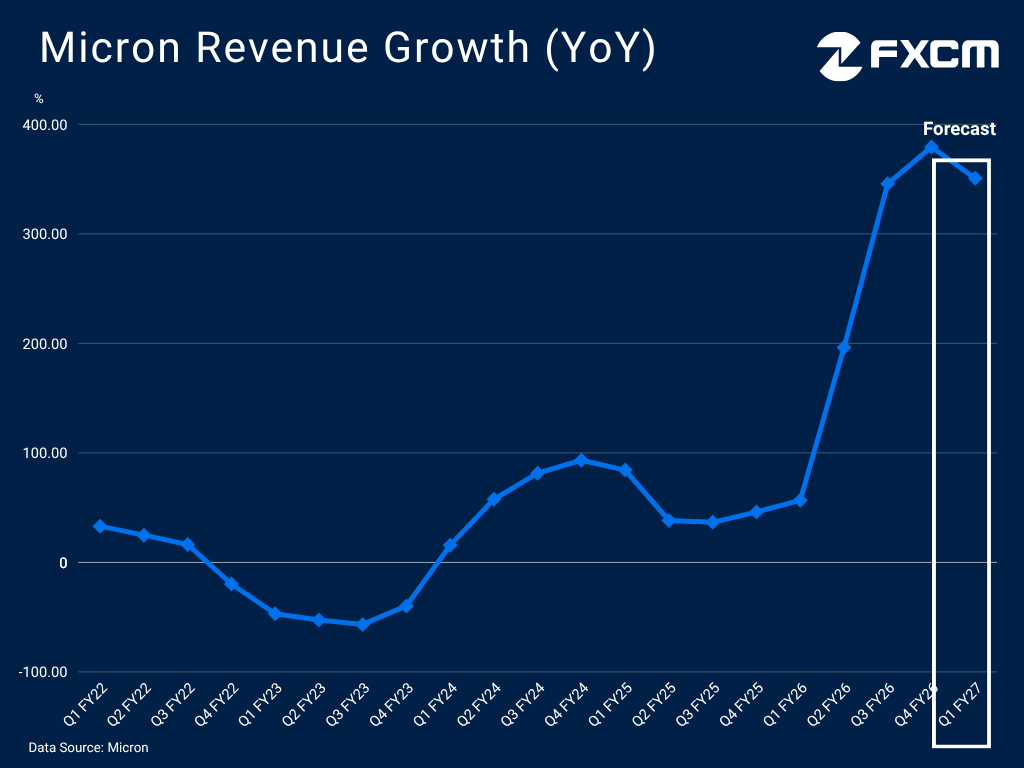
Anchored by long-term Strategic Customer Agreements, which cover over 35% of projected revenue through 2030 and include $32 billion in customer financial commitments, the firm delivered a record fiscal fourth quarter and full FY26 alongside strong guidance. Gross margins rose to an eye-watering 86.8% in Q4 FY26 - levels tech giant like Nvidia can't match - while revenues soared 379.27% y/y, led by the HBM business. Management expects to maintain strong momentum in the current quarter and sees the new fiscal year as even better than the last.
Demand surges but business pitfalls loom
To meet generational demand, Micron is investing heavily in ramping up capacity. Following a massive increase in capital expenditure in FY26, the company expects spending to roughly double in the current fiscal year. However, physical cleanroom and packaging output takes years to scale, raising concerns over future supply gluts in a traditionally hyper-cyclical industry.
These worries intersect with an increasingly challenging macroeconomic backdrop. The broader AI infrastructure buildout is heavily reliant on corporate debt issuance by hyperscalers and cloud providers. As rising bond yields push borrowing costs higher, customer capex appetites could be tested. At the same time, growing calls for safety guardrails and a pacing of development threaten to introduce deployment delays. Compounding these themes, algorithmic shifts in LLM architecture - such as DeepSeek's latest flash model, which requires 75% less HBM [12] - demonstrate how software optimisation could slow raw memory consumption growth over time.
Meanwhile, competitive pressure remains intense. Micron is a smaller player in DRAM relative to both SK Hynix and Samsung, while competing neck and neck with the latter in HBM. This means it must execute its ramp flawlessly or risk falling behind. The most recent data from Counterpoint offer reasons for concern, with Micron's HBM market share declining notably in the second quarter while Samsung pulled ahead. [13]
Micron's stock has more room to run
Memory has become a strategic asset in the AI era, driving generational demand and a multi-year supply gap that upends the historical boom-and-bust cycle of the memory industry. As a linchpin of the global AI buildout, Micron translates these dynamics directly into record-setting financials, while a structural pivot toward long-term customer agreements points to a durable windfall.
Micron's growth runway turbocharges its valuation. The stock has gained 280% year-to-date, placing it firmly in the S&P 500's top five performers and easily outpacing the iShares SOXX Semiconductor Sector Index Fund. Unprecedented demand should keep fuelling operational growth and push the stock toward new all-time highs. However, it remains vulnerable to pullbacks that could test the EMA200 and the bullish outlook.
Micron faces clear operational risks. It must scale rapidly to maintain its edge against fierce rivals without sparking market anxiety over its mounting capex. Broader AI sentiment remains fickle, while supply chain vulnerabilities and a complex geopolitical backdrop continue to pose strategic headwinds.
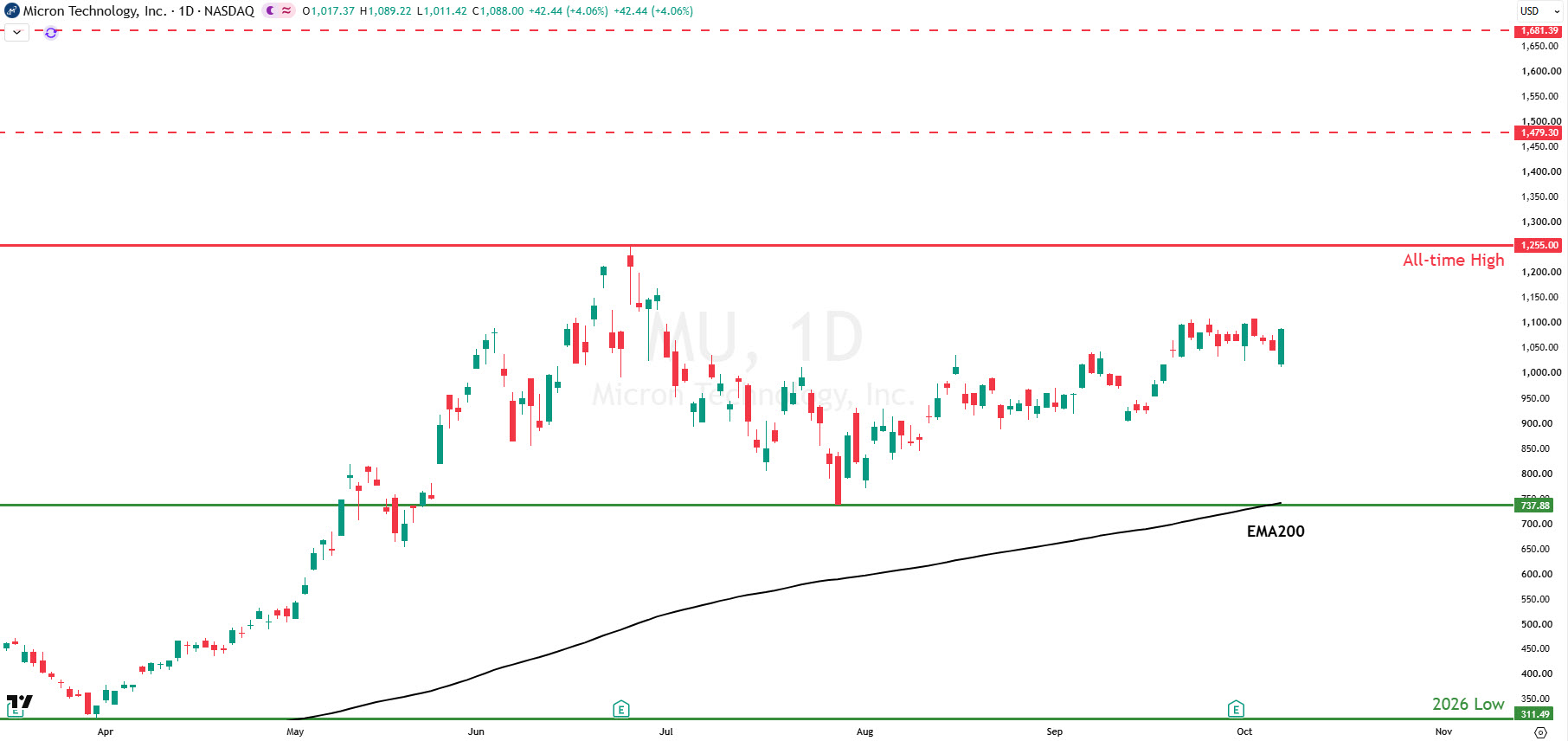
Chart source: www.tradingview.com

Nikos Tzabouras
Senior Financial Editorial Writer
Nikos Tzabouras is a graduate of the Department of International & European Economic Studies at the Athens University of Economics and Business. With extensive experience in market analysis and a strong foundation in international relations, he brings a unique perspective to financial markets. Nikos emphasizes not only technical analysis but also on fundamentals and the growing influence of geopolitics on financial trends.
As a Senior Financial Editorial Writer, he delivers comprehensive and forward-looking insights across a wide range of asset classes, including equities, commodities, and currencies. His work explores how macroeconomic events, political developments, and global policies impact market dynamics, providing readers with a deeper understanding of both short-term movements and long-term trends.


Any opinions, news, research, analyses, prices, other information, or links to third-party sites contained on this website are provided on an "as-is" basis, as general market commentary and do not constitute investment advice. The market commentary has not been prepared in accordance with legal requirements designed to promote the independence of investment research, and it is therefore not subject to any prohibition on dealing ahead of dissemination. Although this commentary is not produced by an independent source, FXCM takes all sufficient steps to eliminate or prevent any conflicts of interests arising out of the production and dissemination of this communication. The employees of FXCM commit to acting in the clients' best interests and represent their views without misleading, deceiving, or otherwise impairing the clients' ability to make informed investment decisions. For more information about the FXCM's internal organizational and administrative arrangements for the prevention of conflicts, please refer to the Firms' Managing Conflicts Policy. Please ensure that you read and understand our Full Disclaimer and Liability provision concerning the foregoing Information, which can be accessed here.