
Market Threads – Resilient Risk Appetite Meets Rising Rate Pressure

.png)
Tracking important market threads across currencies, commodities, and indices.
- Oil is at a crossroads as key support holds and geopolitical risks build, with RSI now poised to signal the market's next big move.
- USDOLLAR is testing key resistance as high US yields and Fed tightening expectations keep the bulls in control, with the next breakout potentially close.
- Gold is clinging to $4,100 support as a firm dollar and high yields keep the bears in control, leaving the next break potentially decisive.
- SPX500 is breaking into fresh highs as AI enthusiasm and earnings optimism keep the bulls firmly in control, despite the drag from elevated yields.
Cross-Asset View
Markets are sending a more nuanced message than the headline moves suggest. Energy is finding support without quite breaking free, the dollar remains well bid as rate differentials stay in focus, and the euro is struggling under a mix of domestic and external pressure. Gold is feeling the weight of firm yields and a resilient greenback, while equities continue to push higher despite a macro backdrop that is anything but comfortable. Taken together, the cross-asset picture points to a market that is still willing to take risk, but one that is becoming increasingly sensitive to yields, relative policy expectations and whether current support levels can continue to hold.
Oil
Technical Analysis
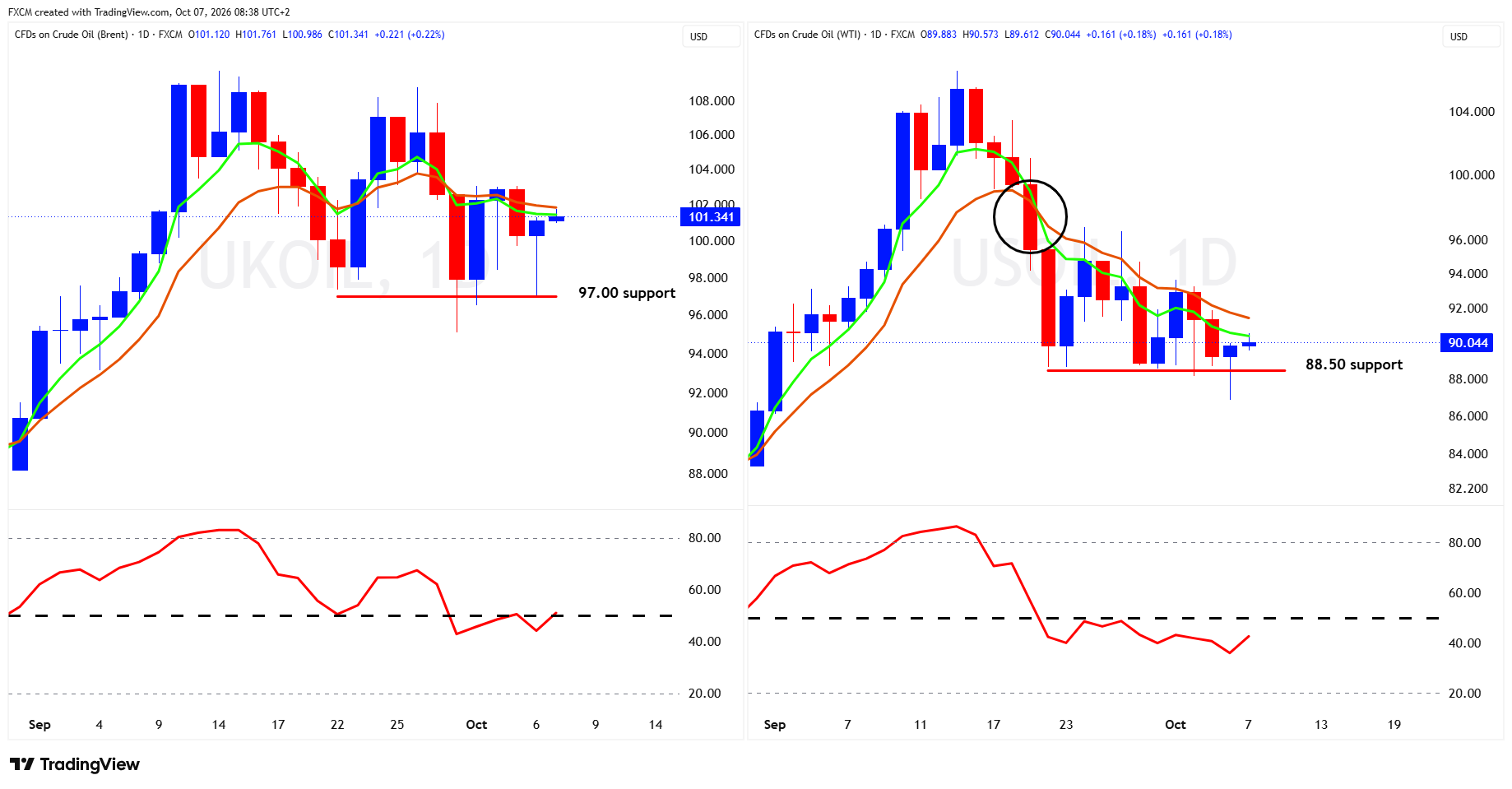
UKOIL is holding above the important $97 support zone, which keeps the immediate technical picture constructive despite the recent loss of momentum. Price has stabilised around the short-term moving averages, suggesting the market is trying to build a base rather than extend the late-September decline. The key signal now comes from RSI, which is testing the 50 midpoint. A sustained move above 50 would indicate that underlying momentum is turning positive and would strengthen the case for a renewed push towards $102–103 and potentially $104–106. If RSI fails at 50, however, it would suggest that bearish momentum is still lurking beneath the surface and could leave UKOIL vulnerable to another test of $100 and ultimately $97.
USOIL remains the weaker of the two contracts, with price still trading beneath declining moving averages and the broader structure characterised by lower highs. Even so, the repeated defence of $88.50 support is important, as sellers have so far failed to force a decisive breakdown. Momentum remains the main concern, with RSI still below 50, meaning the underlying bias remains bearish for now. A recovery above 50, particularly if accompanied by a move back through $91–92, would suggest that buyers are regaining control and that the recent weakness may be starting to reverse. Conversely, if RSI remains below 50 and $88.50 gives way, it would reinforce the bearish trend and increase the risk of a deeper move lower.
Fundamental Perspective
Fundamentally, the oil market is sending much the same message as the charts, with supply threats providing support but several factors still limiting the scope for a decisive break higher. Middle Eastern crude availability has improved, helped by Saudi Arabia's East-West Pipeline carrying around 5.8 million barrels a day, but the region remains highly exposed to fresh disruption. Recent Houthi attacks on Saudi airports in Jazan and Najran have added another layer of uncertainty, while continued attacks on tankers around the Strait of Hormuz mean geopolitical risk has hardly disappeared.
Elsewhere, a strengthening Gulf of Mexico storm is threatening important US offshore production and refining infrastructure, while recent industry data have pointed to falling US crude inventories. The broader balance also remains relatively tight, with global inventories having declined through the third quarter. Working in the opposite direction are stronger crude movements out of the Gulf and the planned release of emergency G7 stocks, which are giving the market some additional supply cushion.
The result is an oil market that still has reasons to resist significant downside, but not yet a compelling enough catalyst to send prices sharply higher. That sits neatly with the technical picture. Support is holding, but momentum still needs to prove itself, making the RSI battle around 50 particularly important.
USDOLLAR
Technical Analysis
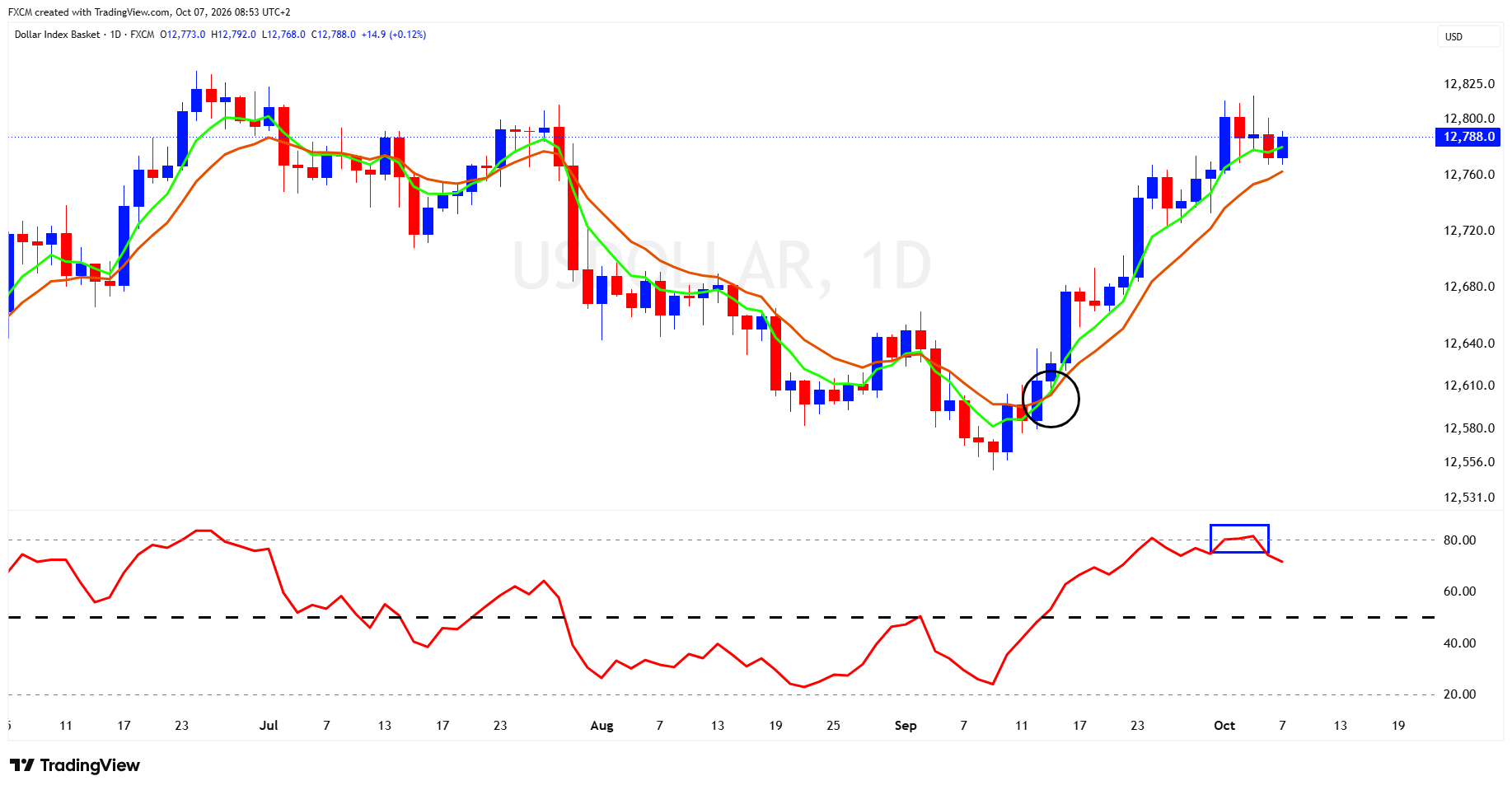
USDOLLAR remains technically constructive after the sharp September reversal, with the bullish moving-average crossover around mid-month marking a clear change in trend and price subsequently establishing a sequence of higher highs and higher lows. The index is now testing the 12,800 area, close to the highs seen earlier in the year, so some hesitation here is understandable. RSI pushed above 80 into overbought territory during the latest advance and has since started to retreat, suggesting the rally is losing some of its immediate heat rather than necessarily reversing. Importantly, momentum remains comfortably above the 50 midpoint, which keeps the underlying bias positive while price continues to hold above rising moving averages. A clean break through roughly 12,800 to 12,825 would reinforce the bullish structure and open the door to another leg higher, while a deeper RSI retreat combined with a loss of the 12,760 area would be the first meaningful sign that the recent dollar rally is beginning to tire.
Fundamental Perspective
Fundamentally, the backdrop continues to give USDOLLAR a solid foundation, although the story is no longer quite as one-sided as the recent rally might suggest. One of the clearest supports remains US yields, with the 10-year Treasury trading around 5.3% after touching 5.31% earlier this week, its highest level since 2002, as investors wrestle with persistent inflation, fiscal concerns and heavy government borrowing.
The Fed also remains part of the dollar's support story. It raised rates by 25 basis points in September to 3.75% to 4.00%, and although softer inflation and employment data have pushed the probability of another October increase down to around 20%, markets still see a strong chance of another hike by December.
Geopolitics is adding another layer. Oil is back above $100 as fresh Houthi attacks on Saudi Arabia and weather risks in the Gulf of Mexico revive supply concerns, keeping inflation risks alive, while unrest in Yemen has also encouraged some safe-haven demand for the dollar.
Meanwhile, lingering fiscal and political unease in Europe remains a headwind for the euro after it fell to a 17-month low earlier in the week, even though the recent retreat in French bond yields has taken some of the immediate pressure out of the story.
Put together, the fundamentals still favour USDOLLAR, but they also help explain why the rally is pausing rather than accelerating. High US yields and the prospect of further Fed tightening continue to favour the bulls, while the easing in RSI from overbought territory looks, for now, more like the market catching its breath than a decisive change in the underlying trend.
EURUSD Squeezed by Rates and European Risk
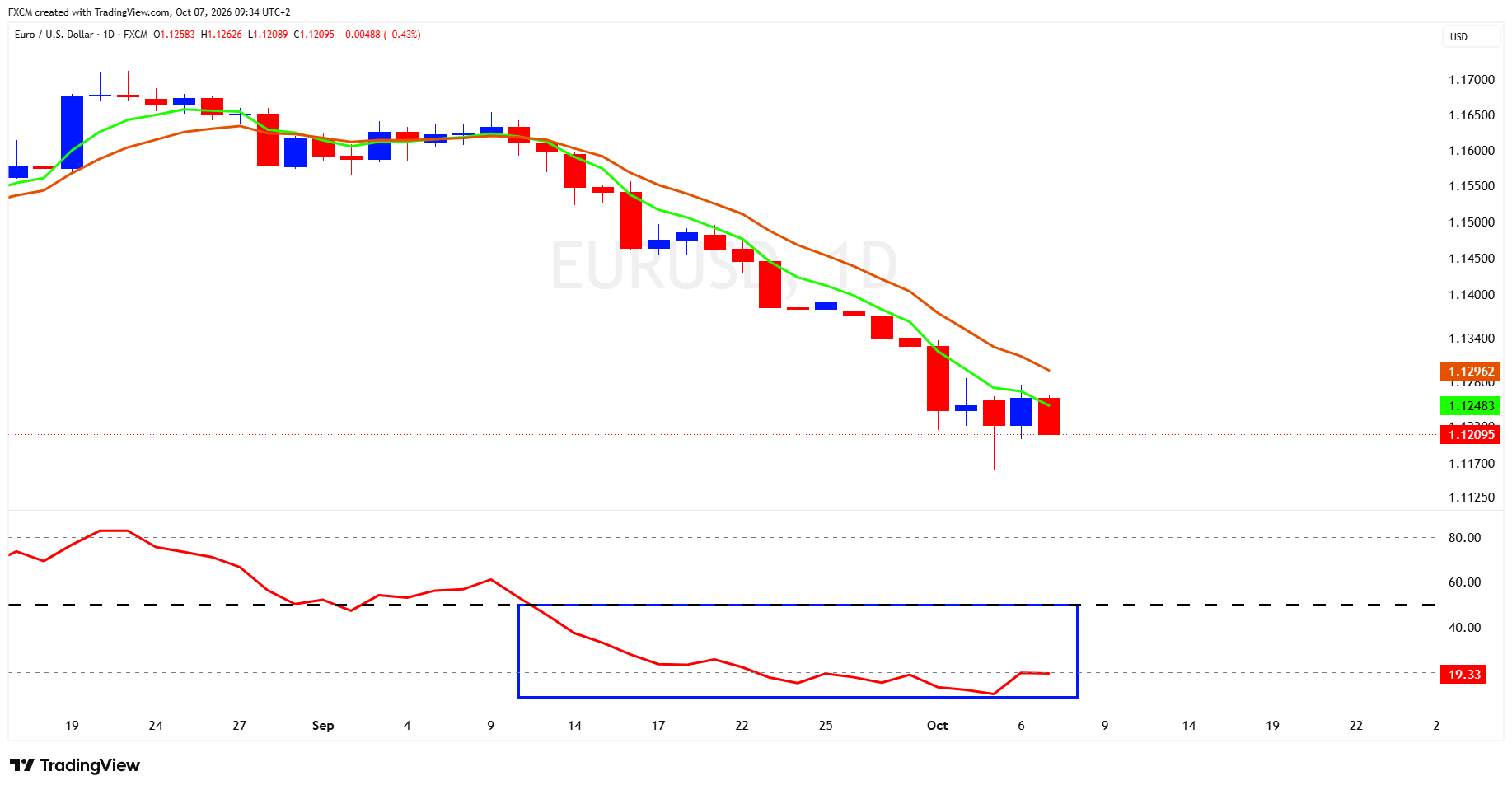
EURUSD is being squeezed from both sides. Europe has its own problems, with concerns over France's public finances and political outlook leaving the French risk premium over Germany elevated, while Spain's decision to call a snap election has added another layer of uncertainty. Those pressures helped send the euro to a 17-month low earlier this week, although some of the immediate stress has eased as French bonds recovered.
The dollar, meanwhile, continues to draw support from the US rates story. Markets have cut the probability of another Fed hike in October to around 20% but still see a high likelihood of another increase by December. That fits particularly well with the German-US two-year yield spread. There is roughly a 97% positive correlation between the spread and EURUSD, suggesting relative short-term yields have been a powerful influence on the pair. When German two-year yields lose ground relative to their US counterparts, the spread moves against the euro and EURUSD has tended to follow.
European stress can make that relationship even more interesting, with investors seeking safety in German government bonds while demanding a much larger premium to hold French debt. Add some renewed safe-haven demand for the dollar as geopolitical tensions flare, and the pressure on EURUSD becomes easier to understand. The euro is not simply facing a firm dollar. It is carrying some fairly heavy baggage of its own.
Gold
Technical Analysis
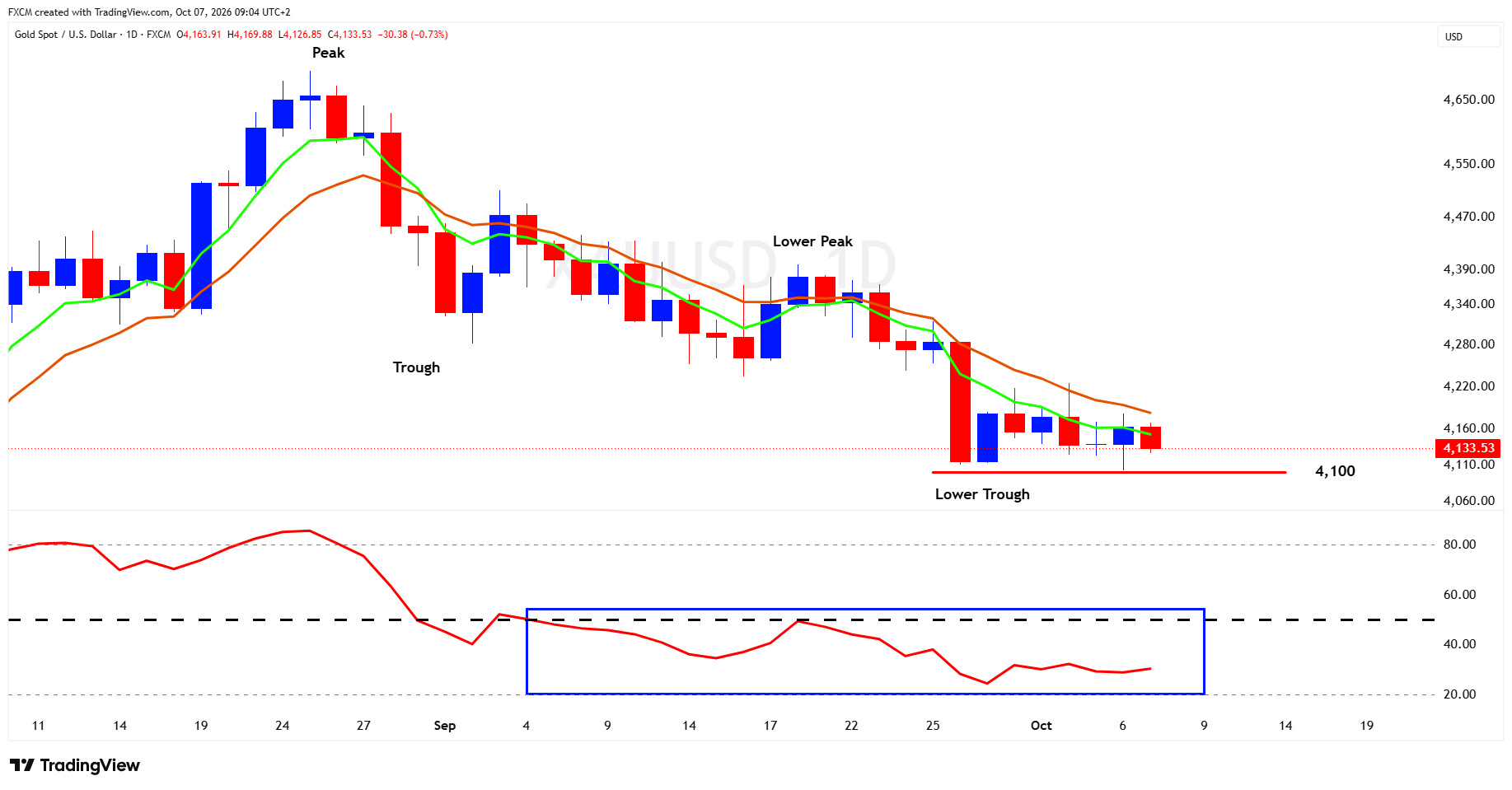
Gold remains technically fragile, with the chart still defined by a clear sequence of lower peaks and lower troughs since the late-August high. Price is trading beneath both declining short-term moving averages, which keeps the broader bias firmly bearish, while the recent sideways action just above $4,100 support looks more like consolidation after a sharp sell-off than a confirmed reversal. RSI reinforces that view. It has spent most of the past month below the 50 midpoint, showing that underlying momentum remains negative, although its slight recovery from near-oversold territory suggests selling pressure is no longer intensifying. The key level is now $4,100. A decisive break below it would confirm another lower trough and expose the market to further downside, while a sustained recovery back through roughly $4,160 to $4,200, ideally accompanied by RSI reclaiming 50, would be the first meaningful sign that the bearish trend is starting to lose its grip.
Fundamental Perspective
A firmer US dollar and exceptionally high Treasury yields remain uncomfortable company for the non-yielding metal, with the US 10-year yield trading around 5.3% today while the dollar strengthened against its major peers. Markets have sharply reduced the chances of another Fed hike in October following softer US data, but investors still see a high probability of further tightening by December, which keeps the interest-rate backdrop challenging for gold. Oil above $100 adds another wrinkle, with Middle East tensions and supply risks keeping inflation concerns alive and helping to underpin elevated bond yields.
There is still a sturdy longer-term cushion underneath gold, however. Central banks continue to add to their reserves, China has extended its buying streak to 23 consecutive months, and reserve diversification and geopolitical hedging remain important structural sources of demand. For the moment, though, those supports are fighting against a difficult macro backdrop rather than overpowering it.
With the dollar firm, yields high and another Fed hike still very much in play, the fundamentals remain consistent with gold trading below falling moving averages and RSI beneath 50. Unless the dollar or yields begin to ease meaningfully, the bulls may struggle to generate the momentum needed to turn the technical picture around.
Index in Focus: SPX500
Technical Analysis
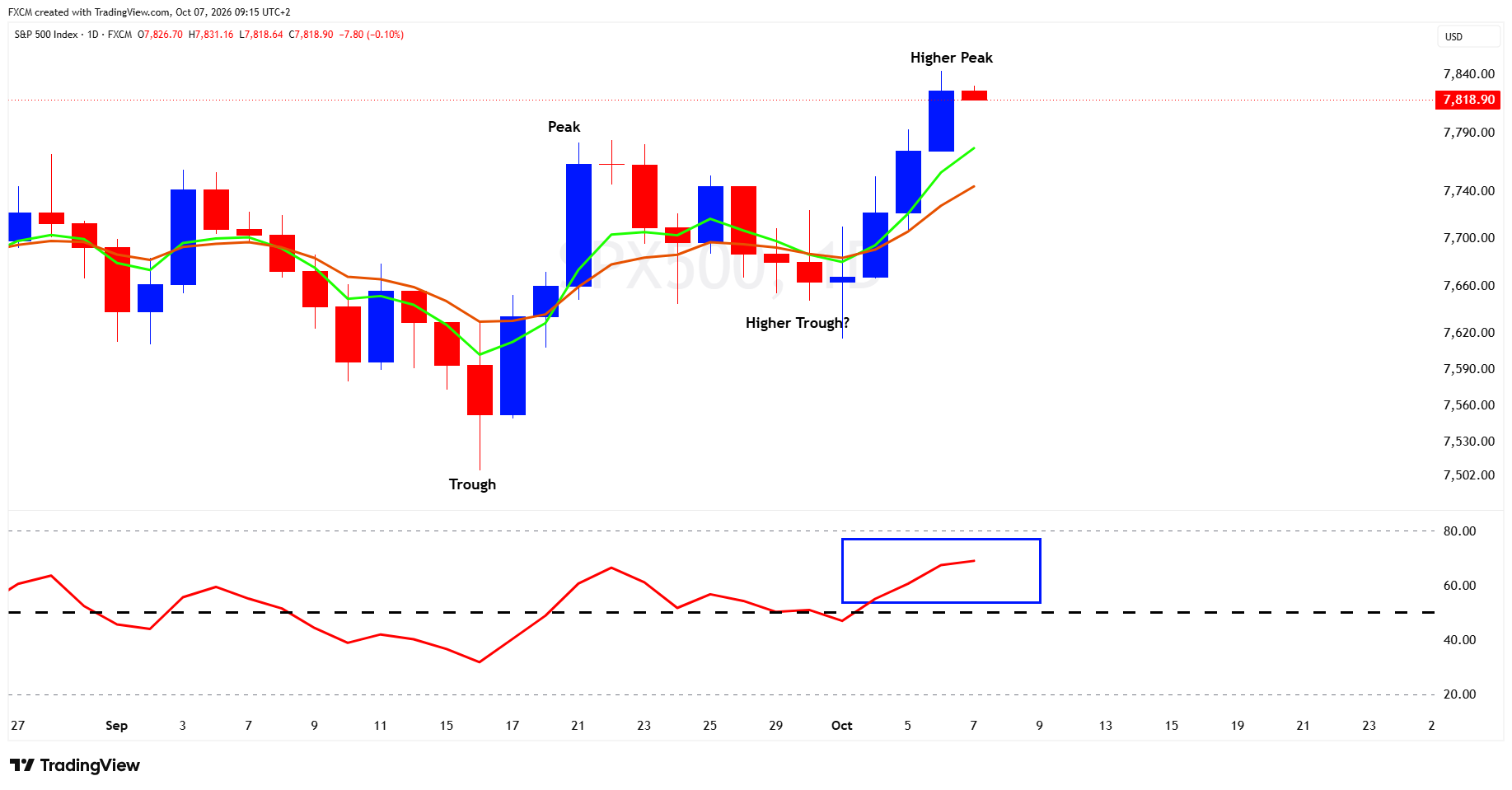
SPX500 remains technically bullish, with the chart now showing a clearer sequence of higher troughs and higher peaks as the index pushes into fresh highs around the 7,820 area. Price is trading comfortably above rising short-term moving averages, which reinforces the positive trend, while the latest consolidation near the highs looks more like a pause after a strong run than an outright reversal. RSI is also supportive, having climbed decisively above the 50 midpoint and into the upper 60s, signalling that underlying momentum remains positive without yet becoming excessively stretched. The main question now is whether buyers can maintain control above the recent breakout area around 7,790 to 7,800. Holding above that zone would keep the path open for another leg higher, while a loss of momentum accompanied by RSI slipping back towards 50 would be the first warning that the rally is starting to lose conviction.
Fundamental Perspective
US equities closed at fresh records on Tuesday as easing Treasury yields and steadier oil prices allowed investors to focus on the approaching third-quarter earnings season, while gains across AI-linked megacaps and semiconductor stocks added further support. Expectations are high, with analysts currently forecasting S&P 500 earnings growth of around 30.6% from a year earlier.
Softer inflation and employment data have also sharply reduced the probability of another Fed hike in October to around 20%, providing some relief for risk assets, although markets still price a high probability of further tightening by December.
The bond market remains the obvious obstacle. The US 10-year Treasury yield was trading around 5.3% today after recently reaching its highest level since 2002, keeping the pressure on equity valuations and ensuring that rates remain impossible for investors to ignore.
For now, earnings optimism and continued enthusiasm around AI are proving strong enough to outweigh those concerns. That fits neatly with the chart, where SPX500 is printing higher peaks and higher troughs, holding above rising moving averages and carrying RSI comfortably above 50. The bulls remain in control, but with yields still exceptionally high, the coming earnings season may need to do much of the heavy lifting if the index is going to extend its breakout.

Russell Shor
Senior Market Strategist
Russell Shor is a Senior Market Strategist at FXCM, having been promoted to the role in 2025 in recognition of his depth of insight and consistent delivery of high-impact market analysis. He originally joined FXCM in October 2017 as a Senior Market Specialist.
Russell holds an Honours Degree in Economics from the University of South Africa, is a certified FMVA®, and a full member of the Society of Technical Analysts (UK). With over 20 years of experience in financial markets, his work is renowned for its clarity, precision, and strategic value across asset classes.


Any opinions, news, research, analyses, prices, other information, or links to third-party sites contained on this website are provided on an "as-is" basis, as general market commentary and do not constitute investment advice. The market commentary has not been prepared in accordance with legal requirements designed to promote the independence of investment research, and it is therefore not subject to any prohibition on dealing ahead of dissemination. Although this commentary is not produced by an independent source, FXCM takes all sufficient steps to eliminate or prevent any conflicts of interests arising out of the production and dissemination of this communication. The employees of FXCM commit to acting in the clients' best interests and represent their views without misleading, deceiving, or otherwise impairing the clients' ability to make informed investment decisions. For more information about the FXCM's internal organizational and administrative arrangements for the prevention of conflicts, please refer to the Firms' Managing Conflicts Policy. Please ensure that you read and understand our Full Disclaimer and Liability provision concerning the foregoing Information, which can be accessed here.