
Copper to new record highs on structural demand and output challenges


Copper analysis
Copper benefits from structural demand drivers and its indispensable role in the AI boom, clean energy and the defence industry. This earnings season confirmed continued spending on the data centre buildout by hyperscalers, with Alphabet expecting its capex to roughly double and TSMC CEO C.C. Wei speaking of "extremely robust" AI demand for chips. [1]
The spike in oil and gas prices is supporting the clean energy transition, which carries forward despite challenges. Solar PV was the largest contributor to last year's energy demand growth according to the International Energy Agency, global renewable capacity additions rose to a record 800 gigawatts and electric car sales rose more than 20%. [2]
Meanwhile, the Middle East conflict and persistent geopolitical uncertainty are boosting the defence industry and security budgets. The United States is raising its budget to new records and President Trump has called for a further increase to $1.5 trillion for the next fiscal year [3]. The European Commission aims to mobilise nearly €800 billion over the next few years [4] and NATO has committed to raising investment to 5% of GDP by 2035. [5]
At the same time, the closure of the Strait of Hormuz is affecting the supply of sulphur, a byproduct of oil refining used to produce sulphuric acid, which is crucial in copper mining. The US Congressional Research Service estimates that Iran, Kuwait, Qatar, Saudi Arabia and the UAE combined produced almost a quarter of the world's sulphur supply last year [6]. According to the International Copper Study Group (ICSG), 21% of global copper mine production comes from SX-EW processes, which are directly dependent on sulphuric acid availability [7]. Adding to concerns, China is also moving to ban sulphuric acid exports according to Bloomberg. [8]
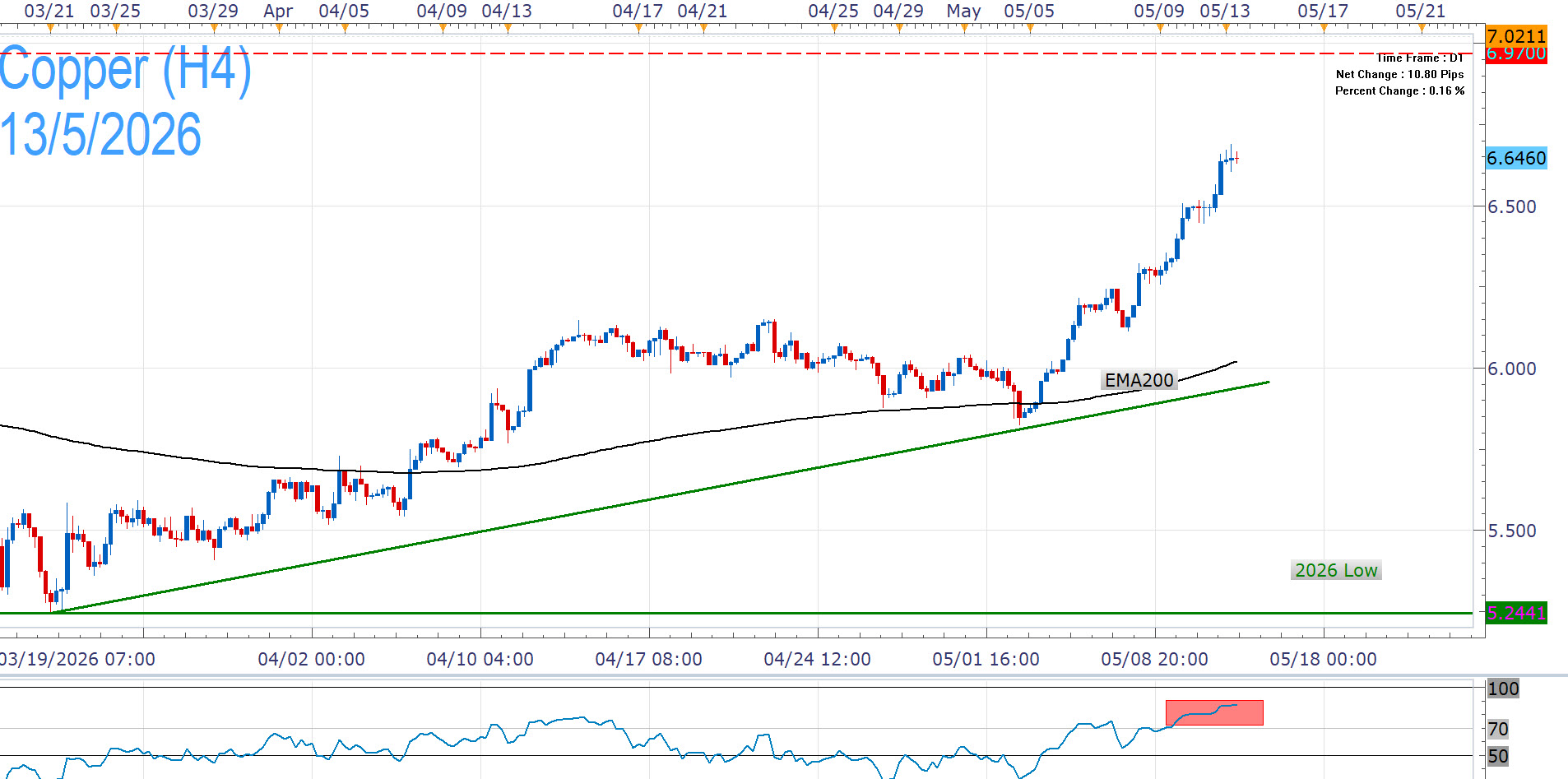
Copper hits new all-time highs today as growing fears of output disruptions due to sulphuric acid availability provide the latest catalyst. This adds to long-term demand from copper's indispensable role in critical industries, sustaining the bullish outlook and keeping the door open to further gains. However, the move is technically stretched, leaving the critical mineral exposed to a correction toward the EMA200, while the fundamentals are actually more mixed than they appear.
The ICSG has downgraded its 2026 refined copper demand outlook due to the Middle East conflict, expecting growth of 1.6%, down from 2.8% in 2025, and another surplus [9]. The conflict has sparked stagflation risks that weigh on the global economy, while a shift toward tightening by major central banks, with the RBA and BoJ already hiking, could further stifle growth. The IMF has lowered its 2026 GDP forecast to 3.1% from 3.3% and expects inflation to rise, assuming the conflict remains "limited in duration and scope", a prospect that is becoming harder to envisage. [10]
The energy shock could weigh on consumer spending and corporate investment, constraining advertising budgets, a key revenue source for the tech giants funding the AI boom, and testing market patience over their massive capex commitments. The Middle East conflict also poses real hurdles for energy-intensive chip manufacturing, making building and running AI infrastructure costlier. Meanwhile, the clean energy transition faces headwinds, particularly in the US as President Trump rolls back green energy projects.

Nikos Tzabouras
Senior Financial Editorial Writer
Nikos Tzabouras is a graduate of the Department of International & European Economic Studies at the Athens University of Economics and Business. With extensive experience in market analysis and a strong foundation in international relations, he brings a unique perspective to financial markets. Nikos emphasizes not only technical analysis but also on fundamentals and the growing influence of geopolitics on financial trends.
As a Senior Financial Editorial Writer, he delivers comprehensive and forward-looking insights across a wide range of asset classes, including equities, commodities, and currencies. His work explores how macroeconomic events, political developments, and global policies impact market dynamics, providing readers with a deeper understanding of both short-term movements and long-term trends.


Any opinions, news, research, analyses, prices, other information, or links to third-party sites contained on this website are provided on an "as-is" basis, as general market commentary and do not constitute investment advice. The market commentary has not been prepared in accordance with legal requirements designed to promote the independence of investment research, and it is therefore not subject to any prohibition on dealing ahead of dissemination. Although this commentary is not produced by an independent source, FXCM takes all sufficient steps to eliminate or prevent any conflicts of interests arising out of the production and dissemination of this communication. The employees of FXCM commit to acting in the clients' best interests and represent their views without misleading, deceiving, or otherwise impairing the clients' ability to make informed investment decisions. For more information about the FXCM's internal organizational and administrative arrangements for the prevention of conflicts, please refer to the Firms' Managing Conflicts Policy. Please ensure that you read and understand our Full Disclaimer and Liability provision concerning the foregoing Information, which can be accessed here.