
Google posts blockbuster earnings on AI-driven cloud growth


Alphabet transitions to an AI leader
Alphabet was caught off guard by the launch of ChatGPT and the advent of the AI era, but has flipped the narrative from catching up to pulling ahead. Its latest Gemini models have been very well received and the Stanford University 2026 AI Index report corroborates this, confirming that the performance gap between top-tier frontier models has effectively converged. [1]
During Wednesday's earnings call, CEO Pichai spoke of the "strongest quarter ever" in consumer AI, driven by adoption of the Gemini app. Alphabet is weaving AI across its vast ecosystem, making it easily accessible on Android and integrated into everyday apps like Gmail and its search engine, while also making progress on enterprise solutions. Gemini Enterprise, the Google equivalent of Microsoft's Copilot, has "great momentum" according to the CEO, with a 40% q/q increase in paid monthly active users. [2]
Behind the scenes, Alphabet is leveraging this intelligence to defend its advertising moat while simultaneously diversifying into high-margin hardware. Its latest TPU v8 (Tensor Processing Units), unveiled earlier this month, are specifically architected for the Agentic AI era, the industry's next inflection point where AI moves from conversation to autonomous action. These custom chips can ultimately do more than bolster self-reliance and reduce the Nvidia tax. They represent a revenue stream opportunity. CFO Anat Ashkenazi confirmed that Google will sell these TPUs to a "select group of customers", with initial revenues expected to materialise later this year.
Monetising AI: cloud becomes the key growth engine
Alphabet's AI advancements come at a high cost. The company raised its 2026 spending target to $180-$190 billion, representing an eye-watering 97%-108% y/y jump, and its CFO expects 2027 capex to "significantly increase" from the current year. However, Wednesday's results confirmed Alphabet's AI leadership and demonstrated that this spending spree is yielding a massive return on investment.
Net profits jumped 81.8% y/y in the first quarter, while total revenues rose 36% y/y at the fastest pace in two years, with strong performance across key segments. Advertising sales posted their biggest increase in four years thanks to AI tools. Crucially, Search growth continued to accelerate, reaching its highest rate since 2021. This strong Search performance is attributed to the successful implementation of AI Mode and AI Overviews, easing concerns that Alphabet's main revenue generator could take a hit from the rise of AI.
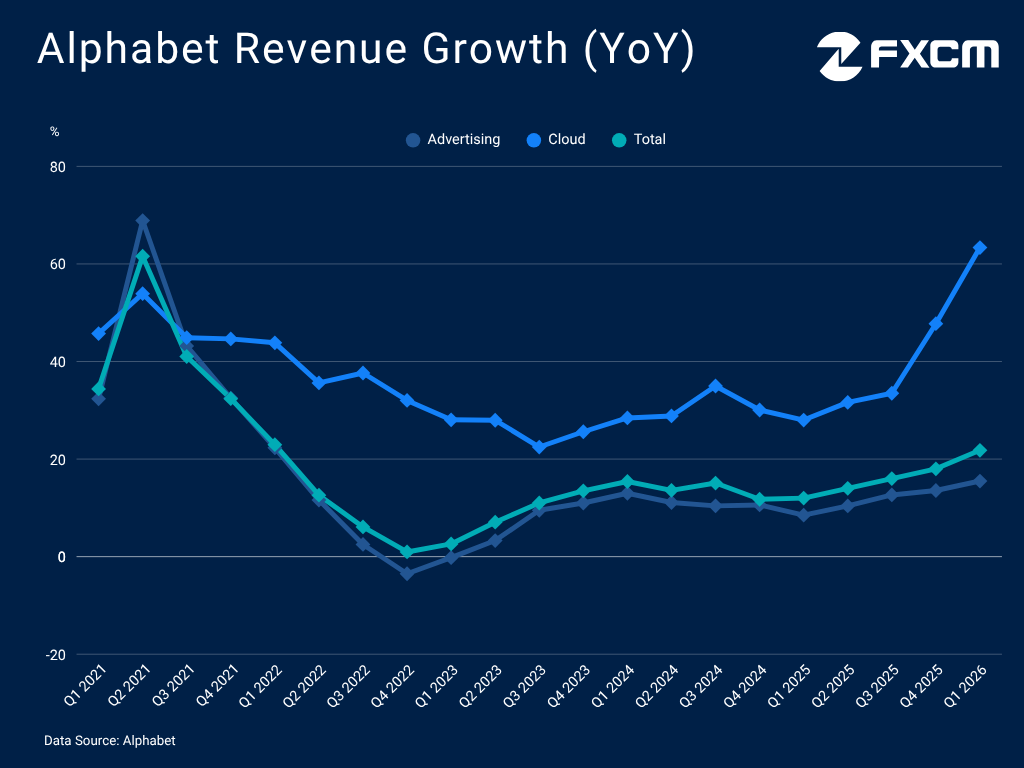
But all of Alphabet's progress and the broader proliferation of AI come down to one thing: its cloud business. CFO Ashkenazi noted "unprecedented internal and external demand" for AI compute, a demand so high that it has effectively transformed Google Cloud into the company's primary growth engine. Revenues for the segment soared by a record 63.4% y/y, with a contract backlog that nearly doubled sequentially to $462 billion.
This performance allows Alphabet to claim a significant victory over its larger rivals. While Microsoft's Azure grew by 40% and Amazon's AWS by 28% during the same period, Google Cloud's faster growth suggests it is aggressively capturing the AI migration market. CEO Sundar Pichai even pointed to near-term capacity constraints that prevented growth from reaching even higher levels, essentially providing the ultimate justification for the company's massive infrastructure investments.
Risks still loom
Despite the blockbuster results, Alphabet's AI pivot is not without significant risk. The company is operating against a volatile macroeconomic backdrop characterised by tariff uncertainties and a persistent energy shock stemming from the Middle East conflict. These disruptions to global energy flows and critical material supply chains pose tangible hurdles, potentially inflating the already eye-watering costs associated with maintaining and expanding global AI infrastructure. Furthermore, a sustained higher-for-longer inflationary environment could eventually weigh on corporate marketing budgets, a key revenue source for tech giants like Alphabet.
While Google's search engine is defying the cannibalisation narrative for now, the competitive landscape is shifting. eMarketer projects that Meta Platforms will overtake Alphabet in global digital ad revenue for the first time this year [3], fuelled by Meta's aggressive integration of AI into its social commerce stack. At the same time, while Search growth is at a four-year high, the risk remains that AI Overviews could eventually degrade click-through rates as users find answers directly on the search page without visiting publisher sites.
YouTube advertising also remains a point of concern. Ad revenue grew just 11% y/y this quarter, a notable deceleration from the 21% growth seen in the same period last year. As short-form video competition intensifies, with TikTok and Instagram Reels vying for the same eyeballs, YouTube's role as a dominant ad driver faces its toughest test yet. And despite outgrowing the market this quarter, Google Cloud remains the third-place player, trailing the deep-seated enterprise moats of Amazon Web Services and Microsoft Azure.
Alphabet stock outlook
Shares of Alphabet are riding high on AI momentum and Wednesday's blockbuster results could extend the advance to new all-time highs. Alphabet has executed a superior pivot compared to its peers. While Microsoft and Meta have faced scepticism over their spending-to-revenue ratios, Google has delivered a clear and undeniable monetisation story. The explosive cloud growth acts as a powerful shield, protecting the stock from concerns over ballooning capital expenditures.
However, from a technical perspective, the move is starting to look stretched. With the Relative Strength Index (RSI) firmly in overbought territory, there is scope for pullbacks as traders look to book profits. A technical correction could see the price drift back toward the EMA200, and while the long-term trend remains bullish, the technical picture is becoming stretched.
Ultimately, Alphabet has successfully reversed the AI laggard narrative and the strong results have earned considerable goodwill from markets. However, it remains vulnerable to risks: any shift in macroeconomic conditions, energy costs or a stumble in its custom silicon supply chain could quickly turn its record-breaking capex into an anchor.
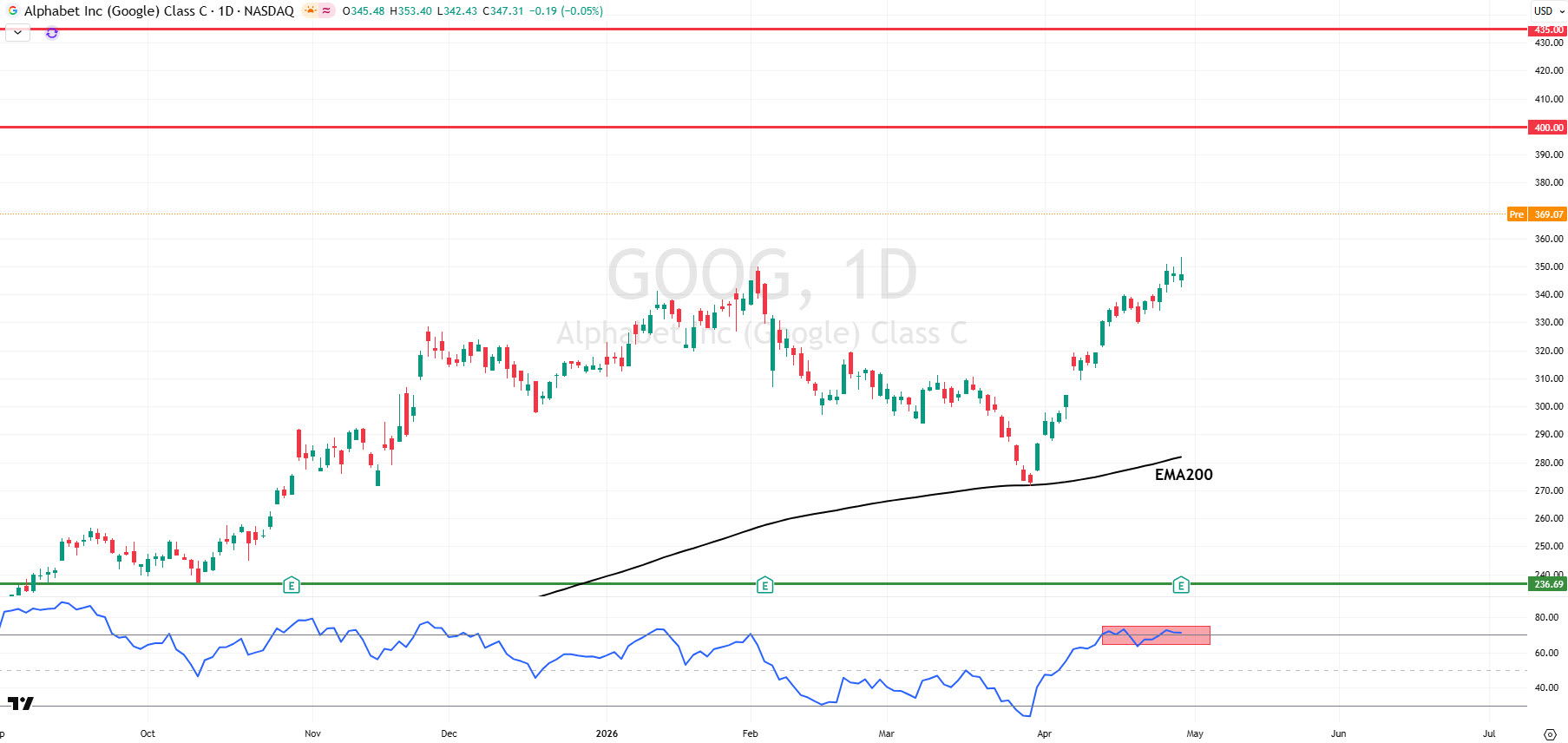
Chart source: www.tradingview.com

Nikos Tzabouras
Senior Financial Editorial Writer
Nikos Tzabouras is a graduate of the Department of International & European Economic Studies at the Athens University of Economics and Business. With extensive experience in market analysis and a strong foundation in international relations, he brings a unique perspective to financial markets. Nikos emphasizes not only technical analysis but also on fundamentals and the growing influence of geopolitics on financial trends.
As a Senior Financial Editorial Writer, he delivers comprehensive and forward-looking insights across a wide range of asset classes, including equities, commodities, and currencies. His work explores how macroeconomic events, political developments, and global policies impact market dynamics, providing readers with a deeper understanding of both short-term movements and long-term trends.
References
| Retrieved 30 Apr 2026 https://hai.stanford.edu/assets/files/ai_index_report_2026.pdf | |
| Retrieved 30 Apr 2026 https://abc.xyz/investor/ | |
| Retrieved 28 Sep 2026 https://www.emarketer.com/learningcenter/guides/meta-to-surpass-google-in-digital-ad-revenues-for-first-time-ever/ |


Any opinions, news, research, analyses, prices, other information, or links to third-party sites contained on this website are provided on an "as-is" basis, as general market commentary and do not constitute investment advice. The market commentary has not been prepared in accordance with legal requirements designed to promote the independence of investment research, and it is therefore not subject to any prohibition on dealing ahead of dissemination. Although this commentary is not produced by an independent source, FXCM takes all sufficient steps to eliminate or prevent any conflicts of interests arising out of the production and dissemination of this communication. The employees of FXCM commit to acting in the clients' best interests and represent their views without misleading, deceiving, or otherwise impairing the clients' ability to make informed investment decisions. For more information about the FXCM's internal organizational and administrative arrangements for the prevention of conflicts, please refer to the Firms' Managing Conflicts Policy. Please ensure that you read and understand our Full Disclaimer and Liability provision concerning the foregoing Information, which can be accessed here.