
USDJPY’s Violent Reversal Suggests Intervention


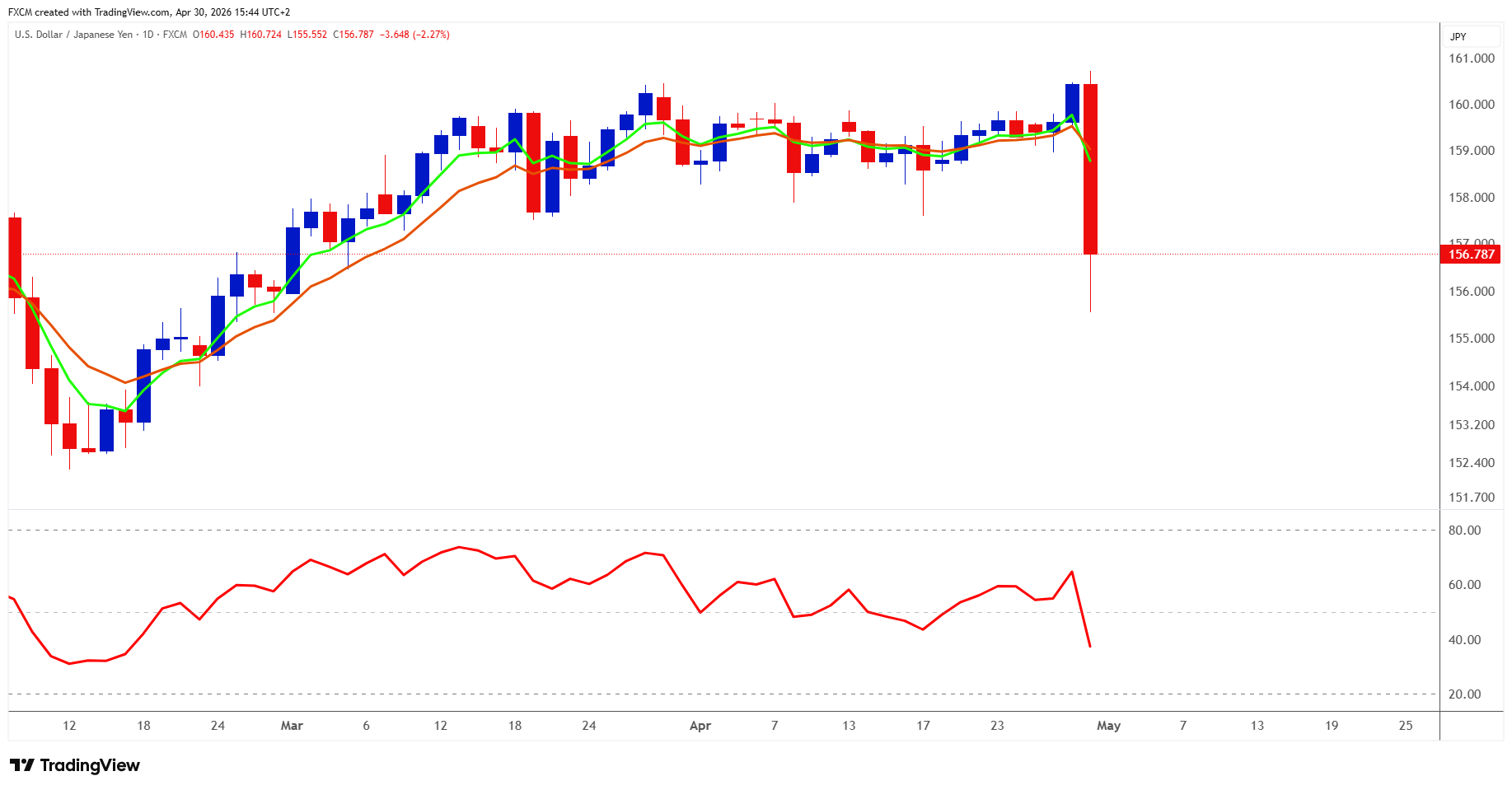
USDJPY delivered one of the wildest sessions of the year today, with a high above 160 before reversing sharply back toward the mid-150s. At its peak, the pair traded around 160.7, only to collapse more than four big figures in a matter of hours. The move immediately sparked the obvious question: did Japan intervene?
So far, there is no official confirmation of intervention. But the timing and scale of the move make one thing clear. Markets are no longer comfortable pressing yen weakness beyond 160 without consequence.
The turning point came after Japan's Finance Minister, Satsuki Katayama, issued her strongest warning yet, saying the timing for "decisive action" was approaching. That was quickly reinforced by currency diplomat Atsushi Mimura, who described recent FX moves as "extremely speculative" and delivered what traders interpreted as a final warning.
The reaction was swift. USD/JPY, which had been grinding higher for weeks, initially pushed through 160 but then reversed sharply. At one point, the yen surged roughly 3% on the day, its biggest move in years, with the dollar falling back toward the mid-156 area.
Importantly, even after the move, officials did not confirm intervention, and Japan's finance ministry declined to comment.
Why 160 Matters More Than Ever
To understand why this move was so violent, you have to look at how crowded the trade had become. For months, investors have been heavily short the yen, driven by a simple macro story: US rates remain elevated, while Japan continues to run much looser policy. That yield gap has kept carry trades firmly in place.
At the same time, rising energy prices linked to geopolitical tensions have weighed on Japan's economy and currency, reinforcing the downward pressure on the yen.
That combination pushed USDJPY steadily toward 160, a level that carries real significance. It is widely seen as the point where Japanese authorities become far more sensitive to currency weakness, not because of the number itself, but because of the pace and disorder of the move. Past episodes near this level have triggered intervention or at least strong policy responses.
What changed today was not just the level, but the tone from policymakers. The language shifted from routine caution to something much more direct. When officials start talking about "decisive action" and "extremely speculative moves," markets tend to listen.
The sharp reversal that followed looks consistent with intervention and a rapid unwind of short yen positions. Some traders also pointed to falling oil prices during the session as an additional factor supporting the yen bounce.
The Bottom Line
There is still no confirmation that Japan stepped into the market. But that may not matter.
The message from Tokyo has clearly shifted, and the reaction tells you everything about positioning. Above 160, USDJPY is no longer just a macro trade driven by rates and energy. It has become a policy risk trade, where the biggest danger is not fundamentals, but the moment authorities decide enough is enough.

Russell Shor
Senior Market Strategist
Russell Shor is a Senior Market Strategist at FXCM, having been promoted to the role in 2025 in recognition of his depth of insight and consistent delivery of high-impact market analysis. He originally joined FXCM in October 2017 as a Senior Market Specialist.
Russell holds an Honours Degree in Economics from the University of South Africa, is a certified FMVA®, and a full member of the Society of Technical Analysts (UK). With over 20 years of experience in financial markets, his work is renowned for its clarity, precision, and strategic value across asset classes.

Any opinions, news, research, analyses, prices, other information, or links to third-party sites contained on this website are provided on an "as-is" basis, as general market commentary and do not constitute investment advice. The market commentary has not been prepared in accordance with legal requirements designed to promote the independence of investment research, and it is therefore not subject to any prohibition on dealing ahead of dissemination. Although this commentary is not produced by an independent source, FXCM takes all sufficient steps to eliminate or prevent any conflicts of interests arising out of the production and dissemination of this communication. The employees of FXCM commit to acting in the clients' best interests and represent their views without misleading, deceiving, or otherwise impairing the clients' ability to make informed investment decisions. For more information about the FXCM's internal organizational and administrative arrangements for the prevention of conflicts, please refer to the Firms' Managing Conflicts Policy. Please ensure that you read and understand our Full Disclaimer and Liability provision concerning the foregoing Information, which can be accessed here.