
RBA hikes rates in split vote amid inflationary risks from the Middle East conflict


The Middle East conflict sparks stagflation risks
The war in the Middle East has now entered its third week, with both sides adopting a defiant stance and offering little hope for an end to the conflict. The US President said he requested to delay the upcoming summit with Chinese President Xi by "a month or so" due to the situation [1], raising fears that the campaign will carry on for an extended period.
The United States has intensified its strikes in recent days and expanded operations by targeting Kharg Island, with President Trump telling NBC they could hit it again "just for fun" [2]. Meanwhile, Iran continues attacks on neighbouring countries and its new Supreme Leader, seen as a hardliner, has insisted that the Strait of Hormuz must remain closed, while the Foreign Minister repeated on CBS that Tehran has not asked for negotiations. [3]
The conflict has fuelled a spike in oil prices as the Strait of Hormuz remains effectively shut, hits on Kharg Island heighten supply fears, oil facilities are targeted and key producers reduce output. Higher energy prices have sparked stagflation risks that complicate the monetary policy decisions of central banks, including that of Australia.
On the other hand, the energy shock could prove temporary and oil flows would be restored should the war end. Despite current severe disruptions, the International Energy Agency (IEA) still believes supply is set to outpace demand this year [4]. Moreover, the release of oil stockpiles by the IEA, the partial lifting of sanctions by the US and a push to secure transit through the Strait of Hormuz could offer relief.
RBA delivers back-to-back hike on inflationary pressures
Australia has already been battling elevated price pressures, with the central bank becoming a frontrunner in monetary tightening due to its pivot to rate hikes last month and forecasts pointing to higher inflation and interest rates. The Middle East conflict adds to these pressures and the RBA today delivered its first back-to-back increase in nearly three years. [5]
Officials raised rates by 25 basis points, acknowledging that the conflict has already led to "sharply higher fuel prices" and noting a "material risk" that inflation will remain above target "for longer than previously anticipated". Treasurer Jim Chalmers had also pointed to such prospects, speaking of a peak at "mid to high fours" on Sky News on Sunday. [6]
RBA policymakers were divided, with four of nine members voting in favour of a hold, though this is not a dovish signal as it appears to be a matter of timing rather than direction. During her post-meeting press conference, Governor Bullock said these dissenters stood pat "in a hawkish sense" and remained focused on the need for additional tightening. [7]
The RBA did not offer specific guidance but its bias is clearly toward additional rate increases. Still, officials may need to proceed with caution as the energy shock could weigh on the economy. Despite being a major energy exporter, Australia still relies on refined oil imports [8], leaving it exposed to supply disruption and higher prices. The Board alluded to such headwinds, saying that higher prices and prolonged uncertainty could cause "growth to be lower".
What's next for AUD/USD?
The Aussie benefits from the RBA's lead in rate hikes, with persistent inflation, low unemployment and economic resilience leaving room for further tightening. Meanwhile, the US remains on an easing cycle and the next Fed chair may be more attuned to President Trump's preference for lower borrowing costs.
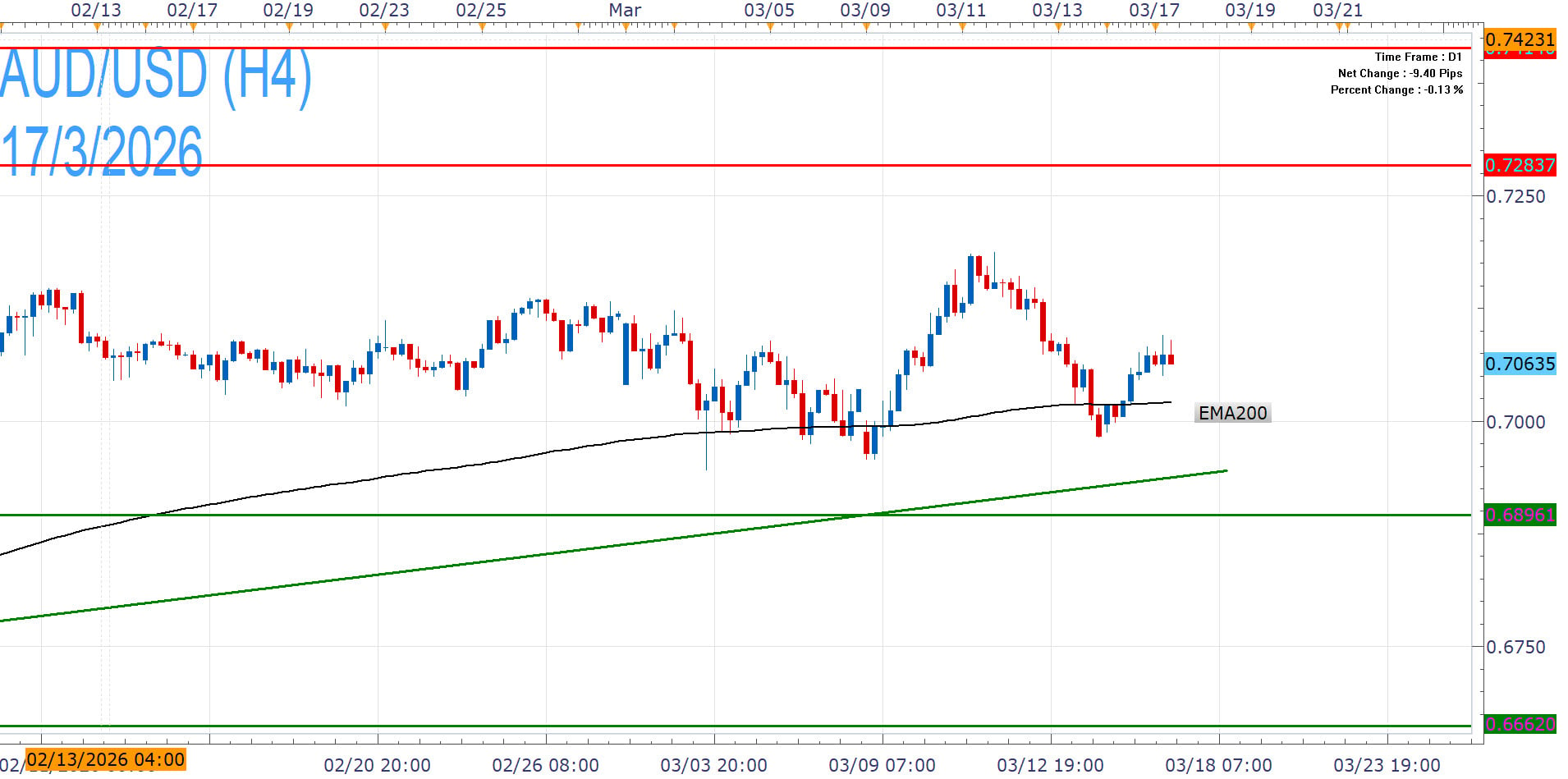
AUD/USD has gained roughly 6% this year and the favourable monetary policy backdrop creates scope for further gains. The technical backdrop is also supportive, as the pair maintains its bullish momentum above the EMA200 and could set new multi-year highs beyond 0.7283.
Nonetheless, AUD/USD faces pressure immediately after the decision given the split vote, which raised some concerns that further tightening may not come easily. Growth risks also warrant caution, risk aversion is not favourable for the Aussie, and the USDOLLAR continues to benefit from safe-haven demand during this turbulent period alongside a hawkish repricing of Fed rate cut expectations. As a result, AUD/USD is vulnerable to pullbacks that would test the bullish outlook, though prolonged weakness appears unlikely under current conditions.

Nikos Tzabouras
Senior Financial Editorial Writer
Nikos Tzabouras is a graduate of the Department of International & European Economic Studies at the Athens University of Economics and Business. With extensive experience in market analysis and a strong foundation in international relations, he brings a unique perspective to financial markets. Nikos emphasizes not only technical analysis but also on fundamentals and the growing influence of geopolitics on financial trends.
As a Senior Financial Editorial Writer, he delivers comprehensive and forward-looking insights across a wide range of asset classes, including equities, commodities, and currencies. His work explores how macroeconomic events, political developments, and global policies impact market dynamics, providing readers with a deeper understanding of both short-term movements and long-term trends.
References
| Retrieved 17 Mar 2026 https://www.youtube.com/watch | |
| Retrieved 17 Mar 2026 https://www.nbcnews.com/politics/donald-trump/iran-negotiate-ceasefire-deal-trump-kharg-hormuz-oil-rcna263474 | |
| Retrieved 17 Mar 2026 https://www.cbsnews.com/news/face-the-nation-full-transcript-03-15-2026/ | |
| Retrieved 17 Mar 2026 https://www.iea.org/reports/oil-market-report-march-2026 | |
| Retrieved 17 Mar 2026 https://www.rba.gov.au/media-releases/2026/mr-26-08.html | |
| Retrieved 17 Mar 2026 https://rba.livecrowdevents.tv/MediaConferenceMonetaryPolicyDecision17March/stream | |
| Retrieved 28 Sep 2026 https://www.dfat.gov.au/sites/default/files/australias-goods-services-by-top-25-imports-2024-25.pdf |

Any opinions, news, research, analyses, prices, other information, or links to third-party sites contained on this website are provided on an "as-is" basis, as general market commentary and do not constitute investment advice. The market commentary has not been prepared in accordance with legal requirements designed to promote the independence of investment research, and it is therefore not subject to any prohibition on dealing ahead of dissemination. Although this commentary is not produced by an independent source, FXCM takes all sufficient steps to eliminate or prevent any conflicts of interests arising out of the production and dissemination of this communication. The employees of FXCM commit to acting in the clients' best interests and represent their views without misleading, deceiving, or otherwise impairing the clients' ability to make informed investment decisions. For more information about the FXCM's internal organizational and administrative arrangements for the prevention of conflicts, please refer to the Firms' Managing Conflicts Policy. Please ensure that you read and understand our Full Disclaimer and Liability provision concerning the foregoing Information, which can be accessed here.