
European automakers grapple with China competition, tariffs and macro-geopolitical uncertainty


Why are European Automakers struggling in 2026?
The European auto industry faces a severe crisis in 2026, driven by the combination of China's EV rise, the economic fallout from the Middle East conflict and an adverse trade environment marked by US tariffs. Chinese brands dominate their domestic market and are rapidly expanding across Europe to capture market share. Concurrently, the Middle East conflict and trade disruptions are increasing operational costs and squeezing profit margins, while persistent macroeconomic headwinds weigh on consumer demand.
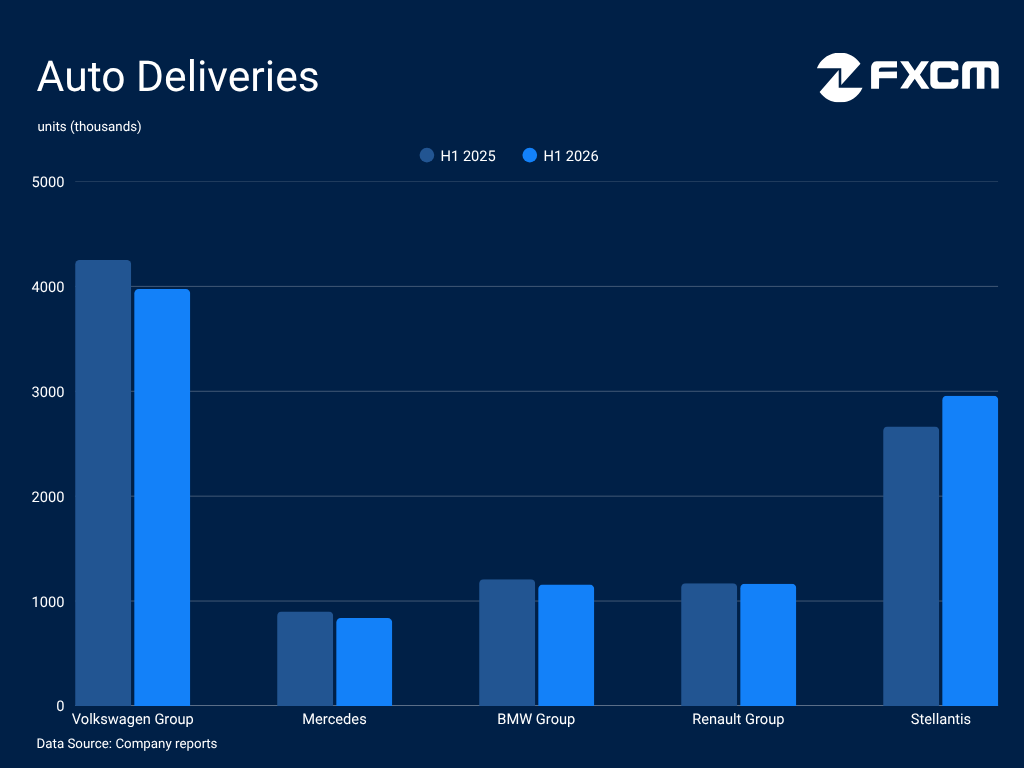
The H1 2026 results perfectly illustrated this adverse environment, showing widespread declines in deliveries, revenues and profitability. However, they also offered reasons for optimism, indicating tangible progress in the strategic turnarounds being executed by legacy automakers like Volkswagen and Mercedes-Benz. These initiatives, including aggressive cost reductions, operational streamlining, accelerated electrification and new model launches, are laying the groundwork to revitalise demand and defend market share.
Macro-geopolitical headwinds weigh on European automakers
European automakers are navigating a severe, multi-front squeeze where macro-geopolitical headwinds threaten both profitability and consumer demand. On the operational side, trade disruptions, Middle East supply chain costs and the memory chip crunch are directly inflating production expenses and eroding margins. Concurrently, weak economic growth, high inflation and tightening monetary policy are suppressing consumer confidence, creating a challenging environment where rising structural costs collide with demand constraints.
The EU and the US may have reached an agreement capping tariffs on European goods at 15% [1], but trade risks linger. After the European Commission fined Google in July, the US Trade Representative signalled that such regulatory actions introduce uncertainty around their agreed framework [2], while President Trump threatened new levies [3]. Any escalation could have an adverse impact on the continent's automotive industry, as road vehicles remain among Europe's top exports to the United States, accounting for a 7.5% share of €41.5 billion in 2025 [4]. The 2025 tariffs already dealt a direct blow, with unit exports dropping 13.5% according to ACEA [5]. Germany, the continent's top manufacturer, registered a 9% decline in US shipments according to the VDA. [6]
Meanwhile, the Middle East conflict is fuelling economic and inflationary risks while driving up input costs and causing supply disruptions. The European economy expanded by 0.4% q/q in the second quarter, but growth remains fragile and risks are tilted to the downside. Inflation has come off its post-war peak but remains well above the ECB's target. Reacting to renewed price pressures, policymakers hiked interest rates in June for the first time in nearly three years [7], simultaneously raising their inflation forecasts and downgrading GDP growth expectations [8]. With the conflict unresolved and further monetary tightening in play, a fragile economic recovery is in peril, leaving consumer confidence suppressed. This threatens domestic sales just as regional tensions weigh on Middle East demand, a key export market particularly for premium brands.
Compounding these issues, higher energy prices alongside logistics and shipping disruptions continue to squeeze margins while threatening shortages of critical materials like industrial-grade aluminium. At the same time, the industry faces semiconductor shortages reminiscent of the pandemic era. These bottlenecks are highlighted by severe disruptions to global helium supplies, a crucial component in semiconductor fabrication, and an acute memory chip crunch driven by unprecedented AI demand.
European automotive industry hurt by the rise of Chinese EV makers
The European automotive industry faces a formidable challenge in the rapid rise of Chinese EV manufacturers. By capturing domestic demand across China, these rising players are directly eroding sales for legacy giants like Volkswagen and Mercedes-Benz, while simultaneously expanding overseas to challenge Europe's automakers on their home turf.
As the world's largest market for electrified vehicles, China has nurtured a dynamic ecosystem of automakers that continually push the technological envelope, offering feature-rich lineups at highly competitive price points. Vanguard brands exemplify this momentum: BYD, which surpassed Tesla in pure BEV deliveries last year, Geely, a top seller of electrified vehicles globally, and tech giant Xiaomi with its successful 2024 EV entry.
Despite progress in their efforts to adapt, Europe's legacy manufacturers continue to trail their Chinese rivals in software innovation and pricing, steadily ceding ground in markets some of them once dominated. According to the China Passenger Car Association, Chinese brands captured 65% of the domestic passenger car retail market in 2025, with New Energy Vehicle sales outselling traditional internal combustion engine models. [9]
With domestic dominance firmly established, Chinese automakers are pivoting aggressively to global markets, posting striking growth across the EU. ACEA data reveals that EU vehicle imports from China surged 30.7% y/y in 2025, topping one million units. Brands like BYD and Chery are among the region's fastest-growing players through the first half of the year, recording sharp triple-digit increases in registrations, while Geely captured a 3% market share [10]. Meanwhile, Nio and XPeng continue their expansion and Xiaomi, which already has a significant installed base in Europe thanks to its smartphones and connected devices, is readying for a 2027 entry. [11]
H1 2026 earnings illustrate sector adversities and operational resilience
European automakers presented a starkly divided picture in their H1 2026 financial results. Declining revenues, slumping deliveries and slashed full-year outlooks exposed deep vulnerabilities for brands exposed to China's EV price war and rising foreign tariffs. However, structural cost cuts, accelerating electrification and insulation from external shocks for some provided tangible evidence of operational resilience.
Volkswagen: poor results, signs of turnaround
Europe's biggest automotive group registered a 6.5% drop in deliveries of passenger cars and small commercial vehicles, fuelled by a 26% y/y slump in China. Revenues edged down 0.2% and the operating margin narrowed to 3.8%. Citing persistent demand weakness, aggressive Chinese export pressures and the drag of US tariffs, management downgraded its full-year 2026 guidance, now projecting group deliveries down 3%-7% and revenues between -3% and 0%. CEO Blume highlighted the adversities during the earnings call, speaking of weak demand and stiff competition in key markets, while noting that Chinese exports are creating pressure within Europe and that US tariffs had a negative impact on financial results. [12]
However, Volkswagen is implementing cost cuts and efficiency gains to counter these pressures, with the CFO noting that structural changes need to be accelerated. These efforts are starting to bear fruit as the total workforce dropped 1.6%, and management maintained its 4%-5.5% operating margin target for the year, which would mark a substantial improvement over 2025. The German auto giant is also betting on more affordable EVs, exemplified by the ID. Polo in the €25,000 region, which the CEO said secured more than 70,000 orders within a few weeks. Moreover, it is not conceding China, instead mounting an offensive with a slew of new models aimed at reviving demand.
Mercedes-Benz: China slump but cost cuts bear fruit
Mercedes-Benz posted an even steeper decline of 28% y/y in China, with overall deliveries sliding 7%, noting "intense" competition and "subdued" consumer sentiment in the country. Revenues were down 4% and operating income dropped 3%. The company also lowered its 2026 forecasts, expecting both revenues and sales to recede compared to a year ago. Management sees China weakness persisting while underscoring uncertainty stemming from geopolitical tensions and tariffs. [13]
Nonetheless, Mercedes had reasons to cheer. Despite the drop in overall deliveries, pure battery electric vehicle sales rose 28% y/y, underscoring the company's progress on electrification. Furthermore, while operating income declined in H1, it jumped 22% y/y in the second quarter and the firm expects it to rise for the full year, underscoring the commitment to improving the cost position and productivity.
BMW: financials take a hit but EV sales offer optimism
The German luxury carmaker had a difficult first half as revenues dropped 8% y/y and profit before tax slumped 29.4%, with the Middle East conflict and the downturn in China, its largest single market, being the main negative drivers. Deliveries in the country plunged 20.4% y/y, pushing overall sales to a 4.2% decline. Alongside tariffs, BMW faces lingering headwinds, reflected in its full-year guidance. Management sees a "significant" decrease in pretax profits, an automotive operating margin of just 1%-3% down from 5.3% in 2025, and a "slight" decline in deliveries. [14]
Still, BMW is pushing on electrification with its new Neue Klasse platform, which could reignite its appeal, while intensifying efficiency measures to reduce complexity and lower costs. Moreover, its large manufacturing presence in the United States makes it less exposed to tariffs compared to some rivals, with US sales rising 3.9% y/y in H1.
Renault: signs of turnaround but challenges persist
The French automaker is largely insulated from two key forces hurting the European industry - US tariffs and China weakness - since it does not sell its cars in either market. Crucially, Renault is a frontrunner in affordable electrification, with BEV sales jumping 63.2% y/y in H1 [5]. Its Renault 5 is a best seller and the company is doubling down with the electric Twingo starting at around €20,000, models that could help fend off competition from Chinese imports.
These efforts showed up in the H1 results, with revenues growing 9.5% y/y and the group returning to profit. Operating margins stood at a solid 5.2% and management expects 5.5% for the full year [16]. Still, that would mark a decline compared to 2025, showing that Renault is not immune to external adversities, while sales were 0.4% down in the first half.
Stellantis: progress on recovery but scepticism persists
Stellantis benefits from limited exposure to China and a large US manufacturing footprint, providing a natural cushion against tariff headwinds. The group saw adjusted operating profits more than triple in the first half of the year while revenues increased 10% and deliveries rose 11%, driven by demand in North America. [17]
These figures show progress in the turnaround plan after a difficult 2025, but investors will likely need more convincing. Profit growth missed estimates and 2026 guidance for revenues and margins was far from inspiring, despite constituting a significant improvement.
EU auto industry reckoning: hardship, adaptation and the road ahead
Legacy European makers are grappling with the rise of Chinese automakers, who now control most of the domestic market and are expanding in Europe with highly appealing and affordable EVs. This tectonic shift is altering the competitive landscape, depriving EU manufacturers of a dominant position in crucial markets. Weak demand, a slow adjustment to electrification, margin compression and trade and geopolitical headwinds create an existential imperative for the industry: adapt rapidly or cede market leadership in the zero-emission era.
Yet amid these severe headwinds, the groundwork for a long-term recovery is being laid and the H1 earnings show the strategic path forward. Companies that focused early on affordable European EVs like Renault, and those with regional manufacturing buffers like Stellantis, show that insulation is possible. Meanwhile, heavyweights like Volkswagen are not standing still. By aggressively trimming structural costs, deploying new software-defined architectures and launching new EVs, European legacy brands are actively recalibrating to meet Chinese pricing and technological parity.
Looking ahead, 2026 stands as the pivotal transition year where European automakers could move from defensive restructuring to offensive adaptation. While near-term profitability will remain constrained by geopolitical friction, tariff burdens and ongoing price competition, the industry's response, combining rigorous cost discipline with accessible, localised EV offerings, signals operational resilience. The coming quarters will determine whether these ambitious product offensives and efficiency gains can successfully restore margins and preserve Europe's automotive sovereignty in an increasingly electrified world.

Nikos Tzabouras
Senior Financial Editorial Writer
Nikos Tzabouras is a graduate of the Department of International & European Economic Studies at the Athens University of Economics and Business. With extensive experience in market analysis and a strong foundation in international relations, he brings a unique perspective to financial markets. Nikos emphasizes not only technical analysis but also on fundamentals and the growing influence of geopolitics on financial trends.
As a Senior Financial Editorial Writer, he delivers comprehensive and forward-looking insights across a wide range of asset classes, including equities, commodities, and currencies. His work explores how macroeconomic events, political developments, and global policies impact market dynamics, providing readers with a deeper understanding of both short-term movements and long-term trends.

Any opinions, news, research, analyses, prices, other information, or links to third-party sites contained on this website are provided on an "as-is" basis, as general market commentary and do not constitute investment advice. The market commentary has not been prepared in accordance with legal requirements designed to promote the independence of investment research, and it is therefore not subject to any prohibition on dealing ahead of dissemination. Although this commentary is not produced by an independent source, FXCM takes all sufficient steps to eliminate or prevent any conflicts of interests arising out of the production and dissemination of this communication. The employees of FXCM commit to acting in the clients' best interests and represent their views without misleading, deceiving, or otherwise impairing the clients' ability to make informed investment decisions. For more information about the FXCM's internal organizational and administrative arrangements for the prevention of conflicts, please refer to the Firms' Managing Conflicts Policy. Please ensure that you read and understand our Full Disclaimer and Liability provision concerning the foregoing Information, which can be accessed here.