
RBA delivers third rate hike to combat oil-fuelled inflation


The Middle East conflict keeps oil prices high
The US-Iran conflict remains unresolved, as the two sides have been unable to reach an agreement despite diplomatic efforts. The Strait of Hormuz stays under a dual blockade with little hope of reopening, and tensions rising as the United Arab Emirates said it came under fresh attacks on Monday. [1]
The US is implementing "Project Freedom" to guide ships out of this crucial waterway, with CENTCOM reporting that two US-flagged commercial ships have transited through [2]. However, Tehran responded by imposing a new maritime control zone. There has also been a flurry of attacks on ships in the region in recent days according to UKMTO [3], intensifying security concerns. President Trump said the US struck multiple Iranian small boats [4], while Tehran claimed it had attacked US Navy ships. [5]
The situation remains highly volatile, keeping oil prices elevated. Even if the Strait reopens, it would take time for flows to normalise. Exxon Mobil's CEO expects this to require one to two months based on his Q1 earnings call comments [6], while Chevron CEO Wirth told Bloomberg on Monday that he remains "concerned about the security of transit". [7]
RBA hikes again but the runway gets shorter
The spike in energy prices is fuelling rising price pressures and inflation expectations globally, including in Australia. CPI rose 4.1% y/y in Q1, the fastest pace in over two years, while consumer expectations jumped to 5.9%, the highest level in nearly four years.
Reacting to the inflationary impulse, the Reserve Bank of Australia delivered its third straight rate hike today [8], cementing its status as a frontrunner in monetary tightening. After the 25 basis point move, interest rates now stand at 4.35%, the highest since late 2024. Policymakers acknowledged that the Middle East conflict has pushed fuel prices "sharply" higher, noting this is "already adding" to inflation, which is expected to remain above the 2-3% target "for some time". The conflict is also driving a rise in expectations and creating wage-price spiral risks.
The central bank refrained from offering guidance on its next step, but the Monetary Policy Report assumes the cash rate will peak at 4.7% by year end [9], leaving room for at least one more hike. Governor Bullock also said during her press conference that officials are not in a wait-and-see mode. [10]
However, the RBA's tightening runway is getting shorter and Governor Bullock said officials are in a position to be alert to risks on both sides. This echoed the policy statement, which noted the Board is "well placed" to respond to developments. Importantly, the decision was not unanimous, with one member voting in favour of a hold, suggesting additional hikes will not come as easily.
Policymakers will have good reason to proceed carefully following the rapid pace of tightening, as the Middle East conflict can hurt the economy. Australia may be a major energy exporter but still relies on refined oil imports [11], leaving it vulnerable to supply disruptions. Officials noted that higher prices and uncertainty "may cause growth to be lower". Even though the economy and labour market have so far remained resilient, the risks are growing. In an early sign of the potential impact, consumer confidence recorded its biggest drop since the onset of the pandemic according to Westpac. [12]
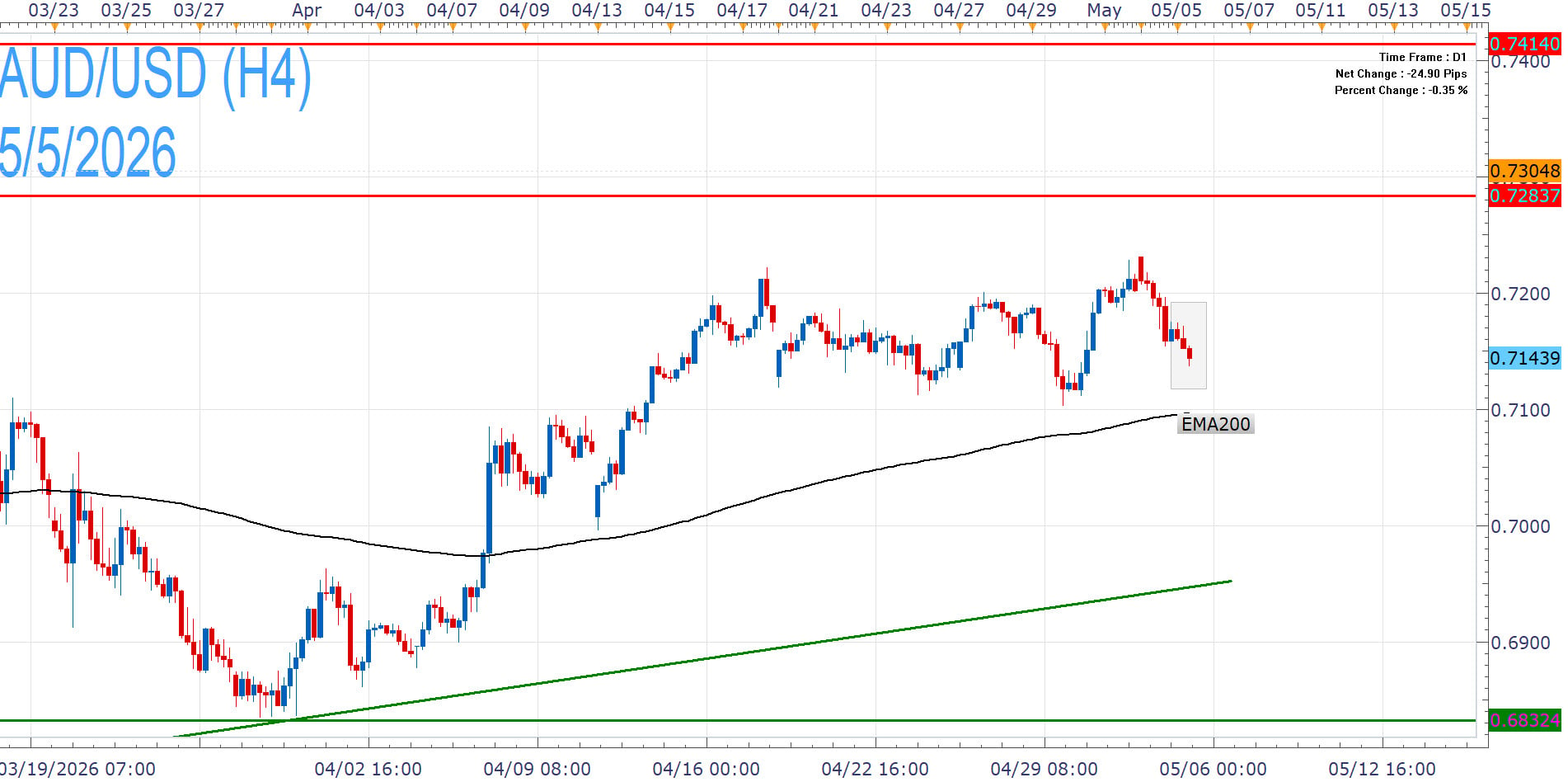
AUD/USD outlook
The RBA's lead in monetary tightening can continue to support AUD/USD and extend this year's rally. Above the EMA200 the bullish bias remains intact, with the road to new multi-year highs open (0.7283).
However, AUD/USD drops today after the decision, as the hike was largely priced in and officials have limited room for additional increases from here. At the same time, markets are pricing out any Fed cuts this year and lingering geopolitical uncertainty continues to support the USDOLLAR. As a result, the pair is exposed to a move below the EMA200 that would shift the immediate bias to the downside and open the door to deeper pullbacks.

Nikos Tzabouras
Senior Financial Editorial Writer
Nikos Tzabouras is a graduate of the Department of International & European Economic Studies at the Athens University of Economics and Business. With extensive experience in market analysis and a strong foundation in international relations, he brings a unique perspective to financial markets. Nikos emphasizes not only technical analysis but also on fundamentals and the growing influence of geopolitics on financial trends.
As a Senior Financial Editorial Writer, he delivers comprehensive and forward-looking insights across a wide range of asset classes, including equities, commodities, and currencies. His work explores how macroeconomic events, political developments, and global policies impact market dynamics, providing readers with a deeper understanding of both short-term movements and long-term trends.
These materials constitute marketing communication and do not take into consideration your personal circumstances, investment experience or current financial situation. The content is provided as general market commentary and should not be construed as containing any type of investment advice, investment recommendation and/or a solicitation for any investment transactions. This market communication does not imply or impose an obligation on you to perform an investment transaction and/or purchase investment products or services. These materials have not been prepared in accordance with legal requirements designed to promote the independence of investment research and are not subject to any prohibition on dealing ahead of the dissemination of investment research.
FXCM, and any of its Affiliates, shall not in any way be liable to you for any inaccuracies, errors or omissions, regardless of cause, in the content of these materials, or for any damages (whether direct or indirect) which may arise from the use of such materials, services and their content. Consequently, any person acting on them does so entirely at their own risk. Please ensure that you read and understand our Full Disclaimer and Liability provision concerning the foregoing Information, which can be accessed here.