
Andy Burnham and GBPUSD – A New Prime Minister, an Old Market Test


Andy Burnham enters Downing Street with a little goodwill, but almost no room for error. Sterling edged up to roughly $1.3480 before today's handover, partly because the dollar softened and partly because reports identifying Shabana Mahmood as the possible chancellor reassured investors. That move should not be mistaken for a lasting endorsement. Markets are merely waiting to see what Burnham actually does.
His political pitch combines business-friendly language with decentralisation, stronger public control and an emphasis on smaller companies. The economic ambition is understandable: revive living standards, repair public services and persuade disillusioned voters that government can deliver. The hard part is paying for it. Burnham has said his plans will respect Labour's fiscal rules, so investors will judge his first appointments, spending commitments and tax decisions against that promise. Carefully costed reforms that improve productivity could help sterling. Vague or unfunded pledges could quickly lift Britain's risk premium.
Britain's economic backdrop is awkward rather than disastrous. Real GDP grew 0.6% in the first quarter, slipped 0.1% in April and recovered only 0.1% in May. May's services growth masked declines in production and construction. Consumer inflation remained at 2.8%, while regular earnings growth eased to 3.4% and vacancies fell to their lowest level since early 2021. Meanwhile, the IMF forecasts growth of just 1.0% in 2026 and expects inflation to exceed 3.5% towards year-end as higher energy costs squeeze real incomes. Burnham therefore inherits sluggish growth, renewed inflation risk and limited fiscal headroom.
GBPUSD, however, is never solely a British story. What matters is how the UK outlook changes relative to America's. The Bank of England held Bank Rate at 3.75% in June, although two policymakers preferred an increase to 4%. Persistent energy inflation could keep British rates higher and support sterling at first; deteriorating demand and employment could produce the opposite result. The Federal Reserve, which kept its target range at 3.50%-3.75% in June, meets on 28-29 July. Softer June core inflation reduced expectations of an immediate increase, but US data, Treasury yields and safe-haven flows remain powerful dollar drivers.
The Gulf conflict adds another complication. Higher oil and gas prices worsen Britain's imported-inflation problem and weaken household purchasing power. At the same time, geopolitical stress often draws money towards the dollar. A prolonged energy shock could consequently hurt the pound even if it makes the Bank of England more hawkish.
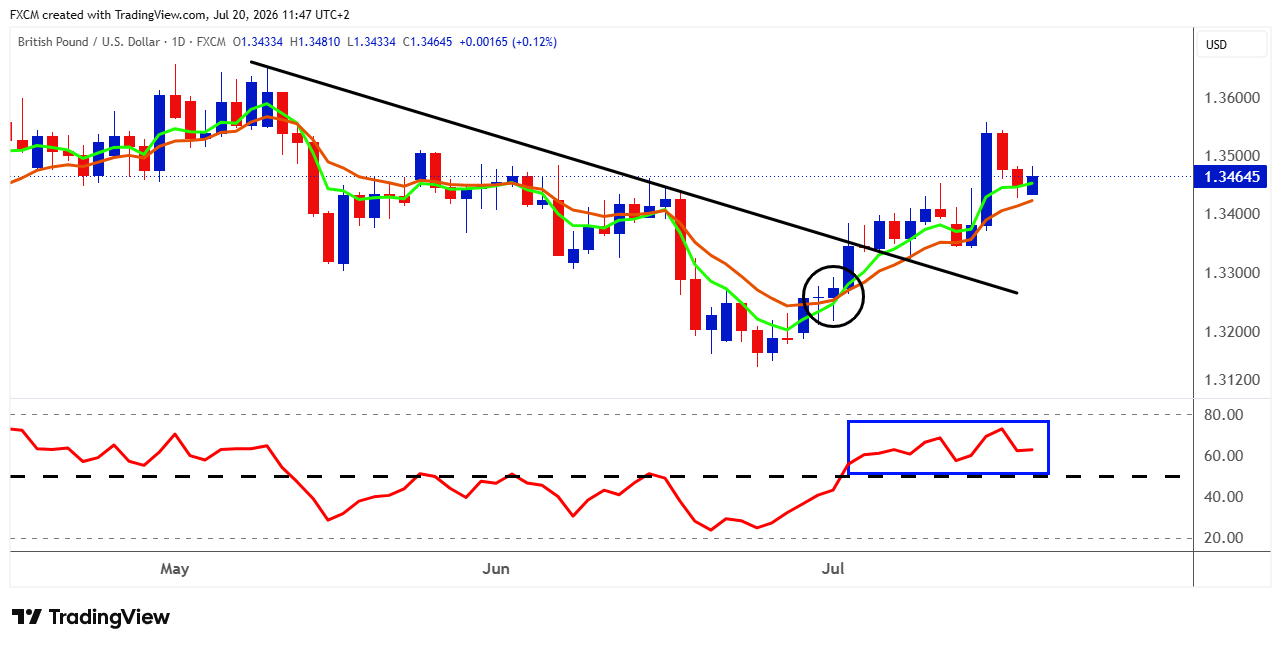
The chart offers bulls some encouragement, not certainty. GBPUSD has cleared the black descending trend line, the exponential moving averages are in bullish order and RSI is above 50. Yet price around 1.3465 remains below the recent peak near 1.3540. A sustained break above that area would reinforce the recovery; a retreat beneath the averages, especially alongside RSI below 50, would expose a false breakout.
Traders should now watch Burnham's chancellor and first costed programme, gilt-market behaviour, UK inflation, wages, employment and retail sales, both July central-bank meetings, and energy prices. The new prime minister may set the mood, but fiscal credibility, relative interest rates and global risk appetite will determine sterling's direction over the coming months.

Russell Shor
Senior Market Strategist
Russell Shor is a Senior Market Strategist at FXCM, having been promoted to the role in 2025 in recognition of his depth of insight and consistent delivery of high-impact market analysis. He originally joined FXCM in October 2017 as a Senior Market Specialist.
Russell holds an Honours Degree in Economics from the University of South Africa, is a certified FMVA®, and a full member of the Society of Technical Analysts (UK). With over 20 years of experience in financial markets, his work is renowned for its clarity, precision, and strategic value across asset classes.
These materials constitute marketing communication and do not take into consideration your personal circumstances, investment experience or current financial situation. The content is provided as general market commentary and should not be construed as containing any type of investment advice, investment recommendation and/or a solicitation for any investment transactions. This market communication does not imply or impose an obligation on you to perform an investment transaction and/or purchase investment products or services. These materials have not been prepared in accordance with legal requirements designed to promote the independence of investment research and are not subject to any prohibition on dealing ahead of the dissemination of investment research.
FXCM, and any of its Affiliates, shall not in any way be liable to you for any inaccuracies, errors or omissions, regardless of cause, in the content of these materials, or for any damages (whether direct or indirect) which may arise from the use of such materials, services and their content. Consequently, any person acting on them does so entirely at their own risk. Please ensure that you read and understand our Full Disclaimer and Liability provision concerning the foregoing Information, which can be accessed here.