
Gold rises as safe haven demand from US-Iran conflict adds to structural tailwinds


Geopolitical tensions drive safe-haven demand
United States and Israeli military strikes against Iran have sparked a flight to safety, boosting demand for gold and other safe haven assets. President Trump has provided "a four to five week" horizon and remains steadfast, saying that the US will do "whatever it takes" to achieve its objectives [1], which still appears somewhat vague. He also refrained from ruling out sending ground troops, in a New York Post interview [2]. Furthermore, the goal of eliminating Tehran's nuclear capabilities may prove a challenging task, given that more than 400kg of 60% enriched uranium has been unaccounted for since last year's attacks, according to IAEA Director General Grossi. [3]
Meanwhile, Iran is trying to prolong and regionalise the war with attacks on Israel [4] and US assets across multiple countries in the region. These include the United Arab Emirates [5] and the US Embassy in Riyadh, Saudi Arabia [6], while Saudi Aramco's Ras Tanura oil refinery was struck, according to Reuters [7]. Moreover, Iran appears unwilling to resume talks, with key official Ali Larijani saying that "We will not negotiate with the United States". [8]
These developments create scope for a protracted war that could spill over into the broader Middle East. The US also risks igniting frictions with Beijing, which sees its oil suppliers being attacked, as the Iran strikes follow the operation in Venezuela. These two countries accounted for 15% of China's oil imports in 2025, according to the Center on Global Energy Policy [9]. Saudi Arabia is its second largest provider, with supply lines at risk of disruption in the Straits of Hormuz.
However, China appears to be keeping a low profile for now ahead of an expected Xi-Trump meeting. Moreover, Washington's seemingly unclear objectives create an offramp and flexibility around ending hostilities, while Department of Defense Secretary Pete Hegseth succinctly stated that "this is not endless" and "not a so-called regime-change war". [10]
Trade and economic uncertainty support gold
The military operation has fuelled a surge in oil prices as it creates supply risks, with shipping through the Straits of Hormuz already being disrupted. This crucial transit corridor accounted for 20% of global petroleum liquids consumption, according to the US Energy Information Administration (EIA) [11], and for 11% of global maritime trade volume, according to the United Nations Conference on Trade and Development (UNCTAD). [12]
The US Maritime Administration has advised vessels to avoid the area, while shipping giant Maersk has suspended all vessel crossings [13]. Maersk has also paused shipping through the Suez Canal [14] - another chokepoint responsible for 20% of global container trade, according to UNCTAD. [15]
At the same time, the spike in crude prices could spark oil-driven reflationary pressures and enhance bullion's appeal as an inflation hedge. It may also weigh on global economic activity against an already challenging backdrop as the world grapples with fresh tariff uncertainty.
After the Supreme Court struck down the tariffs imposed under the International Emergency Economic Powers Act (IEEPA), President Trump doubled down. He put in place a 10% global levy [16]and threatened to raise it to 15% [17]. It is unclear what will happen to all the trade deals that have been agreed, but the European Union has halted implementation of the EU-US agreement. [18]
Weak dollar and debasement trends offer structural tailwinds
Renewed geopolitical, economic and trade uncertainty compounds gold's strength tied to broader de-dollarisation and debasement trends. Fears over ballooning global deficits are eroding confidence in major currencies. The International Monetary Fund expects public debt to surpass post-war levels by 2029 [19]. Gold is uniquely positioned to benefit, having become the world's second largest reserve asset according to a recent ECB study. [20]
Meanwhile, geopolitical and trade frictions are accelerating efforts by emerging economies to reduce reliance on the greenback, spearheaded by China. This has led to increased gold purchases by central banks, with the PBoC adding to its reserves for a fifteenth straight month in January. [21]
Disruptive trade policies, concerns over Fed independence and ballooning deficits have weighed on the USDOLLAR, which has shed 4% of its value in 2025. Greenback weakness is likely to persist, as a potentially costly prolonged war could add further deficit pressures amid global reserve diversification and fiat debasement dynamics that fuel gold demand.
Gold price outlook
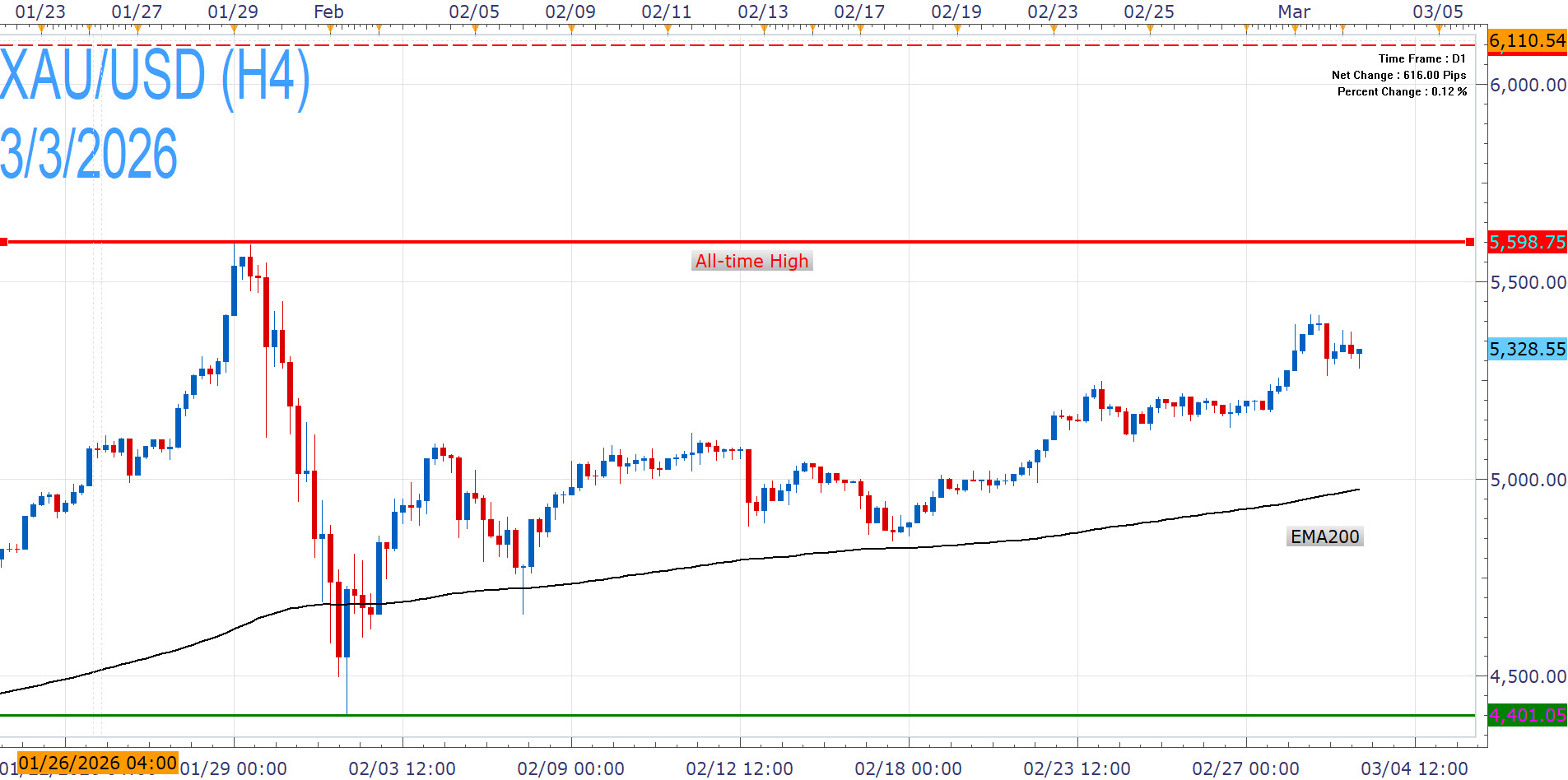
Prospects of a prolonged war and spillover risks, oil-driven reflation, trade disruptions and tariffs are all forces that can continue to push investors towards gold's safe embrace. Safe haven flows compound structural demand from broader de-dollarisation and debasement trends, creating a powerful mix that could support further strength. The XAU/USD bullish bias is reaffirmed, putting it on a path towards new all-time highs.
Nonetheless, gains may be capped as the USDOLLAR is also attracting safe haven flows, while reflationary pressures could constrain Fed easing and provide additional support to the currency. At the same time, XAU/USD remains susceptible to profit taking and volatility, especially given speculative behaviour highlighted by the Bank for International Settlements [22]. This keeps bullion vulnerable to pullbacks towards the EMA200 that could challenge the bullish outlook.

Nikos Tzabouras
Senior Financial Editorial Writer
Nikos Tzabouras is a graduate of the Department of International & European Economic Studies at the Athens University of Economics and Business. With extensive experience in market analysis and a strong foundation in international relations, he brings a unique perspective to financial markets. Nikos emphasizes not only technical analysis but also on fundamentals and the growing influence of geopolitics on financial trends.
As a Senior Financial Editorial Writer, he delivers comprehensive and forward-looking insights across a wide range of asset classes, including equities, commodities, and currencies. His work explores how macroeconomic events, political developments, and global policies impact market dynamics, providing readers with a deeper understanding of both short-term movements and long-term trends.



Any opinions, news, research, analyses, prices, other information, or links to third-party sites contained on this website are provided on an "as-is" basis, as general market commentary and do not constitute investment advice. The market commentary has not been prepared in accordance with legal requirements designed to promote the independence of investment research, and it is therefore not subject to any prohibition on dealing ahead of dissemination. Although this commentary is not produced by an independent source, Friedberg Direct, FXCM or its affiliates takes all sufficient steps to eliminate or prevent any conflicts of interests arising out of the production and dissemination of this communication. The employees of Friedberg Direct and FXCM commit to acting in the clients' best interests and represent their views without misleading, deceiving, or otherwise impairing the clients' ability to make informed investment decisions. For more information about the Friedberg Direct's internal organizational and administrative arrangements for the prevention of conflicts, please refer to the Firms' Managing Conflicts Policy. Please ensure that you read and understand our Full Disclaimer and Liability provision concerning the foregoing Information, which can be accessed here.**