
US and Israel strike Iran: what’s next for oil markets?


Military action against Iran
The United States and Israel launched military strikes against Iran on Saturday, resulting in the killing of Supreme Leader Khamenei [1]. President Trump vowed not to let Iran obtain a nuclear weapon, while calling on the security forces to surrender and urging the Iranian people to "take over your government". [2]
In a Sunday update, the US President said that "hundreds of targets" had been hit, adding that operations continue "at full force" and will go on "until all of our objectives are achieved" [3]. In a Daily Mail interview, he noted that the military action is a "four-week process", pointing to a potentially protracted campaign. [4]
Meanwhile, Tehran has launched attacks on Israel [5] and US assets across multiple countries in the region, including the United Arab Emirates [6], raising the risk of a broader regional conflict.
Offering some hope for a diplomatic solution, President Trump told The Atlantic that Tehran wants to talk and that he has agreed to talks [7]. However, senior Iranian official Ali Larijani dismissed such prospects, stating that "We will not negotiate with the United States". [8]
While there are signs that a diplomatic offramp may be sought, the situation remains highly fluid and US objectives do not appear particularly clear. This leaves scope for an extended military campaign and increases the risk of escalation.
Oil supply disruption risks
Iran is among the top OPEC producers, pumping over 3 million barrels per day, or around 3% of global oil output, according to the International Energy Agency (IEA) [9]. Any damage to its oil facilities would have a meaningful impact on the market, but even without direct strikes, unrest could still weigh on production and exports.
However, attention is focused on the Strait of Hormuz - the main transit route for Persian Gulf crude. This critical corridor accounted for around 20% of global petroleum liquids consumption in 2024, according to the US Energy Information Administration (EIA). [10]
There are concerns that Iran could attempt to close the Strait of Hormuz, but even short of such action, shipping activity is already being affected and insurance costs are likely to surge. The US Maritime Administration has advised vessels to avoid the area [11], while MarineTraffic data shows multiple tankers anchored near the strait and reports strikes on some ships [12]. Shipping giant Maersk has also said, "We are suspending all vessel crossings in the Strait of Hormuz until further notice". [13]
For now, there are no reports of damage to Iran's oil infrastructure. Closing the strait would also be a high-risk move for Tehran, as it would inflict economic harm on itself and potentially anger China, the main buyer of its crude. In addition, a well-supplied market could absorb disruptions if they prove limited and short-lived.
Unfavourable supply-demand dynamics could persist
In the absence of a major supply shock, the oil market is headed for a surplus this year, with production expected to outpace demand. The International Energy Agency forecasts output growth of 2.6 million barrels per day [9]. Meanwhile OPEC+ decided on Sunday to resume its supply hikes after a first-quarter pause, adding 206,000 barrels per day in April. [14]
At the same time, the US has begun rolling back sanctions on Venezuelan crude and US Energy Secretary Chris Wright has spoken of "several hundred thousand barrels" of additional output by year-end. [15]
Furthermore, renewed tariffs uncertainty poses fresh challenges to the global economy as US President Trump imposed a 10% global levy [16]after the Supreme Court decision and threatened an even higher rate. This could continue to weigh on oil consumption, with the IEA already cutting its demand growth outlook. [9]
Oil at $100?
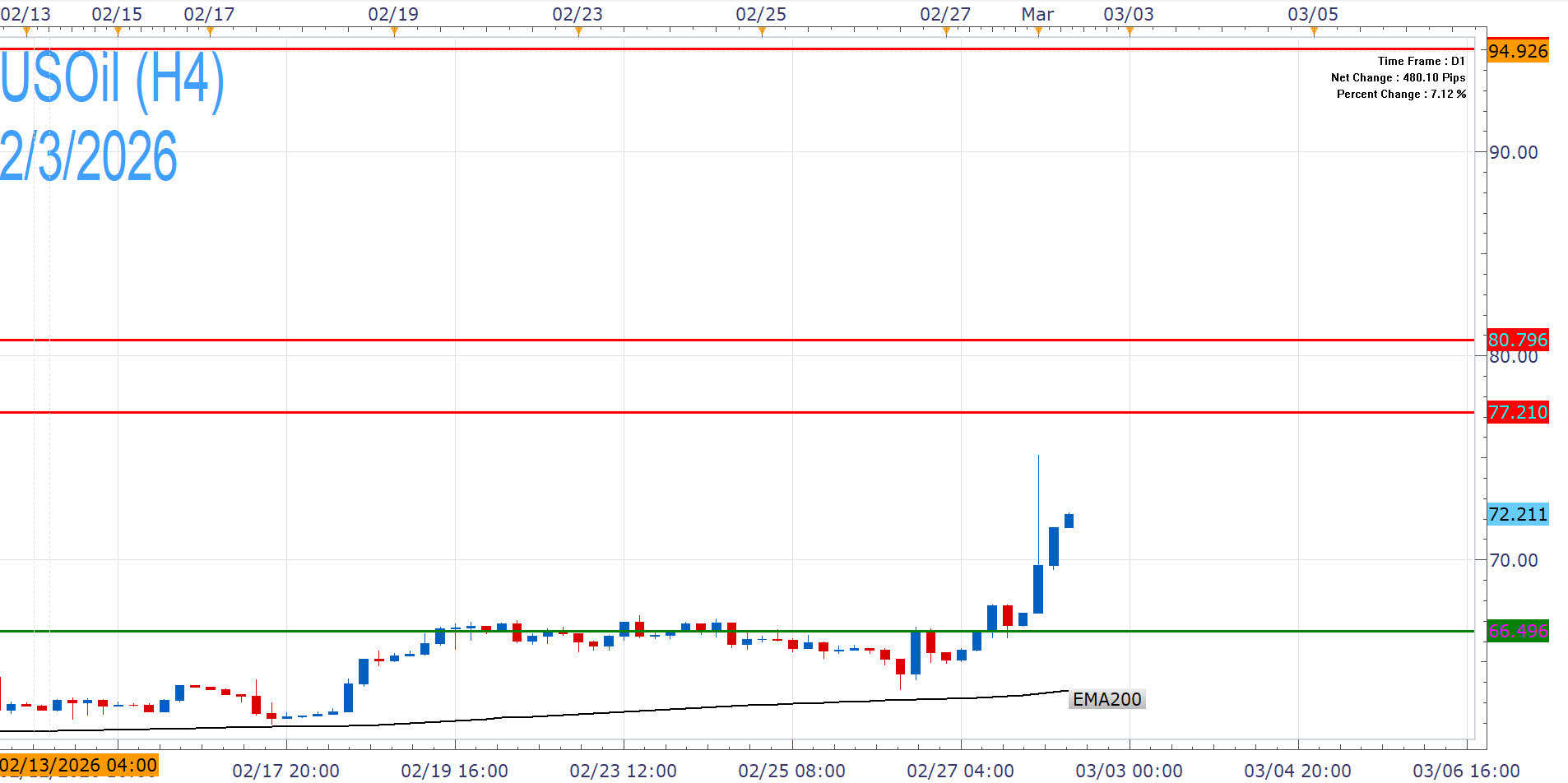
USOil and UKOil have jumped as the geopolitical risk premium rises in response to the conflict. The situation threatens not only Iran's own output but also flows through the Strait of Hormuz. A tightening market could shift the current supply-demand balance, opening the door to higher prices and bringing the $100 level into view.
However, sustained gains would require prolonged disruptions to production or transit. A well-supplied market may still be able to withstand limited interference. Persistently high oil prices would also complicate President Trump's efforts to reduce living costs at home, a key domestic priority. Meanwhile, OPEC+ is resuming output increases, Venezuelan crude is returning to markets and tariffs may continue to dampen demand.

Nikos Tzabouras
Senior Financial Editorial Writer
Nikos Tzabouras is a graduate of the Department of International & European Economic Studies at the Athens University of Economics and Business. With extensive experience in market analysis and a strong foundation in international relations, he brings a unique perspective to financial markets. Nikos emphasizes not only technical analysis but also on fundamentals and the growing influence of geopolitics on financial trends.
As a Senior Financial Editorial Writer, he delivers comprehensive and forward-looking insights across a wide range of asset classes, including equities, commodities, and currencies. His work explores how macroeconomic events, political developments, and global policies impact market dynamics, providing readers with a deeper understanding of both short-term movements and long-term trends.



Any opinions, news, research, analyses, prices, other information, or links to third-party sites contained on this website are provided on an "as-is" basis, as general market commentary and do not constitute investment advice. The market commentary has not been prepared in accordance with legal requirements designed to promote the independence of investment research, and it is therefore not subject to any prohibition on dealing ahead of dissemination. Although this commentary is not produced by an independent source, Friedberg Direct, FXCM or its affiliates takes all sufficient steps to eliminate or prevent any conflicts of interests arising out of the production and dissemination of this communication. The employees of Friedberg Direct and FXCM commit to acting in the clients' best interests and represent their views without misleading, deceiving, or otherwise impairing the clients' ability to make informed investment decisions. For more information about the Friedberg Direct's internal organizational and administrative arrangements for the prevention of conflicts, please refer to the Firms' Managing Conflicts Policy. Please ensure that you read and understand our Full Disclaimer and Liability provision concerning the foregoing Information, which can be accessed here.**