
AUD/USD soft as RBA holds rates steady


AUD/USD Analysis
The Reserve Bank of Australia kept rates steady unanimously at 4.35% today [1] after three consecutive rate hikes this year. Policymakers reiterated the view that policy is "well placed" to respond to developments following the aggressive tightening, pointing to a potentially prolonged holding stance.
Officials have strong incentives to stay put as the energy shock from the Middle East conflict creates growth risks that additional tightening would exacerbate. Despite being an energy producer, Australia heavily relies on imports of refined oil [2], leaving it exposed to supply disruptions. Unemployment is rising, consumer confidence is deteriorating and GDP expanded by just 0.3% q/q in the first quarter, causing the RBA to downgrade its growth projections.
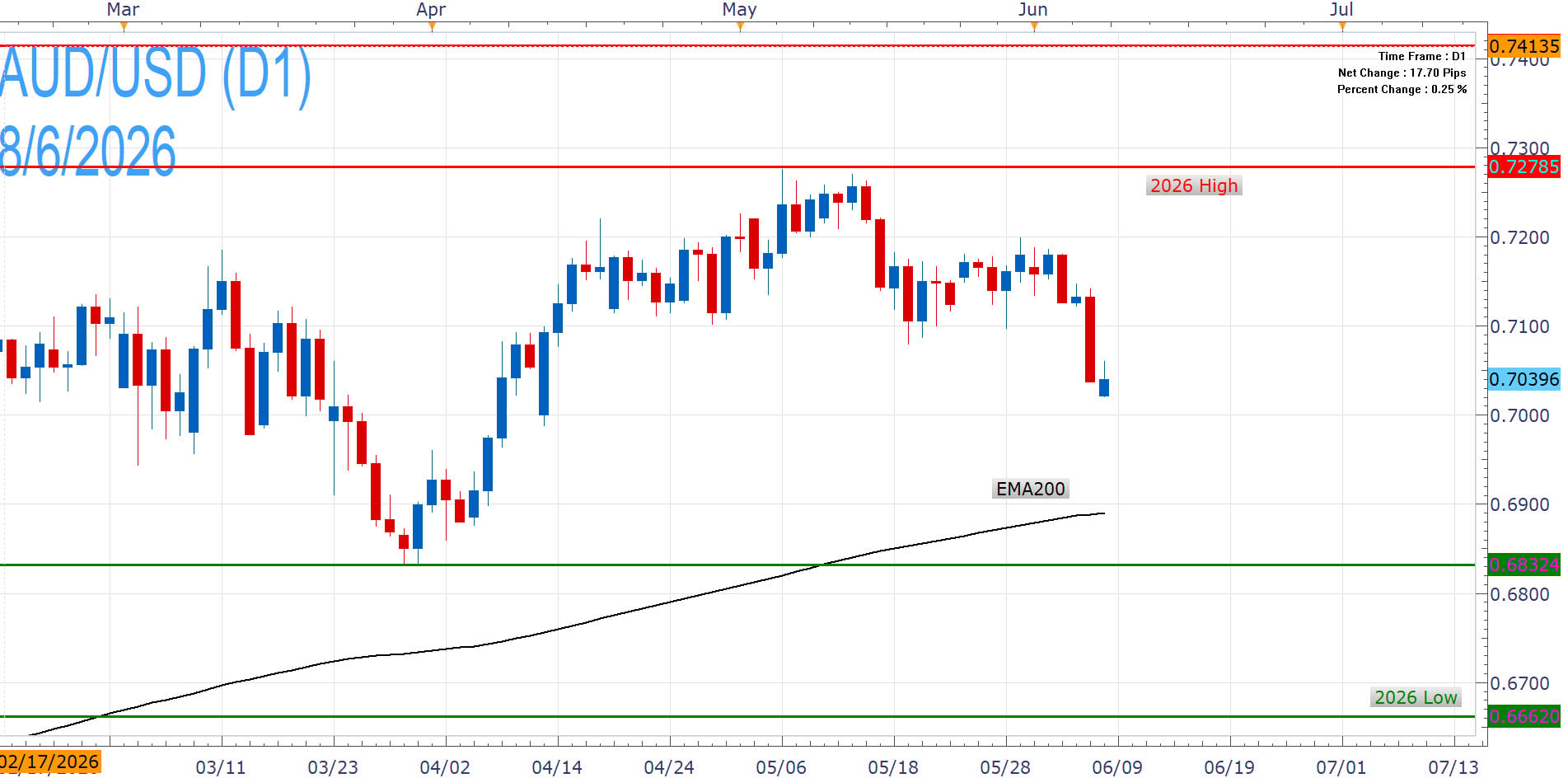
AUD/USD drops this month and faces more pressure after the RBA's decision. The central bank's front-running has supported a surge this year but the shift to a holding stance leaves the Aussie exposed to deeper declines, as the immediate bias is on the downside below the EMA200. However, AUD/USD can still push higher and the 2026 peak does not leave the spotlight, with the trajectory heavily depending on the USDOLLAR and Wednesday's Fed outcome amid a wave of central bank decisions this month.
The RBA may have adopted a cautious stance, but more tightening is likely within the year. Based on last month's updated forecast, officials don't expect inflation to drop below 4% this year - well above the 2-3% target - and these projections assume interest rates peaking at 4.7% [3]. This leaves room for at least one more hike and the Board today left the door open to "increasing the cash rate target further" if needed.

Nikos Tzabouras
Senior Financial Editorial Writer
Nikos Tzabouras is a graduate of the Department of International & European Economic Studies at the Athens University of Economics and Business. With extensive experience in market analysis and a strong foundation in international relations, he brings a unique perspective to financial markets. Nikos emphasizes not only technical analysis but also on fundamentals and the growing influence of geopolitics on financial trends.
As a Senior Financial Editorial Writer, he delivers comprehensive and forward-looking insights across a wide range of asset classes, including equities, commodities, and currencies. His work explores how macroeconomic events, political developments, and global policies impact market dynamics, providing readers with a deeper understanding of both short-term movements and long-term trends.
References
| Retrieved 16 Jun 2026 https://www.rba.gov.au/media-releases/2026/mr-26-15.html | |
| Retrieved 16 Jun 2026 https://www.dfat.gov.au/sites/default/files/australia-goods-services-exports-imports-2025.pdf | |
| Retrieved 19 Sep 2026 https://www.rba.gov.au/publications/smp/2026/may/pdf/statement-on-monetary-policy-2026-05.pdf |



Any opinions, news, research, analyses, prices, other information, or links to third-party sites contained on this website are provided on an "as-is" basis, as general market commentary and do not constitute investment advice. The market commentary has not been prepared in accordance with legal requirements designed to promote the independence of investment research, and it is therefore not subject to any prohibition on dealing ahead of dissemination. Although this commentary is not produced by an independent source, Friedberg Direct, FXCM or its affiliates takes all sufficient steps to eliminate or prevent any conflicts of interests arising out of the production and dissemination of this communication. The employees of Friedberg Direct and FXCM commit to acting in the clients' best interests and represent their views without misleading, deceiving, or otherwise impairing the clients' ability to make informed investment decisions. For more information about the Friedberg Direct's internal organizational and administrative arrangements for the prevention of conflicts, please refer to the Firms' Managing Conflicts Policy. Please ensure that you read and understand our Full Disclaimer and Liability provision concerning the foregoing Information, which can be accessed here.**