
Oil Prices Supported by Supply Concerns & China’s Factory Activity Expansion


USOIL Analysis
USOil advanced by more than 15% in the first quarter of the year, largely due to supply concerns, as Middle East hostilities and recent Ukrainian attacks on Russian refineries create disruptions. Furthermore, OPEC+ recently agreed to extend its curbs into Q2, while US crude production dropped in January from its record highs, according to Friday's data form the Energy Information Administration. [1]
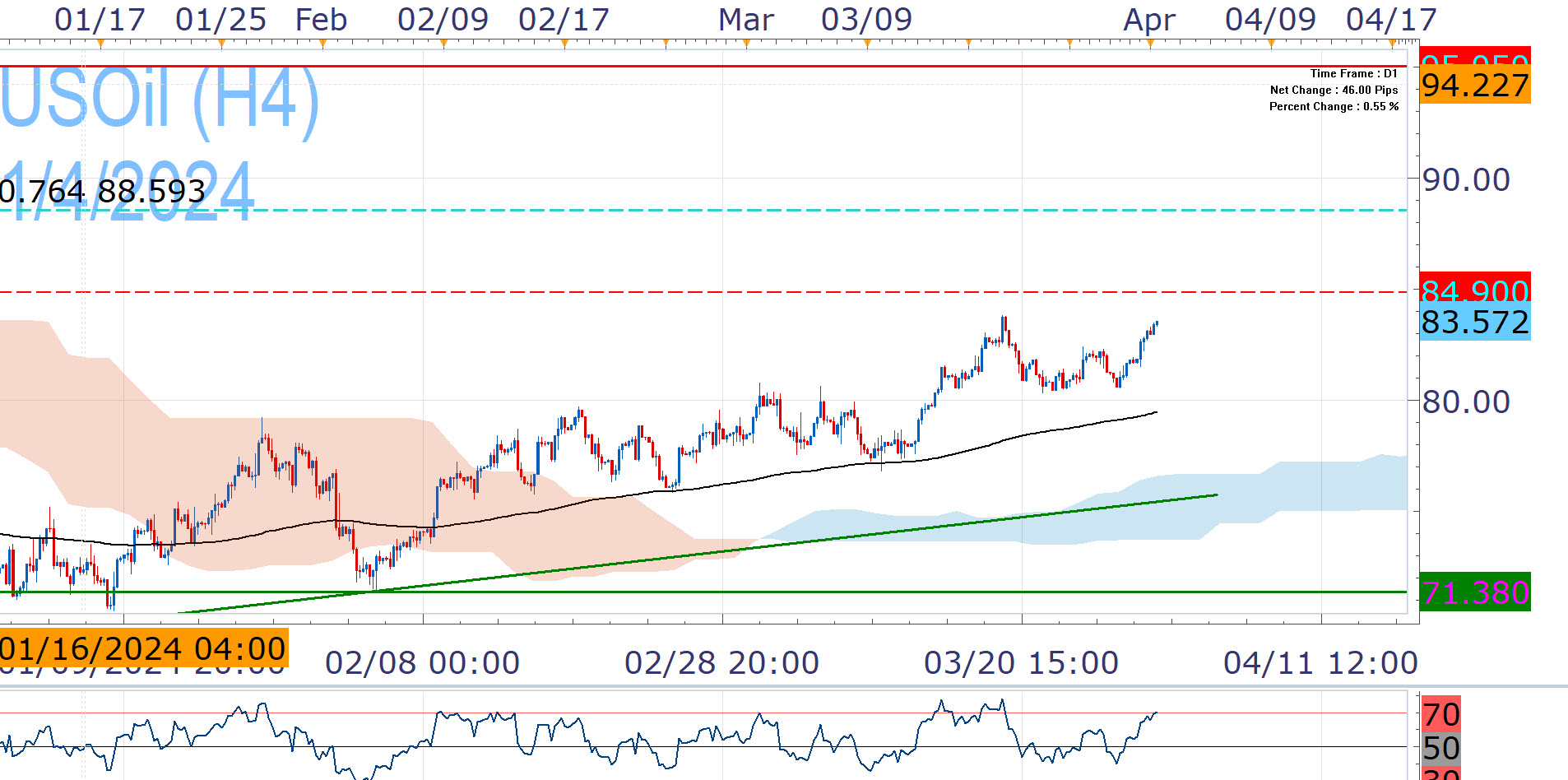
Upbeat weekend data form China help prices at the start of the week, as factory activity in the world's second largest consumer of oil expanded for the first time since October. USOil tries to take out 84.90, which would bring 88.59 in its crosshairs, but we remain cautious around its ascending prospects.
China's economic recovery remains bumpy and the recent increase in oil prices is mostly a result of supply concerns, rather that demand growth which would be a stronger driver. Despite raising its 2024 outlook, the International Energy Agency (IEA) still expects a substantial slowdown in supply growth. [2]
On the technical side, the Relative strength Index moves to overbought territory, which could cap USOil gains and lead to a pullback that would test the EMA200 (79.50). Daily closes could shift bias to the downside, but it appears well-protected with the first line of defense provided by the daily Ichimoku cloud and the ascending trendline from the December lows.

Nikos Tzabouras
Senior Financial Editorial Writer
Nikos Tzabouras is a graduate of the Department of International & European Economic Studies at the Athens University of Economics and Business. With extensive experience in market analysis and a strong foundation in international relations, he brings a unique perspective to financial markets. Nikos emphasizes not only technical analysis but also on fundamentals and the growing influence of geopolitics on financial trends.
As a Senior Financial Editorial Writer, he delivers comprehensive and forward-looking insights across a wide range of asset classes, including equities, commodities, and currencies. His work explores how macroeconomic events, political developments, and global policies impact market dynamics, providing readers with a deeper understanding of both short-term movements and long-term trends.
References
| Retrieved 01 Apr 2024 https://www.eia.gov/petroleum/production/ | |
| Retrieved 01 Oct 2026 https://www.iea.org/reports/oil-market-report-march-2024 |

Any opinions, news, research, analyses, prices, other information, or links to third-party sites contained on this website are provided on an "as-is" basis, as general market commentary and do not constitute investment advice. The market commentary has not been prepared in accordance with legal requirements designed to promote the independence of investment research, and it is therefore not subject to any prohibition on dealing ahead of dissemination. Although this commentary is not produced by an independent source, FXCM takes all sufficient steps to eliminate or prevent any conflicts of interests arising out of the production and dissemination of this communication. The employees of FXCM commit to acting in the clients' best interests and represent their views without misleading, deceiving, or otherwise impairing the clients' ability to make informed investment decisions. For more information about the FXCM's internal organizational and administrative arrangements for the prevention of conflicts, please refer to the Firms' Managing Conflicts Policy. Please ensure that you read and understand our Full Disclaimer and Liability provision concerning the foregoing Information, which can be accessed here.