
Oil prices slip after the US captures Venezuelan President Maduro


USOIL Analysis
The United States arrested Venezuelan President Nicolás Maduro in a military operation inside Caracas, following months of pressure that included an oil embargo and the seizure of tankers. In a press conference after the operation, US President Trump said, "we are going to run the country", and promised billions of dollars to "fix the badly broken" oil infrastructure. [1]
The move has exacerbated oversupply concerns, as Venezuela is a significant OPEC member with "the world's largest proven crude oil reserves" in 2023, according to the US Energy Information Administration (EIA), accounting for 17% of global reserves [2]. The prospect of additional barrels entering an already well-supplied market could reinforce the bearish bias and leave USOil vulnerable to deeper declines below last year's low. At the same time, markets are monitoring diplomatic efforts to end the war in Ukraine, which could unlock Russian crude and further intensify glut risks. Meanwhile, tariff-fuelled global economic headwinds continue to weigh on oil consumption.
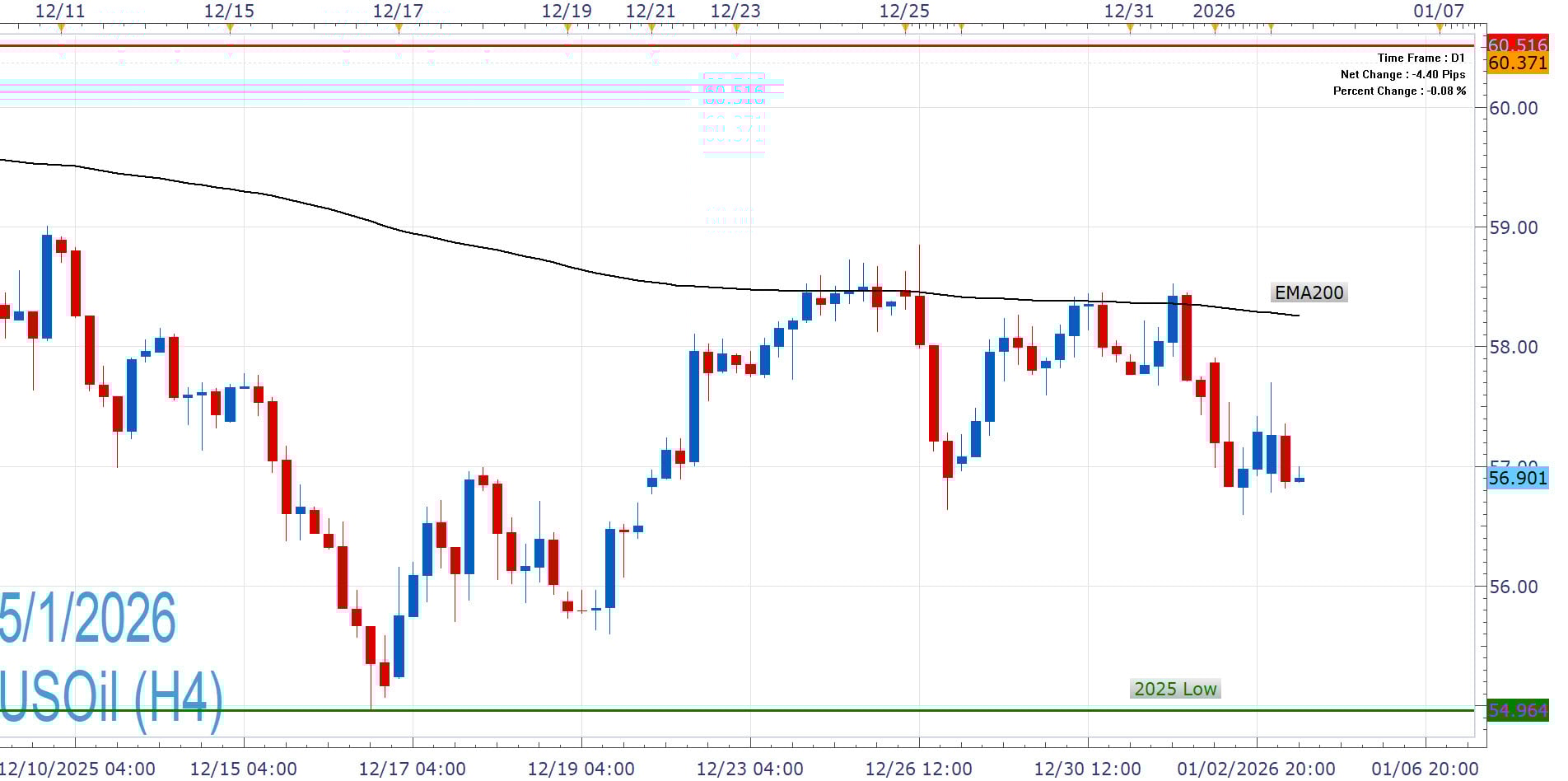
However, current Venezuelan output is relatively modest in the context of global supply, at around 0.86 million barrels per day in November according to the IEA [3], while restoring capacity would likely be a time-consuming and challenging task. In addition, OPEC+ has stuck to its decision not to increase production in the first quarter of the year [4] and retains the ability to stabilise the market and support prices if needed. Meanwhile, an end to the war in Ukraine remains elusive, and US President Trump has recently warned Iran of consequences in the event of missile or nuclear build-up [5], sustaining supply-side risks.
These factors could help contain further downside in oil prices and offer scope for a recovery towards the 200-day EMA. However, a durable rebound remains difficult under current supply–demand dynamics.

Nikos Tzabouras
Senior Financial Editorial Writer
Nikos Tzabouras is a graduate of the Department of International & European Economic Studies at the Athens University of Economics and Business. With extensive experience in market analysis and a strong foundation in international relations, he brings a unique perspective to financial markets. Nikos emphasizes not only technical analysis but also on fundamentals and the growing influence of geopolitics on financial trends.
As a Senior Financial Editorial Writer, he delivers comprehensive and forward-looking insights across a wide range of asset classes, including equities, commodities, and currencies. His work explores how macroeconomic events, political developments, and global policies impact market dynamics, providing readers with a deeper understanding of both short-term movements and long-term trends.
References
| Retrieved 05 Jan 2026 https://www.youtube.com/live/SsdkClL2_bg | |
| Retrieved 05 Jan 2026 https://www.eia.gov/international/analysis/country/VEN | |
| Retrieved 05 Jan 2026 https://www.iea.org/reports/oil-market-report-december-2025 | |
| Retrieved 05 Jan 2026 https://www.opec.org/pr-detail/1574587-4-january-2026.html | |
| Retrieved 01 Oct 2026 https://www.youtube.com/watch |

Any opinions, news, research, analyses, prices, other information, or links to third-party sites contained on this website are provided on an "as-is" basis, as general market commentary and do not constitute investment advice. The market commentary has not been prepared in accordance with legal requirements designed to promote the independence of investment research, and it is therefore not subject to any prohibition on dealing ahead of dissemination. Although this commentary is not produced by an independent source, FXCM takes all sufficient steps to eliminate or prevent any conflicts of interests arising out of the production and dissemination of this communication. The employees of FXCM commit to acting in the clients' best interests and represent their views without misleading, deceiving, or otherwise impairing the clients' ability to make informed investment decisions. For more information about the FXCM's internal organizational and administrative arrangements for the prevention of conflicts, please refer to the Firms' Managing Conflicts Policy. Please ensure that you read and understand our Full Disclaimer and Liability provision concerning the foregoing Information, which can be accessed here.