
Delta kicks off aviation earnings as high demand meets high oil


Risks from the Middle East conflict
Delta kicks off the earnings season for airliners, announcing its quarterly results on Wednesday, April 8. The report comes at a challenging period for the industry due to the ongoing Middle East conflict, which has sparked a spike in oil prices and travel disruptions.
The Jet Fuel Price Monitor by the International Air Transport Association (IATA) shows a clear surge in fuel costs after the hostilities started [1]. Beyond crude prices, widening crack spreads - the cost of refining oil into jet fuel - have added further pressure to airline overheads. Eurocontrol found that 602 tonnes of extra fuel are burnt every day due to reroutes and that the conflict led to 56% fewer flights between Europe and the Middle East, including overflights. [2]
Flight disruptions and higher fuel costs can hurt profitability and demand, adding to existing headwinds from macroeconomic uncertainty, tariffs, and elevated inflation. In mid-March, the CEO of Delta Air Lines noted a $400 million hit from the surge in fuel prices [3], while United and JetBlue have hiked baggage fees according to CNBC [4]. This comes as the United States is becoming a less desirable destination, with overseas visitors falling 2.5% y/y last year, according to the US International Trade Administration. [5]
Premium shield vs fuel costs
However, airlines have pricing power as travel demand has remained strong, and they can resort to the go-to solution of tactical capacity discipline to protect margins. Coming off a strong year, major US airliners raised their guidance in March despite the Middle East conflict.
American Airlines now expects Q1 revenue growth to exceed 10% y/y and losses to be narrower than previously expected [6]. JetBlue forecasts a 5%-7% increase in revenue per available seat mile (ASM) amid strong demand [7]. Delta also upgraded its revenue forecast for the first quarter and retained its call for a 20% increase in full-year earnings. [3]
The resilience of major US airlines largely stems from a focus on premiumisation and loyalty, which act as structural safeguards against rising fuel costs and other adversities. By shifting the revenue mix toward high-yield seats, carriers can better absorb the fuel cost burden that often cripples low-margin, budget models. Even JetBlue - traditionally closer to the value end of the market - is aggressively pivoting toward a more premium offering to capture this margin. This shift allows carriers to command greater pricing power and boosts their margins. The leader and frontrunner in this transition is Delta Air Lines, one of our top stock picks for Q2.
Delta well-positioned to weather risks
The successful execution and increasing importance of this strategy was evident in Delta's 2025 results. Premium segment revenue rose 7% and surpassed main cabin sales for the first time ever, while the latter dropped 5% [8]. This shift is bolstered by a high-margin loyalty business. Delta's partnership with American Express generated $8.2 billion in 2025, providing a crucial revenue stream that is insulated from oil price volatility. This puts Delta in a strong position to extend its momentum, especially given strong corporate demand, which is more inelastic.
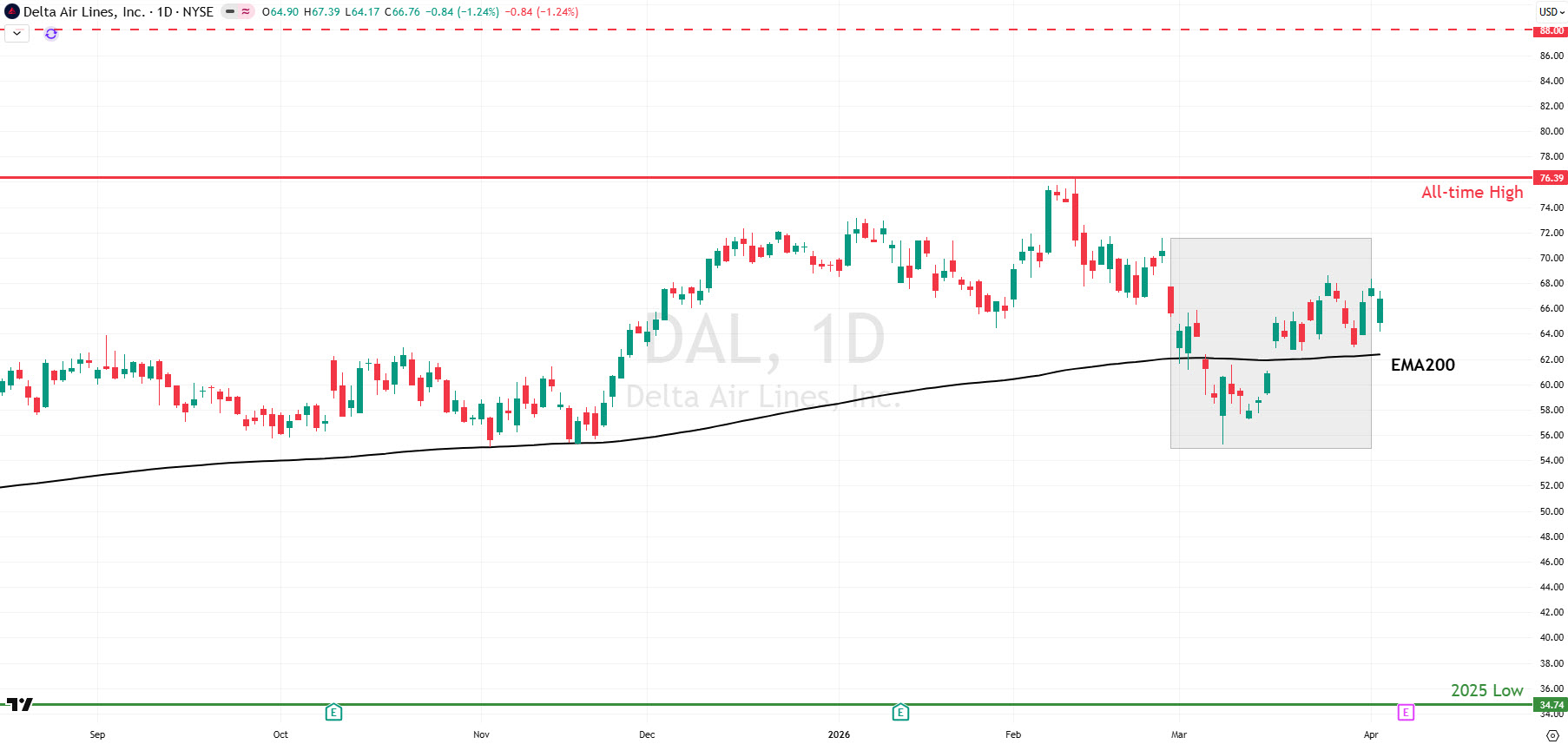
Shares of Delta Air Lines reflected this resilience, recording an increase in March and recovering from the initial negative reaction to the Middle East hostilities. Still, the stock remains down this year, underscoring the risks.
The premium shield does not make Delta immune to mounting challenges. The inflationary impulse from the Middle East conflict can hurt demand for discretionary purchases like plane tickets. Moreover, the spike in fuel costs adds to cost pressures that weigh on margins. While reducing flight frequencies helps offset the immediate sting of high fuel prices, the challenge for major carriers lies in balancing these cuts without driving up unit costs.

Nikos Tzabouras
Senior Financial Editorial Writer
Nikos Tzabouras is a graduate of the Department of International & European Economic Studies at the Athens University of Economics and Business. With extensive experience in market analysis and a strong foundation in international relations, he brings a unique perspective to financial markets. Nikos emphasizes not only technical analysis but also on fundamentals and the growing influence of geopolitics on financial trends.
As a Senior Financial Editorial Writer, he delivers comprehensive and forward-looking insights across a wide range of asset classes, including equities, commodities, and currencies. His work explores how macroeconomic events, political developments, and global policies impact market dynamics, providing readers with a deeper understanding of both short-term movements and long-term trends.

Any opinions, news, research, analyses, prices, other information, or links to third-party sites contained on this website are provided on an "as-is" basis, as general market commentary and do not constitute investment advice. The market commentary has not been prepared in accordance with legal requirements designed to promote the independence of investment research, and it is therefore not subject to any prohibition on dealing ahead of dissemination. Although this commentary is not produced by an independent source, FXCM takes all sufficient steps to eliminate or prevent any conflicts of interests arising out of the production and dissemination of this communication. The employees of FXCM commit to acting in the clients' best interests and represent their views without misleading, deceiving, or otherwise impairing the clients' ability to make informed investment decisions. For more information about the FXCM's internal organizational and administrative arrangements for the prevention of conflicts, please refer to the Firms' Managing Conflicts Policy. Please ensure that you read and understand our Full Disclaimer and Liability provision concerning the foregoing Information, which can be accessed here.