
AUD/USD Cautious after Poor Australian Employment Report


AUD/USD
Unemployment in Australia steadied at 3.9% in December, but the country shed 65,100 jobs, marking the first loss since summer and the worst print in more than two years. The Reserve bank of Australia has not ruled out further tightening, but kept rates at 5.35% at its last meeting. Today's poor employment report along with progress on inflation that decelerated to 4.1% y/y in November, helps policymakers stay on the sidelines.
Their US peers are more dovish, as their projections suggest at least three rate cuts this year. However, recent figures had shown stickiness in inflation and some officials appeared more cautious this week. Governor Waller saw "no reason to move as quickly or cut as rapidly as in the past" [1]. This led to a de-escalation in aggressive expectations around the policy path, but markets are still very hawkish. CME's Fed Watch Tool still assigns the highest probability to 150 basis points of cuts this ear, starting in March. [2]
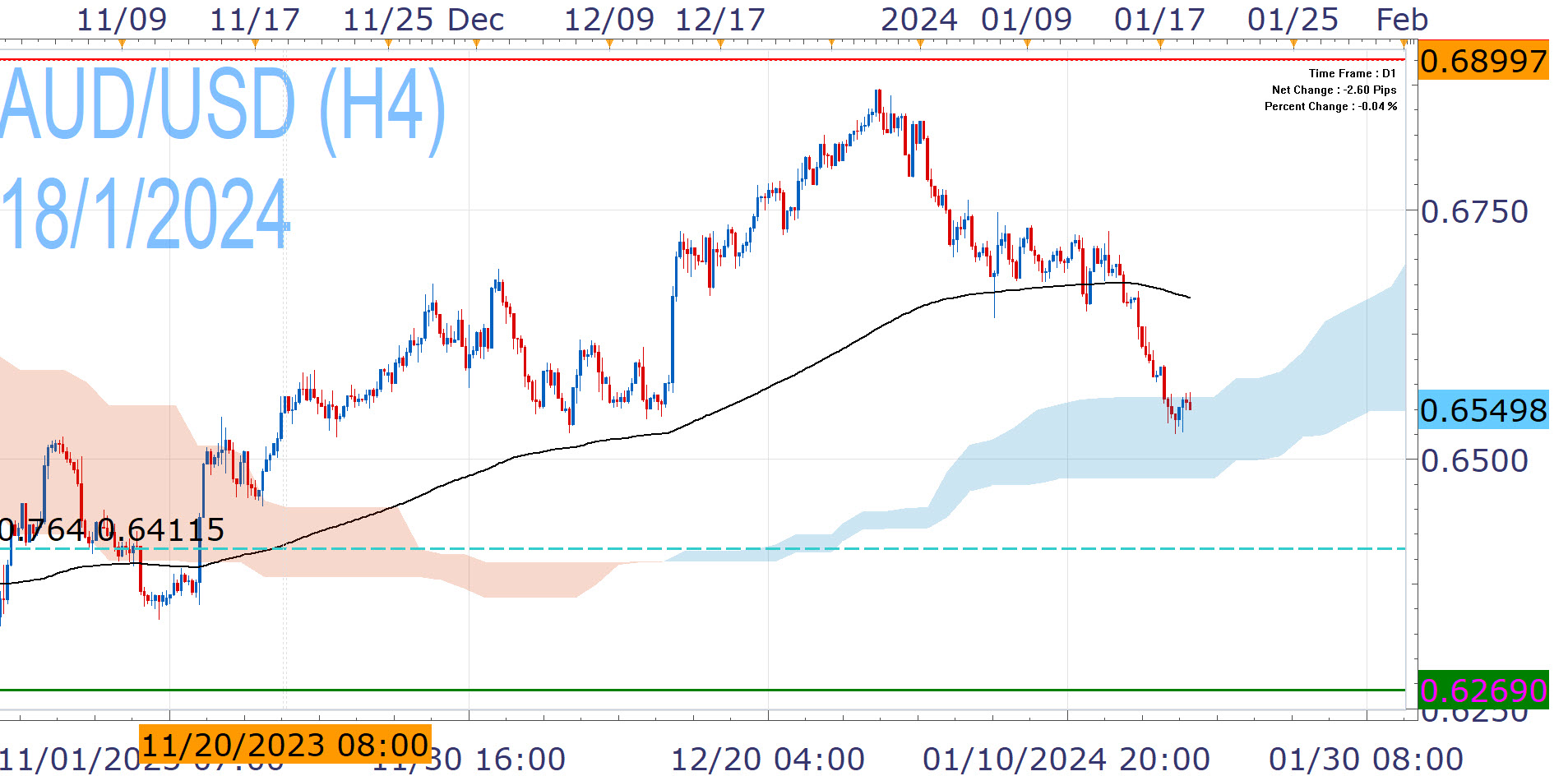
This week's risk aversion on escalating hostilities in the Middle East and the rethink around the Fed's rate cut prospects have sent AUD/USD to a steep decline. Today's Australian data don't help the Aussie and make it vulnerable to 0.6411, although 0.6269 is distant.
Despite another poor performance this week, the pair tries to find support today, as the fall looks stretched and the Fed is closer to a policy pivot than its Australian counterpart. The daily Ichimoku cloud has the potential to contain the fall, but catalyst would be needed for a return above the EMA200 (at around 0.6660) that would shift bias on the upside.

Nikos Tzabouras
Senior Financial Editorial Writer
Nikos Tzabouras is a graduate of the Department of International & European Economic Studies at the Athens University of Economics and Business. With extensive experience in market analysis and a strong foundation in international relations, he brings a unique perspective to financial markets. Nikos emphasizes not only technical analysis but also on fundamentals and the growing influence of geopolitics on financial trends.
As a Senior Financial Editorial Writer, he delivers comprehensive and forward-looking insights across a wide range of asset classes, including equities, commodities, and currencies. His work explores how macroeconomic events, political developments, and global policies impact market dynamics, providing readers with a deeper understanding of both short-term movements and long-term trends.
References
| Retrieved 18 Jan 2024 https://www.federalreserve.gov/newsevents/speech/waller20240116a.htm | |
| Retrieved 01 Oct 2026 https://www.cmegroup.com/markets/interest-rates/cme-fedwatch-tool.html |

Any opinions, news, research, analyses, prices, other information, or links to third-party sites contained on this website are provided on an "as-is" basis, as general market commentary and do not constitute investment advice. The market commentary has not been prepared in accordance with legal requirements designed to promote the independence of investment research, and it is therefore not subject to any prohibition on dealing ahead of dissemination. Although this commentary is not produced by an independent source, FXCM takes all sufficient steps to eliminate or prevent any conflicts of interests arising out of the production and dissemination of this communication. The employees of FXCM commit to acting in the clients' best interests and represent their views without misleading, deceiving, or otherwise impairing the clients' ability to make informed investment decisions. For more information about the FXCM's internal organizational and administrative arrangements for the prevention of conflicts, please refer to the Firms' Managing Conflicts Policy. Please ensure that you read and understand our Full Disclaimer and Liability provision concerning the foregoing Information, which can be accessed here.