
AlphaTrack – Geopolitical Tensions and AI Weakness Rattle US Stocks


Thoughtful insights and approachable analysis.
- Delta is approaching a make-or-break moment as record revenue and upbeat guidance collide with weakening momentum, rising fuel costs and a critical test of support at $84-85.
- Johnson & Johnson's breakout faces its biggest test yet as strong growth, earnings momentum and the battle to hold $250 collide ahead of results.
- Meta's bullish breakout is gathering momentum as surging ad growth and new AI opportunities put record highs firmly within reach.
Quick Market Overview
US stocks started the week lower as renewed tensions in the Middle East and weakness across AI-related shares weighed on sentiment ahead of the second-quarter earnings season. Investors are balancing strong corporate earnings expectations against rising geopolitical risks, while lofty profit expectations for the technology sector leave little room for disappointment. Inflation data and comments from Federal Reserve Chair Kevin Warsh are expected to provide the next major catalysts for markets.
General Equity Market Health (SPX500)
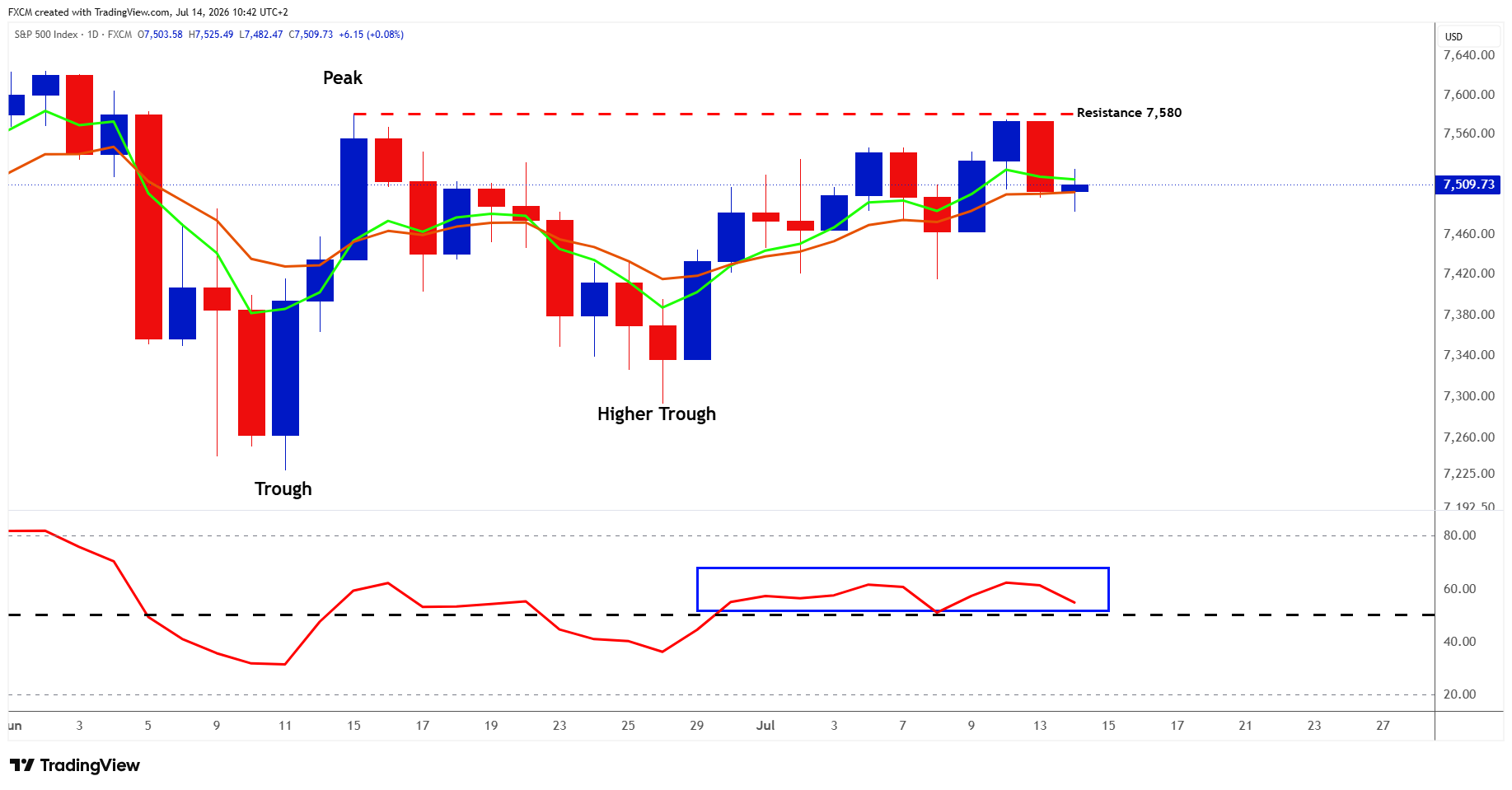
The SPX500 remains technically constructive, but the rally has reached an important decision point. Price has recovered from the late-June higher trough and established a sequence of higher troughs, while the short-term moving averages are still rising beneath the market. However, the index has again been rejected near the 7,580 resistance zone, the same area that capped the previous advance, suggesting sellers remain active at the highs. Momentum is also cooling: the RSI has stayed above 50, which preserves the bullish bias, but has turned lower from the low-60s rather than confirming the latest price test. A decisive daily close above 7,580 would complete the breakout and strengthen the case for another leg higher, while continued failure at resistance could pull the index back towards underlying support.
The SPX500 is testing resistance at a particularly fragile moment. Renewed US-Iran hostilities around the Strait of Hormuz have pushed Brent crude to a four-week high, reviving fears that higher energy and shipping costs could prolong inflation and keep bond yields elevated. Those concerns place added weight on today's US CPI release and Wednesday's producer-price data, as any upside surprise could further reduce expectations for monetary easing.
Meanwhile, the second-quarter earnings season begins in earnest with JPMorgan, Bank of America, Citigroup, Goldman Sachs and Wells Fargo reporting, shifting attention from geopolitical headlines to whether corporate profits can justify the market's elevated levels. Strong results and credible guidance could provide the catalyst needed to clear 7,580, but disappointing earnings or another inflation shock would make the index's repeated failure at resistance increasingly significant.
Potential Trade Setups
As the second-quarter earnings season gathers pace, Delta Air Lines, Johnson & Johnson and Meta present three very different tests of relative strength. Delta must show that its earlier leadership can survive a post-results pullback, J&J approaches tomorrow's update with its recent breakout under scrutiny, while Meta's renewed outperformance hints at a potentially more decisive move. With market-wide profit expectations already elevated, the most interesting opportunities may emerge not simply from whether companies beat forecasts, but from how their shares respond around critical technical levels as results and guidance are absorbed.
Delta Air Lines (DAL.us)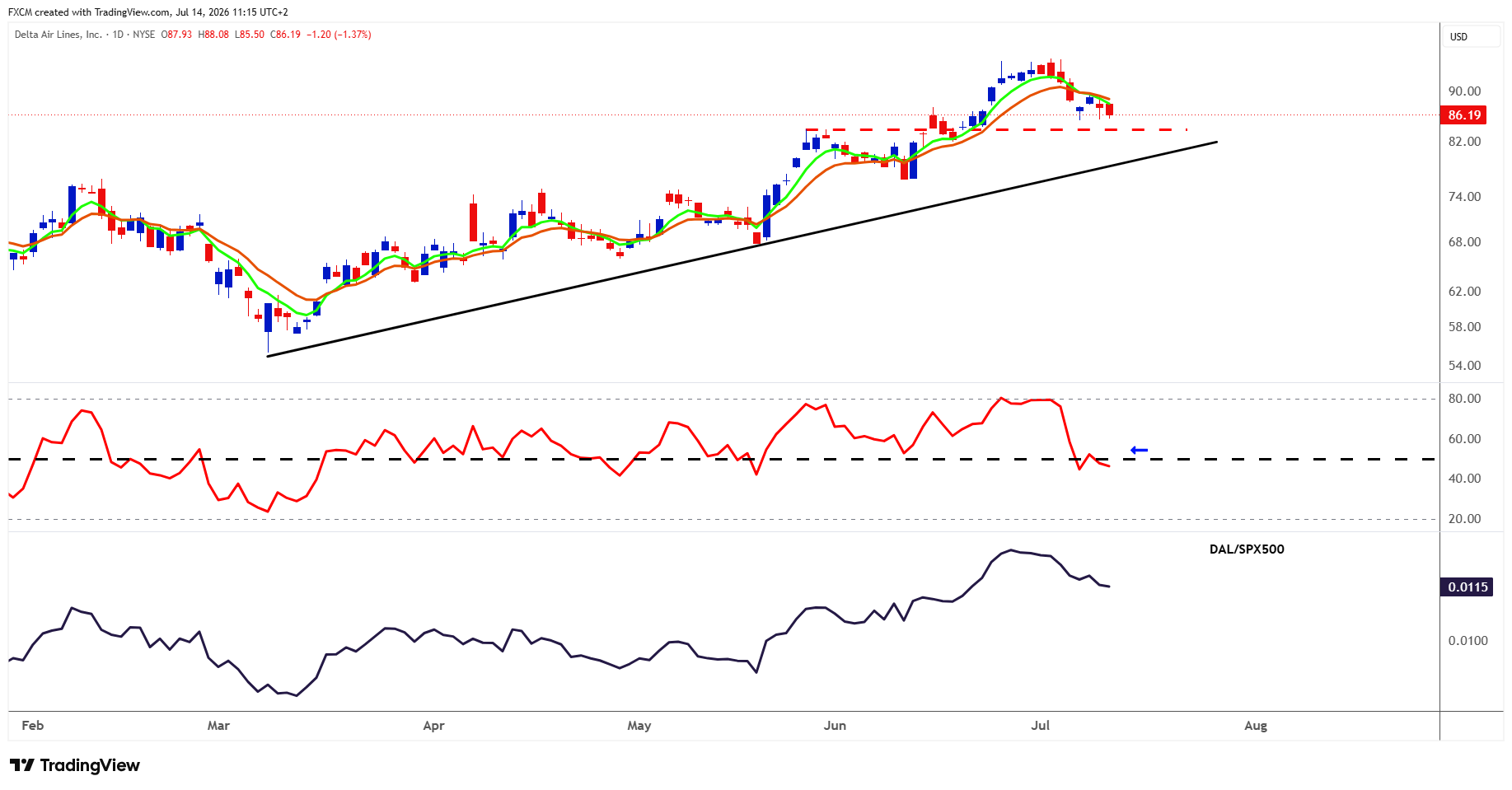
Technical Analysis
Delta Air Lines remains in a broader uptrend, but the chart is entering a critical test. After rallying from its March low near $55 to above $92, the shares have pulled back sharply, slipped beneath both short-term moving averages and lost momentum, with the RSI now below 50. The $84-85 area is the key battleground, marking the June breakout zone and providing initial support. A convincing hold there could turn the current weakness into a healthy retest and open the way for another attempt at $90-93. However, a daily close below $84 would weaken the breakout structure and expose the rising trendline near $81-82. Relative performance against the SPX500 has also rolled over from its recent peak, showing that Delta's earlier leadership is fading. The longer-term trend remains constructive, but buyers must defend support before the pullback develops into something more serious. The key now is rebuilding momentum: an RSI move back above 50 that holds would strengthen the case that this is merely a dip within the broader uptrend.
Caveat
If the RSI remains below 50, the shares are likely to stay under pressure and the risk of a deeper pullback will increase.
Fundamental Perspective
Delta's latest results were constructive but mixed. The airline delivered record June-quarter adjusted revenue of $17.7 billion, up 14% on approximately 1% capacity growth, supported by strong premium, loyalty and corporate demand. However, adjusted earnings declined 26% to $1.56 per share as adjusted fuel expense surged 77%.
Management nevertheless issued encouraging third-quarter guidance for mid-teen revenue growth, an operating margin of 11%-13% and earnings of $2.00-$2.50 per share, while reaffirming full-year earnings guidance of $6.50-$7.50. The principal risk remains fuel: Delta's projected third-quarter all-in price of approximately $3.15 per gallon was based on the forward curve as of 2 July, before renewed conflict around the Strait of Hormuz drove oil sharply higher.
The investment case now depends on Delta preserving fare and premium-revenue strength sufficiently to offset elevated fuel and non-fuel costs, particularly as the industry enters the traditionally softer post-summer travel period.
Johnson & Johnson (JNJ.us)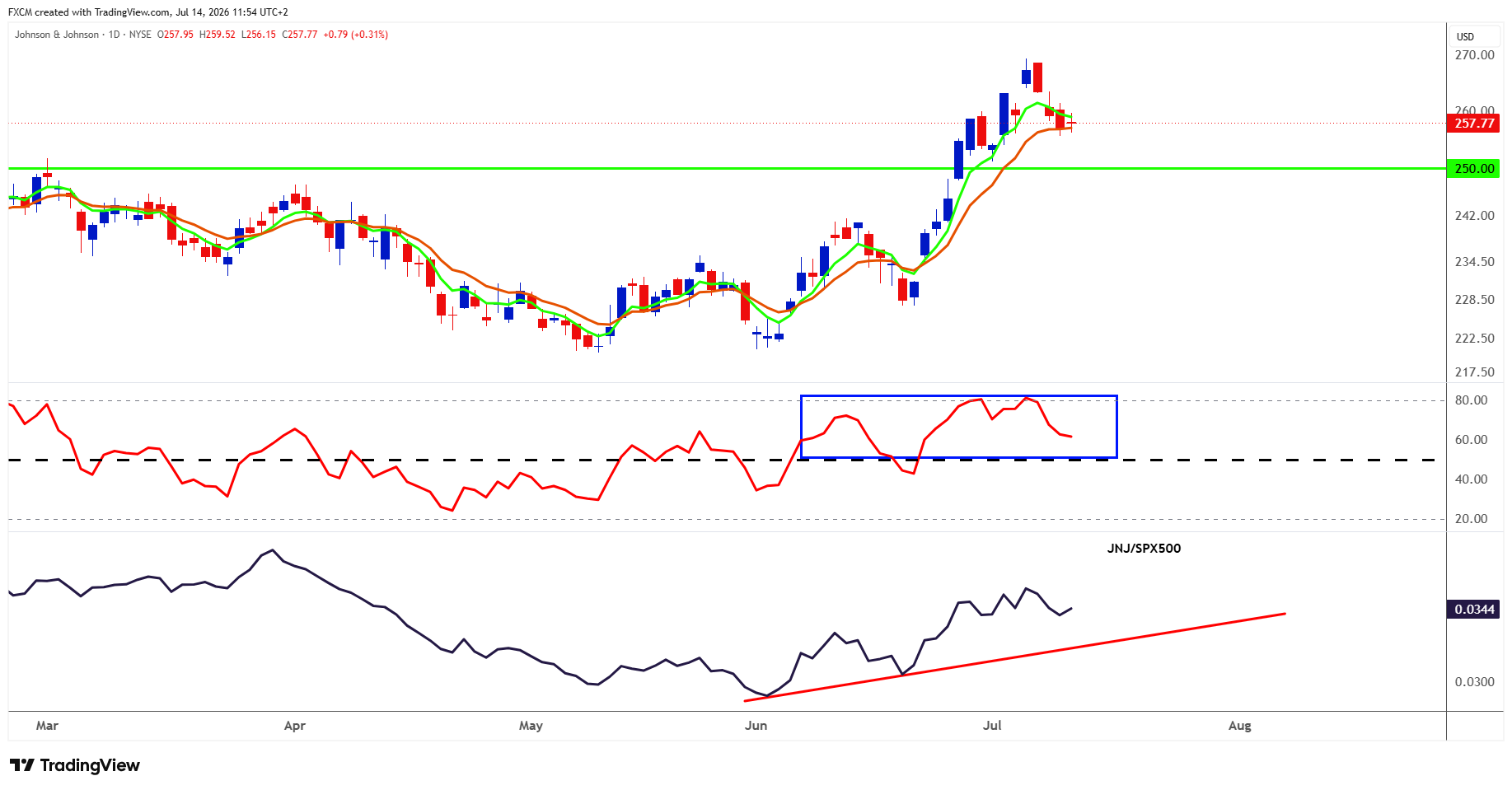
Technical Analysis
Johnson & Johnson is consolidating after a powerful breakout, and the chart still favours the bulls despite the recent loss of momentum. The shares surged through the long-standing $250 resistance level and reached roughly $268 before pulling back towards the rising short-term moving averages. That retreat has taken the RSI down from overbought territory, but it remains comfortably above 50, suggesting momentum has cooled rather than collapsed. The key technical question is whether the former $250 resistance zone can now hold as support; staying above it would keep the breakout structure intact and leave room for another test of $265-270. Relative strength against the SPX500 has also improved sharply since June, although the recent dip shows some of that leadership is being surrendered. A sustained move back above $260 would signal renewed momentum.
Caveat
A close below $250 would raise the risk that the breakout was false and expose a deeper retracement, while an RSI move below 50 that holds would confirm a bearish shift in momentum.
Fundamental Perspective
Johnson & Johnson enters its 15 July second-quarter results with solid sales momentum but a higher bar to clear following the share-price breakout. First-quarter sales rose 9.9% to $24.1 billion, adjusted EPS was $2.70, and management raised the midpoint of its 2026 outlook to approximately $100.8 billion in sales and $11.55 in adjusted EPS, although adjusted earnings were slightly lower year on year. Strong demand for Darzalex and Tremfya more than offset a roughly 60% decline in Stelara sales, while MedTech grew 7.7% and the early Icotyde launch provides an additional potential growth driver.
The central question for investors is whether these businesses can continue absorbing the Stelara patent cliff sufficiently to maintain or raise guidance. Talc litigation remains a separate overhang: J&J recently secured a favourable Los Angeles verdict, but more than 67,000 plaintiffs continue to pursue related claims. With the shares already above the former $250 resistance level, strong execution and constructive guidance may be required to sustain the breakout.
Meta Platforms (META.us)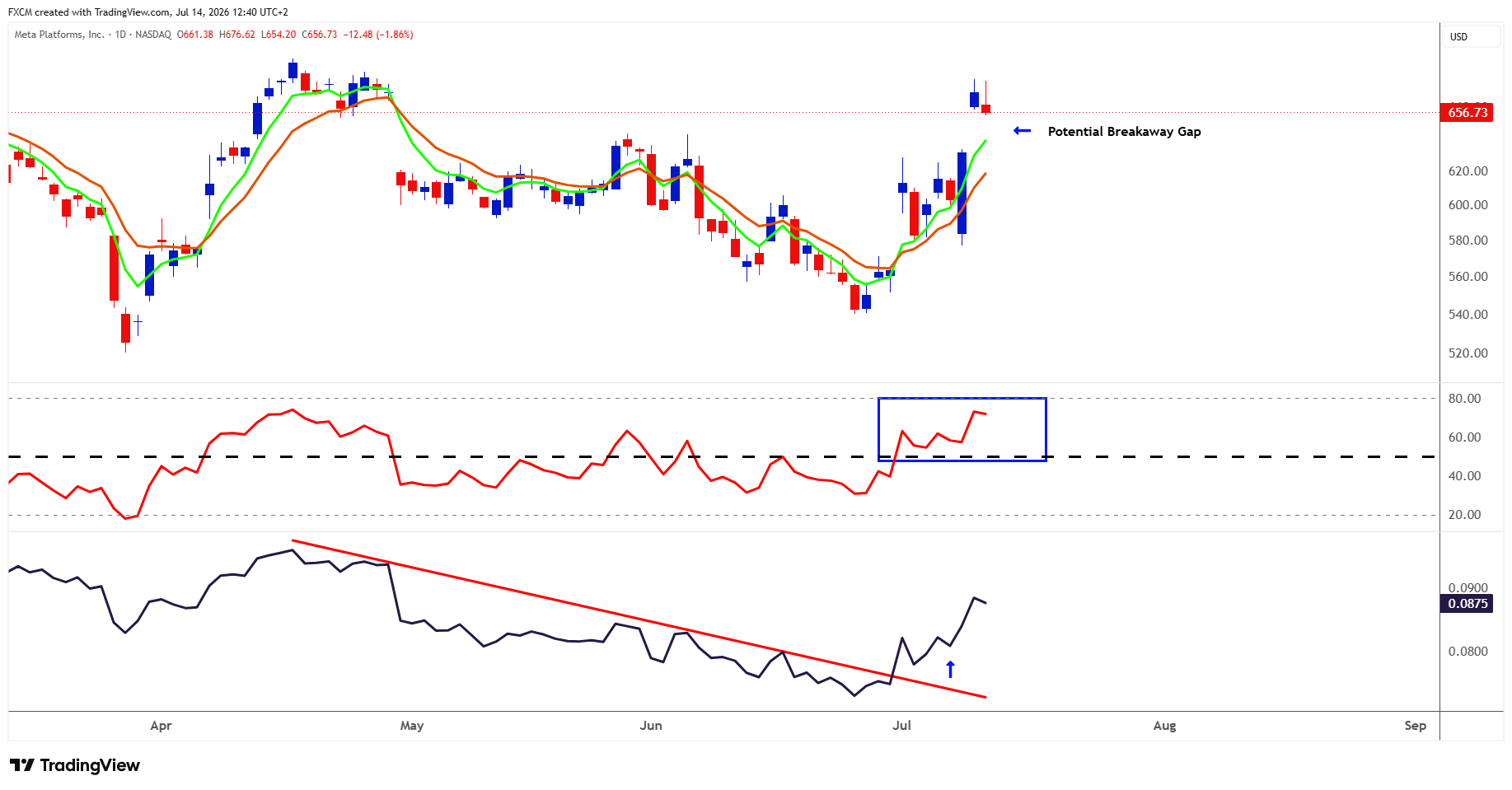
Technical Analysis
Meta's chart has shifted decisively in favour of the bulls after a sharp rebound from the late-June low and what may prove to be a breakaway gap above the $640 area. Price is now trading well above both rising short-term moving averages, while the META/SPX500 ratio has broken through its multi-month downtrend, signalling a meaningful return of relative strength. Holding above the gap zone around $640-650 would keep the breakout structure intact and support another attempt at those highs, while a move through $680 could open the door to fresh records.
Caveat
A sustained move back into and through the gap would undermine the bullish breakout and suggest the rally was a potential exhaustion move rather than the beginning of a new leg higher.
Fundamental Perspective
Meta's breakout is supported by an exceptionally strong advertising business and emerging, though still unproven, routes to monetise its AI investment beyond improvements to advertising. First-quarter revenue rose 33% to $56.3 billion, with ad impressions up 19%, average price per ad up 12% and Family daily active people increasing 4%, while management guided for second-quarter revenue of $58-61 billion.
The launch of Muse Spark 1.1 through the Meta Model API gives developers direct access to its latest model, while reported plans for an AI cloud service could create an additional revenue stream, although Meta has not confirmed the project and the strategy remains under development. The principal concern is cost: Meta expects 2026 capital expenditure of $125-145 billion and has expanded its Louisiana data-centre investment to more than $50 billion.
EU action against allegedly addictive engagement features and an August US youth-safety trial add regulatory risk. The next results must therefore show that advertising growth can continue funding the AI build-out while Meta develops more credible direct monetisation; strong execution would support the breakout, whereas weaker guidance or higher spending expectations could quickly revive concerns over returns.
Hot News, Cold Logic
June inflation was colder than expected, with headline CPI falling 0.4%, core prices unchanged and July rate-hike odds dropping to roughly 15%. Yet much of the relief came from a 9.7% fall in gasoline prices that is already reversing as renewed conflict around Hormuz pushes oil higher. Oil spikes matter only if they persist: a prolonged disruption could revive fuel and freight inflation and squeeze margins, while a brief surge is unlikely to overturn the softer core trend. However, Hormuz may determine how durable that relief proves.
Final Thought
Markets are entering the second half of the year with cautious optimism as softer US inflation offers relief just as earnings season begins. Yet with oil surging on renewed Middle East tensions, valuations still demanding and investors increasingly focused on execution over expectation, the next leg of this bull market will depend less on optimism and more on companies proving that the growth already priced into markets is real.

Russell Shor
Senior Market Strategist
Russell Shor is a Senior Market Strategist at FXCM, having been promoted to the role in 2025 in recognition of his depth of insight and consistent delivery of high-impact market analysis. He originally joined FXCM in October 2017 as a Senior Market Specialist.
Russell holds an Honours Degree in Economics from the University of South Africa, is a certified FMVA®, and a full member of the Society of Technical Analysts (UK). With over 20 years of experience in financial markets, his work is renowned for its clarity, precision, and strategic value across asset classes.

Any opinions, news, research, analyses, prices, other information, or links to third-party sites contained on this website are provided on an "as-is" basis, as general market commentary and do not constitute investment advice. The market commentary has not been prepared in accordance with legal requirements designed to promote the independence of investment research, and it is therefore not subject to any prohibition on dealing ahead of dissemination. Although this commentary is not produced by an independent source, FXCM takes all sufficient steps to eliminate or prevent any conflicts of interests arising out of the production and dissemination of this communication. The employees of FXCM commit to acting in the clients' best interests and represent their views without misleading, deceiving, or otherwise impairing the clients' ability to make informed investment decisions. For more information about the FXCM's internal organizational and administrative arrangements for the prevention of conflicts, please refer to the Firms' Managing Conflicts Policy. Please ensure that you read and understand our Full Disclaimer and Liability provision concerning the foregoing Information, which can be accessed here.