
Oil rises after US President Trump orders blockade of oil tankers into and out of Venezuela


The US President has ordered a blockade of sanctioned oil tankers entering and leaving Venezuela, while designating the regime of President Nicolas Maduro as a "FOREIGN TERRORIST ORGANIZATION" [1]. This marks an escalation in pressure from the US administration on the Venezuelan leader, following an oil tanker seizure last week and strikes on alleged drug-trafficking vessels.
The move raises supply concerns, as Venezuela is a significant OPEC member and has been producing around one million barrels per day in recent months, according to the International Energy Agency (IEA) [2]. This development comes at a time when a Ukraine peace deal remains elusive, while OPEC+ has announced a pause in its output hikes for the first quarter of 2026 [3]. In addition, the blockade could trigger broader geopolitical frictions, as most Venezuelan oil is shipped to China, accounting for 69% of its crude exports in 2023, according to the US Energy Information Administration (EIA). [4]
As a result, USOil jumped today and has the chance to push towards the 200-day EMA, which could challenge the prevailing bearish bias. However, oil prices set a near five-year low on Tuesday and remain vulnerable to further declines amid unfavourable fundamentals.
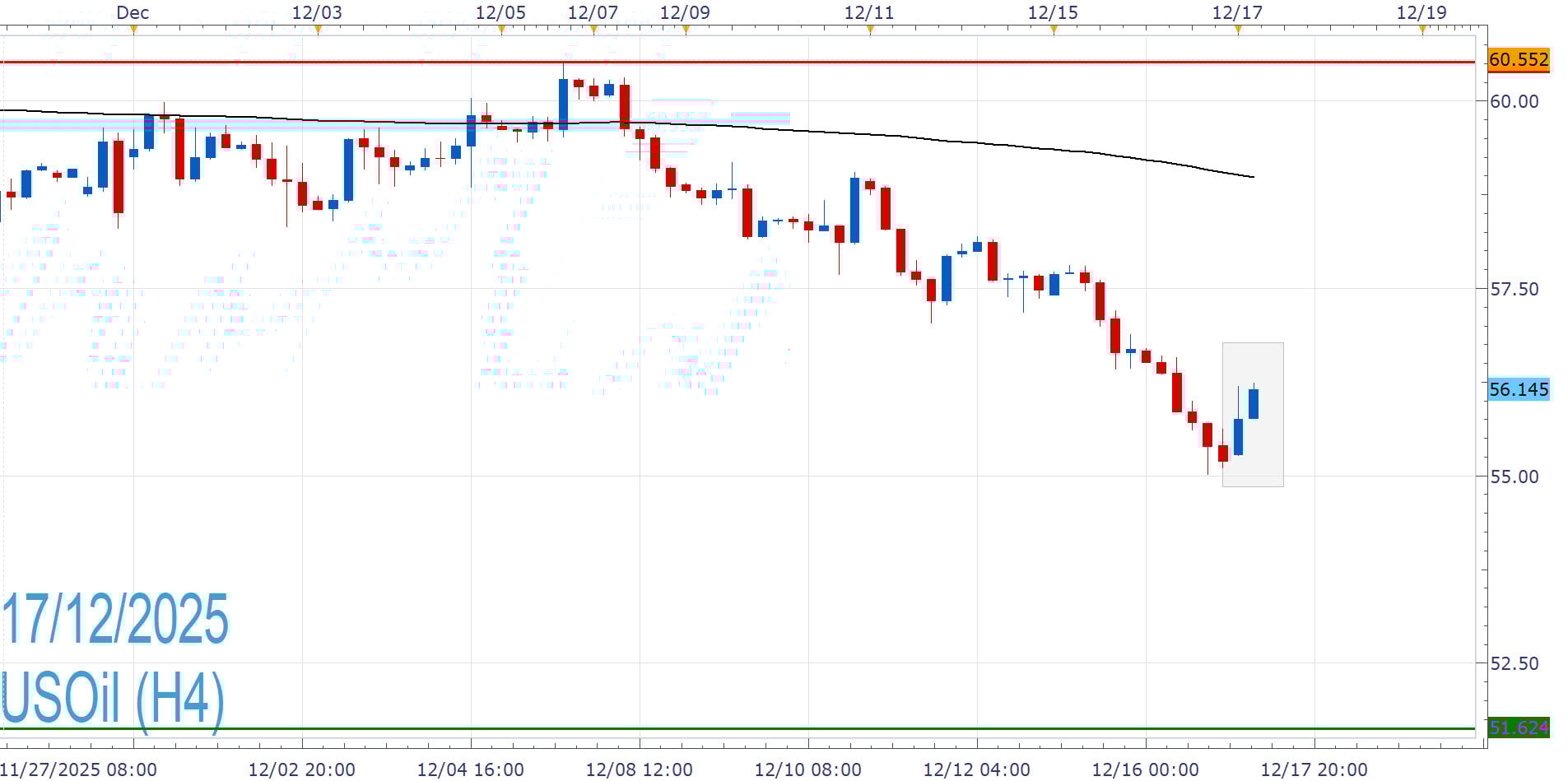
A prolonged blockade could have a material impact, but for now the market is well supplied. Moreover, ongoing diplomatic efforts raise the prospect of a Ukraine peace agreement that could unlock additional Russian oil, with President Trump stating that such an outcome is now closer than ever [5]. Meanwhile, recent weak data from China and global economic headwinds stemming from disruptive tariffs continue to weigh on demand and sustain concerns over a supply glut.

Nikos Tzabouras
Senior Financial Editorial Writer
Nikos Tzabouras is a graduate of the Department of International & European Economic Studies at the Athens University of Economics and Business. With extensive experience in market analysis and a strong foundation in international relations, he brings a unique perspective to financial markets. Nikos emphasizes not only technical analysis but also on fundamentals and the growing influence of geopolitics on financial trends.
As a Senior Financial Editorial Writer, he delivers comprehensive and forward-looking insights across a wide range of asset classes, including equities, commodities, and currencies. His work explores how macroeconomic events, political developments, and global policies impact market dynamics, providing readers with a deeper understanding of both short-term movements and long-term trends.
References
| Retrieved 17 Dec 2025 https://truthsocial.com/@realDonaldTrump/posts/115731908387416458 | |
| Retrieved 17 Dec 2025 https://www.iea.org/reports/oil-market-report-december-2025 | |
| Retrieved 17 Dec 2025 https://www.opec.org/pr-detail/1574583-30-november-2025.html | |
| Retrieved 17 Dec 2025 https://www.eia.gov/international/content/analysis/countries_long/Venezuela/pdf/venezuela_2024.pdf | |
| Retrieved 01 Oct 2026 https://www.youtube.com/watch |


Any opinions, news, research, analyses, prices, other information, or links to third-party sites contained on this website are provided on an "as-is" basis, as general market commentary and do not constitute investment advice. The market commentary has not been prepared in accordance with legal requirements designed to promote the independence of investment research, and it is therefore not subject to any prohibition on dealing ahead of dissemination. Although this commentary is not produced by an independent source, FXCM takes all sufficient steps to eliminate or prevent any conflicts of interests arising out of the production and dissemination of this communication. The employees of FXCM commit to acting in the clients' best interests and represent their views without misleading, deceiving, or otherwise impairing the clients' ability to make informed investment decisions. For more information about the FXCM's internal organizational and administrative arrangements for the prevention of conflicts, please refer to the Firms' Managing Conflicts Policy. Please ensure that you read and understand our Full Disclaimer and Liability provision concerning the foregoing Information, which can be accessed here.