
Oil prices soften after surge from Middle East escalation


USOIL analysis
Hostilities between the United States and Iran continued for a second day after President Trump warned that Tehran "will have to pay the price" for stalling on negotiations [1]. US forces "completed additional self-defense strikes against multiple targets in Iran" [2] while Iran struck US bases in the region and declared a total closure of the Strait of Hormuz according to local media [3]. However, US CENTCOM said that commercial ships are continuing to transit [4]. Adding to the mixed signals, President Trump told Fox that he had spoken with Iranian officials who asked him to stop the strikes [5], but Iranian media rejected this claim [6].
The military escalation raises the geopolitical risk premium and exacerbates uncertainty around a deal that would allow the Strait of Hormuz to reopen. The prolonged blockade restricting supply has tightened the market and reverses previously unfavourable fundamentals. The IEA now sees a deficit "until the final quarter of the year" [7], and even if this crucial corridor reopens, flows could take months to restore. Exxon Mobil's CEO estimated one to two months during the May 1 earnings call [8], while the CEO of Saudi Aramco said rebalancing could extend to 2027 if the reopening of the Strait takes further weeks. [9]
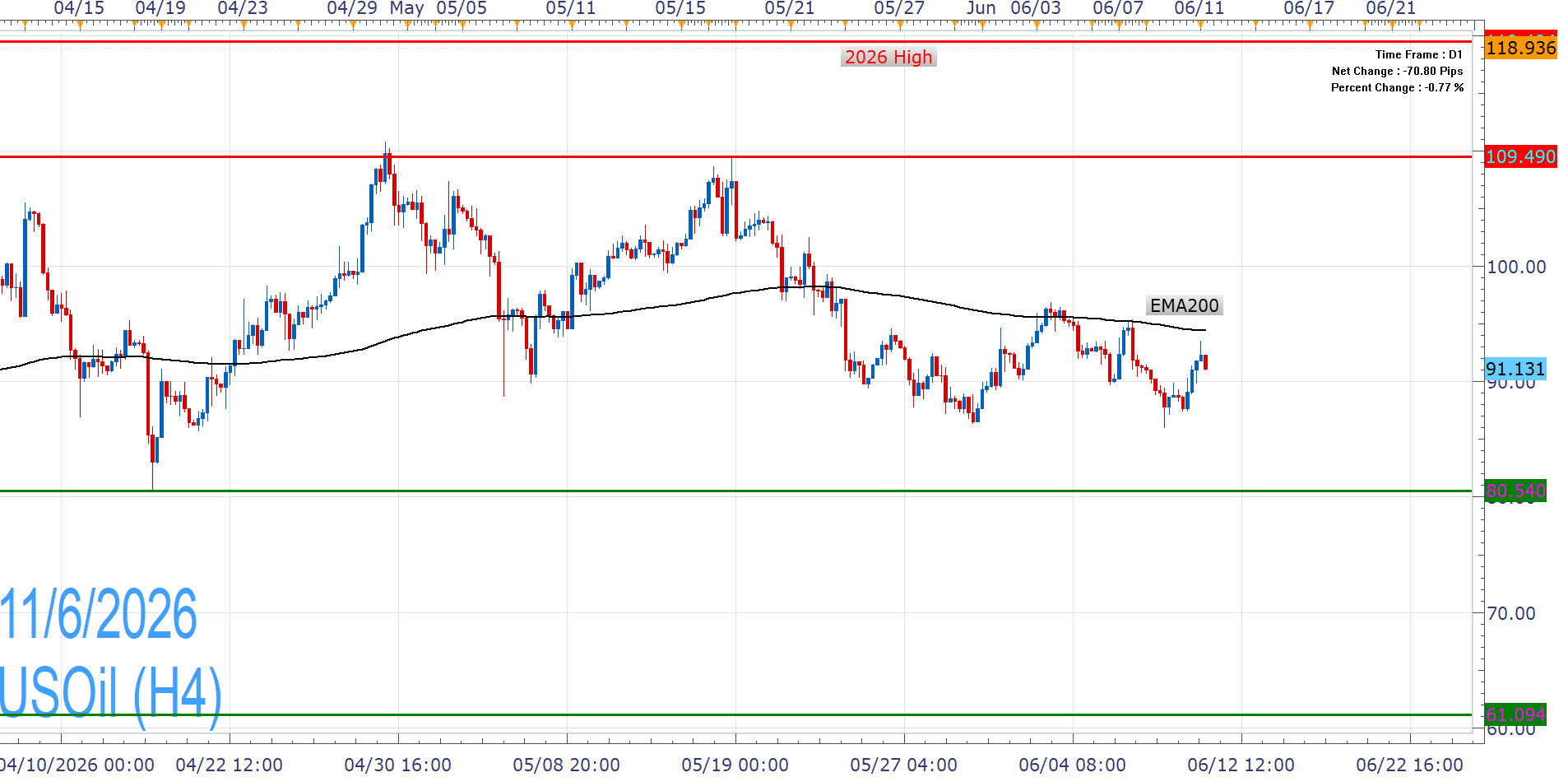
USOil jumped on Wednesday following the geopolitical flare-up and now has the opportunity to reclaim the EMA200, which would shift the immediate bias to the upside and open the door to further gains. However, prices are subdued today as markets assess the situation, staying below this pivotal technical level and leaving USOil vulnerable to deeper declines.
Despite the hostilities, neither side appears ready to formally abandon the fragile ceasefire and President Trump has repeatedly expressed a preference for a deal, also using escalations as a tool to pressure Tehran. Moreover, the prolonged spike in crude prices is weighing on global economic activity and causing demand destruction, with the IEA expecting consumption to decline this year. Higher energy prices are sparking an inflationary impulse that is pushing central banks in a more hawkish direction, compounding economic and demand headwinds. This has also fuelled higher-for-longer Fed expectations that boost the USDOLLAR, adding further pressure on USOil.

Nikos Tzabouras
Senior Financial Editorial Writer
Nikos Tzabouras is a graduate of the Department of International & European Economic Studies at the Athens University of Economics and Business. With extensive experience in market analysis and a strong foundation in international relations, he brings a unique perspective to financial markets. Nikos emphasizes not only technical analysis but also on fundamentals and the growing influence of geopolitics on financial trends.
As a Senior Financial Editorial Writer, he delivers comprehensive and forward-looking insights across a wide range of asset classes, including equities, commodities, and currencies. His work explores how macroeconomic events, political developments, and global policies impact market dynamics, providing readers with a deeper understanding of both short-term movements and long-term trends.


Any opinions, news, research, analyses, prices, other information, or links to third-party sites contained on this website are provided on an "as-is" basis, as general market commentary and do not constitute investment advice. The market commentary has not been prepared in accordance with legal requirements designed to promote the independence of investment research, and it is therefore not subject to any prohibition on dealing ahead of dissemination. Although this commentary is not produced by an independent source, FXCM takes all sufficient steps to eliminate or prevent any conflicts of interests arising out of the production and dissemination of this communication. The employees of FXCM commit to acting in the clients' best interests and represent their views without misleading, deceiving, or otherwise impairing the clients' ability to make informed investment decisions. For more information about the FXCM's internal organizational and administrative arrangements for the prevention of conflicts, please refer to the Firms' Managing Conflicts Policy. Please ensure that you read and understand our Full Disclaimer and Liability provision concerning the foregoing Information, which can be accessed here.