
Central banks on a tightrope: pivotal June rate decisions amid inflation and growth risks


Central banks grapple with inflation and growth risks
The US-Iran conflict that erupted in late February remains unresolved, leaving the Strait of Hormuz effectively shut. Prolonged and severe disruptions in global energy flows have caused the oil market to tighten aggressively, reversing previously soft fundamentals and triggering a massive surge in prices. The IEA recently noted that global inventories are depleting at a "record pace", estimated supply losses already in excess of one billion barrels and projects a deficit this year. [1]
Recent commentary from oil and gas majors strongly reinforces this bleak outlook. TotalEnergies CEO Patrick Pouyanné warned that the market surplus anticipated for 2026 "is now over". [2] Saudi Aramco CEO Amin H. Nasser spoke of "catastrophic consequences" the longer the shipping disruption drags on [3], and ExxonMobil CEO Darren Woods cautioned that even if the Strait reopens tomorrow, crude flows would require a couple of months to normalise. [4]
The spike in energy prices is pushing inflation higher, with the OECD expecting consumer prices in G20 countries to rise to 4.0% this year from 3.4% in 2025 [5]. These mounting inflationary pressures, second-round effects and de-anchoring risks are pushing key central banks toward a more hawkish stance. Some, like the RBA, are already tightening aggressively, while others like the ECB are expected to move this month.
However, the energy shock is creating severe headwinds for global economic activity, complicating the path for central banks and limiting their appetite for tightening. The OECD expects global GDP growth to slow from 3.4% last year to 2.8% in 2026. The economic fallout from the Middle East conflict adds to pre-existing headwinds from disruptive trade policies. The US Supreme Court struck down the US IEEPA tariffs in late February [6], but the President introduced a 150-day universal levy under a different scheme [7] and has also proposed fresh tariffs under Section 301 over labour practices. [8]
June represents a crossroads for global monetary policy as a series of major central banks announce their latest rate decisions. While surging inflation remains the primary concern, driving most institutions toward a hawkish shift, not all are ready to act. Mounting domestic growth risks provide a compelling reason for caution, leading many policymakers to opt for a look-through approach for the time being. These pivotal decisions, against an uncertain backdrop, could spark volatility in FX markets and shape the trajectory of major currencies.
Bank of Canada (BoC) – Wednesday 10 June
The Bank of Canada has maintained interest rates at 2.25% and markets widely expect another hold this month. However, the path forward remains highly uncertain and fast-changing, meaning the policy statement and the Governor's press conference remarks will be closely monitored for fresh clues regarding the BoC's medium-term intentions.
For now, policymakers are deliberately looking through the temporary inflationary impulse from higher global energy prices. The latest CPI report vindicates this patient stance, with core inflation cooling to 2.1% in April. Governor Macklem noted that the current interest rate level "looks appropriate" [9], reinforcing broad market expectations for an extended holding pattern.
With rates at the bottom end of the neutral range after 275 basis points of total cuts, there is structurally limited room for additional easing, though further cuts cannot be entirely ruled out. The Canadian economy is partially shielded from the economic fallout of the Middle East conflict due to its status as a net energy exporter. However, it is not immune to global headwinds. Domestic GDP contracted for a second straight quarter at the start of the year, putting Canada in a technical recession, while trade tariffs and lingering USMCA uncertainty continue to weigh and the labour market remains soft.
Even though officials appear content with their current stance, pressure for an eventual pivot to rate hikes could mount if energy markets remain unhinged. Headline inflation accelerated to 2.8% y/y in April, its highest level in nearly two years, as rising oil prices filter through. The Governor recently flagged that higher energy prices could mutate into "ongoing generalized inflation increases", a scenario that would ultimately force a shift toward monetary tightening.
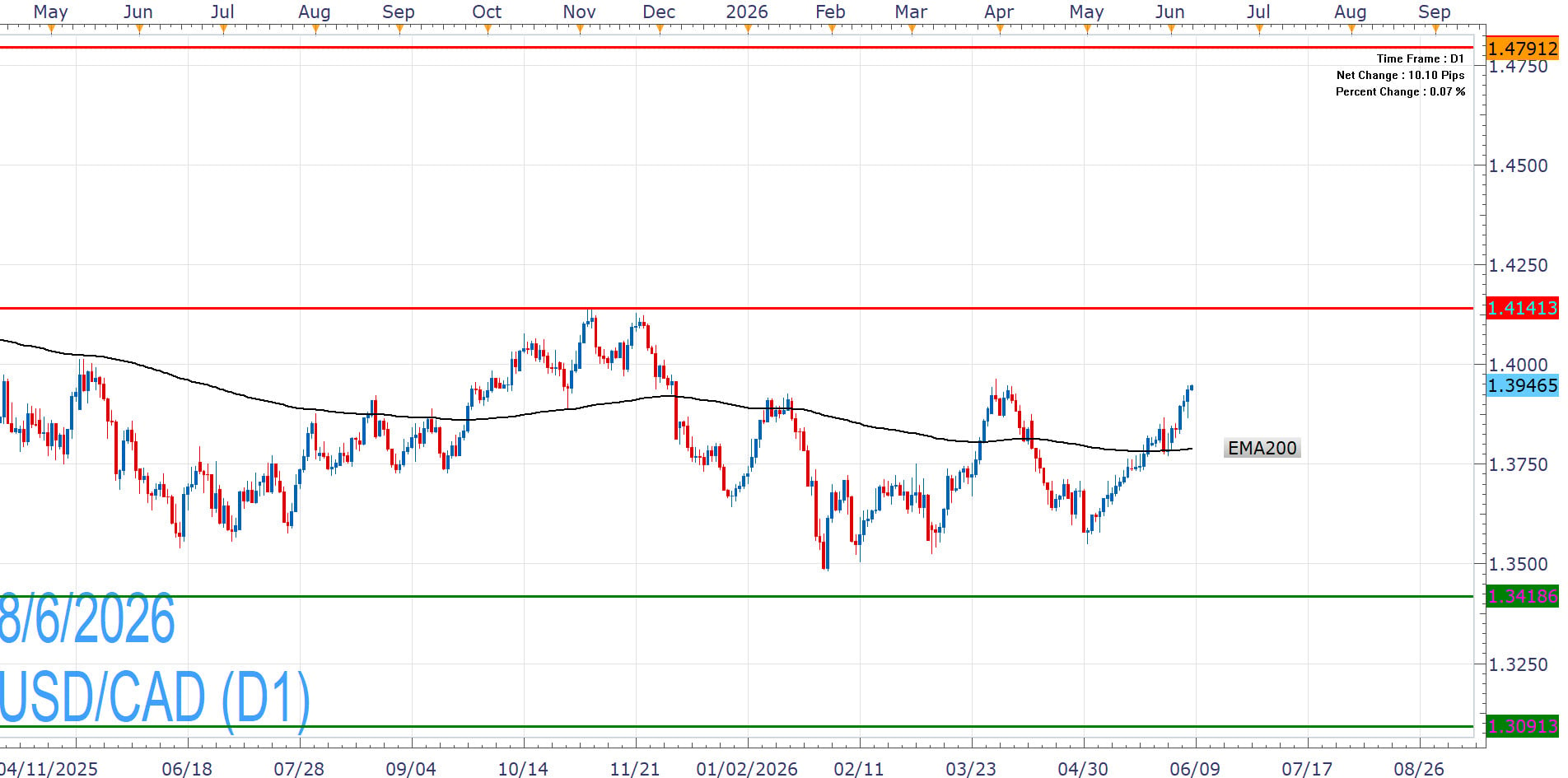
USD/CAD could extend its gains amid shifting Fed expectations and risk-off flows, though the advance looks technically stretched. The spike in energy prices remains helpful for commodity-linked currencies like the Canadian dollar and, combined with the BoC's steady stance, creates scope for USD/CAD declines.
European Central Bank (ECB) – Thursday 11 June
The ECB has long paused its easing cycle, keeping the deposit facility rate (DFR) steady at 2% for the past year, but this is likely to change on Thursday. Markets widely expect a policy pivot and a 25 basis point rate increase. The road ahead remains highly uncertain, however, as the Middle East conflict elevates risks for both inflation and growth, making the updated macroeconomic projections a major focal point.
For now, the impact on inflation is the more pressing concern and the ECB looks determined not to repeat past mistakes of underestimating it. Key policymakers have already laid the groundwork for this shift. Bundesbank President Nagel told Handelsblatt in late May that rate hikes are becoming increasingly likely [10], while Executive Board member Schnabel warned that "looking through is no longer an option" [11]. Preliminary May CPI jumped to 3.2% y/y, its fastest pace in more than two years, and while President Lagarde noted after the April hold that there were no signs of second-round effects [12], core inflation accelerated substantially last month, suggesting mounting risks.
Nonetheless, officials have strong incentives to tread carefully and are unlikely to commit to future moves, as monetary tightening risks further stifling an already fragile economy. Europe is particularly exposed to global energy shocks just as key industries continue to grapple with tariffs and trade headwinds, with Eurozone GDP dropping 0.2% q/q in the first quarter. Furthermore, S&P expects a Eurozone contraction in the second quarter after private sector activity fell at its sharpest pace in 18 months in May. [13]
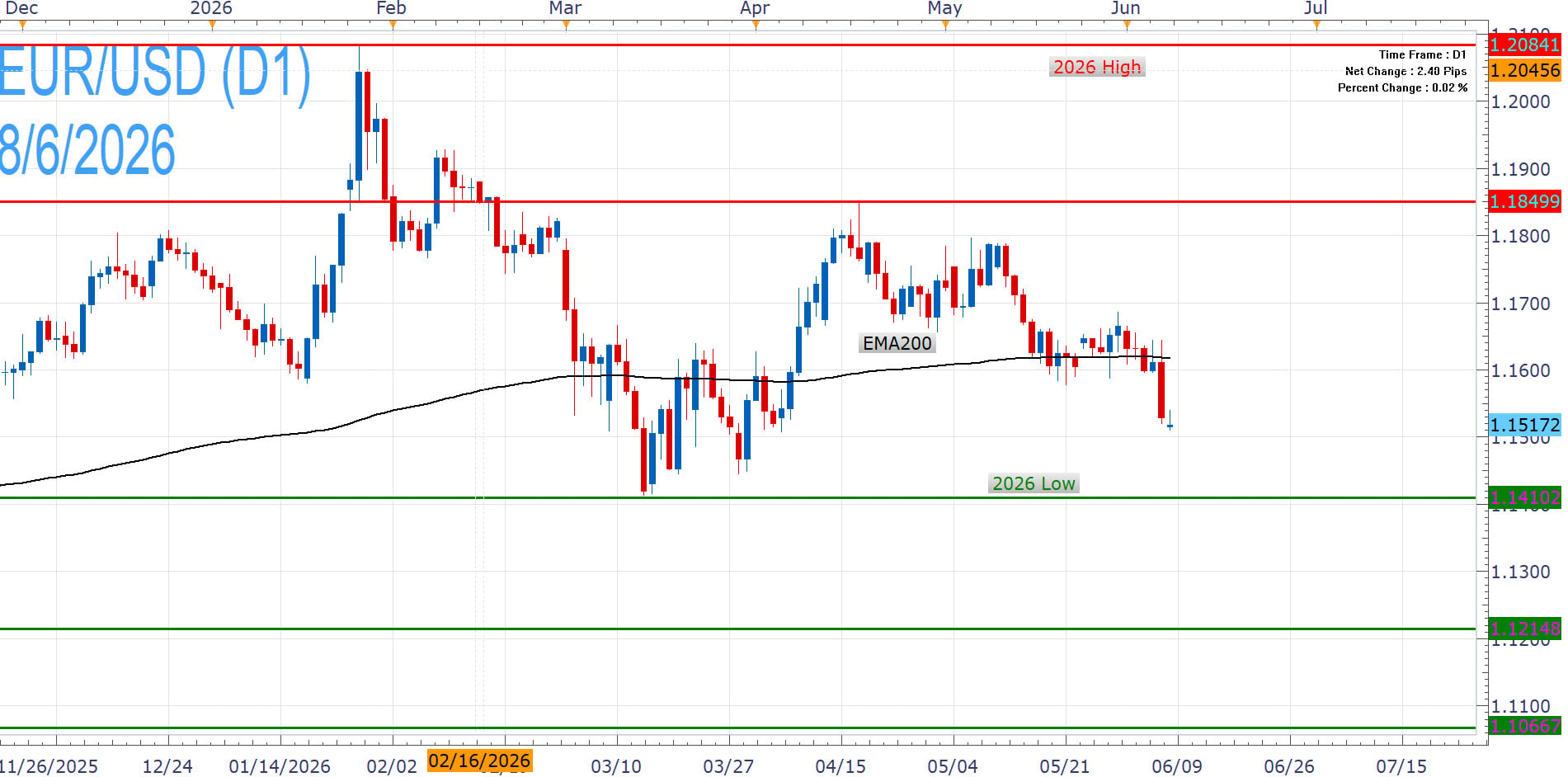
The expected ECB pivot could offer near-term support to EUR/USD, but it is unlikely to act as a lasting catalyst given that officials will probably avoid signalling a broader aggressive tightening cycle. As long as the dollar continues to benefit from safe-haven flows and higher-for-longer Fed expectations, the pair remains highly exposed to deeper declines.
Bank of Japan (BoJ) – Tuesday 16 June
Unlike most of its major peers, the Bank of Japan had already embarked on a tightening cycle before the Middle East shock erupted. While officials have refrained from moving on rates so far this year, hawkish signals are mounting rapidly and markets are pricing in a hike at this month's meeting. Governor Ueda dropped a strong hint earlier this month, explicitly warning of external shocks impacting underlying inflation and noting that the board "should thoroughly discuss the pros and cons" of raising rates [14]. This follows an April meeting where three of nine board members dissented in favour of an immediate hike, while the subsequent Summary of Opinions cemented the bank's hawkish tilt. [15]
Headline inflation eased substantially in April, but that downshift was largely a product of base effects and government utility subsidies and is expected to prove temporary. The BoJ forecasts core inflation to accelerate to 2.8% in the current fiscal year. Further supporting the case for immediate rate normalisation, real inflation-adjusted pay gained for a fourth consecutive month in April, while the Rengo union federation confirmed a robust 5.02% average increase in negotiated spring wages[16]. The domestic economy is also showing notable resilience, posting solid 1.8% GDP growth in the first quarter, driven by Japan's world-class semiconductor industry. Chip shipments surged 41.6% y/y in April, acting as a primary engine behind the country's broader 14.8% increase in overall exports. [17]
Nonetheless, the Japanese economy remains particularly vulnerable to the energy shock from the Middle East conflict as it sources most of its oil from the region, with petroleum imports plunging 49.9% in April. Oil shortages and higher prices threaten to crimp key manufacturing industries and dent consumer spending, explaining why the BoJ projects frail GDP growth of just 0.5% for FY26. While the government's emergency fiscal measures are designed to mitigate this impact, they also add complexity to the central bank's monetary calculus. Against this volatile backdrop, policymakers are unlikely to abandon their characteristically cautious approach to tightening.
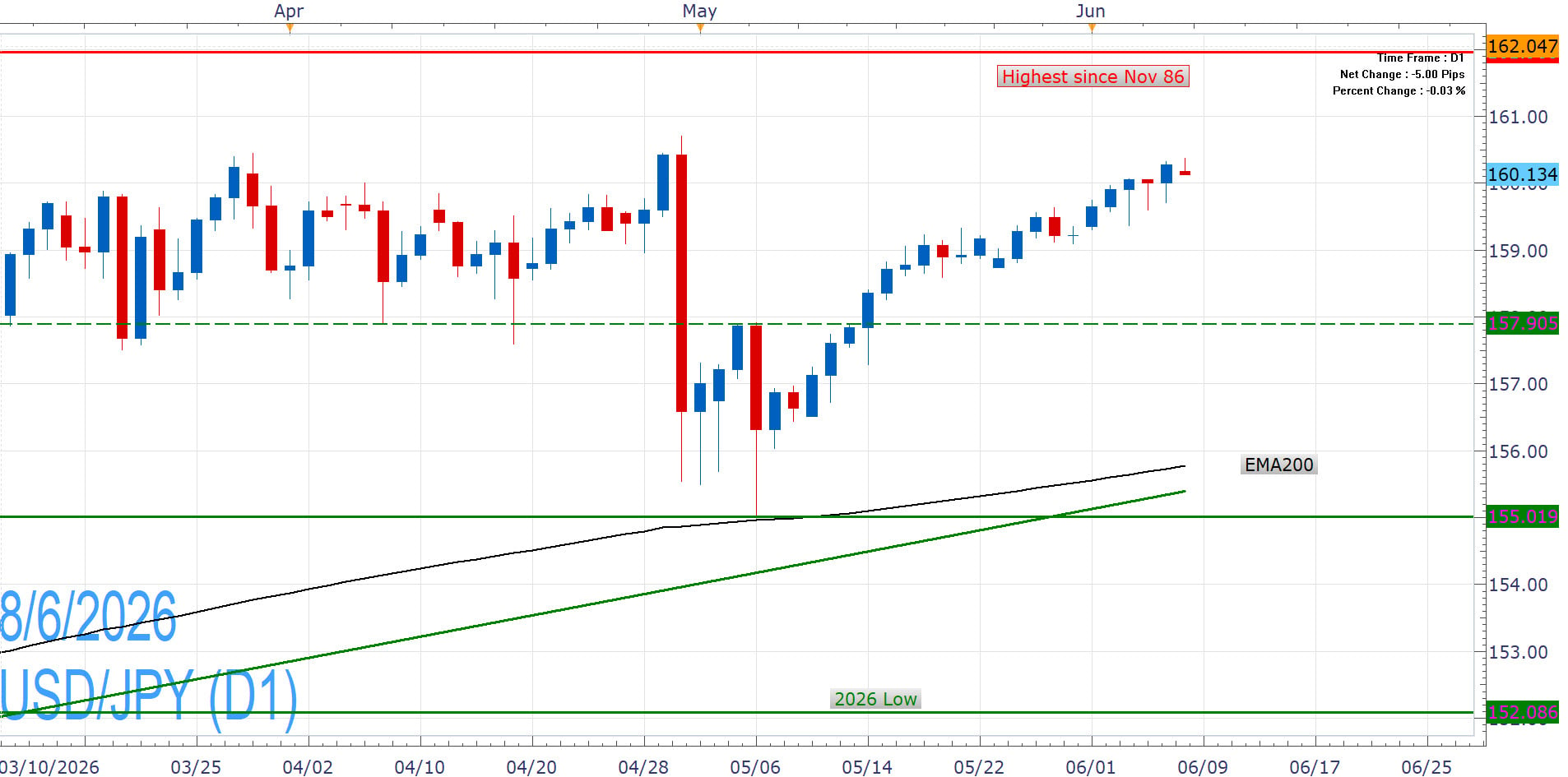
Additional BoJ tightening could weigh on USD/JPY, while the risk of fresh FX intervention by Japanese authorities could create volatility and leave the pair vulnerable to declines. However, the structural bullish case remains formidable. The nominal interest rate differential between the Fed and the BoJ remains vast, Tokyo's decision to inject an extra ¥3.1 trillion in spending [18] on top of an already record budget enhances fiscal sustainability concerns and plays into long-term yen debasement trends, while the USDOLLAR continues to draw support from a broader hawkish repricing of the Fed's policy path.
Reserve Bank of Australia (RBA) – Tuesday 16 June
Australia's central bank is a frontrunner in monetary tightening, having delivered three consecutive 25 basis point hikes, bringing rates to 4.35%, the highest level since late 2024. Officials will have strong incentive to press forward as fuel prices are "adding to inflation" while creating risks of second-round effects. CPI rose to 4.1% y/y in Q1, staying well above the 2%-3% target, and the 4.75% increase in minimum wages from July 1 could exacerbate pressures. Policymakers expect CPI to peak at 4.8% in the current quarter, a forecast based on an implied rate of 4.7%, leaving room for at least one more hike this year.
Despite the RBA's aggressive action, the last tightening step took the shape of a dovish hike and markets widely anticipate a hold this week. Officials explicitly noted they are now "well positioned" to respond to incoming economic developments, while a dissenting vote against the last hike indicates that the tightening runway is getting shorter. Governor Bullock reiterated this patient narrative earlier this month, suggesting that the initial restrictive effects of the RBA's policy are beginning to show across the real economy. [19]
Policymakers will have good reason to proceed with caution as the Middle East conflict creates growth risks. Unemployment is rising, consumer confidence is deteriorating and GDP expanded by just 0.3% q/q in the first quarter, prompting the RBA to downgrade its growth projections. Furthermore, while Australia is a global energy powerhouse, it remains highly reliant on refined oil imports, leaving its industrial cost base deeply exposed to global energy supply disruptions.
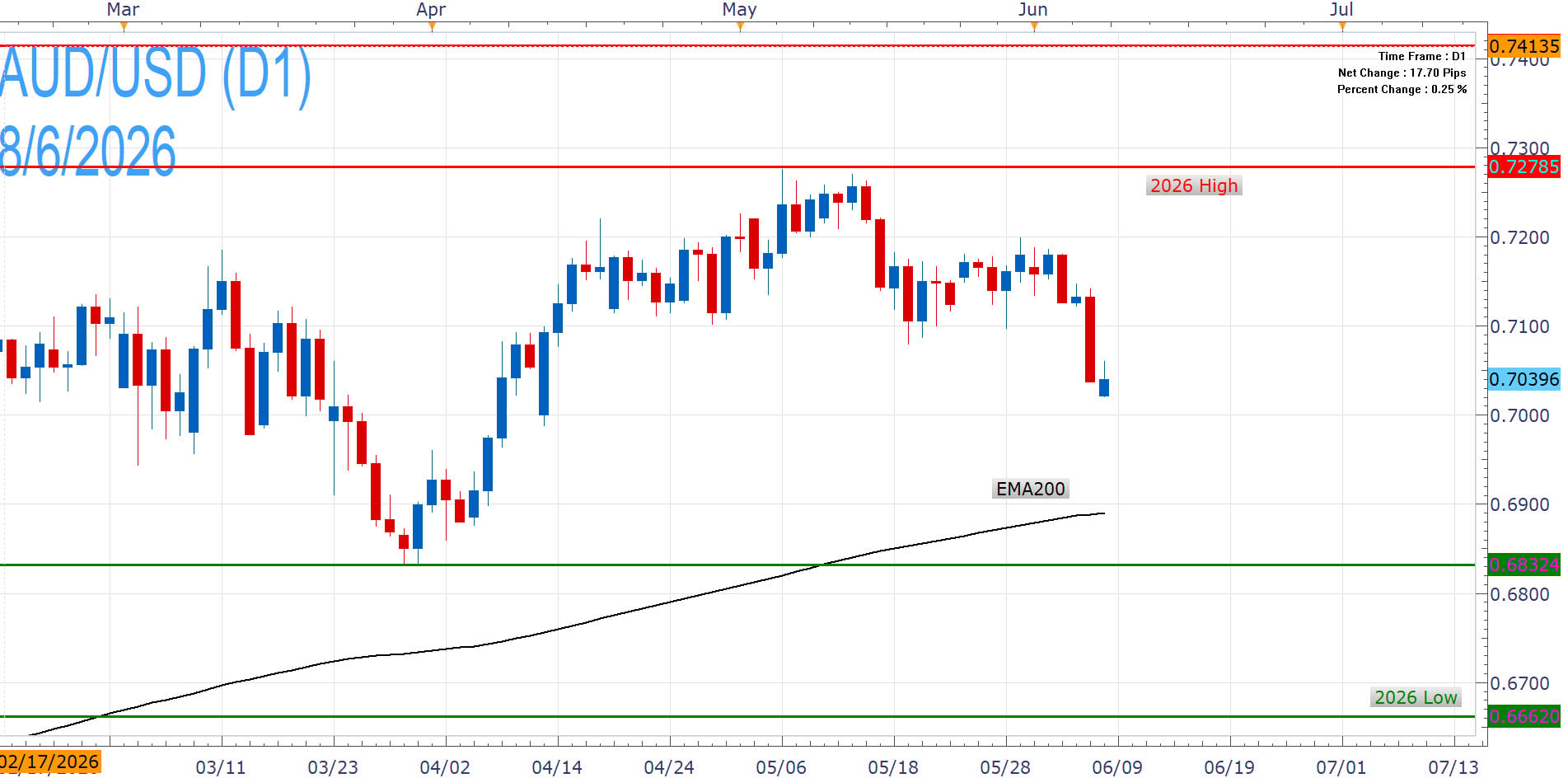
The RBA's aggressive policy stance this year has provided clear fundamental backing for AUD/USD, creating structural room to drive the pair toward new multi-year highs. However, as the central bank has already front-run its global peers, policymakers are growing reluctant to tighten much further. This hesitation, alongside mounting expectations for a hawkish Fed trajectory, leaves the Aussie vulnerable to pullbacks, and a break below the EMA200 would negate the upside bias.
US Federal Reserve – Wednesday 17 June
The Fed is not expected to move on rates this week, but markets will have plenty to unpack amid an increasingly uncertain monetary path. This marks the first policy decision under new Chair Kevin Warsh, meaning his inaugural press conference will be thoroughly scrutinised, while the updated dot plot will reveal whether officials still favour a rate cut later this year.
Markets are certainly not pricing in any near-term easing. Chair Warsh inherits a deeply divided and increasingly hawkish FOMC as inflation climbs, with recent CPI and PPI prints pointing to broadening and persistent price pressures. At the same time, relative energy independence shields the US economy to an extent from the Middle East conflict, while the ongoing AI boom remains a structural driver of growth.
Against this backdrop, the internal battle over the Fed's policy language will be a major focal point, given that three members opposed maintaining the easing bias in the last statement [20]. The minutes revealed that "many participants" would have preferred to remove that dovish wording entirely, while a "majority" pointed to the need for "some policy firming" if inflation continues to run above the 2% target [21]. Underscoring this shift, Fed Governor Waller noted late last month that "a cut is no more likely in the future than a rate increase".[22]
Still, the inflationary impulse may prove temporary, with Governor Bowman expecting a "temporary imprint" on inflation[23]. The energy shock and tariffs create growth risks and with plunging consumer confidence, record household debt and elevated delinquencies, policymakers may want to proceed with caution and maintain their easing bias.
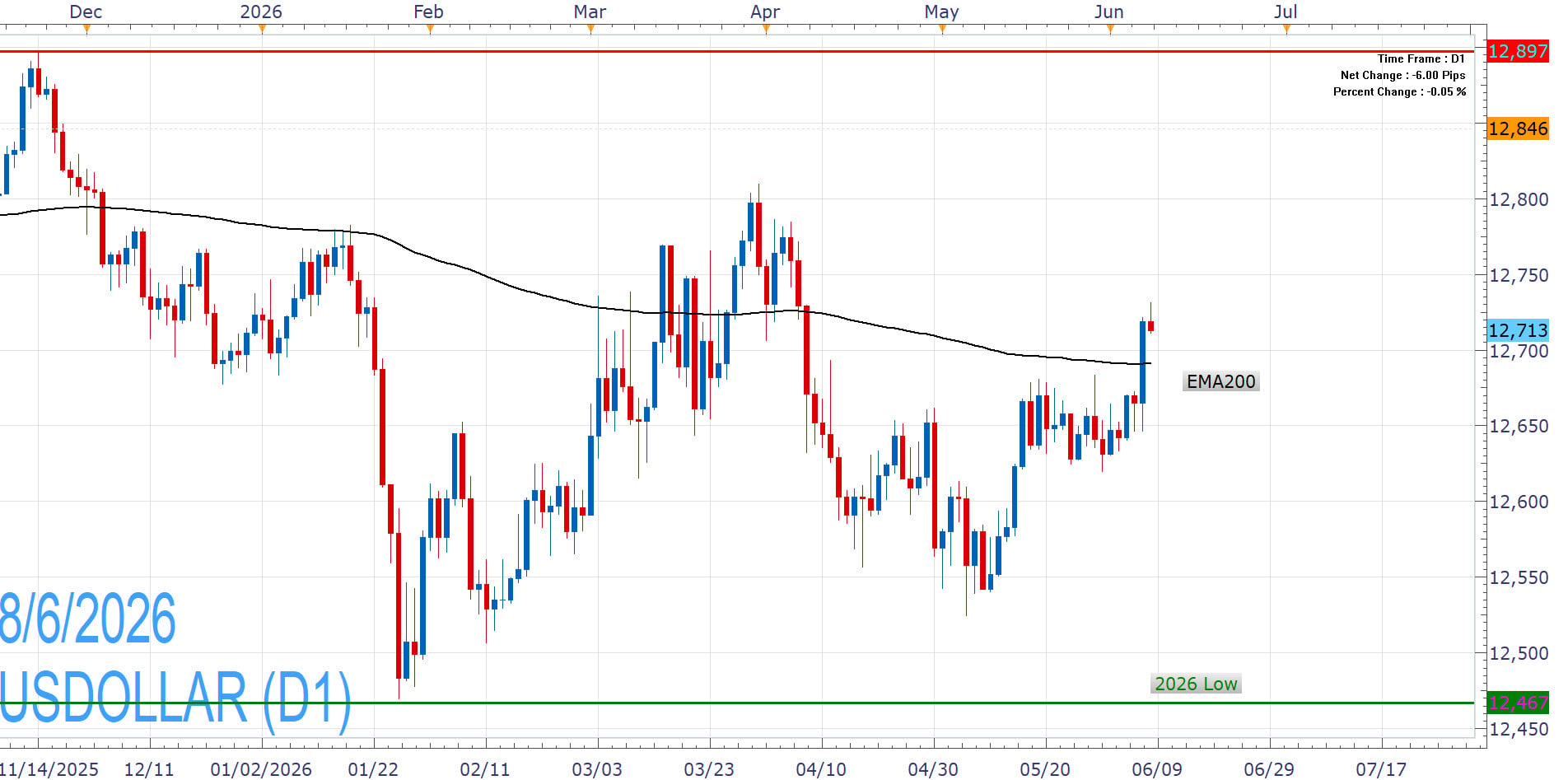
The USDOLLAR has emerged as a key beneficiary of the Middle East conflict, attracting safe-haven flows. Higher-for-longer expectations, bolstered by the latest strong NFP print, compound its strength and create scope for further gains. However, should the Fed disappoint hawkish market expectations or if diplomatic progress is made between Iran and the US, the dollar could quickly come under pressure. Factor in lingering trade uncertainty, structural deficit concerns and broader de-dollarisation trends, and the currency could easily face renewed selling.
Bank of England (BoE) – Thursday 18 June
Before the outbreak of the Middle East conflict, the BoE was well on track to deliver deeper monetary easing this year. However, the subsequent surge in global oil and gas prices has taken cuts off the table, forcing markets to price in a higher rate trajectory for 2026. The central bank has shifted its stance to ensure that persistently high inflation returns to target, flagging risks of a wage-price spiral, with Governor Bailey warning that it would be "a mistake to wait to see" second-round effects before acting. [24]
However, officials may not be ready to move yet, with markets anticipating a hold this month. The Governor seems under no immediate pressure to hike after headline inflation cooled to 2.8% in April, noting that the recent upward shift in market pricing is effectively doing the bank's tightening work for it and providing "some time to assess" the landscape [25]. This patient approach aligns with the IMF, which recently noted that further rate hikes are unnecessary and that keeping rates steady for the remainder of the year would maintain a "sufficiently restrictive monetary stance to limit second-round effects and keep long-term inflation expectations anchored". [26]
The IMF also highlighted clear downside risks from domestic political uncertainty amid the ongoing leadership challenge to Prime Minister Starmer, urging the Treasury to stay the course on deficit reduction after public net borrowing hit a five-year high in April. Compounding this fiscal vulnerability, the UK economy faces headwinds from global tariffs and supply chain shocks, while rising unemployment creates a strong incentive for the MPC to maintain a cautious stance.
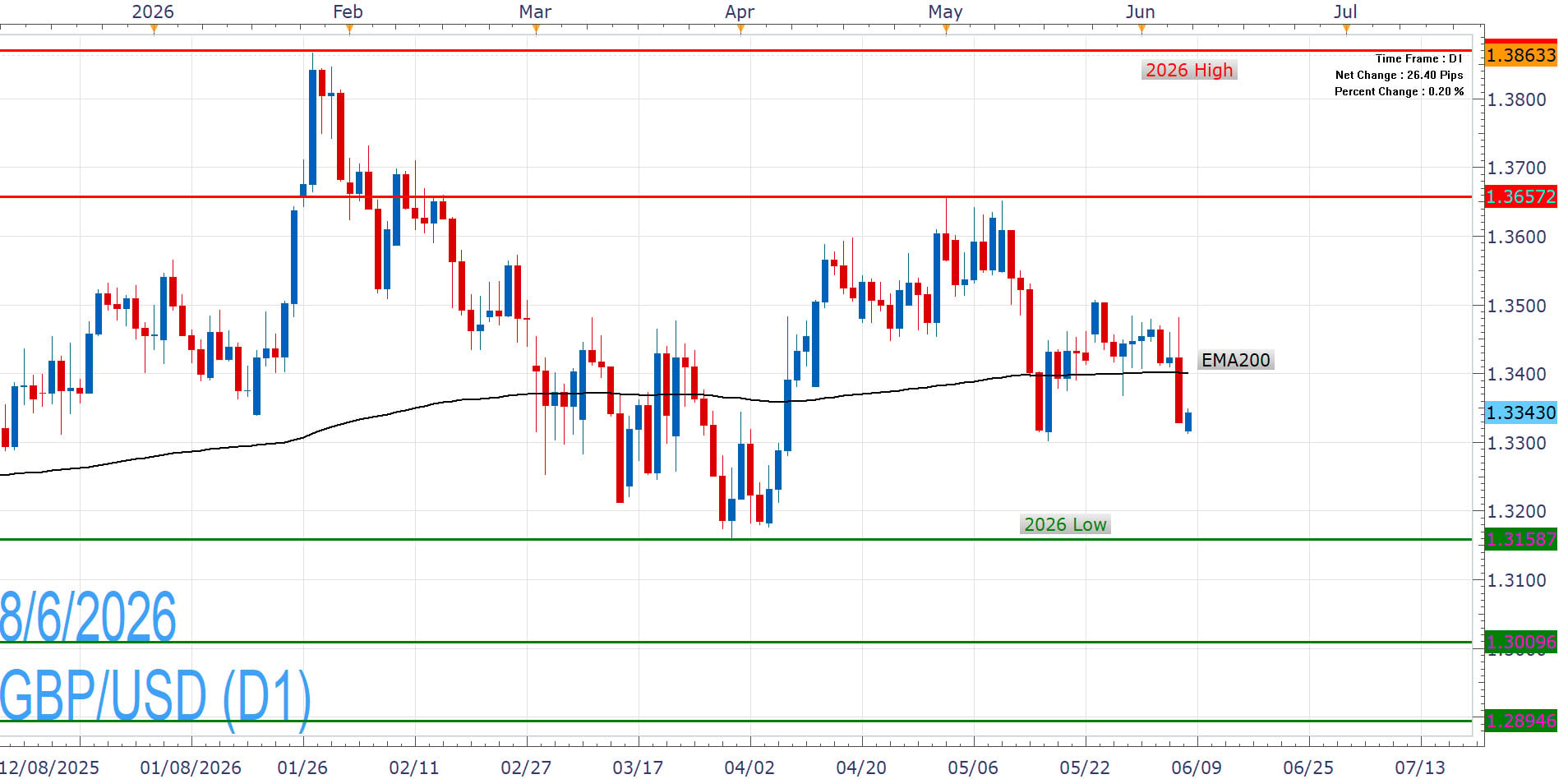
This structural shift away from easing and toward a potential hike could offer support to sterling, but a sustained recovery will require a Middle East resolution and a broader weakening of the USDOLLAR. The intermediate outlook for GBP/USD therefore remains challenging, leaving the pair vulnerable to further declines. Domestic political instability alongside persistent fiscal and growth concerns continues to erode confidence in the pound, while a hawkish Fed adds to the headwinds.
Swiss National Bank (SNB) – Thursday 18 June
The SNB is well positioned to hold interest rates steady at 0% for a fourth consecutive meeting this month. The domestic economy continues to show resilience, backed by solid 0.7% q/q growth in the first quarter, and the SNB expects momentum carry through the full year [27]. Meanwhile, headline inflation rose just 0.6% y/y in April, sitting comfortably at the lower end of the 0%-2% target range, with officials projecting a modest 0.5% average for 2026. These forecasts are conditioned on rates remaining at current levels, reinforcing expectations for a steady environment.
Nonetheless, the outlook is uncertain amid the economic fallout from the Middle East conflict and US trade policies, which could weigh on activity and create pressure for additional easing. Officials have little room or appetite for sub-zero rates and appear more reliant on FX operations to contain franc strength than on monetary policy, which can allow for hike should price pressures accelerate. They have signalled this clearly, stating that their "willingness to intervene in the foreign exchange market has increased".
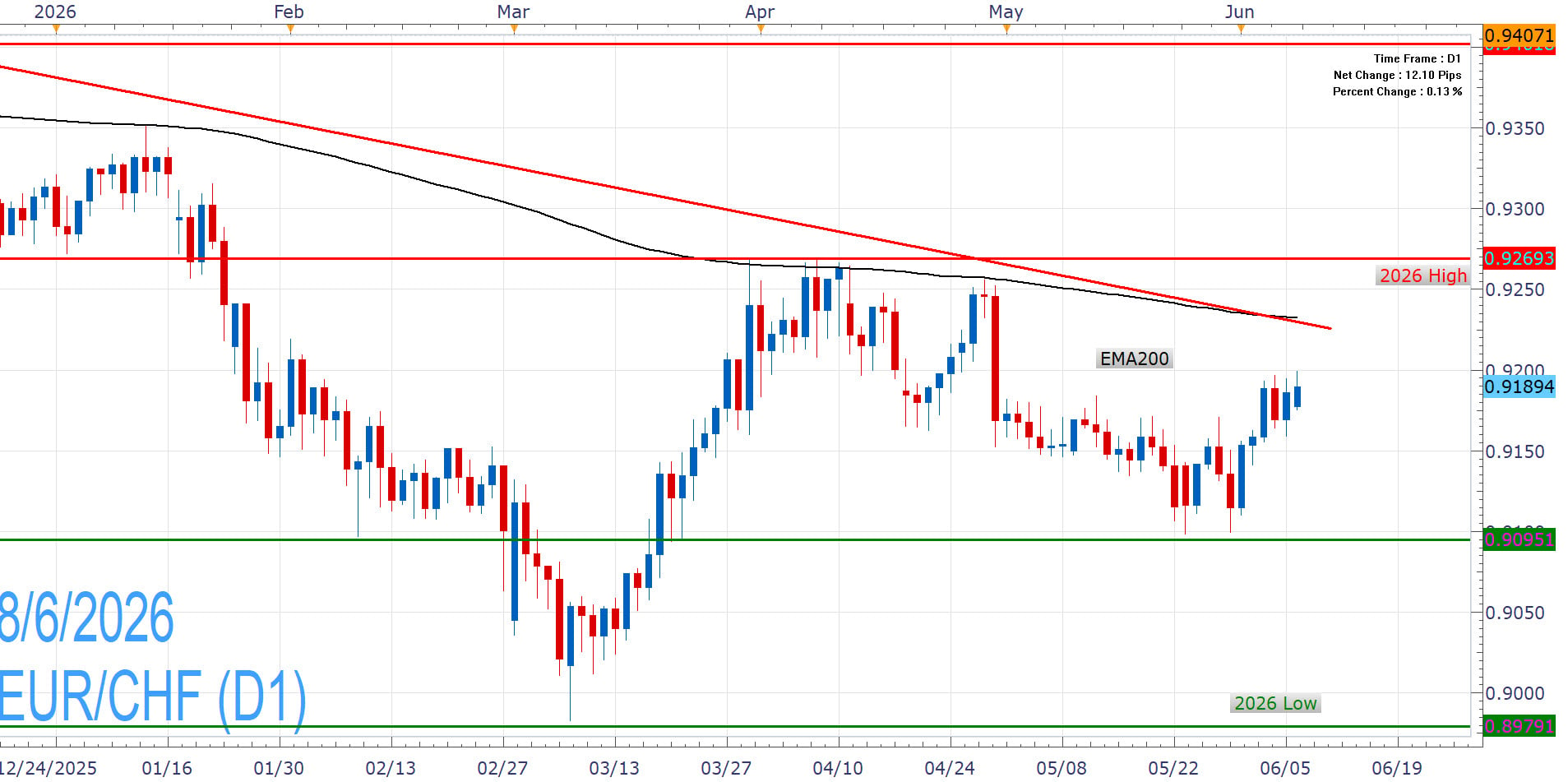
As long as geopolitical uncertainty dominates the headlines, the safe-haven franc will likely attract persistent risk-off flows, leaving EUR/CHF vulnerable to deeper losses. However, with the ECB expected to pivot to rate hikes, monetary policy dynamics are becoming more favourable for the pair, which could push the euro to new 2026 highs and shift the bias to the upside.
Banxico – Thursday 25 June
The Bank of Mexico lowered interest rates by 25 basis points to 6.5% last month but accompanied the move with a distinct hawkish shift, signalling a pause in the easing cycle that has produced 475 basis points of cuts since March 2024. Policymakers judged it "appropriate" to maintain the reference rate at its current level and markets expect a hold at this month's meeting and beyond. [28]
Inflation continues to hover stubbornly above the 3% target and the Middle East conflict creates upside risks. Reflecting these forces, the central bank does not expect inflation to converge to this goal for another year, limiting its appetite for additional easing and potentially creating incentives for an eventual hike, though such action is not on the horizon at this stage.
The domestic landscape adds further complexity: the Mexican economy contracted by 0.6% q/q in the first quarter, its weakest performance in over a year. Compounding this slowdown are headwinds from the Middle East shock, US tariffs and lingering USMCA uncertainty. Growth concerns could keep officials on hold while pressure for additional cuts may persist.
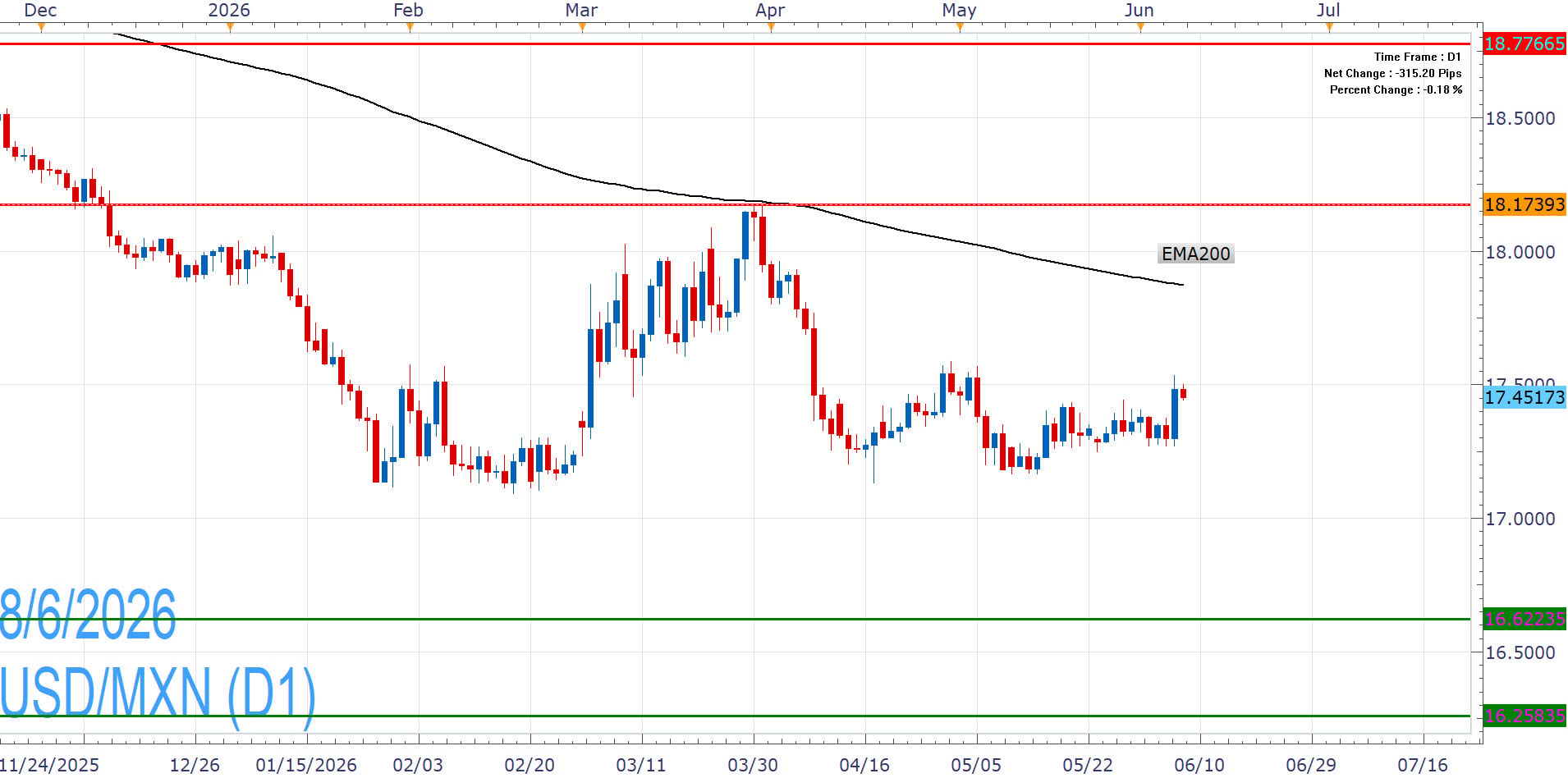
Banxico's holding stance could support the Mexican peso and facilitate deeper USD/MXN declines toward fresh 2026 lows. However, the pair's trajectory will ultimately depend on the dollar's direction. Risk-off flows persist for now and higher-for-longer Fed expectations add to its strength. As long as these factors linger, USD/MXN could push higher, and a move above the EMA200 would shift the bias to the upside.

Nikos Tzabouras
Senior Financial Editorial Writer
Nikos Tzabouras is a graduate of the Department of International & European Economic Studies at the Athens University of Economics and Business. With extensive experience in market analysis and a strong foundation in international relations, he brings a unique perspective to financial markets. Nikos emphasizes not only technical analysis but also on fundamentals and the growing influence of geopolitics on financial trends.
As a Senior Financial Editorial Writer, he delivers comprehensive and forward-looking insights across a wide range of asset classes, including equities, commodities, and currencies. His work explores how macroeconomic events, political developments, and global policies impact market dynamics, providing readers with a deeper understanding of both short-term movements and long-term trends.


Any opinions, news, research, analyses, prices, other information, or links to third-party sites contained on this website are provided on an "as-is" basis, as general market commentary and do not constitute investment advice. The market commentary has not been prepared in accordance with legal requirements designed to promote the independence of investment research, and it is therefore not subject to any prohibition on dealing ahead of dissemination. Although this commentary is not produced by an independent source, FXCM takes all sufficient steps to eliminate or prevent any conflicts of interests arising out of the production and dissemination of this communication. The employees of FXCM commit to acting in the clients' best interests and represent their views without misleading, deceiving, or otherwise impairing the clients' ability to make informed investment decisions. For more information about the FXCM's internal organizational and administrative arrangements for the prevention of conflicts, please refer to the Firms' Managing Conflicts Policy. Please ensure that you read and understand our Full Disclaimer and Liability provision concerning the foregoing Information, which can be accessed here.