
Silver rebound faces technical hurdles and macro risks


XAG/USD analysis
Silver has staged a rebound on optimism over the Middle East conflict and the prospect of a reopening of the Strait of Hormuz. President Trump said negotiations with Tehran were moving along "very nicely" and hinted that a deal could come as early as Thursday [1]. Meanwhile, Iran and Oman are finalising an agreement for a safe commercial shipping route [2]. A successful outcome would allow crude flows to normalise, easing inflationary fears and paring back market bets for Fed tightening, weighing on the dollar.
The improving macro-geopolitical environment adds to structural demand drivers tied to silver's use in industries driving the global economy. Similar to copper, silver is indispensable to the physical AI buildout, the clean energy transition and defence projects.
The latest tech earnings were generally strong, with hyperscalers staying committed to the investment funding the AI infrastructure boom. Microsoft, Alphabet, Amazon and Meta Platforms now target combined capex of $720-$745 billion for the year. Micron, which supplies memory chips crucial in AI training and inference, posted a record quarter and boosted its spending plans to increase capacity and meet insatiable demand [3]. Reflecting these forces, WSTS projects the semiconductor market to jump 89.9% this year and reach the $1.5 trillion threshold. [4]
Meanwhile, electricity consumption keeps growing and is increasingly powered by renewables, which were the fastest-growing source of generation last year according to the IEA. The agency also forecasts global renewable output rising by 1,000 terawatt-hours annually through 2030, with photovoltaics being the largest contributor, where silver is a key input. [5]
The critical mineral is also crucial to the defence industry and programmes like precision-guided munitions and drones, amid ballooning security budgets. The United States is targeting a record security budget and the Pentagon has requested emergency funding of $67 billion for the war with Iran [6], while NATO has committed to raising investment to 5% of GDP by 2035. [7]
Easing inflationary fears and retreating rate hike expectations have helped XAG/USD to a strong week and a return above the EMA200. Supported by long-term industrial demand, the precious metal is attempting to surpass a key resistance cluster that would allow it to extend its advance to the pivotal 38.2% Fibonacci level of the May high to July low decline and beyond.
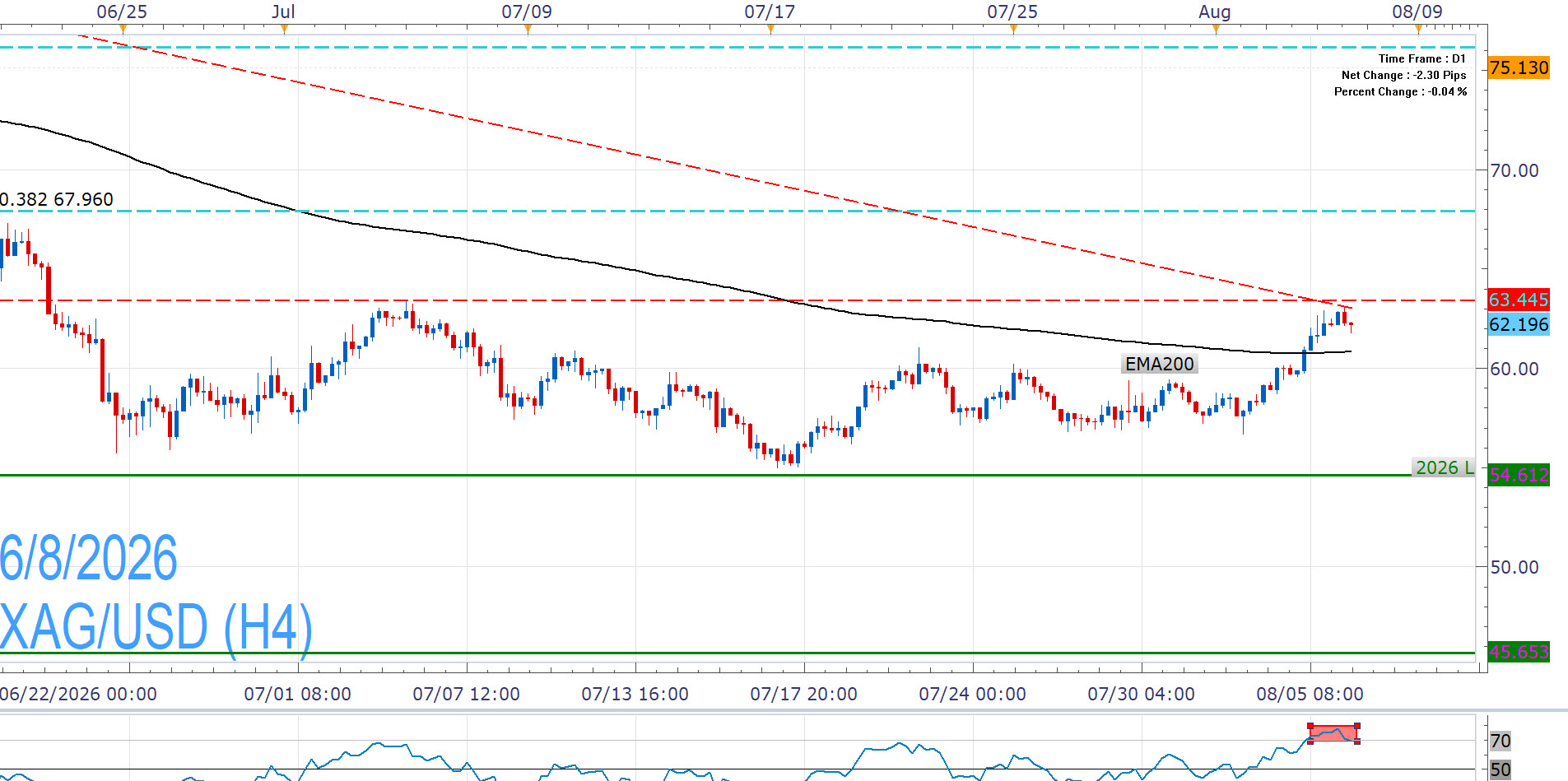
However, the technical landscape remains challenging, with the RSI pointing to overbought conditions that could contain the upside. A rejection of either of the aforementioned resistance levels would reinstate the bearish bias and expose XAG/USD to new 2026 lows.
Should diplomatic efforts fail to produce a US-Iran deal and a reopening of the Strait of Hormuz, inflationary and growth risks would reignite and pressure on the Fed to tighten would strengthen, with markets already pricing in a hike this year. Meanwhile, worries over the mounting cost of the AI buildout linger, especially as it is increasingly funded by debt issuance against tough macros and elevated yields pushing the cost of capital higher. Moreover, thrifting in the solar industry could hurt consumption as silver use is reduced through technological advancements and lower-cost alternatives.
Although the Silver Institute forecasts a sixth straight year of deficits, supply-demand dynamics are more complex. Despite strong use in key industries, demand is projected to decline 2% in 2026 [8], while major producers like Newmont [9] and Pan American [10] expect higher output.

Nikos Tzabouras
Senior Financial Editorial Writer
Nikos Tzabouras is a graduate of the Department of International & European Economic Studies at the Athens University of Economics and Business. With extensive experience in market analysis and a strong foundation in international relations, he brings a unique perspective to financial markets. Nikos emphasizes not only technical analysis but also on fundamentals and the growing influence of geopolitics on financial trends.
As a Senior Financial Editorial Writer, he delivers comprehensive and forward-looking insights across a wide range of asset classes, including equities, commodities, and currencies. His work explores how macroeconomic events, political developments, and global policies impact market dynamics, providing readers with a deeper understanding of both short-term movements and long-term trends.

Any opinions, news, research, analyses, prices, other information, or links to third-party sites contained on this website are provided on an "as-is" basis, as general market commentary and do not constitute investment advice. The market commentary has not been prepared in accordance with legal requirements designed to promote the independence of investment research, and it is therefore not subject to any prohibition on dealing ahead of dissemination. Although this commentary is not produced by an independent source, FXCM takes all sufficient steps to eliminate or prevent any conflicts of interests arising out of the production and dissemination of this communication. The employees of FXCM commit to acting in the clients' best interests and represent their views without misleading, deceiving, or otherwise impairing the clients' ability to make informed investment decisions. For more information about the FXCM's internal organizational and administrative arrangements for the prevention of conflicts, please refer to the Firms' Managing Conflicts Policy. Please ensure that you read and understand our Full Disclaimer and Liability provision concerning the foregoing Information, which can be accessed here.