
Oil rises as President Trump rejects Iran’s counteroffer


USOIL Analysis
President Trump said he did not like Tehran's response to the US peace proposal, calling it totally unacceptable [1]. Iranian President Masoud Pezeshkian struck a defiant tone, stressing that his country will never bow before the enemy and that negotiations do not mean surrender or retreat[2]. Speaking on CBS, Israeli PM Netanyahu noted the war is "not over" as Iran still possesses nuclear material [3]. These developments send oil prices higher as they douse hopes for an agreement that would reopen the Strait of Hormuz, while raising fears of fresh military escalation.
The US and Iran have been under a fragile ceasefire since early April, but last week President Trump warned that "the bombing starts" again if Tehran does not agree to a deal [4]. Meanwhile, hostilities in the region continue, with the United Arab Emirates facing new attacks over the weekend [5]. Attacks on shipping have also continued according to the UK Maritime Trade Operations (UKMTO), which reported a bulk carrier in the Gulf being struck by an unknown projectile. [6]
The Strait of Hormuz remains effectively shut and ongoing hostilities sustain security fears. Chevron CEO Wirth told Bloomberg last week that he "remains concerned about the security of transit" [7]. The prolonged disruption is tightening the oil market and reversing previously unfavourable fundamentals. Saudi Aramco CEO Nasser warned of "catastrophic consequences" for global oil markets [8], while TotalEnergies CEO Pouyanné said the surplus markets were anticipating for 2026 "is now over" [9]. Shell CEO Sawan spoke of crude shortages "close to one billion barrels" that deteriorate every day [10]. Even if the Strait fully reopened, flows would need time to normalise, with Exxon Mobil CEO estimating a lag of one to two months.[11]
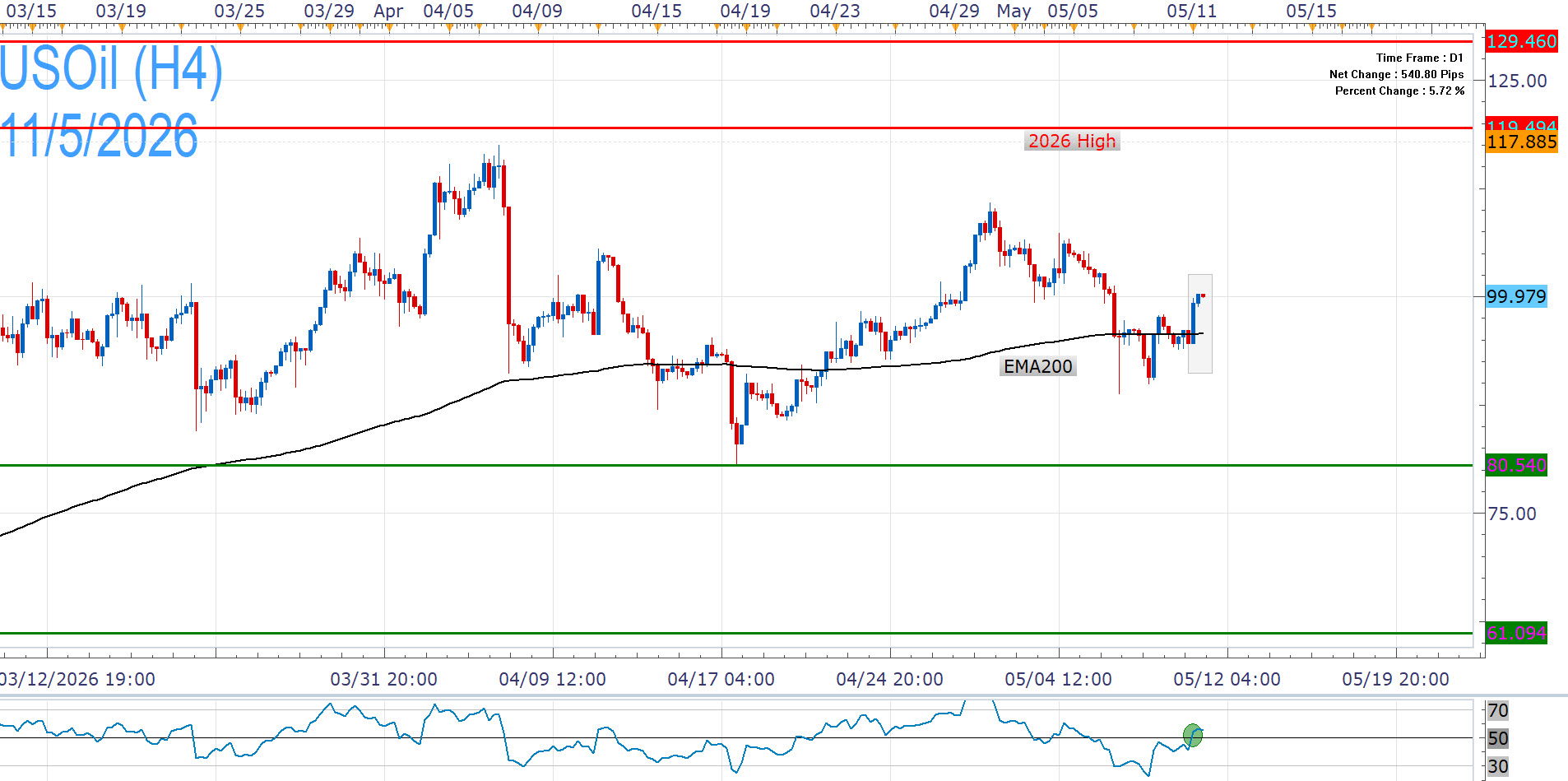
USOil jumps today after President Trump rejected Iran's counter-offer, with scope for further gains both technically and fundamentally. Prices remain above the EMA200, maintaining the upside bias, while the Relative Strength Index (RSI) has crossed above 50. The geopolitical risk premium stays elevated as hopes of a US-Iran deal retreat, fears over fresh hostilities rise and crude flows remain impaired with inventories depleted.
On the other hand, USOil remains vulnerable to a move below the EMA200 and deeper pullbacks following last week's slide. Both countries have incentives to end the conflict and reopen the Strait, while this week's Trump-Xi meeting could potentially help toward a resolution. The prolonged spike in crude prices raises risks to the global economy and oil consumption. The International Energy Agency (IEA) now expects consumption to contract this year, noting that "demand destruction" will spread "as scarcity and higher prices persist".[12]
Meanwhile, the recent OPEC+ decision to increase output [13] may be largely symbolic but signals commitment to supporting supply. Shortly after leaving the group, the UAE provided the first indication of its intention to pursue a production growth strategy, with Abu Dhabi National Oil Company (ADNOC) accelerating its plans for upstream and downstream expansion to meet rising global demand.[14]

Nikos Tzabouras
Senior Financial Editorial Writer
Nikos Tzabouras is a graduate of the Department of International & European Economic Studies at the Athens University of Economics and Business. With extensive experience in market analysis and a strong foundation in international relations, he brings a unique perspective to financial markets. Nikos emphasizes not only technical analysis but also on fundamentals and the growing influence of geopolitics on financial trends.
As a Senior Financial Editorial Writer, he delivers comprehensive and forward-looking insights across a wide range of asset classes, including equities, commodities, and currencies. His work explores how macroeconomic events, political developments, and global policies impact market dynamics, providing readers with a deeper understanding of both short-term movements and long-term trends.

Any opinions, news, research, analyses, prices, other information, or links to third-party sites contained on this website are provided on an "as-is" basis, as general market commentary and do not constitute investment advice. The market commentary has not been prepared in accordance with legal requirements designed to promote the independence of investment research, and it is therefore not subject to any prohibition on dealing ahead of dissemination. Although this commentary is not produced by an independent source, FXCM takes all sufficient steps to eliminate or prevent any conflicts of interests arising out of the production and dissemination of this communication. The employees of FXCM commit to acting in the clients' best interests and represent their views without misleading, deceiving, or otherwise impairing the clients' ability to make informed investment decisions. For more information about the FXCM's internal organizational and administrative arrangements for the prevention of conflicts, please refer to the Firms' Managing Conflicts Policy. Please ensure that you read and understand our Full Disclaimer and Liability provision concerning the foregoing Information, which can be accessed here.