
Shares of Oracle benefit from strong AI-driven earnings but risks linger


Oracle Analysis
Oracle posted strong results for the three months ending February (Q3 FY26) and upbeat guidance on Wednesday, suggesting no slowdown in AI computing demand [1]. Net income expanded 27% y/y and revenue growth accelerated (up 22% y/y). This was driven by the Cloud business overperformance, benefiting from the proliferation of Artificial Intelligence and its massive investments in data centres buildout.
Crucially its software segment returned to growth, and CEO Mike Sicilia dismissed disruption risks saying that smaller players may be impacted, succinctly stating that Oracle "will not be among them". Moreover, Oracle sees the AI boom continuing into the next fiscal year, expecting to maintain its strong sales momentum.
Oracle has been pouring vast sums of money into building data centres that power AI - underscored by the Stargate project in collaboration with OpenAI - and reiterated its $50 billion capex target for the current fiscal year. The solid results and outlook allowed markets to look past spending concerns, while the software business growth eased SAASpocalypse worries.
As a result, shares of Oracle jumped more than 9% on Thursday after the report and the solid business outlook offers an opportunity for a bigger rebound towards the EMA200. Recapturing this technical level would negate the bearish bias and offer a solid basis for a lasting recovery.
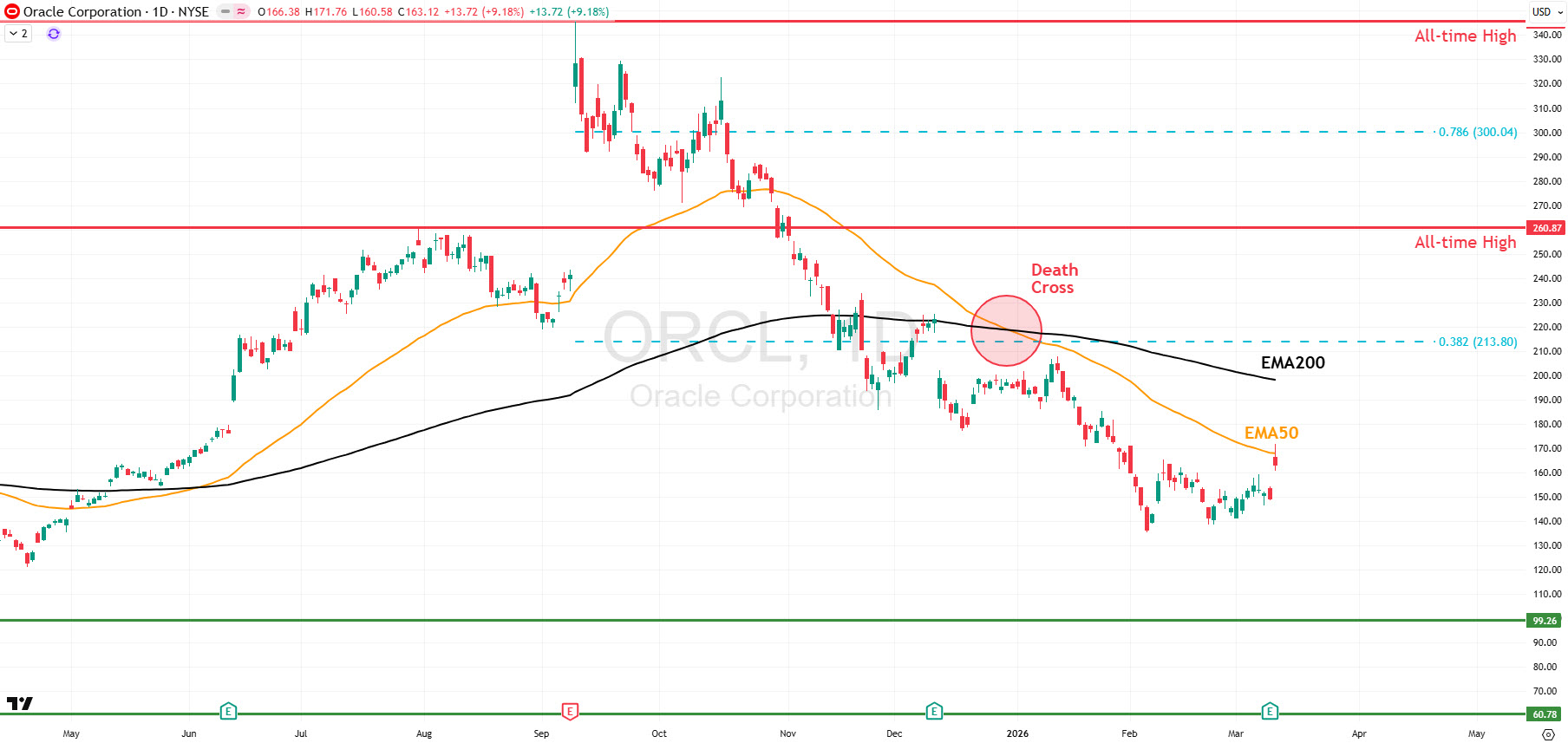
Chart Source: www.tradingview.com
However, the technical setup remains unfavourable for now, while business headwinds can persist. Below the EMA200 and the 38.2% Fibonacci (of the September-February decline) the bearish bias remains intact, and the formation of a Death Cross (EMA50 < EMA200) can be a precursor of protracted weakness.
Shares of Oracle shed 16% this year, largely due to software displacement fears that have gripped Wall Street and concerns of ballooning spending. The firm remains exposed to disruption challenges, while its debt-fuelled investments make it vulnerable against a challenging macroeconomic backdrop that deteriorates by emerging stagflation risk from higher energy prices. At the same time, challenges to the proliferation of AI don't go away, given tough macros, energy constraints and fraught supply chains.

Nikos Tzabouras
Senior Financial Editorial Writer
Nikos Tzabouras is a graduate of the Department of International & European Economic Studies at the Athens University of Economics and Business. With extensive experience in market analysis and a strong foundation in international relations, he brings a unique perspective to financial markets. Nikos emphasizes not only technical analysis but also on fundamentals and the growing influence of geopolitics on financial trends.
As a Senior Financial Editorial Writer, he delivers comprehensive and forward-looking insights across a wide range of asset classes, including equities, commodities, and currencies. His work explores how macroeconomic events, political developments, and global policies impact market dynamics, providing readers with a deeper understanding of both short-term movements and long-term trends.
References
| Retrieved 19 Sep 2026 https://s23.q4cdn.com/440135859/files/doc_financials/2026/q3/3q26-pressrelease-March-FINAL.pdf |



Any opinions, news, research, analyses, prices, other information, or links to third-party sites contained on this website are provided on an "as-is" basis, as general market commentary and do not constitute investment advice. The market commentary has not been prepared in accordance with legal requirements designed to promote the independence of investment research, and it is therefore not subject to any prohibition on dealing ahead of dissemination. Although this commentary is not produced by an independent source, Friedberg Direct, FXCM or its affiliates takes all sufficient steps to eliminate or prevent any conflicts of interests arising out of the production and dissemination of this communication. The employees of Friedberg Direct and FXCM commit to acting in the clients' best interests and represent their views without misleading, deceiving, or otherwise impairing the clients' ability to make informed investment decisions. For more information about the Friedberg Direct's internal organizational and administrative arrangements for the prevention of conflicts, please refer to the Firms' Managing Conflicts Policy. Please ensure that you read and understand our Full Disclaimer and Liability provision concerning the foregoing Information, which can be accessed here.**